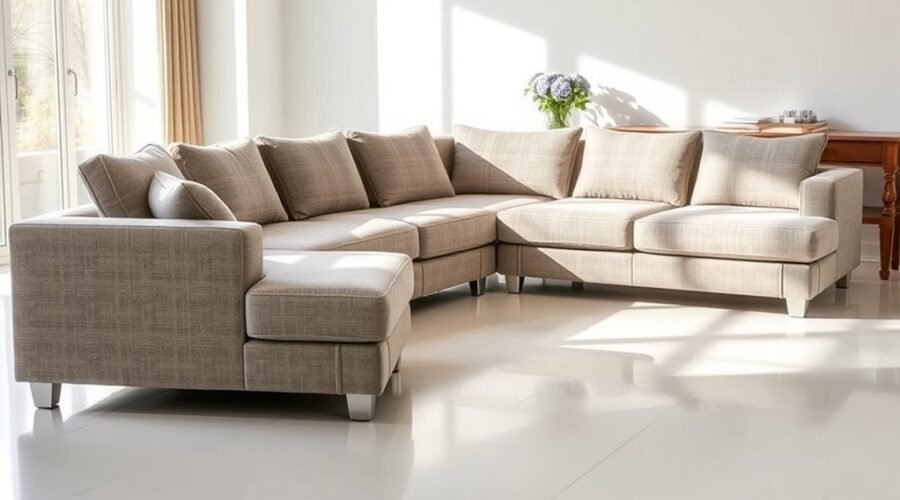
A modular sofa is made from separate seating sections that can be combined, separated, and often rearranged as your room or seating needs change. Common modules include armless seats, corner units, chaises, ottomans, and arm or back sections. The exact connector system varies by brand, so stability and reconfiguration depend on the hardware built into that specific sofa.
Quick Answer
A modular sofa is a seating system built from separate pieces that can be connected in different layouts. Some use clamps, brackets, rails, or other model-specific hardware to keep sections aligned. Unlike a fixed-layout sectional, a modular system is designed to be reconfigured, expanded, or separated when the room or seating plan changes.
Key Takeaways
- A modular sofa uses separate seating units that can be combined into multiple layouts.
- Connector hardware is not universal; brands use different clamps, brackets, rails, shoes, feet, and locking systems.
- “Modular” and “sectional” can overlap: many modular sofas are sold as modular sectionals.
- Measure both the room and the delivery path, including doors, stairs, hallways, and elevators.
- Before buying, compare comfort, upholstery care, connector design, warranty, and whether extra modules will remain available.
What Is a Modular Sofa?
A modular sofa is a flexible seating system built from separate units, or modules, that are designed to work together in more than one configuration. Depending on the collection, those units may include armless seats, corner pieces, chaises, ottomans, arm sections, back sections, or storage seats.
The defining idea is not that every piece can stand alone in every orientation. Instead, the system is designed so approved modules can be connected, separated, and rearranged within the layouts supported by that product line. For example, IKEA’s UPPÅKRA modular sofa is sold as a system whose modules can be connected in different combinations, while Lovesac Sactionals use seats, sides, clamps, shoes, and feet as configurable building blocks.
A modular sofa is best understood as a reconfigurable seating system, not simply a sofa that arrives in more than one box.
This flexibility can be useful in apartments, open-plan rooms, multipurpose spaces, or homes where the seating plan may change over time. You can often build a straight run, an L-shape, a corner arrangement, or a chaise-style setup without replacing the entire sofa.
How Modular Sofa Pieces Stay Together
Modular sofa pieces stay together with model-specific connection hardware. There is no single connector used by every manufacturer. Lovesac, for example, documents steel clamps plus shoes and feet to connect and stabilize Sactionals, while IKEA assembly manuals show other locking and rail-style mechanisms on different modular collections.
That means terms such as “alligator clip” or “U-clip” should not be treated as a universal description. The safest approach is to identify the exact connector on your sofa and follow its assembly instructions.
- Identify the hardware. Check the product manual for clamps, brackets, rails, posts, shoes, or other locking parts.
- Place the modules on a level surface. Uneven feet or flooring can make the joint look misaligned even when the connector is correct.
- Align the sections carefully. Bring the modules together in the orientation shown by the manufacturer.
- Engage the connector fully. Lock, clamp, lower, slide, or tighten the hardware only in the way specified for that model.
- Test the joint. Press on both sections and check for rocking, separation, or a connector that is only partly engaged.
Warning: Do not force two modules together or improvise with screws, straps, or drilled hardware unless the manufacturer approves it. Forcing a misaligned connector can damage the frame, upholstery, or locking parts.
How to Keep Modular Sofa Sections From Shifting
If sections drift apart, first confirm that every connector is fully engaged and that all feet sit evenly on the floor. Then check the manual for missing shoes, clamps, brackets, or anti-slip parts. On smooth flooring, a properly sized rug or non-slip rug pad beneath the whole arrangement can also reduce movement without altering the sofa.
If a gap returns repeatedly, inspect the connection points for looseness or damage rather than simply pushing the pieces back together. Replacement hardware should match the manufacturer’s specification.
Modular Sofa vs. Sectional Sofa
Modular sofa and sectional sofa are overlapping terms, not exact opposites. A sectional describes seating made from multiple sections, often arranged in an L- or U-shape. A modular sofa emphasizes that its units are designed to be rearranged, expanded, or separated into different supported configurations. Many products are therefore both modular and sectional.
| Feature | Modular Sofa or Modular Sectional | Fixed-Layout Sectional |
|---|---|---|
| Configuration | Designed for multiple approved layouts | Usually intended for one main layout |
| Expansion | May allow extra compatible modules | Usually limited to the original set |
| Moving | Separates into smaller modules | May have larger, less flexible sections |
| Connections | Designed for repeated connecting and separating | Often connected mainly to hold the planned layout together |
| Best fit | Changing rooms, moves, or evolving seating needs | Stable floor plans where one arrangement already works |
The practical question is not which label appears in the product name. Check the manufacturer’s layout diagrams to see which pieces can move, rotate, swap sides, or work independently.
Benefits of a Modular Sofa
One of the biggest advantages of a modular sofa is the ability to adapt the seating plan without replacing the whole piece. You can add, remove, or reposition compatible sections as your household, room, or entertaining needs change.
| Benefit | What You Get | Why It Matters |
|---|---|---|
| Flexible configuration | Rework approved modules | Adapts to changing layouts |
| Smaller moving pieces | Separate modules for transport | Can make tight access easier |
| Expandable system | Add compatible pieces on some lines | Lets seating grow with your needs |
| Care options | Removable or washable covers on some models | Can simplify cleaning and refreshing |
Modular construction can also make delivery easier because each section may be smaller than a full sofa. That is still not a guarantee that every module will fit through your home. IKEA’s delivery guidance specifically recommends checking hallways, stairs, elevators, and the intended room before large-item delivery.
Disadvantages of a Modular Sofa
Modular sofas trade some simplicity for flexibility. The downsides vary by product, but several are worth checking before you buy:
- Visible seams: Separate modules create joints that a one-piece sofa does not have.
- Possible shifting: Poorly engaged or worn connectors can allow gaps or movement.
- More setup: Multiple boxes, covers, feet, and connectors may take longer to assemble.
- Potentially higher cost: Some modular systems cost more than comparable fixed sofas, but there is no reliable universal percentage.
- Compatibility limits: Extra modules must match the same system, dimensions, and connection method.
- Future availability: Fabrics, colors, or modules can be discontinued, so expansion years later is not always guaranteed.
Comfort can also vary from module to module if cushions wear unevenly or if the seats are not aligned correctly. Trying the sofa in person, when possible, is the best way to judge seat depth, cushion feel, back support, and the sensation of sitting near a seam.
How to Choose a Modular Sofa for Your Home
Start with the room, not the product photo. A modular sofa should fit the floor plan, the delivery route, and the way you actually sit, lounge, host, and clean.
- Measure the room. Record the available width, depth, and height, plus the locations of windows, doors, outlets, vents, and walking paths. IKEA’s sofa-planning guidance recommends measuring the space and noting doors, windows, and outlets before planning a sofa.
- Measure the delivery path. Check door openings, hallway turns, stair widths, elevator dimensions, and any tight landings. Compare those measurements with the packaged or module dimensions.
- Choose the right modules. Decide whether you need armless seats, corner pieces, a chaise, an ottoman, storage, or separate arm and back units.
- Check the connector system. Look for clear manufacturer documentation showing how sections join, separate, and stay aligned.
- Test comfort. Compare seat height, seat depth, cushion firmness, back support, and how the seams feel when you sit across two modules.
- Review upholstery care. Removable or machine-washable covers are available on some systems, including IKEA UPPÅKRA and Lovesac Sactionals, but they are not a universal modular-sofa feature.
- Check long-term support. Review the warranty and whether the brand sells individual replacement covers, cushions, connectors, and add-on modules.
Pro Tip: Tape the planned sofa footprint on the floor before ordering. Walk around it, open nearby doors, and place a chair where the chaise or corner will sit. This makes circulation problems much easier to spot than relying on dimensions alone.
How to Reconfigure or Take Apart a Modular Sofa
Do not assume every modular sofa comes apart by lifting one section until a clip releases. Some systems use clamps, locking rails, brackets, shoes, or other hardware that must be disengaged in a specific order.
- Remove loose cushions and anything stored inside the modules.
- Find the connector points shown in the manufacturer’s manual.
- Support both sections so one module does not twist against the other.
- Release the clamp, bracket, rail, or locking part exactly as instructed.
- Separate the modules without dragging connector hardware across the floor.
- Before reconnecting, inspect the hardware and align the new layout using an approved configuration.
If the connector will not release with normal hand pressure, stop and recheck the instructions. For example, IKEA assembly documents for modular seating show specific alignment and locking steps rather than one universal “lift and pull” method.
Troubleshooting Gaps, Wobble, and Misalignment
If a modular sofa does not feel stable after assembly, work through the connection points before assuming the sofa itself is defective.
- Gap between modules: Re-align the sections and confirm that the connector is fully seated.
- One section sits higher: Check feet, floor level, cushion placement, and whether the modules are intended to connect in that orientation.
- Modules slide on smooth flooring: Verify factory anti-slip parts first, then consider a rug or non-slip pad beneath the complete setup.
- Connector feels loose: Inspect it for damage and use the manufacturer’s replacement part rather than a generic substitute.
Repeated separation after correct assembly is a good reason to contact the manufacturer or retailer, especially while the sofa is under warranty.
Frequently Asked Questions
How Do I Connect My Modular Sofa Pieces Together?
Find the connector hardware specified for your model, align the modules, and engage the clamp, bracket, rail, shoe, or locking mechanism exactly as the manual shows. After connecting the pieces, press on both sections and check that the joint does not rock or separate.
What Are the Disadvantages of Modular Sofas?
Common trade-offs include visible seams, more assembly, the possibility of gaps or shifting if connectors are not secure, and dependence on compatible modules from the same system. Some modular sofas also cost more than similar fixed sofas, but there is no universal percentage that applies across brands.
Do Modular Couches Attach to Each Other?
Usually, yes. Many modular couches include hardware that connects compatible modules so they act as one seating arrangement. The exact method varies by model, so check the manufacturer’s instructions rather than assuming every sofa uses the same clip or bracket.
How Do You Take a Modular Sofa Apart?
Remove loose cushions, locate the connection points, and release the hardware in the order shown by the manufacturer. Some systems lift apart, while others use clamps, rails, or brackets that must be unlocked first. Never force the modules if the connector is still engaged.
Do Modular Sofas Slide Apart?
They can if connectors are missing, partly engaged, worn, or used on an uneven surface. Correct assembly, level feet, intact factory hardware, and a stable floor surface usually reduce movement. Persistent separation should be checked against the product manual or warranty support.
Are Modular Sofas Good for Small Spaces?
They can be, especially when a collection lets you start with fewer modules and add only the pieces your room needs. Measure the complete footprint and walking clearance first, because deep seats, wide arms, or oversized corner units can still overwhelm a small room.
Conclusion
A modular sofa gives you a seating system that can change with the room instead of locking you into one permanent layout. The key is to look beyond the word “modular” and check the actual module sizes, connector design, supported configurations, upholstery care, comfort, and long-term parts availability. Measure carefully, follow the model-specific assembly instructions, and choose a system that can stay stable while still giving you the flexibility you want.
Sources
- Lovesac — Sactionals sectional connection system — documents steel clamps, shoes, and feet used to connect and stabilize modules.
- IKEA — UPPÅKRA modular corner sofa — supports the use of modules in different combinations.
- IKEA — Sofa planning guidance — supports measuring room dimensions and noting doors, windows, and outlets before planning.
- IKEA — Delivery terms and conditions — supports checking hallways, stairs, elevators, and room access for large furniture delivery.
- IKEA — SLATORP assembly instructions — shows a model-specific modular connection and locking process.