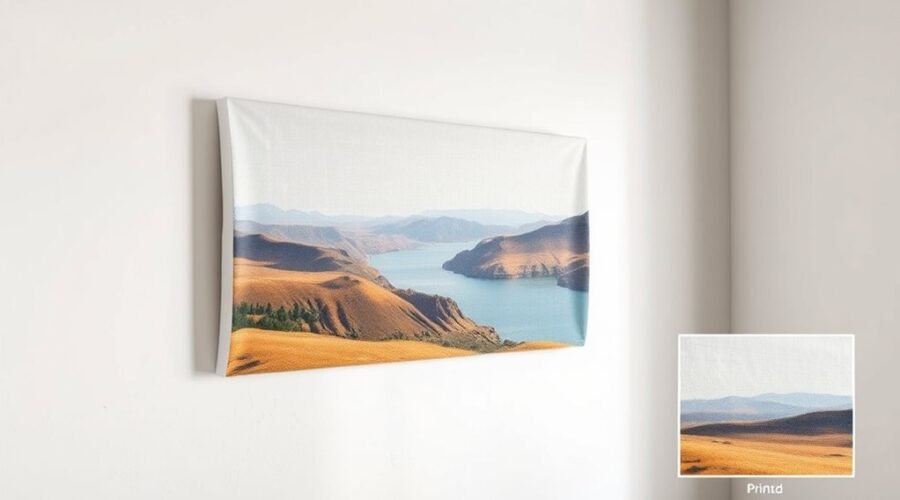
A canvas print turns a photograph, digital artwork, or scanned image into textured wall art by printing the image onto specially prepared canvas and usually stretching that canvas over a wooden frame. The result has more surface texture and physical depth than a standard paper photo print, while modern inkjet printing can preserve fine detail and accurate color when the file, canvas, ink, and printer are properly matched.
Quick Answer
A canvas print is an image printed onto coated woven canvas, commonly made from cotton, polyester, or a blend, and then stretched over wooden stretcher bars. Most modern photo canvases are produced with large-format inkjet printers. The canvas texture gives photographs and artwork a softer, gallery-style look without requiring glass over the image.
Key Takeaways
- Canvas prints use woven, ink-receptive material rather than ordinary photo paper.
- Cotton, polyester, and cotton/polyester blends are all used; there is no single universal canvas weight or thickness.
- Print quality depends on the source-image resolution, color management, canvas coating, printer, ink, and finishing process.
- After printing and drying, the canvas is normally stretched over wooden stretcher bars and secured at the back.
- Pigment inks can offer excellent fade resistance, but lifespan depends on the exact ink-and-media combination plus light, humidity, pollutants, and handling.
- Optional protective coatings should only be used when they are compatible with the specific canvas and ink system.
What Is a Canvas Print?
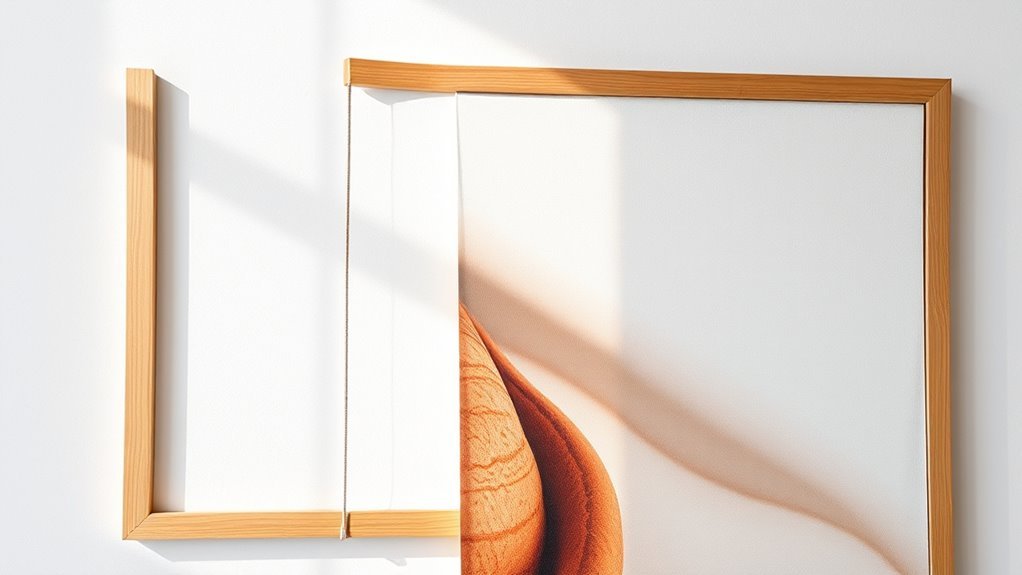
A canvas print is a photograph, illustration, or other image reproduced on a woven canvas printing material. The printed sheet is commonly stretched around a wooden stretcher-bar frame, creating a dimensional piece that can often be hung without glass or a conventional picture frame.
The word canvas describes the printing surface, not one exact material specification. Photo canvas may be made from cotton, polyester, or a cotton/polyester blend. It normally has an ink-receptive coating that helps the printer produce clean detail and controlled color on the textured surface.
Professional and retail canvas-printing systems commonly use large-format inkjet technology. Pigment-based aqueous inks are widely used for photographic and fine-art applications, although other commercial printing technologies are also available.
A canvas print combines a digitally printed image with a textured textile surface and the depth of a stretched wooden support.
The finished appearance can range from a simple gallery wrap to a framed canvas or multi-panel arrangement. The best option depends on the image, desired edge treatment, room, and overall presentation.
What Canvas Prints Are Made From
Modern printing canvas is commonly made from cotton, polyester, or a blend of the two. Each material can produce good results when the coating, printer, ink, and color profile are designed to work together.
| Canvas Type | Typical Characteristics | What to Know |
|---|---|---|
| Cotton | Natural fiber, traditional texture, popular for fine-art reproduction | Surface and stretch behavior vary by weave and coating. |
| Polyester | Dimensionally stable and capable of smooth, consistent reproduction | Often chosen for commercial and high-volume printing. |
| Cotton/poly blend | Combines natural texture with added dimensional stability | A common option, but blend percentages differ among products. |
Canvas weight is normally expressed in GSM, or grams per square meter. Some retail canvas products fall around the 300-plus-GSM range, but there is no universal 320–340 GSM specification. Thickness also varies by manufacturer and product line.
The printable coating is just as important as the underlying fabric. It controls how ink spreads, how much color the surface can hold, and how sharply small details reproduce. A heavier canvas is not automatically a better canvas; the entire ink, coating, weave, and printer combination matters.
How Canvas Prints Are Made
The basic process starts with a digital file and ends with a tensioned, finished canvas. Professional workflows vary, but most follow the same general sequence:
- Prepare the image: size, crop, sharpen, and check the source file for enough resolution.
- Choose the edge treatment: decide whether the sides will use an image wrap, mirror wrap, solid color, or another finish.
- Color-manage the file: use settings or ICC profiles appropriate for the printer, ink, and canvas.
- Print the image: send the prepared file to a compatible wide-format printer.
- Dry or cure the print: allow the ink and canvas to stabilize according to the media and ink manufacturer’s instructions.
- Finish and stretch: apply an approved coating if required, then stretch and secure the canvas over stretcher bars.
- Inspect the result: check tension, corners, alignment, surface condition, and hardware before display.
Materials And Canvas Base
A quality print begins with inkjet-compatible canvas whose coating is designed for the chosen printer and ink system. The fabric needs enough strength and dimensional stability to survive printing, handling, folding around corners, and long-term tension on the frame.
Canvas specifications vary widely. Instead of assuming that a particular thickness or GSM automatically indicates quality, look for a documented material intended for photographic or fine-art printing and compatible with the printer being used.
The wooden support matters too. Straight, dry stretcher bars and properly joined corners help the finished artwork remain square and evenly tensioned.
Digital Image Printing
A high-resolution digital file gives the printer enough information to reproduce detail at the final canvas size. One important distinction is that image files are best evaluated by their pixel dimensions or effective PPI, pixels per inch, while printer specifications may describe output in DPI.
You can estimate effective resolution with a simple calculation:
pixel dimension ÷ final print dimension in inches = effective PPI
| Canvas Size | Pixels for 150 PPI | Pixels for 300 PPI |
|---|---|---|
| 12 × 16 in | 1,800 × 2,400 | 3,600 × 4,800 |
| 16 × 20 in | 2,400 × 3,000 | 4,800 × 6,000 |
| 24 × 36 in | 3,600 × 5,400 | 7,200 × 10,800 |
The ideal number depends on the print provider, image content, viewing distance, sharpening, and printing workflow. Always use the printer’s own resolution warning or file recommendations when ordering.
Pro Tip: Keep faces, text, signatures, and other important details away from the outer edge of the file. A gallery wrap can use part of the image to cover the sides of the stretcher frame, so edge content may disappear from the front.
Printers also differ. For example, the older HP DesignJet Z6100 is a thermal inkjet system that uses HP Vivera pigment inks. It should not be described as an HP Latex printer.
Stretching And Finishing
After the print has dried sufficiently, the canvas is aligned on the stretcher frame and tensioned gradually so the face remains flat without distorting the image.
| Step | Purpose | Quality Check |
|---|---|---|
| Align | Position the image correctly on the frame | Subject and horizon remain straight. |
| Stretch | Create even tension | No sagging, rippling, or excessive distortion. |
| Fold corners | Create clean wrapped edges | Corners are neat and consistent. |
| Secure | Hold the canvas on the bars | Fasteners are secure and the frame stays square. |
A protective coating may be part of the production workflow, but it is not automatically required for every canvas. Epson notes that over-coating performance depends on the product and that third-party coating results are not universally guaranteed.
Note: Do not apply a generic clear spray, varnish, or household coating to a finished canvas unless the canvas or print manufacturer specifically says it is compatible. The wrong coating can alter gloss, color, flexibility, adhesion, or the printed surface.
How the Image Goes Onto Canvas
The image is normally transferred to modern photo canvas through direct digital printing. Instead of attaching an existing paper photograph to the fabric, the printer places ink directly onto an ink-receptive coating on the canvas.
This direct-print method is one reason the weave remains visible through the image and gives canvas its characteristic texture.
Image Transfer Methods
Large-format inkjet printing is the most common method for photographic canvas. The prepared digital file is interpreted by the printer, which deposits controlled amounts of ink across the coated canvas.
| Production Step | Purpose |
|---|---|
| File preparation | Sets crop, dimensions, resolution, sharpening, and edge treatment. |
| Color management | Helps the printer reproduce predictable tones and color on the selected canvas. |
| Direct inkjet printing | Places the digital image onto the coated textile surface. |
| Drying and finishing | Allows safe handling before coating, stretching, framing, or packing. |
Some sellers use the term giclée for high-quality inkjet reproductions. The label itself does not guarantee a particular canvas, ink, archival rating, or production standard, so the actual material and printer specifications are more useful when judging quality.
Printing And Coating
For photographic and fine-art canvas, pigment ink is popular because high-quality pigment systems can provide strong lightfastness and color stability. Commercial canvas can also be produced with other compatible technologies, so the correct ink depends on the specific canvas and printer.
Epson has published high print-permanence ratings for particular UltraChrome HD systems. For example, some tested combinations are rated up to 200 years for color under specified conditions. These figures do not mean that every canvas printed with pigment ink will last 200 years.
Epson’s own product information states that actual print stability depends on factors including the media and display environment.
After printing, some production workflows add a compatible liquid or spray coating for abrasion, moisture, or UV protection. Other coated canvases are designed to be displayed without an additional varnish.
Stretching The Canvas
Once dry, the printed canvas is wrapped around wooden stretcher bars. Bar depth varies by manufacturer and product, so there is no single standard such as 3.2 cm for every canvas print.
The technician usually secures opposite sides in sequence rather than pulling one whole side tight first. Balanced tension helps prevent skewing and keeps the image flat.
The edge design also affects stretching. With an image wrap, part of the photograph continues around the sides. With a mirror wrap, reflected edge content fills the sides. A solid-color wrap keeps the full original composition on the front.
Once stretching is complete, the print should be inspected for corner folds, alignment, frame squareness, visible surface damage, and consistent tension.
Canvas Print Styles and Finish Options
Canvas prints come in several presentation styles. The best option depends more on the image and room than on a single “premium” format.
- Gallery or image wrap: part of the image continues around the sides of the stretcher frame.
- Mirror wrap: pixels near the image edge are reflected to create the side area without cropping as much of the front composition.
- Solid-color wrap: the front image stays intact while the sides use a selected color.
- Framed canvas: the stretched canvas sits inside an additional decorative or floater-style frame.
- Multi-panel or split canvas: one image or coordinated images are divided among several separate canvases.
- Single-panel canvas: the full artwork remains on one uninterrupted surface.
Finish can also vary from matte to satin or gloss depending on the canvas coating and any approved protective finish. A matte surface generally minimizes reflections, while satin or gloss finishes can make contrast and color appear more pronounced.
Canvas Print Sizes and Display Ideas
Canvas prints are available in small square formats, standard photo proportions, panoramic layouts, and large statement sizes. Exact dimensions vary by provider, so there is no universal 8×8-to-32×48-inch range.
Choose size by considering the wall area, viewing distance, image resolution, subject placement, and surrounding furniture. Small prints work well in grouped arrangements, while a large canvas can function as the primary focal point over a sofa, bed, desk, or console.
A panoramic canvas suits wide landscapes, skylines, and group scenes. Square formats can work well for portraits, pets, abstract art, and social-media-style crops.
For a multi-panel display, account for the physical gap between panels when preparing the image. Important faces, words, or straight lines should not fall directly into the spaces between canvases.
How to Choose the Right Image for a Canvas Print
The best source file is not simply the one with the largest file size. Look for an image that is sharp at the intended print dimensions and has enough room around important subjects for cropping and wrapping.
- Check focus: enlargement will not repair a genuinely out-of-focus image.
- Check pixel dimensions: larger canvases generally require more pixels.
- Inspect faces at 100%: compression artifacts and motion blur can become more noticeable in a large print.
- Allow edge space: do not place critical content against the crop boundary.
- Use the original file: a full-resolution camera or phone image is usually better than a screenshot or an image downloaded from social media.
- Preview the crop: confirm that the canvas aspect ratio does not remove important parts of the composition.
Benefits of Canvas Prints
Canvas prints are popular because their textured surface and wrapped construction create a different visual effect from a conventional photograph behind glass.
- Texture: the weave adds a tactile, painterly character to photographs and digital artwork.
- Reduced reflections: many matte canvas surfaces produce less glare than glossy photo paper or glazing.
- Depth: stretched canvas projects from the wall and creates a three-dimensional presentation.
- Customization: personal photographs, illustrations, designs, and artwork can all be reproduced.
- Flexible presentation: single panels, gallery wraps, framed canvases, panoramas, and multi-panel arrangements are available.
- No glass required in many displays: a stretched canvas is commonly hung as an exposed printed surface.
The trade-off is that the canvas texture can soften extremely fine photographic detail compared with a smooth high-quality photo or fine-art paper.
Canvas Print vs. Photo Print
| Feature | Canvas Print | Photo Print |
|---|---|---|
| Surface | Textured woven material | Smooth or lightly textured photographic paper |
| Detail appearance | Texture can soften very fine details | Smooth surfaces can emphasize fine detail |
| Display | Usually stretched on bars; often displayed without glass | Often framed, mounted, or placed in an album |
| Glare | Often low on matte canvas | Depends strongly on matte, luster, satin, or glossy paper and glazing |
| Look | Dimensional and painterly | Clean, photographic, and paper-based |
| Longevity | Depends on ink, canvas, coating, light, humidity, and handling | Depends on photographic process or ink, paper, light, humidity, and storage |
Neither format is automatically more durable than the other in every case. Longevity depends on the complete print system and display environment rather than the word canvas or photo alone.
How Long Canvas Prints Last
There is no single lifespan that applies to every canvas print. A print’s fade resistance and physical stability depend on the ink chemistry, canvas coating, protective finish, light exposure, humidity, atmospheric pollutants, handling, and storage conditions.
High-quality pigment printing can perform extremely well. Epson has reported very high permanence ratings for specific UltraChrome HD ink-and-media combinations, and Wilhelm Imaging Research publishes detailed test results showing how ratings differ according to media and display conditions.
Those laboratory figures should not be interpreted as a guarantee that an ordinary consumer canvas will remain unchanged for a particular number of years. A canvas displayed in strong sunlight or a humid, polluted environment can age much faster than the same print kept under controlled conditions.
For practical longevity, use a reputable printing system, keep the canvas away from sustained direct sunlight and moisture, avoid touching the printed face, and maintain a reasonably stable indoor environment.
How to Care for a Canvas Print
Good care focuses on controlling light, dust, moisture, pollutants, and physical contact. The Library of Congress recommends limiting light exposure and maintaining a cool, relatively dry, stable environment for photographic materials.
- Avoid sustained direct sunlight. Light exposure can accelerate fading and other changes.
- Keep the print dry. Avoid bathrooms, damp basements, or locations with frequent condensation unless the product is specifically designed for that environment.
- Remove loose dust gently. A clean air blower is safer for a delicate print surface than aggressive rubbing.
- Avoid household cleaners. Glass cleaner, furniture polish, solvents, and abrasive products can damage the coating or ink.
- Handle the frame rather than the image surface. Skin oils and dirt can leave permanent marks.
- Protect it during storage. Keep the canvas upright or safely supported in a clean, dry location where the face cannot rub against another object.
Warning: Do not wet-clean a canvas print or apply a new protective coating unless the printer or media manufacturer approves that method. Uncoated, varnished, aqueous-ink, latex, UV, and other canvas systems can react differently to moisture and cleaning products.
If the canvas begins to sag, do not soak or heavily mist it in an attempt to tighten the fabric. A professional framer or the original print provider can determine whether the piece can be safely re-tensioned.
How to Judge Canvas Print Quality
Price alone does not tell you whether a canvas print is well made. Before ordering, look for clear information about the materials and production process.
- Canvas specification: Is the fiber type, coating, or product line identified?
- Ink system: Does the provider state whether it uses pigment, dye, latex, UV, or another printing technology?
- Resolution check: Does the ordering system warn when your uploaded file is too small?
- Color management: Professional workflows should use appropriate printer/media settings or profiles.
- Wrap preview: You should be able to see what will appear on the edges before printing.
- Frame construction: Look for straight stretcher bars, square corners, and appropriate support on larger pieces.
- Surface protection: If a coating is used, it should be designed for the specific print system.
- Workmanship: The image should be aligned, the canvas evenly tensioned, and the corners neatly finished.
How Much Do Canvas Prints Cost?
Canvas-print pricing changes too frequently to define one normal price. Cost depends on the print size, canvas material, frame depth, edge treatment, decorative frame, number of panels, production method, shipping, and promotions.
A basic unframed canvas is normally less expensive than the same print with a decorative or floater frame. Large canvases and multi-panel sets also require more material, printing area, framing, labor, and packaging.
When comparing prices, check the final dimensions and included options rather than comparing only the advertised starting price. One seller may include hanging hardware, coating, or a deeper frame while another charges separately.
Sources
- Epson SureColor P6000 specifications — UltraChrome HD pigment ink and qualified print-longevity information.
- Wilhelm Imaging Research: Epson SureColor P600 Print Permanence Ratings — independent permanence testing and the effect of media/display conditions.
- HP DesignJet Z6100 specifications — confirms HP Thermal Inkjet technology and Vivera pigment inks.
- Library of Congress: Care, Handling and Storage of Photographs — guidance on light, humidity, dust, handling, and storage.
- Epson canvas over-coating guidance — compatibility and limitations of protective coatings.
Frequently Asked Questions
What Is the Difference Between a Canvas Print and a Regular Print?
A canvas print places the image on woven, coated canvas and is usually stretched over wooden bars. A conventional print is normally produced on paper or another flat sheet. Canvas adds visible texture and physical depth, while smooth paper can reproduce very fine photographic detail with less interference from surface texture.
What’s the Difference Between a Photo Print and a Canvas Print?
A photo print is normally produced on photographic or inkjet photo paper, while a canvas print uses woven fabric with an ink-receptive coating. Photo paper can emphasize crisp detail and smooth tonal transitions; canvas adds texture and is commonly stretched into a ready-to-display wall piece.
How Much Do Canvas Prints Usually Cost?
There is no reliable universal price because retailers change prices and promotions frequently. Size, canvas type, stretcher-bar depth, decorative framing, multi-panel layouts, coatings, shipping, and production quality all affect the total cost. Compare equivalent sizes and included features rather than advertised starting prices alone.
What Exactly Is a Canvas Print?
A canvas print is an image printed onto coated woven canvas and normally stretched over wooden stretcher bars. It combines digital printing with a textured textile surface to create dimensional wall art from photographs, illustrations, or other artwork.
Do Canvas Prints Need a Frame?
A stretched gallery-wrap canvas normally does not need an additional frame because the wooden stretcher structure already supports it. You can still add a decorative or floater frame if you prefer that appearance.
Can Any Photo Be Printed on Canvas?
Almost any digital photo can technically be printed, but good results require enough resolution for the chosen size, acceptable focus, and enough room for cropping or edge wrapping. Screenshots, heavily compressed social-media images, and small downloaded files may look soft when enlarged.
Are Canvas Prints Waterproof?
Do not assume a canvas print is waterproof. Water resistance varies with the canvas coating, ink, protective finish, and manufacturing process. Even a water-resistant print can suffer damage from prolonged moisture, so follow the specific printer or supplier’s care instructions.
Why Does a Canvas Print Sag?
Sagging can result from insufficient initial tension, changes in humidity, frame movement, or material relaxation over time. Avoid improvised wetting treatments; ask the original printer or a professional framer whether the canvas can be safely re-tensioned.
Conclusion
A canvas print combines digital printing with a traditional woven surface. The image is printed onto coated cotton, polyester, or blended canvas and usually stretched over wooden bars to create textured, dimensional wall art. Quality depends on far more than one GSM number or ink brand: source-file resolution, canvas coating, color management, ink compatibility, stretching, finishing, and display conditions all matter.
Choose a print provider that clearly explains its materials and checks image resolution before production. Once the canvas is on the wall, protect it from strong direct sunlight, excess moisture, abrasive cleaning, and unnecessary handling. With a well-matched printing system and sensible care, a quality canvas can remain an attractive display piece for many years.