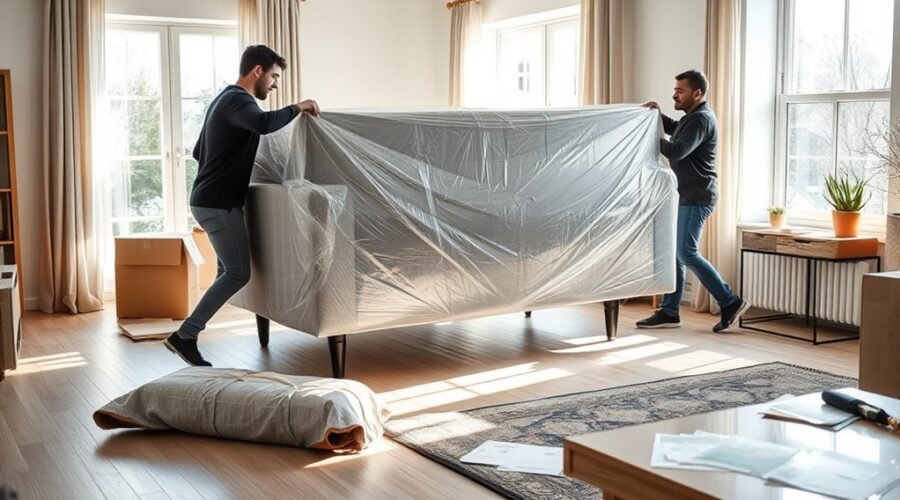
A smooth sofa delivery starts before the truck arrives. Confirm what the delivery service includes, measure the entire route into the room, clear obstacles, and have the destination ready. When the sofa arrives, inspect it before discarding packaging, document any damage, assemble it according to the manufacturer’s instructions, and give compression-packed cushions the recommended recovery time.
Quick Answer
When a new sofa arrives, first verify the item and inspect it for damage before the crew leaves. Keep the delivery path clear, protect floors, follow the manufacturer’s assembly instructions, and document problems with photos. If cushions were compression-packed, let them recover for the time specified by the manufacturer before judging their final shape.
Key Takeaways
- Confirm whether your service is doorstep, in-room, or white-glove delivery and what assembly, packaging removal, or haul-away it includes.
- Measure the sofa or cartons and every doorway, hallway, stairway, elevator, landing, and tight turn on the delivery route.
- Inspect the sofa for damage, stains, wrong parts, missing hardware, and malfunctioning features before discarding packaging.
- Use proper moving equipment and enough helpers for a heavy or bulky sofa instead of attempting an unsafe solo lift.
- Follow the manufacturer’s instructions for assembly, compressed-cushion recovery, cleaning, rotation, and ongoing care.
At a Glance
| Time Required | About 30–90 minutes for inspection, placement, and basic assembly, plus any manufacturer-specified cushion recovery time |
| Difficulty | Easy to moderate with professional delivery; potentially difficult for large, heavy, or sectional sofas |
| Tools Needed | Tape measure, phone/camera, furniture sliders or moving blankets, felt pads, and any assembly tools specified by the manufacturer |
| Cost | Often little or no extra cost if supplies are already available; delivery upgrades, assembly, and haul-away fees depend on the retailer |
Prepare for Sofa Delivery Day

Before the sofa arrives, clear a direct path from the entrance to the room where it will be placed. Remove shoes, rugs, wall decor, lamps, small furniture, pet gates, and anything else that could narrow the route or create a trip hazard.
Measure more than the final room. Compare the sofa’s product and packaged dimensions with the narrowest parts of the delivery route. Check doorway height and width, hallways, stairs, landings, elevators, ceiling clearance, door swing, handles, railings, and sharp corners. Article’s furniture-delivery measuring guide also recommends checking diagonal clearance where a box may need to tilt or rotate.
Pro Tip: Use painter’s tape to mark the sofa’s footprint on the floor before delivery. This makes it easier to confirm walking space, outlet access, door clearance, and the final orientation before a heavy piece enters the room.
If you live in an apartment or condominium, confirm building rules in advance. Some properties require an elevator reservation, loading-dock time, protective elevator pads, or a certificate of insurance from the delivery company.
Secure pets and keep children away from the delivery path. Review the sofa’s assembly instructions and prepare any tools that are not included with the product.
Also confirm what you purchased. Doorstep delivery, in-room delivery, and white-glove service can include very different levels of handling, unpacking, assembly, and packaging removal. Check the retailer’s service description, fees, payment requirements, and gratuity policy rather than assuming that every delivery team provides the same service.
Note: Keep cartons, labels, hardware bags, and protective packaging until the sofa has been inspected and you understand the seller’s return or exchange policy. Some retailers specifically recommend keeping original packaging in case a return is needed.
Inspect the Sofa for Damage and Missing Pieces
Inspect the delivery before throwing away packaging or signing off on the condition of the furniture. Start by confirming that the model, upholstery color, sectional orientation, and number of cartons or modules match the order.
Check the sofa from several angles under good light. Look for:
- Scratches, dents, cracks, tears, punctures, or crushed corners
- Stains, unusual discoloration, or upholstery damage
- Loose seams, crooked stitching, or exposed fasteners
- Missing legs, cushions, brackets, hardware, power supplies, or accessories
- Frame movement, unusual noises, or parts that do not align correctly
- Recliners, sleeper mechanisms, headrests, USB ports, or power controls that do not operate as intended
Photograph any problem clearly. Take both close-up photos and wider images showing where the defect appears on the sofa. Photograph damaged cartons as well if the packaging shows evidence of mishandling.
If the delivery crew is still present, raise the concern immediately and ask how it should be recorded. If you notice the issue later, contact the retailer promptly and follow its damage, warranty, or return procedure. Avoid repairing, cleaning, cutting, or modifying a damaged area until the seller tells you what to do, because unauthorized work can complicate a claim.
Move the Sofa In Without Scratching Floors
Once the sofa has been inspected, protect the path before moving it into position. Furniture sliders can reduce friction on suitable floors, while moving blankets or other protective materials can help shield walls, door frames, railings, and finished surfaces.
Warning: Do not attempt to move a heavy or bulky sofa alone if you cannot control its weight and balance safely. NIOSH and OSHA guidance for heavy material handling favors lift-assist equipment and team handling to reduce strain and injury risk.
Keep the load as close to the body as practical, avoid twisting while carrying, and coordinate turns before anyone lifts. Move slowly through doors and corners instead of forcing the sofa through a tight opening.
Measure the sofa and every entry point first, then clear tight turns before lifting. A few minutes of route planning can prevent damage to the sofa, walls, floors, and the people moving it.
If the sofa will not fit, stop rather than pushing harder. Recheck the packaged and unpackaged dimensions, removable legs, doors that can safely be removed from their hinges, and alternate entrances. Follow the manufacturer’s instructions before removing any sofa component. If the route still does not work, contact the retailer or delivery company for the approved next step.
After the sofa reaches the room, check the flooring and nearby walls for marks. Once the final position is confirmed, suitable felt pads or floor protectors can help prevent future scratches.
Assemble and Test the New Sofa
Use the manufacturer’s instructions when installing legs, joining sectional modules, attaching backs, or connecting other components. Do not assume that similar-looking brackets or hardware can be installed in either direction.
Count all hardware before assembly and work on a clean, soft surface when parts must be turned over. Tighten fasteners as directed, but avoid overtightening bolts into wood or threaded inserts.
For modular or sectional sofas, engage every connector completely so adjoining pieces cannot slide apart during normal use. Confirm that legs sit flat and the frame does not rock.
If the sofa includes powered recliners, lighting, charging ports, or adjustable headrests, route cords where they will not be pinched by moving parts or create a trip hazard. Use the electrical setup specified by the manufacturer and test every powered function after assembly.
Let the Cushions Fully Expand
If cushions were shipped in compression bags, open the packaging carefully so a blade or pair of scissors does not cut the upholstery. Place the cushions in their intended positions and allow the foam or filling to recover according to the manufacturer’s instructions.
There is no universal 24-hour rule for every sofa. Recovery time depends on the cushion materials, how heavily they were compressed, packaging method, temperature, and the manufacturer’s directions. Sofas whose cushions were not compressed may not require a special expansion period at all.
If the manufacturer instructs you to wait before judging the final shape or firmness, follow that period before reporting a cushion as undersized or misshapen. Gentle fluffing or repositioning may help loose-fill cushions, but avoid aggressive bending or treatment that conflicts with the care instructions.
A new sofa can also feel firmer than a heavily used showroom sample. Foam and upholstery may soften gradually with use, but there is no single break-in period that applies to every model.
Place, Fluff, and Care for Your Sofa
Once assembly and any required cushion recovery are complete, place the sofa where it leaves comfortable circulation through the room and does not block doors, exits, vents, or frequently used outlets.
Fluff loose cushions and align seat and back cushions so they sit evenly. If the cushions are reversible or designed to be rotated, periodically changing their position can help distribute normal wear. Follow the manufacturer’s guidance because not every cushion is designed to be flipped.
Inspect the sofa once more after setup. Look for loose seams, frame movement, scratches, uneven legs, malfunctioning mechanisms, or cushions that remain abnormal after the specified recovery period. Report genuine defects within the seller’s stated return or warranty window.
For cleaning, use the care instructions supplied with the upholstery. Different fabrics and leathers require different methods, so avoid applying a generic stain remover, solvent, fabric protector, or household cleaner unless it is approved for that material. Regular vacuuming with an appropriate upholstery attachment can also help remove dust and debris from cushions and crevices.
Frequently Asked Questions
What Is the 2-2-1 Rule for Sofas?
There is no single standardized 2-2-1 sofa rule. In throw-pillow styling, it commonly means two larger pillows at the outer ends, two smaller pillows layered inside them, and one accent pillow in the center. Some furniture guides also use 2-2-1 to describe a balanced room-seating arrangement. It is a decorating guideline, not a sofa-delivery or safety requirement.
How Long Does It Take to Break in a New Sofa?
There is no universal sofa break-in period. Foam, fiber, feathers, upholstery, cushion construction, and frequency of use all affect how quickly the seat changes in feel. Compression-packed cushion recovery is a separate issue and should follow the manufacturer’s specified timing. Report structural defects, persistent abnormal indentations, or other problems instead of assuming every issue will disappear with use.
What Is the 2/3 Rule for a Sofa?
The 2/3 rule is a design guideline rather than a construction standard. It is often used to suggest that a sofa occupy roughly two-thirds of the wall or visual space behind it. The same proportion is sometimes used when sizing a coffee table or artwork relative to a sofa. Room dimensions and traffic flow matter more than following the ratio exactly.
When You Get a Couch Delivered, Do They Take the Old One?
Sometimes, but it depends on the retailer, location, and delivery package. For example, Article currently states that it does not provide haul-away service, while IKEA US offers paid sofa removal with qualifying in-home delivery in select markets. Confirm removal availability, preparation requirements, and fees before delivery instead of assuming the crew will take the old sofa.
What Should You Do If the Sofa Does Not Fit Through the Door?
Stop before forcing it through. Recheck the sofa or carton dimensions, door width and height, diagonal clearance, nearby corners, and any removable legs or doors. Only remove sofa components when the manufacturer allows it. If there is still no safe route, contact the retailer or delivery company about another entrance, professional disassembly, exchange, or return options.
Should You Keep the Sofa Packaging After Delivery?
Keep the packaging until you have inspected the sofa, confirmed all parts are present, tested its features, and checked the seller’s return policy. Original cartons and labels can make a return or damage claim easier for some retailers. Once you know the sofa is accepted and no packaging is required, recycle or dispose of the materials according to local rules.
Conclusion
A new sofa is much easier to enjoy when delivery day is treated as a short setup project rather than simply a drop-off. Measure the full route, confirm the service level, protect the home, inspect the furniture carefully, assemble it according to the manufacturer’s instructions, and document problems promptly. If cushions were compressed, follow their specific recovery instructions instead of relying on a universal waiting period. Those steps reduce fit problems, damage, injuries, and expensive delivery-day surprises.
Sources
- Article — Measure for Delivery — doorway, hallway, stair, elevator, and diagonal-clearance preparation.
- Article — Shipping & Delivery — delivery preparation, packaging, service information, and haul-away policy.
- CDC/NIOSH — Materials Handling: Lifting and Carrying Toolbox Talk — current guidance on heavy lifting, teamwork, and handling equipment.
- IKEA US — Removal Services — example of a retailer offering paid sofa removal in select markets.
- CHITA Living — 2-2-1 Sofa Styling Rule — the throw-pillow use of the 2-2-1 guideline.
- Ashley — Loveseat and Layout Guidance — sofa proportion, 2/3, and alternative 2-2-1 room-layout guidance.