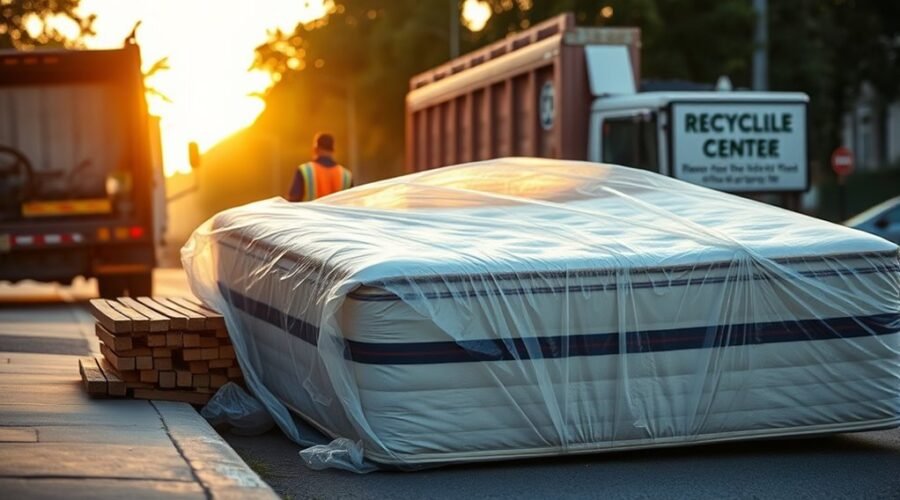
Getting rid of an old mattress usually takes more planning than putting ordinary household trash at the curb. Depending on where you live and the mattress’s condition, you may be able to recycle it, donate or give it away, use municipal bulky-item service, arrange retailer take-back, or hire a licensed junk-removal company. Always check local rules before moving the mattress outside.
Quick Answer
To dispose of a mattress, first check your city or county’s bulky-waste and mattress-recycling rules. A clean mattress may qualify for recycling, donation, retailer take-back, or municipal pickup. Wet, heavily soiled, badly damaged, or bed-bug-infested mattresses often need a different disposal route. Never leave a mattress where dumping is prohibited.
Key Takeaways
- Check municipal bulky-item pickup, mattress-recycling programs, and approved drop-off sites before paying a private hauler.
- Mattress Recycling Council reports that up to about 75% of a mattress can be recycled into other products.
- Donation is appropriate only when the receiving organization accepts used mattresses and the mattress is clean, dry, pest-free, and usable.
- Wet, heavily soiled, severely damaged, or bed-bug-infested mattresses may be rejected by normal recycling programs.
- Retailer take-back rules vary. In California, retailers delivering a new mattress must offer used-mattress take-back at no additional charge, subject to health and safety exceptions.
- Do not leave a mattress beside a road, alley, dumpster, or curb unless your local waste program specifically authorizes that placement.
Your Mattress Disposal Options
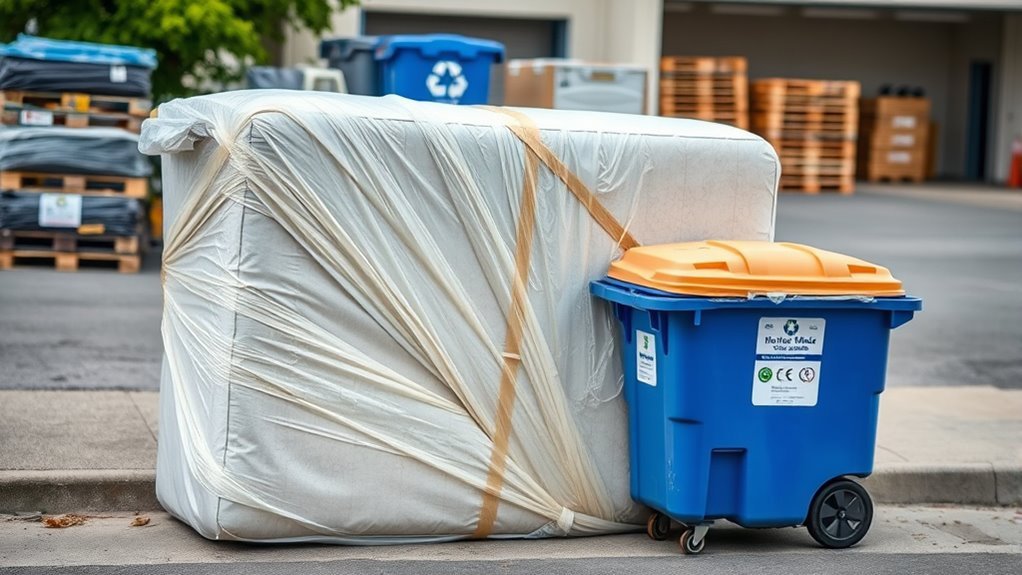
The best disposal method depends on the condition of the mattress, local services, transportation, and cost. Start with your city, county, or solid-waste provider because local programs often have specific pickup days, drop-off sites, bagging requirements, limits, or fees.
| Option | Best for | What to check |
|---|---|---|
| Mattress recycling | Worn-out but acceptable mattresses | Accepted condition, fees, drop-off limits |
| Donation or giveaway | Clean, usable mattresses | Organization policy and local resale rules |
| Municipal bulky-item service | Residents with local collection | Appointment, bagging, placement, fee |
| Retailer take-back | Buying a replacement mattress | Eligibility, fee, timing, health restrictions |
| Licensed junk removal | No suitable municipal or recycling option | Price and final recycling/disposal destination |
If your mattress is still usable, donation or direct reuse may keep the whole product in service. If it is worn out but clean enough for a recycling program, recycling can recover steel, foam, fibers, and wood. If it is contaminated or rejected by recyclers, follow your local solid-waste authority’s disposal instructions.
Pro Tip: Before paying a junk-removal company, check whether your city, county, retailer, or state mattress program already offers a lower-cost pickup or drop-off option.
Can You Donate or Give Away an Old Mattress?
You may be able to donate or give away a mattress that is clean, dry, structurally sound, and free from mold, odors, stains, and pests. Acceptance varies widely, so call the organization before transporting the mattress.
Do not assume that every thrift store or charity accepts mattresses. Some organizations reject used mattresses because of sanitation rules, storage limitations, or local regulations. For example, Habitat for Humanity’s national ReStore donation guidance does not accept mattresses or box springs.
Local furniture banks, shelters, community organizations, or direct-reuse networks may have different policies. Describe the mattress honestly and ask about condition requirements before scheduling a drop-off or pickup.
Warning: Do not donate, sell, or give away a mattress with bed bugs, mold, significant bodily-fluid contamination, major structural damage, or other conditions that could create a health or pest problem for another person.
Why You Shouldn’t Put It in the Trash
A mattress should not automatically go into your regular trash cart or be left beside it. Mattresses are bulky, difficult to compact, and may require separate handling by waste facilities. Local rules vary: some communities offer scheduled bulk collection, others require drop-off, and some route mattresses into dedicated recycling programs.
Recycling may also recover materials that would otherwise enter the waste stream. Mattress Recycling Council reports that up to about 75% of a mattress can be recycled, although the actual recovery rate depends on construction, condition, recycler capabilities, and markets for recovered material.
Landfill Space Waste
Mattresses take up considerable volume and do not compact as efficiently as ordinary household waste. Steel springs and large flexible frames can also make handling more difficult for waste equipment.
| Mattress issue | Why it matters |
|---|---|
| Bulky size | Uses substantial collection and disposal space |
| Steel coils and frames | Can complicate handling and processing |
| Reusable materials | Steel, foam, fiber, and wood may have recycling outlets |
| Illegal curbside placement | May result in missed collection or local penalties |
Mattress Recycling Council reports that more than 50,000 mattresses are discarded in the United States each day, and up to about 75% of a mattress can be recycled into other products.
Recycling Program Benefits
Mattress recycling separates usable materials instead of treating the entire mattress as mixed waste. Steel can enter scrap-metal markets, foam is commonly used in rebond applications such as carpet padding, fibers may find industrial uses, and wood from foundations can be processed for suitable secondary uses where markets and contamination allow.
Not every component from every mattress is recovered. Recycling performance depends on product design, contamination, local facilities, transportation, and demand for recovered materials. That is why it is better to use a current local program’s acceptance rules rather than assume a mattress is automatically recyclable.
How to Recycle Your Mattress Near You
Start with your city or county waste authority. Search its bulky-item, transfer-station, or mattress-recycling instructions and confirm whether you need an appointment, proof of residency, a mattress bag, or a disposal fee.
Residents of California, Connecticut, Oregon, and Rhode Island also have statewide mattress stewardship programs operated by Mattress Recycling Council under the Bye Bye Mattress brand. Oregon’s statewide program began January 1, 2025. Collection options vary by state and community.
| Option | Best use |
|---|---|
| Municipal program | Local pickup or resident drop-off |
| State stewardship program | Participating locations in CA, CT, OR, and RI |
| Retail take-back | Convenient when a new mattress is being delivered |
| Junk removal service | When transportation or municipal service is unavailable |
Before making a trip, call or check the receiving facility’s current rules. A recycler may refuse wet, heavily soiled, severely damaged, or bed-bug-infested mattresses.
Which Mattress Parts Can Be Recycled?
Mattress recyclers typically dismantle accepted mattresses and foundations so different materials can be sorted for secondary markets.
- Steel: Innersprings and metal frames can be separated and sold as scrap metal for new steel products.
- Foam: Recoverable polyurethane foam is commonly processed for applications such as rebond carpet padding.
- Textiles and fibers: Some fibers can be used in padding, insulation, automotive products, or other industrial applications, depending on the material and available markets.
- Wood: Wood from foundations may be chipped or used for suitable secondary applications, although nails, staples, contamination, and local markets can limit recovery.
- Cardboard and some plastics: These materials may also be recovered when clean and when a recycler has a suitable outlet.
Mattress Recycling Council currently describes up to about 75% of a mattress as recyclable. Treat that as an upper-end program figure rather than a guarantee for every mattress.
How to Prepare Your Mattress for Pickup
Preparation rules differ by city, recycler, and hauler. Confirm the instructions before putting the mattress outside. Some programs want a clean, unbagged mattress for inspection, while others require a sealed mattress bag for curbside collection.
Clear Bedding First
Remove sheets, pillowcases, mattress protectors, toppers, blankets, and personal items. These items usually belong in separate reuse, textile-recycling, or waste streams rather than with the mattress.
If the mattress is accepted for recycling or donation, keep it dry while waiting for collection. Do not leave it outdoors for days where rain, snow, dirt, or animals can make an otherwise acceptable mattress unusable.
Check for Damage
Inspect the mattress for major tears, exposed springs, severe sagging, mold, heavy staining, odors, moisture, and signs of bed bugs. The result helps determine whether donation, recycling, or disposal is appropriate.
Mattress Recycling Council programs generally exclude items that are wet, heavily soiled, severely damaged, or infested with bed bugs. Other municipal programs may have different procedures for contaminated mattresses.
Wrap for Pickup
Do not automatically wrap every mattress before recycling. Follow the receiving program’s instructions. Some locations inspect mattresses unbagged, while certain curbside programs require mattresses to be completely enclosed in a clear or sealed mattress bag.
If your local program requires wrapping, use the specified mattress bag or plastic covering and seal it as directed. Keep the mattress in the designated pickup location only during the allowed time window.
Note: Bagging rules are local. For example, Providence requires a clean mattress or box spring to be bagged in a clear mattress bag for its paid curbside collection, while its Saturday resident drop-off program accepts qualifying units unbagged for inspection.
Can You Use Retailer Take-Back Services?
Yes. Many mattress retailers offer haul-away or take-back when a replacement mattress is delivered, but the price and conditions vary.
- Ask about take-back before completing the purchase.
- Confirm whether the service is free or carries a haul-away fee.
- Ask whether the mattress will be recycled, reused, or disposed of.
- Confirm whether stains, pests, moisture, or severe damage make the mattress ineligible.
- Make sure pickup timing works with the delivery schedule.
California has a stronger requirement than a typical voluntary retailer program. When a retailer delivers a new mattress to a final California consumer, state law requires the retailer to offer to take back a used mattress at no additional charge. Delivery or setup fees for the new product can still apply, and a retailer may refuse a used mattress that creates a health or safety risk.
Outside California, do not assume take-back is free. Check the retailer’s current policy before purchase.
What If Your Mattress Can’t Be Recycled?
A mattress may be rejected from recycling if it is wet, heavily soiled, severely damaged, twisted, contaminated, or infested with bed bugs. Acceptance standards differ, so the final decision belongs to the receiving program.
If recycling is not available, contact your municipal or county solid-waste authority and ask how non-recyclable mattresses must be handled. Depending on the area, the answer may be scheduled bulky-waste collection, a transfer station, a permitted disposal facility, or a licensed private hauler.
Warning: If you suspect bed bugs, avoid carrying an uncovered mattress through shared hallways, vehicles, or other rooms. Follow your local pest-management and waste-disposal instructions for containing and labeling the item before moving it.
Do not assume that a contaminated mattress belongs at a household hazardous-waste facility. A mattress is generally handled through solid-waste or specialized bulky-item procedures unless your local authority specifically directs you elsewhere.
Product type also matters. Mattress Recycling Council programs accept standard mattresses, box springs, and qualifying futon mattresses, but exclude several products such as many non-upholstered air mattresses, sofa beds, mattress toppers, pillows, and futon frames.
How to Avoid Illegal Dumping
Leaving a mattress beside a road, in an alley, beside a commercial dumpster, on vacant property, or at an unauthorized curb location can constitute illegal dumping. It also shifts cleanup costs to property owners, municipalities, and waste services.
- Check your local bulky-waste or mattress-recycling rules.
- Schedule collection before placing the mattress at the curb when an appointment is required.
- Use authorized drop-off sites and follow residency, quantity, and fee rules.
- If hiring a private hauler, use a legitimate company and ask where the mattress will go.
- Report illegally dumped mattresses through your city or county’s normal reporting system.
Do not place the mattress outside early merely because pickup has been requested. Many cities specify exactly when bulky items may be set out.
How to Make Your Mattress Last Longer
Keeping a mattress usable longer can delay replacement and reduce waste. Follow the manufacturer’s care instructions because rotation, flipping, foundation requirements, and cleaning methods differ by mattress design.
| Action | Why it matters |
|---|---|
| Vacuum periodically | Removes surface dust and debris |
| Rotate when recommended | Can help distribute wear on compatible mattresses |
| Use a mattress protector | Helps protect against spills and stains |
| Use the recommended foundation | Supports the mattress as designed |
| Keep it dry and ventilated | Reduces moisture and mold risk |
Do not automatically rotate every mattress every three to six months. Some models have specific rotation schedules, while others are designed for a particular orientation. Follow the care instructions supplied by the manufacturer.
Frequently Asked Questions
Can I cut up a mattress to throw it away?
Check your local disposal rules before cutting up a mattress. Dismantling it does not automatically make it acceptable for regular trash, and the job can expose sharp springs, staples, and other internal components. If a recycler or bulk-waste service accepts the mattress whole, using that service is usually simpler and safer than cutting it apart.
How can I get rid of a mattress for free?
Start with your municipal waste authority and local mattress-recycling program. Some communities provide free resident drop-off, periodic bulky-item collection, or recycling funded through a state stewardship program. A retailer may also include take-back with a new purchase. Always confirm fees and eligibility because free service is not available everywhere.
Where can I dispose of my mattress in Williamson County, TN?
Williamson County residents can currently take mattresses and box springs for recycling to the Nolensville Convenience Center, Grassland Convenience Center, or Landfill Convenience Center. The county lists a $20 recycling charge per mattress or box spring, payable by credit or debit card. The listed hours are Monday through Friday from 9:00 a.m. to 5:00 p.m. and Saturday and Sunday from 7:00 a.m. to 3:00 p.m. County solid-waste facilities stopped accepting mattresses and box springs as free trash disposal in April 2024.
Where can I dispose of a mattress for free in Providence, RI?
Providence residents can currently drop off qualifying mattresses and box springs free at the Department of Public Works mattress drop-off location at 700 Allens Avenue on Saturdays from 7:00 a.m. to 12:45 p.m. The city requires valid Providence identification and limits the drop-off to two items. Providence also offers curbside mattress collection through Waste Management for a fee; qualifying curbside mattresses must be clean and sealed in a clear mattress bag.
Can I donate an old mattress?
Possibly, but only if the receiving organization accepts used mattresses and yours is clean, dry, structurally usable, and free from pests, mold, heavy staining, and odors. Donation rules differ significantly, so call first. Do not assume a national charity accepts mattresses simply because it accepts other furniture.
Can a bed-bug-infested mattress be recycled?
Many mattress-recycling programs do not accept bed-bug-infested mattresses. Do not donate or give away an infested mattress. Contact your local waste authority for the required containment, labeling, pickup, or disposal procedure before moving it.
Conclusion
The right way to dispose of a mattress depends on its condition and your local rules. If it is still usable, check legitimate donation or reuse options. If it is worn out but acceptable for recycling, look for municipal programs, statewide mattress programs, retailer take-back, or approved recycling facilities. For contaminated or rejected mattresses, follow your local solid-waste authority’s instructions rather than dumping the mattress or forcing it into an unsuitable recycling stream.
Sources
- Mattress Recycling Council / Bye Bye Mattress — mattress recyclability, accepted and excluded products, statewide program information, and material recovery.
- CalRecycle — California Mattress Stewardship Program and retailer used-mattress take-back requirements.
- Connecticut Department of Energy & Environmental Protection — Connecticut Mattress Stewardship Program and resident recycling guidance.
- Oregon Department of Environmental Quality — Oregon Mattress Stewardship Program, including its January 1, 2025 launch.
- Williamson County, Tennessee — current Spring Back mattress-recycling locations, fees, and facility rules.
- City of Providence Department of Public Works — current mattress drop-off, curbside collection, preparation, eligibility, and fee rules.