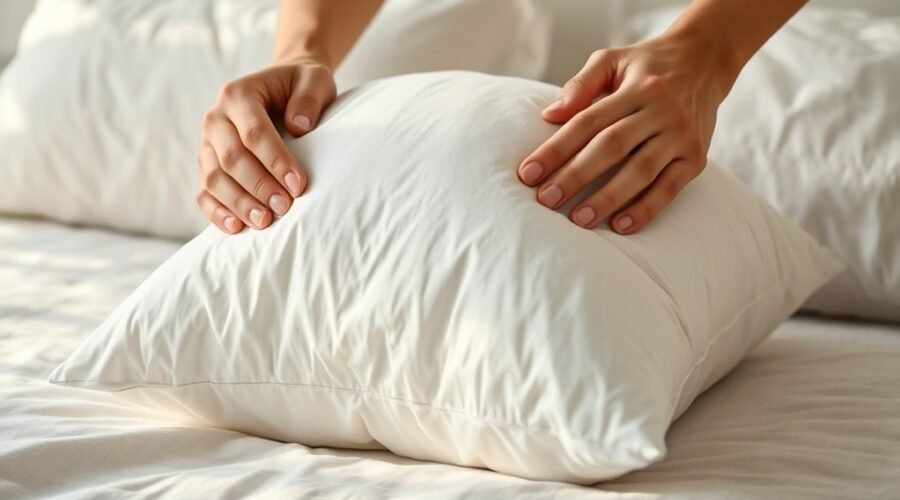
A flat or lumpy down pillow often needs redistribution rather than replacement. Start by checking the care label, then loosen the fill by hand with gentle shaking, compressing, and kneading. If the label allows tumble drying, a low-heat, air-fluff, or no-heat cycle with dryer balls can help separate stubborn clumps and restore loft.
Quick Answer
To fluff a down pillow, remove the pillowcase, check the care label and seams, then shake and compress the pillow from several directions to redistribute the fill. If the label permits machine drying, tumble it on the approved low or no-heat setting with dryer balls, stopping to fluff and check it until the center is completely dry.
Key Takeaways
- Start with the sewn-in care label because washing and dryer instructions vary by pillow.
- Shake, compress, and gently knead the pillow from several directions to break apart clumps and redistribute the down.
- Use a dryer only when the label allows it; low heat, air fluff, or no heat is safer than assuming medium or high heat is acceptable.
- Do not rely on a fixed drying time. The center of the pillow must be completely dry before you use or store it.
- A dry, breezy airing can help with retained moisture, but ordinary sunlight should not be treated as a dependable sanitizing method.
- If the pillow quickly collapses again, leaks fill, stays lumpy, or no longer supports you comfortably, replacement or professional refurbishment may make more sense.
At a Glance
| Time Required | A few minutes by hand; dryer time varies by pillow, moisture level, and the care label |
| Difficulty | Easy |
| Tools Needed | Your hands; optional dryer and clean dryer balls if the care label permits tumble drying |
| Cost | Usually $0 if you already have the needed supplies; dryer balls are optional |
Why Does a Down Pillow Go Flat?
Down is soft and compressible, so a pillow naturally becomes flatter where your head rests night after night. Moisture from humidity or perspiration can also make the clusters stick together, while body oils and ordinary use can contribute to clumping over time.
Fluffing works by loosening compressed clusters, moving fill back into thin areas, and allowing more air between the down. It can restore a pillow that is temporarily compressed, but it cannot repair worn fabric, missing fill, or down that no longer provides useful support.
Before You Fluff a Down Pillow
Check the sewn-in care label before using a dryer, washing machine, or any heat. Down pillows do not all have identical cleaning instructions. For example, Pacific Coast recommends following the exact wash and dryer settings on the pillow’s sewn-in label, while individual products from other manufacturers may specify different settings.
- Remove the pillowcase and protector. Fluff the pillow itself unless the manufacturer specifically instructs otherwise.
- Inspect the shell and seams. Stop if you see an open seam, torn fabric, or escaping down.
- Check for dampness. If the pillow is wet or recently washed, complete drying is more important than simply making the outside look fluffy.
- Read the dryer instructions. Do not assume medium or high heat is safe.
Warning: Do not use high heat, wring or twist a wet down pillow, or return a damp pillow to your bed or storage. The shell can feel dry while moisture remains deep in the fill.
How to Fluff a Down Pillow by Hand
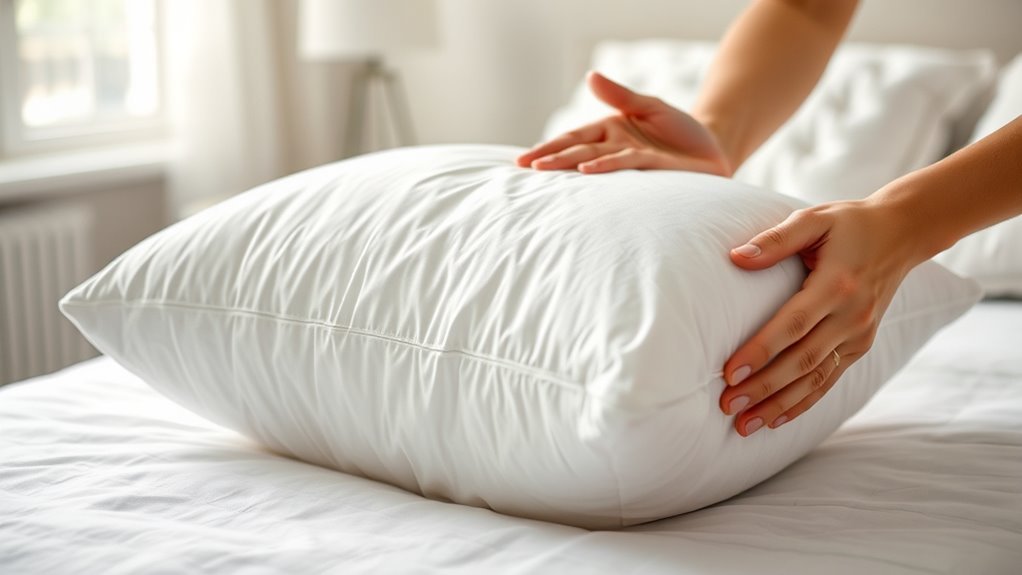
Hand fluffing is the best first step because it requires no heat and lets you feel where the fill has become uneven.
- Hold opposite sides. Grip the pillow firmly at two opposite edges and give it several gentle shakes.
- Compress and release. Push the two sides toward each other, release them, then rotate the pillow and repeat from another direction.
- Knead any lumps. Use your fingers to gently work apart areas where the fill has gathered into clumps.
- Move fill toward thin spots. Work the down through the shell toward visibly flatter areas rather than repeatedly striking one section.
- Shake again. Finish with a few gentle shakes so the fill spreads more evenly.
- Let it settle. Put the pillow on a flat surface for several minutes, then check its shape and support again.
A daily shake is one of the simplest ways to redistribute down and keep a pillow from developing one permanently compressed area.
Use the Dryer to Restore Loft
If hand fluffing is not enough, tumble drying can help separate compressed down, but only if the pillow’s care label allows it. The American Down and Feather Council recommends low heat for compatible down and feather products, while some manufacturers also allow air-fluff or no-heat settings.
- Choose the label-approved setting. Low heat, air fluff, or no heat is common for dryer-safe down pillows, but the label on your pillow takes priority.
- Add clean dryer balls if permitted. They can help separate clumps as the pillow tumbles.
- Give the pillow room to move. Do not pack the dryer so tightly that the pillow cannot tumble freely.
- Pause periodically. Remove the pillow, break apart remaining clumps with your hands, shake it, and return it to the dryer if needed.
- Judge dryness by the center, not a timer. Drying can take more than one cycle, particularly after washing.
There is no universal “20-minute” rule for a down pillow. Size, construction, dryer type, moisture content, and the approved setting all affect the time required.
Pro Tip: After a drying cycle, let the surface warmth fade for a moment and press the center of the pillow between your hands. If the center feels cooler, damper, denser, heavier, or contains wet clumps, continue drying on the label-approved setting.
IDFL’s down and feather care guidance stresses that proper drying is critical and that a pillow should be completely dry before use or storage.
Air Out Your Down Pillow in Fresh Air
Airing can help a down pillow release retained moisture and odors between deeper cleanings. Choose a dry day and place the pillow on a clean, dry surface with good airflow. Gentle sunlight can be useful for drying when the pillow manufacturer allows it, but fresh air and dryness are the main goals.
- Remove the pillowcase and protector.
- Place the pillow somewhere clean, dry, and well ventilated.
- Turn or rotate it so both sides receive airflow.
- Bring it indoors if humidity rises or the pillow begins picking up moisture.
- Shake and hand-fluff it again before putting the case back on.
Note: Do not rely on ordinary sunlight as a substitute for proper washing, drying, or other manufacturer-approved cleaning. Sunlight may help a pillow air out, but it is not a controlled sanitizing treatment.
Should You Wash a Flat Down Pillow?
A pillow that is merely compressed usually does not need to be washed just to restore its shape. Start with hand fluffing and, when allowed, a dryer refresh.
Washing may make sense when the pillow is actually soiled or when the manufacturer recommends periodic laundering. The cleaning method must come from the care label because the shell construction is as important as the fill. IDFL notes that many down and feather products can be washed successfully when their fabric permits it, but the pillow must then be dried thoroughly.
If your home washer or dryer is too small for the pillow to move freely, use suitable larger-capacity equipment or a professional bedding-laundering service rather than forcing the pillow into a cramped machine.
How to Keep a Down Pillow Fluffy Longer
- Fluff it regularly: Give the pillow a quick shake and compress-and-release routine when you make the bed.
- Use a washable protector: A zippered pillow protector helps keep sweat, body oils, dust, and spills away from the shell and fill.
- Keep it dry: Avoid storing a down pillow in a damp basement, humid bag, or other moisture-prone location.
- Follow the care label: Do not create a fixed washing schedule that conflicts with the manufacturer’s instructions.
- Deal with spills promptly: Follow the label’s spot-cleaning or laundering directions instead of leaving moisture trapped in the fill.
- Do not overheat it: More heat does not mean better fluffing and can damage components that are not designed for high temperatures.
Troubleshooting a Down Pillow That Will Not Fluff
| Problem | What to Do |
| One area stays flat | Massage the surrounding fill toward the thin area, then shake the pillow from several directions. |
| Clumps remain after washing | The interior may still be damp. Separate the clumps gently and continue label-approved drying until the center is completely dry. |
| Pillow smells musty | Stop using it until you determine whether retained moisture is present. Follow the manufacturer’s cleaning and drying instructions. |
| Down is escaping | Do not wash or aggressively fluff a damaged shell. Repair it according to the manufacturer’s guidance or consider professional refurbishment. |
| Pillow becomes flat again immediately | The fill may be worn or insufficient for your preferred support. Fluffing cannot restore material that has permanently lost useful resilience. |
Common Down-Pillow Fluffing Mistakes
- Using high heat: Follow the pillow’s approved dryer temperature rather than trying to speed up the process.
- Stopping when only the shell feels dry: Moisture can remain in the center.
- Twisting or wringing: Wet down is heavy, and aggressive handling can strain the shell and seams.
- Ignoring damaged stitching: A small opening can become a much larger leak during washing or tumbling.
- Leaving the protector on automatically: Remove outer covers unless their instructions specifically allow them to be dried together.
- Opening a sewn pillow to add fill: Do this only when the pillow was designed to be refillable or the manufacturer specifically permits it.
When to Replace a Flattened Down Pillow
A replacement schedule can be a useful reminder, but the pillow’s condition matters more than an exact age. Down and feather pillows are often discussed in terms of roughly a few years of regular use, yet quality, construction, care, moisture exposure, and nightly use can make the real lifespan shorter or longer.
Consider replacing the pillow when:
- It no longer regains useful loft: Hand fluffing and label-approved dryer fluffing produce little improvement.
- It immediately collapses under your head: A pillow can look full when unused yet provide little support once compressed.
- The shell is badly worn: Repeated leaks, torn seams, or thinning fabric can make continued use impractical.
- It remains persistently lumpy: Large uneven areas that cannot be redistributed may indicate that the fill has deteriorated.
- Odor or moisture problems persist: A pillow that cannot be cleaned and dried successfully may be better replaced.
- It no longer feels comfortable: If the pillow consistently fails to provide the loft and support you need, continued fluffing may only offer a temporary cosmetic improvement.
Frequently Asked Questions
How to Make a Down Pillow Fluffy Again?
Remove the pillowcase, check the care label and seams, then shake, compress, and gently knead the pillow from several directions. If it is still flat and the label permits tumble drying, use the approved low or no-heat setting with clean dryer balls and continue only as needed.
How to Revive Down Pillows?
Start with hand fluffing. Redistribute clumps, move fill toward thin areas, and let the pillow settle. If the care label permits drying, tumble it on the specified setting and check the center carefully. Wash the pillow only when its label allows washing and the pillow actually needs cleaning.
How to Restore Pillow Shape?
For a down pillow, shake it from several directions, compress and release opposite sides, then massage clumps apart with your fingers. A label-approved dryer cycle may help with stubborn compression. If the pillow immediately collapses again, the problem may be worn fill rather than simple uneven distribution.
Can Feather Pillows Be Restuffed?
Some can, but do not automatically cut open a conventional sewn pillow. DIY restuffing is best limited to pillows specifically designed with refillable access. For a sealed pillow, check with the manufacturer or a bedding-repair professional before opening the down-proof shell.
How Long Should a Down Pillow Stay in the Dryer?
There is no universal drying time. Follow the care label and check the pillow between cycles. After the surface heat fades, the center should not feel cool, damp, dense, unusually heavy, or contain wet clumps. Continue on the approved setting until the entire pillow is dry.
Does Putting a Down Pillow in the Sun Fluff It?
A dry, breezy airing can help remove retained moisture, which may make compressed down easier to fluff. Brief sunlight can be part of that process when the manufacturer allows it, but ordinary sunlight should not be treated as a guaranteed way to sanitize a pillow.
Conclusion
You can usually restore a flat down pillow by redistributing the fill rather than replacing it immediately. Start with gentle hand fluffing, then use a dryer only when the care label permits it. Choose the approved low or no-heat setting, break apart clumps between cycles, and make sure the center is completely dry. Regular fluffing, a washable protector, and dry storage can help preserve loft. If the pillow remains flat, damaged, lumpy, or uncomfortable after proper care, replacement or professional refurbishment may be the better option.
Sources
- Pacific Coast — How to Wash Down Pillows Without Damaging the Fill — care-label checks, dryer settings, complete-dryness testing, and troubleshooting.
- American Down and Feather Council — Consumer Guidance — regular fluffing and low-heat dryer guidance for compatible down and feather products.
- IDFL — Care Label for Down and Feather Products — washing, drying, shell considerations, and the importance of complete drying.
- The Company Store — Feather & Down Pillow Care Instructions — example manufacturer guidance for gentle washing, low/no-heat drying, and dryer balls.