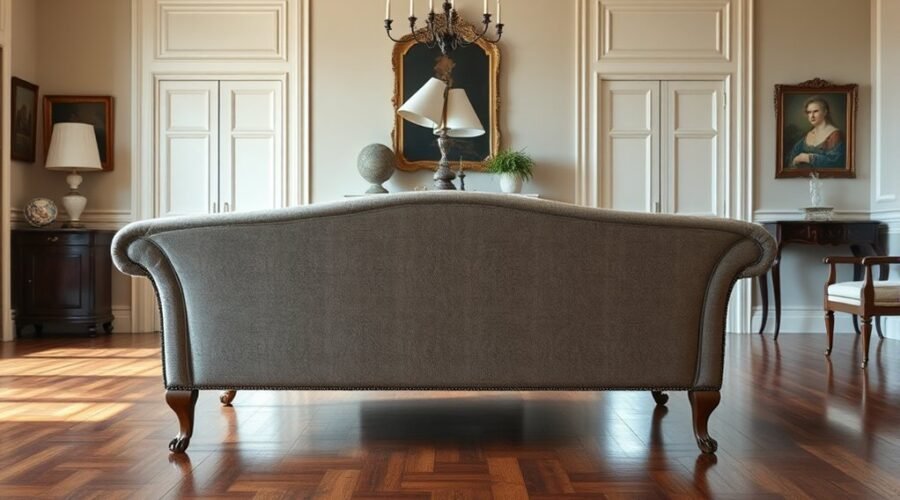
If you’re wondering what makes a camelback sofa stand out, look first at the top line of the back. A true camelback has a shaped crest that rises toward the center, creating the hump-like profile that gives the style its name. Rolled or scrolling arms, exposed wood, and period-style legs are common, but the curved back is the feature that matters most.
Quick Answer
A camelback sofa is a sofa with a back that rises into a pronounced central crest or related double-peaked curve. The form is strongly associated with 18th-century Georgian and Chippendale-era furniture and became especially important in American furniture making, including Philadelphia examples from the late 1700s.
Key Takeaways
- The defining feature is the shaped back, usually with a central hump or crest.
- Rolled arms, exposed wood, mahogany frames, and period-style legs are common historical features, but they are not present on every version.
- The style is closely associated with 18th-century Chippendale-era furniture and was already well established in America by the late 1700s.
- Antique age cannot be confirmed from the silhouette alone; construction, materials, alterations, provenance, and expert examination all matter.
- Modern reproductions can work in traditional or contemporary rooms, but dimensions and comfort vary widely, so measure and test the actual sofa before buying.
What Is a Camelback Sofa?
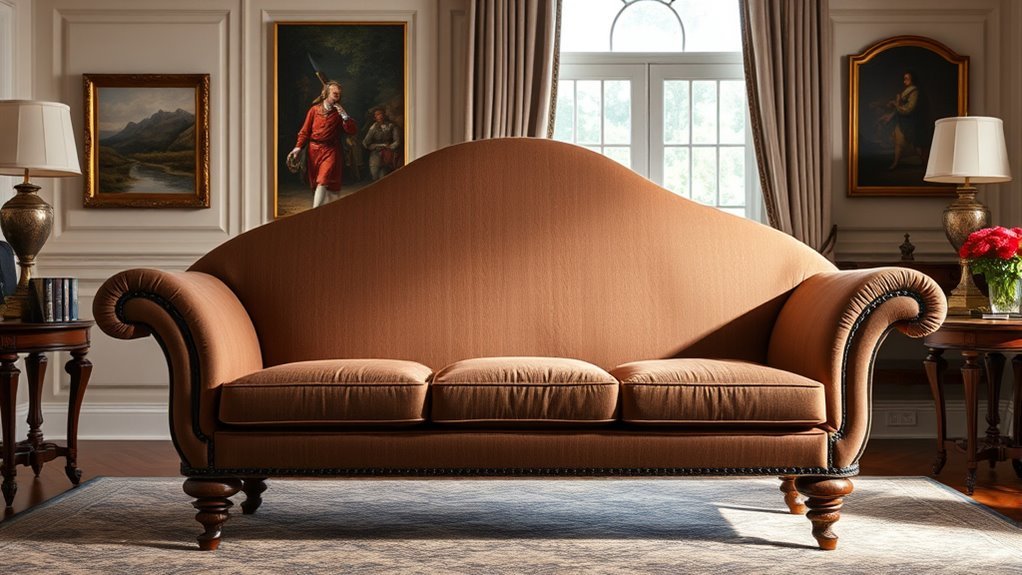
A camelback sofa is identified primarily by its shaped backrest, which rises toward the center to form a hump-like crest. The Metropolitan Museum of Art describes the historic camel-back form by the central hump of its crest and documents American examples dating from 1760–90.
Traditional versions often combine that curved back with scrolling or rolled arms, visible wooden legs, and a tailored upholstered body. Historic examples were frequently made in mahogany, although wood, leg style, carving, upholstery, and proportions varied by maker and period.
Some versions have one broad central rise. Others use a more complex or double-peaked crest. The shape may be subtle or dramatic, so the sofa does not need to resemble a literal camel to belong to the family.
Modern reproductions may simplify the woodwork, use different cushion constructions, or reinterpret the profile with contemporary fabrics. That means rolled arms, exposed rails, tufting, or plush cushions can support the look, but none of those details is as important as the characteristic back line.
The Metropolitan Museum of Art identifies the camel-back as a major American sofa form of the second half of the 18th century, with particularly strong surviving evidence from Philadelphia.
How to Identify a Camelback Sofa
Start with the silhouette rather than the upholstery. The clearest sign is a back that rises toward a central crest or follows a related double-peaked curve. After that, look at the arms, legs, exposed wood, and upholstery as supporting clues.
| Feature | What to look for | How important it is |
|---|---|---|
| Back shape | A central rise or related double-peaked curved crest | Defining feature |
| Arms | Often rolled, scrolling, or outward-curving on traditional examples | Common, not required |
| Woodwork | Exposed legs, rails, carving, or other visible frame details may appear | Varies by period and maker |
| Upholstery | Tight upholstery, loose seat cushions, pillows, bolsters, or modern cushioning | Not a reliable defining feature |
| Proportions | Usually visually symmetrical around the center crest | Useful supporting clue |
Historic examples can look quite different from modern showroom versions. A Philadelphia camel-back sofa in the Metropolitan Museum of Art, for example, combines a central hump with period woodwork and dates to 1760–90. The U.S. Department of State documents another large Philadelphia-associated example with an arched back, serpentine seat rail, and outward-scrolling arms.
How to Tell an Antique From a Reproduction
The shape alone cannot prove that a sofa is an 18th-century antique. Camelback forms have been reproduced and reinterpreted for generations, so age should be judged from the whole object.
- Inspect the frame: look underneath and behind removable cushions for joinery, repairs, replacement wood, labels, and changes to the original construction.
- Study the materials: wood species, secondary woods, hardware, upholstery foundations, and finishes can help an expert establish when and where a piece was made.
- Look for consistent age: genuine wear should make sense across the frame rather than appearing only on exposed surfaces.
- Check provenance: old invoices, estate records, dealer records, photographs, or museum-quality documentation can matter more than a seller’s verbal description.
- Expect alterations: an old frame may have newer upholstery, repaired joints, replaced feet, or refinished wood without ceasing to be an antique.
Note: One old-looking screw, tack, leg, or fabric does not authenticate a sofa. If age or value matters to the purchase, have the complete piece examined by a qualified furniture specialist or conservator.
How Camelback Sofas Compare to Other Styles
The easiest way to distinguish a camelback from another sofa is to compare the overall silhouette rather than one decorative detail.
| Style | Visual clue | Overall impression |
|---|---|---|
| Camelback | Back rises into a central or double-peaked crest | Sculptural, symmetrical, traditionally formal |
| Chesterfield | Typically has a more level back-and-arm line with prominent deep buttoning | Heavy, enveloping, club-like |
| Lawson | Straightforward frame with lower arms and separate back cushions common in many versions | Relaxed and cushion-focused |
| Cabriole-style sofa | Continuous curved frame and exposed decorative wood are often more visually dominant | Decorative and furniture-frame focused |
A camelback therefore does not need deep tufting, unusually thick cushions, or elaborate carving. If the shaped central crest controls the silhouette, the sofa is much closer to the camelback family.
Where the Camelback Sofa Came From
The camelback belongs to the world of 18th-century Georgian and Chippendale-era furniture. Thomas Chippendale was one of the period’s most influential designers and publishers, and surviving sofa drawings connected with his influential furniture pattern book date to 1759 and 1760. One of those drawings is preserved by the Metropolitan Museum of Art.
It is more accurate, however, to describe Chippendale as a major influence on the form than to assume that every camelback was personally designed by him. “Chippendale” also became a broad stylistic term used by later British and American craftspeople.
In America, the form was already important in the second half of the 18th century. The Met dates one Philadelphia example to 1760–90 and describes camel-back sofas as especially common in Philadelphia during that period. The Diplomatic Reception Rooms of the U.S. Department of State likewise document numerous surviving sofas with arched backs and scrolling arms from Philadelphia.
Historic examples also show why the sofa became such an imposing furnishing. Upholstery was expensive, large sofas required substantial material and labor, and well-made pieces could serve as prominent focal points in formal rooms. Surviving examples demonstrate several variations rather than one rigid template.
Common Camelback Variations
The classic version uses a broad central hump, but period furniture makers experimented with the crest and base. A double-peaked camelback creates two high points separated by a shallow dip, while other examples combine the shaped back with serpentine seat rails, straight Marlborough-style legs, cabriole legs, carving, or relatively restrained woodwork.
These differences are useful when studying a particular piece, but they should not be treated as a simple age chart. Regional workshops, later restorations, and revival furniture can combine features from several periods.
How to Choose the Right Camelback Sofa
Choosing the right sofa starts with how the piece will actually function in your room. Historic examples can be much larger than the graceful silhouette makes them appear, while modern reproductions come in a wider range of dimensions.
- Measure the room and delivery path. Check sofa width, depth, height, doorways, hallways, stair turns, and the space needed for comfortable circulation.
- Test the seat. Seat depth, cushion firmness, back angle, and seat height affect comfort far more than the word “camelback.”
- Inspect the frame. On used or antique pieces, check for loose joints, splits, wobbling legs, poor previous repairs, and evidence of major structural alteration.
- Check the upholstery. Look for stains, fading, odors, torn seams, collapsed support, and fabric wear along the arms and seat edge.
- Consider the woodwork. Exposed legs and rails become part of the room’s visual palette, so their finish should work with nearby tables and cabinetry.
- Choose fabric for the way you live. A formal textile can emphasize the sofa’s historical character, while a plain linen-look fabric, subtle texture, or restrained pattern can make the profile feel more relaxed.
Pro Tip: Tape the sofa’s full footprint on the floor before buying. The arched back may look visually light in a photograph, but some historic camelbacks are roughly eight feet wide, so the actual measurements matter more than the style name.
Choosing an Antique Versus a Modern Reproduction
An antique may offer period construction, genuine age, and distinctive craftsmanship, but it may also require conservation or specialist upholstery work. A reproduction gives you more freedom to choose dimensions, cushion construction, fabric, and durability while keeping the characteristic silhouette.
If historical value matters, avoid major refinishing or structural alterations until the piece has been assessed. Original finishes, upholstery evidence, old repairs, and construction details can contain information that disappears once a sofa is aggressively stripped or rebuilt.
Why Camelback Sofas Still Fit Modern Homes?
Camelback sofas can work in contemporary rooms because the curved outline gives the furniture a strong shape without requiring heavy ornament. The easiest approach is to let the silhouette provide the traditional element while keeping the surrounding room simpler.
Try a solid or lightly textured upholstery with clean-lined side tables, restrained lighting, and fewer ornate accessories. In a more traditional room, patterned fabric, polished wood, decorative trim, and layered textiles can emphasize the sofa’s historical character.
A camelback also works well as a visual counterpoint to straight architectural lines. The curved crest can soften a room dominated by rectangular windows, shelving, tables, or modern cabinetry.
Do not assume the style is automatically compact, however. A museum example at the Met measures about 98 inches wide, while a Department of State example is roughly 100.5 inches wide. Modern versions may be much smaller, so use the measurements of the particular sofa rather than the style’s visual lightness to judge whether it fits.
How to Care for a Camelback Sofa
For an ordinary modern sofa, follow the upholstery manufacturer’s cleaning instructions and fabric care code. Regular dust removal and careful vacuuming can help prevent debris from working into the textile.
Use more caution with genuine antiques or fragile upholstery. The Smithsonian Museum Conservation Institute treats upholstered furniture as a textile-conservation concern and emphasizes examination, documentation, preventive care, and appropriate treatment. Avoid soaking old fabric, aggressively scrubbing delicate textiles, or applying furniture products to an unknown historic finish without understanding the materials first.
Frequently Asked Questions
Are camelback sofas out of style?
No furniture silhouette is permanently “in” or “out.” A heavily patterned antique camelback can look traditional, while the same curved profile in a simple fabric can fit a contemporary room. Proportion, upholstery, surrounding furniture, and personal preference matter more than the age of the design.
What couch styles are considered outdated?
There is no objective list of outdated sofa styles. Very bulky proportions, worn upholstery, or strongly era-specific fabrics can make a piece feel dated in some rooms, but Chesterfields, sectionals, floral sofas, and other traditional forms continue to be used successfully. Updating upholstery or simplifying the surrounding decor can change the effect considerably.
What color goes well with a camel couch?
If by “camel couch” you mean a camel-tan or warm brown sofa, try cream, warm white, olive or muted green, charcoal, navy, rust, burgundy, or deeper blue accents. For a quiet palette, combine camel with tan, cream, natural wood, and textured neutrals. For more contrast, use green, blue, or deep red in pillows, rugs, or artwork.
What color couch is in style in 2026?
There is no single required sofa color for 2026, but major color forecasts show strong interest in warm, grounded neutrals and sophisticated brown-based tones. Sherwin-Williams selected Universal Khaki as its 2026 Color of the Year, while Benjamin Moore selected Silhouette, a deep espresso-and-charcoal hue. For a sofa, warm tan, khaki, brown, cream, muted green, or another color that works with the room is more useful than chasing a single trend.
How can you tell if a camelback sofa is really antique?
Do not rely on the hump-shaped back alone. Examine the joinery, wood, hardware, finish, upholstery foundation, wear, repairs, labels, and provenance together. Because later reproductions can copy period silhouettes closely, a valuable piece should be examined by a qualified furniture specialist or conservator before you rely on an age attribution.
Is a camelback sofa good for a small living room?
It can be, but the style itself does not guarantee a small footprint. Some historic camelbacks are around eight feet wide. Measure the exact sofa, delivery route, surrounding furniture, and walking space before deciding. A compact modern reproduction can provide the same curved profile in a much smaller room.
Conclusion
A camelback sofa is defined first by its shaped, hump-like back, not by one particular fabric, cushion type, arm, or leg. Its strongest historical associations reach into 18th-century Georgian and Chippendale-era furniture, with important American examples documented in Philadelphia by the late 1700s. Today, the same silhouette can work in a traditional or modern room when the sofa’s scale, upholstery, comfort, and condition suit the space.
Sources
- The Metropolitan Museum of Art — American Sofa, 1760–90 — documents the central-hump camel-back form and its importance in late-18th-century American furniture.
- The Metropolitan Museum of Art — Thomas Chippendale Sofa Drawing, 1759 — documents an original sofa design associated with Chippendale’s influential pattern book.
- U.S. Department of State Diplomatic Reception Rooms — Chippendale Mahogany Camel-Back Sofa — provides detailed evidence about Philadelphia construction, upholstery, form, and historical use.
- Smithsonian Museum Conservation Institute — Textile Conservation — supports appropriate preventive care and conservation of upholstered furniture and historic textiles.
- Benjamin Moore — Color of the Year 2026 — documents Silhouette AF-655 and the company’s 2026 color palette.
- Sherwin-Williams — Color of the Year 2026 — documents Universal Khaki and the company’s 2026 emphasis on warm, grounded neutrals.