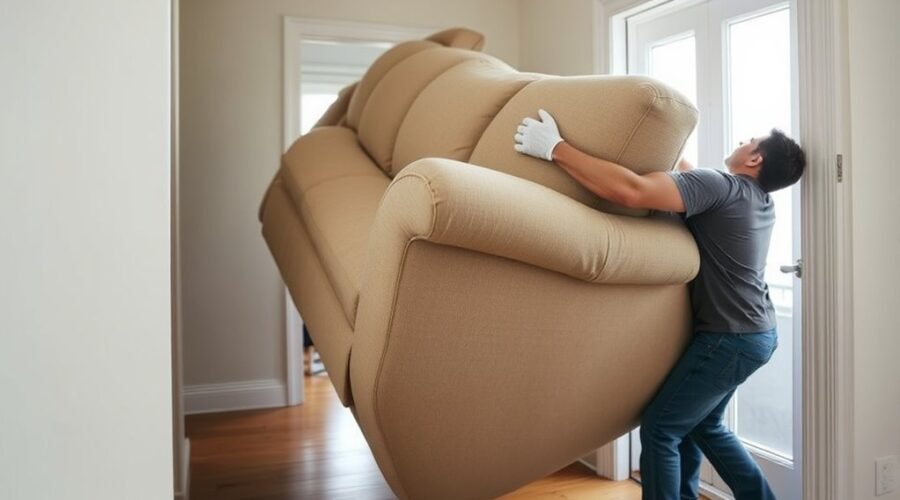
You can move a sofa through a doorway without damaging the furniture, walls, or trim if you measure the full route first and use the right orientation. Check the sofa’s rigid dimensions, the clear doorway opening, and the space available for turning on both sides. Remove only parts designed to come off, protect contact points, and use controlled movement instead of force.
Quick Answer
Measure the sofa’s rigid height, depth, width, and diagonal depth if available, then measure the clear doorway and the turns on both sides. Remove cushions and manufacturer-approved detachable parts, protect the frame and walls, and use a controlled tilt or end-first pivot with a helper. Never force a tight fit.
Key Takeaways
- Measure the sofa, the clear doorway opening, and every tight turn, hallway, landing, stairway, or elevator along the route.
- Remove cushions, legs, or other parts only when the furniture was designed for safe removal.
- Protect upholstery, floors, walls, and door jambs before lifting or pivoting the sofa.
- Use a helper or mechanical aid for a bulky or heavy sofa, and pivot with your feet instead of twisting your torso.
- If the sofa binds, becomes unstable, or requires major disassembly, stop and consider another entry or professional help.
At a Glance
| Time Required | Varies by sofa, route, and disassembly; allow enough time to measure and move without rushing. |
| Difficulty | Moderate for a simple doorway; higher with stairs, sharp turns, sleeper sofas, or powered furniture. |
| Tools Needed | Tape measure, screwdriver or approved furniture tool, moving blankets, gloves, straps, sliders or dolly as appropriate, and a labeled bag for hardware. |
| Cost | Low if you already own basic supplies; equipment rental or professional moving help adds cost and varies by location. |
Measure the Sofa and Doorway
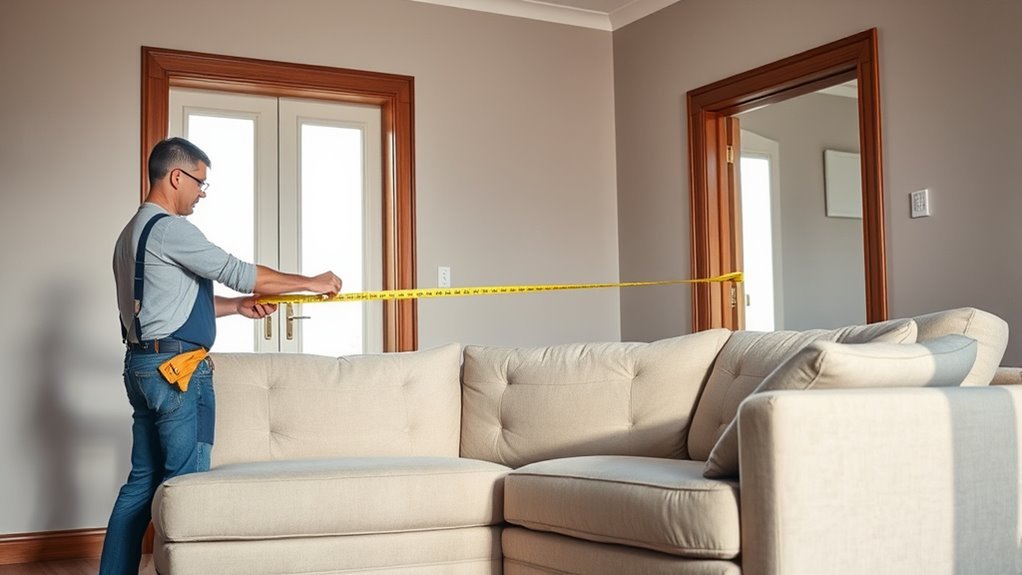
Start by measuring the sofa’s rigid width, height, and depth. Remove loose cushions before measuring the frame, but do not assume legs, arms, backs, or mechanisms detach unless the manufacturer intended them to come off.
If the manufacturer lists a diagonal depth, record it too. Pottery Barn’s furniture-delivery measuring guidance uses diagonal depth to help determine whether upholstered furniture can be brought through an opening on its end.
Next, measure the clear doorway width and height at the narrowest usable points. Measure the actual open space rather than relying on the nominal door size. Account for the door slab, knob, hinge hardware, stops, fixed trim, and anything else that projects into the route.
Do not treat one diagonal measurement as a guarantee. A sofa can pass a doorway in several orientations, and the correct fit depends on the sofa’s rigid profile, the doorway’s clear dimensions, and whether you have enough room to tilt and rotate the piece before and after it crosses the opening.
Note: Measure the entire route, not just the narrowest door. A sofa that clears the opening can still get stuck at a hallway turn, stair landing, elevator, low ceiling, handrail, or light fixture.
Room & Board’s delivery guide recommends checking doorways, hallways, stairways, landings, elevators, railings, low fixtures, and the available turning space along the route.
If your measurements are close, recheck them before lifting. A small clearance on paper can disappear once blankets, door hardware, an uneven frame, or a difficult turning angle enters the equation.
Gather the Tools You’ll Need
Gather everything before you lift the sofa so you are not searching for tools while the furniture is balanced in an awkward position. Useful supplies include a measuring tape, the correct screwdriver or furniture tool, moving straps, furniture sliders, moving blankets, work gloves, and a labeled bag for screws or bolts.
A furniture dolly or hand truck may also help on a suitable level route, but it does not make stairs, sharp pivots, or a badly balanced sofa safe for one person.
Essential Moving Tools
Start with a measuring tape so you can verify the sofa and every clearance point along the route.
Keep the correct screwdriver, hex key, or manufacturer-specified tool nearby if the sofa has parts that were designed to be removed. Never pry off an arm, back, or panel simply because it looks detachable.
Moving straps can improve control when used correctly, while furniture sliders can reduce the amount of lifting needed on compatible floors. A dolly or hand truck can help transport a suitable load across a clear, level path.
Wear work gloves that let you maintain a secure grip without reducing hand control.
Protective Supplies
Use moving blankets or furniture pads to protect upholstery, wood edges, and exposed corners. Secure the padding so it does not slide under your hands or become a trip hazard.
Add door jamb guards or securely positioned padding at the parts of the frame most likely to be contacted. Protect nearby walls and floors where the sofa will pivot.
Keep straps and padding clear of reclining mechanisms, electrical controls, hinges, and moving hardware.
Measuring Equipment
A reliable tape measure is the main measuring tool you need. Check the sofa at its widest rigid points and measure the doorway at its narrowest usable points.
For the route, record hallway width, ceiling restrictions, stair width, landing depth, elevator dimensions, and the space available to rotate the sofa on each side of the doorway.
Write the measurements down instead of relying on memory. Comparing them before lifting is much easier than discovering a problem while the sofa is halfway through the opening.
Remove Cushions and Detachable Parts
Start by removing all loose seat and back cushions. This reduces bulk, keeps cushions from falling during the move, and makes the frame easier to grip.
Then remove legs, feet, or other components only if they are designed for routine removal. Follow the manufacturer’s assembly or disassembly instructions when available.
Place screws, bolts, washers, and other small hardware in a labeled Ziplock bag or small container so nothing disappears during the move.
Remove Seat Cushions
Removing loose cushions makes a sofa more manageable and may create a slimmer working profile around the doorway.
Keep the cushions together in a clean bag, box, or protected area. Reserve small Ziplock bags for screws and hardware rather than trying to store bulky cushions in them.
After the cushions are removed, remeasure the rigid frame if the original dimensions included loose upholstery.
Detach Loose Parts
Remove only components that the sofa was designed to release safely. Legs are commonly detachable, while armrests, backs, reclining mechanisms, and upholstered panels vary widely by model.
After removing approved parts, reassess the sofa’s rigid dimensions and decide which orientation gives you the safest route through the opening.
| Part | Action |
|---|---|
| Legs or feet | Remove if designed to unscrew or release |
| Armrests or back | Remove only when manufacturer instructions allow it |
| Frame | Remeasure and reassess the moving angle |
Wrap exposed edges after disassembly and keep the sofa balanced as you move it. If a component resists, stop and inspect the attachment rather than prying or forcing it.
Bag Small Hardware
Put screws, bolts, washers, brackets, and similar parts into a labeled hardware bag. If several components come off, use separate labeled bags so you know which hardware belongs to each piece.
Keep those bags with the sofa or with the corresponding removed component rather than putting them loose into a general moving box.
Once the frame is prepared, cover vulnerable areas with moving blankets and confirm that no blanket or strap interferes with the grip points you plan to use.
Clear the Path Before Moving
Before lifting, clear the entire route from the sofa’s current position to its destination. Move furniture, rugs, cords, shoes, decor, toys, pet items, and anything else that could become a trip or snagging hazard.
A sofa that fits through the doorway can still fail at the next hallway turn, stair landing, or low ceiling, so measure the entire route before lifting.
Check both sides of the doorway for enough room to rotate the sofa. Also inspect handrails, low light fixtures, ceiling slopes, doorknobs, wall art, and other projections that may reduce usable clearance.
Protect walls, corners, floors, and door frames before the sofa reaches them. If you are moving through a shared building, also follow any elevator, service-entry, or property-management requirements.
Warning: Do not force a sofa through an opening or continue when the load becomes unstable. OSHA lifting guidance stresses mechanical assistance, additional people for heavier loads, keeping the load close, maintaining a neutral posture, and avoiding twisting. A bulky sofa can be difficult to control even when its weight alone does not seem extreme.
Remove the Door If You Need More Clearance
If the open door itself reduces the usable opening, removing an interior door slab may provide extra clearance. Room & Board notes that interior doors can sometimes be removed and reattached to make furniture delivery easier.
Only do this if the door and hinge hardware are appropriate for removal and you are comfortable handling its weight. Have another person support the door, remove the hinge pins or fasteners as the hardware requires, and place the door on a padded surface away from the moving path.
Do not pry off fixed casing, structural material, or other trim simply to gain a small amount of space. In a rental, condominium, or managed building, get any required approval before altering the opening.
Pro Tip: Measure the opening again after the door is removed. Do not assume the extra clearance is enough—confirm it before lifting the sofa a second time.
Tilt the Sofa to Fit Through the Doorway
If the sofa does not pass straight through, remove approved detachable parts and test whether a controlled tilt gives the rigid frame enough clearance.
With a helper, bring the sofa close to the doorway and adjust the angle before committing the full weight to the turn. One person should communicate the direction and pace so both movers change position together.
Depending on the sofa’s proportions, the top or lower corner may enter first while the rest of the frame pivots through. There is no single angle that works for every sofa, so use the measurements and available turning space rather than relying on force.
Keep your feet moving as the sofa turns instead of twisting your torso under load. OSHA recommends keeping loads as close to the body as practical and turning by moving the feet rather than twisting while lifting.
If the frame contacts both sides of the opening, the sofa loses balance, or you cannot maintain a secure grip, back out and reset.
Use the Vertical Move for Tight Spaces
Some sofas can pass through a tight opening more easily when moved on one end, but only when the furniture, doorway height, ceiling clearance, and surrounding space allow it.
Before attempting a vertical move, confirm that the sofa’s overall dimensions and rigid side profile can clear the doorway and that there is enough height to raise and rotate the piece safely.
- Put on gloves and confirm the route is clear.
- Use a helper and agree on who will call the movement.
- Protect the end of the sofa and the floor before raising it.
- Bring the sofa upright slowly while maintaining control of the center of gravity.
- Guide the leading edge through the opening and pivot in small, coordinated movements.
- Stop immediately if the sofa begins to tip or either person loses a secure grip.
Do not rest a sofa on switches, electrical connections, delicate trim, reclining controls, or unsupported mechanisms.
For a sofa whose manufacturer publishes a diagonal-depth measurement, use that dimension together with the doorway and route measurements when deciding whether an end-first move is realistic.
Special Cases: Sectionals, Sleepers, and Powered Sofas
Sectional sofas should usually be separated at their intended connectors before you try to maneuver the individual pieces. Do not assume every joint simply pulls apart; check how the sections lock together first.
For a sleeper sofa, reclining sofa, or other furniture with internal moving hardware, treat the piece as more complex than a basic fixed-frame couch. Do not disassemble internal mechanisms unless the manufacturer provides instructions or you know the model is designed for that procedure.
For a powered recliner or powered sofa, unplug it before moving. Disconnect only the cables or modules the manufacturer identifies as user-detachable, secure loose cords, and keep straps away from motors, wiring, controls, and moving joints.
If the furniture requires removing upholstery, cutting staples, dismantling the frame, or working on a reclining or sleeper mechanism to pass the doorway, professional furniture disassembly may be the safer option.
Protect Walls and Door Frames
Once you know which orientation you will use, protect the route with moving blankets, cardboard, floor protection, or purpose-made jamb guards.
Secure padding so it stays in place but does not create a slippery surface or interfere with your hands.
Protect the sofa too, especially wood edges, corners, exposed hardware, leather, and upholstery likely to contact the doorway during a pivot.
Use moving straps only when they improve control and can be positioned without crossing fragile mechanisms or making the movers adopt awkward postures.
Move slowly and make small corrections. If the clearance disappears, reverse the move while you still have control instead of trying to squeeze the final corner through.
Reattach Sofa Parts After the Move
Once the sofa is safely through the doorway and placed on a stable surface, reattach the removed parts. Find the labeled hardware bags before you begin so you do not substitute the wrong screw or bolt.
Lay out each sofa part in order and match it carefully to its original attachment point.
- Align each removable leg, foot, back, or approved component with its original mounting point.
- Install the correct hardware by hand first where possible so you do not cross-thread it.
- Tighten the fasteners securely without overtightening or damaging the frame.
- Check that all components are stable and that the sofa sits evenly.
- Reconnect powered components only according to the furniture manufacturer’s instructions.
Return the cushions after the frame is fully assembled. Furniture coasters or floor pads can be placed under the legs if you need additional floor protection.
When to Call Professional Movers
Call professional movers when the sofa will not clear the route after careful measuring and legitimate disassembly, or when the move involves risks you cannot control safely.
Professional help is especially worth considering when you have a very bulky piece, stairs, a narrow landing, a sleeper or powered mechanism, no secure handholds, limited helpers, or a sofa that requires complex disassembly and reassembly.
Movers may also have equipment and experience that lets them manage difficult pivots without damaging trim, walls, floors, or upholstery.
Costs vary by location, access, labor time, furniture type, and the amount of disassembly required, so compare written quotes rather than relying on a generic savings percentage.
If a move would require taking apart structural furniture components, removing windows or railings, lifting over a balcony, or performing another high-risk maneuver, get professional assistance rather than improvising.
Frequently Asked Questions
What is the best way to move a sofa through a doorway?
Measure the sofa, clear doorway, and entire route first. Remove loose cushions and only manufacturer-approved detachable parts, protect the furniture and doorway, and use a controlled straight carry, tilt, or end-first pivot with a helper. Keep the load under control and reset the angle instead of forcing a tight fit.
Will a 40-inch-wide sofa fit through a 32-inch door?
Possibly. The sofa’s 40-inch overall width alone does not determine whether it will fit. Check its rigid height, depth, diagonal profile, removable legs or other approved parts, the doorway’s clear width and height, and the space available to rotate the sofa. If no safe orientation clears the 32-inch opening, use another entry, approved disassembly, or professional help.
What should I do if a sofa will not fit through the door?
Stop forcing it. Recheck the measurements, remove cushions and approved detachable parts, test a different safe orientation, and consider removing the interior door slab if it is reducing the clear opening. Also check another entrance such as a wider patio or garage door. If the rigid frame still cannot clear the route, use professional furniture disassembly or movers.
What can I use to move a couch by myself?
Furniture sliders, a suitable dolly or hand truck, protective blankets, and straps can reduce carrying on a clear, level route. However, do not attempt a heavy or bulky sofa alone if you must lift it vertically, use stairs, negotiate a tight turn, or cannot maintain a secure grip. Get another adult or professional help for those situations.
Should I remove the door from its hinges to move a sofa?
Removing an interior door can help when the door slab or hardware reduces the usable opening. Measure first to confirm the extra clearance will matter. Support the door while removing the appropriate hinge pins or fasteners, place it on a padded surface, and reinstall it after the move. Do not remove fixed trim just to gain a small amount of space.
How much clearance should I leave when measuring?
Avoid planning a move around a zero-clearance measurement. Padding, protruding hardware, uneven furniture shapes, and the space needed to rotate the sofa can use up a small theoretical margin. When the numbers are extremely close, remeasure the route and consider another orientation or professional advice rather than forcing the piece.
Conclusion
Moving a sofa through a doorway is mainly a problem of measurement, route planning, and controlled handling—not brute force. Measure the sofa and the entire route, remove only parts designed to come off, protect the furniture and your home, and choose an orientation that gives you real clearance. Use a helper for bulky lifting, pivot with your feet instead of twisting, and stop when the sofa becomes unstable or begins to bind. If the rigid frame still will not clear the route safely, use another entry or call professional movers rather than forcing it.
Sources
- Pottery Barn — How to Measure for Furniture Delivery — supports measuring furniture dimensions, diagonal depth, and passageways before delivery.
- Room & Board — Measuring for Furniture Delivery — supports checking doorways, hallways, elevators, stairways, landings, obstacles, and alternate entries.
- U.S. Occupational Safety and Health Administration — Heavy Lifting — supports mechanical assistance, team lifting, load control, neutral posture, and avoiding twisting.
- U.S. Occupational Safety and Health Administration — Ergonomics: Solutions to Control Hazards — supports reducing heavy manual lifting through mechanical aids and multiple-person handling.
- CDC/NIOSH — Applications Manual for the Revised NIOSH Lifting Equation — supports the importance of load position, asymmetry, twisting, reach, and other factors in manual-lifting risk.