
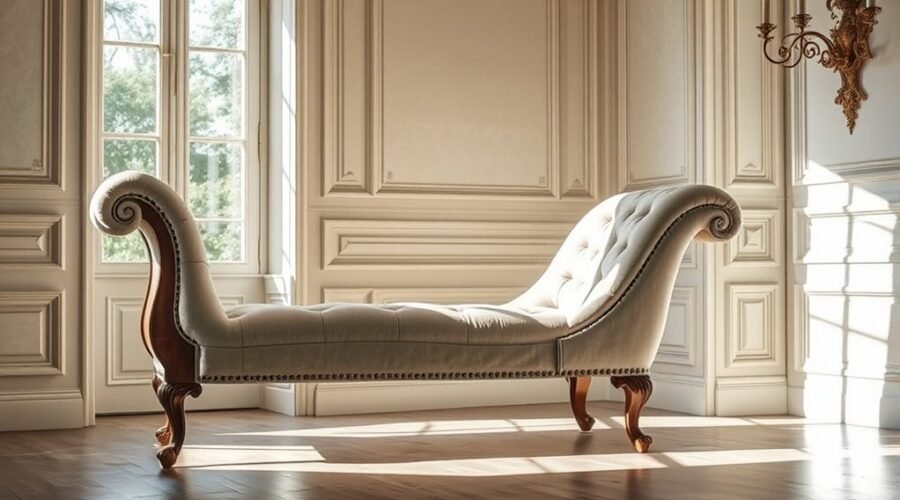
A chaise lounge is an elongated chair or sofa-like seat that lets one person recline with their legs supported. The original French term is chaise longue, literally “long chair.” Although reclining furniture existed in ancient cultures, the modern term and familiar European forms are more closely tied to French furniture history.
Quick Answer
A chaise lounge is a long seat designed so one person can sit back with their legs extended. Its name comes from the French chaise longue, meaning “long chair.” “Chaise lounge” is a common English variant created when the unfamiliar French word longue shifted toward the familiar English word “lounge.”
Key Takeaways
- Chaise longue is the original French term and literally means “long chair.”
- Chaise lounge is a well-established English variant influenced by the familiar word “lounge.”
- Ancient Egyptians, Greeks, and Romans used beds and reclining couches, but these are better treated as historical precedents than as a proven direct lineage to the French chaise longue.
- French reclining furniture developed into several distinctive forms, including the duchesse brisée, récamier, and méridienne.
- Modern chaises appear as freestanding indoor furniture, sectional extensions, and outdoor loungers.
What Does Chaise Lounge Mean?
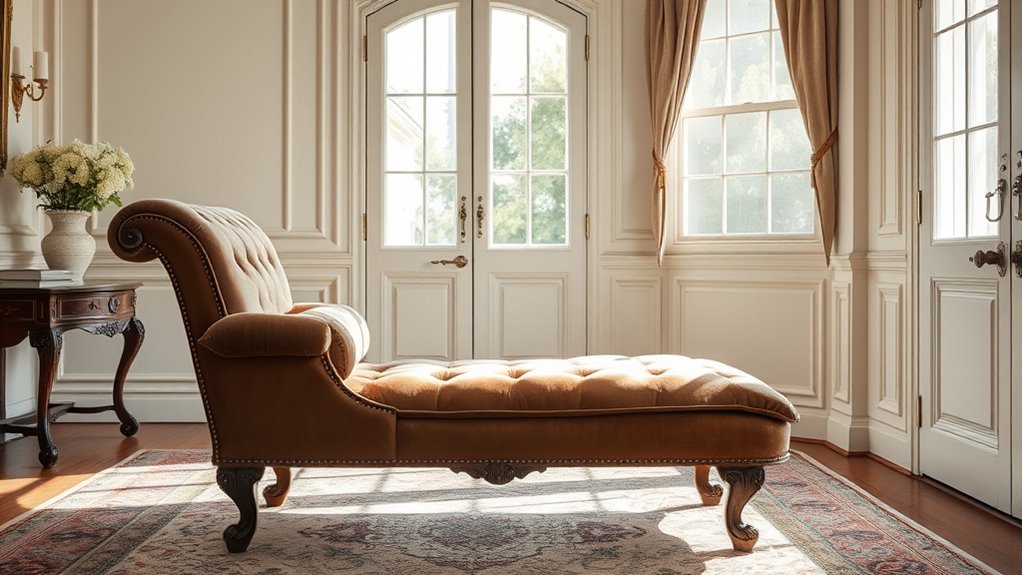
A chaise lounge is a long chair or couch-like seat built so you can recline while supporting your legs. The name comes from the French chaise longue, which means “long chair.” Merriam-Webster explains that English speakers gradually reshaped the unfamiliar word longue into the familiar word lounge, a process known as folk etymology.
Both forms are encountered in English. Chaise longue stays closest to the French expression, while chaise lounge is especially familiar in American English and is often associated with indoor or outdoor reclining furniture.
Note: You do not need to treat “chaise lounge” as a completely different piece of furniture from a “chaise longue.” In ordinary English, the terms overlap heavily. Product makers may also use “chaise,” “lounger,” or “chaise lounge” for slightly different designs.
The defining feature is the elongated seat. Unlike a normal armchair, a chaise gives your legs a built-in place to rest without requiring a separate ottoman.
The reclining couch also became strongly associated with psychoanalysis. The Freud Museum London preserves Sigmund Freud’s famous psychoanalytic couch, which was given to him by a patient around 1890. That couch helped make reclining furniture a lasting visual symbol of psychoanalysis, although not every psychoanalytic couch is technically a chaise longue.
Where Did the Chaise Lounge Come From?
The history is easier to understand when ancient reclining furniture is separated from the later French furniture type and name.
| Period | What We Know |
|---|---|
| Ancient Egypt | Beds, chairs, stools, and other furniture survive from ancient Egypt. UCL Digital Egypt notes that furniture was placed in some tombs as early as the Early Dynastic Period around 3000 BC. These pieces show a long history of elevated resting furniture, but they are not proof of a direct Egyptian-to-French chaise lineage. |
| Ancient Greece and Rome | Greeks and Romans used multifunctional bed-couches called the kline and lectus. Research summarized by the University of Helsinki describes these as furniture for reclining, dining, sleeping, convalescence, and other activities. |
| 18th-century France | Elaborate French resting furniture is firmly documented. Musée Carnavalet, for example, preserves a Paris-made duchesse brisée dated to about 1760. |
| Late 18th to early 19th century | The French term chaise longue entered English use, while forms associated with the French Empire period—including the later récamier—became recognizable furniture types. |
| Modern era | Designers adapted the long reclining-seat idea to modern materials, sectionals, pool furniture, reading chairs, and sculptural statement pieces. |
Ancient reclining furniture helps explain the long human history of resting on elevated couches, but the safest historical description is that these pieces are predecessors and parallels—not a proven unbroken lineage to the French chaise longue.
How 18th-Century French Design Shaped Chaise Longues
By the 18th century, French furniture makers were producing sophisticated seating made specifically for reclining and rest. These pieces could combine carved wooden frames, curved backs, upholstered cushions, and coordinated foot sections.
A well-documented example is the duchesse brisée in the Musée Carnavalet collection, made in Paris around 1760. It consists of two coordinated pieces: a deeply curved chair and a separate foot section. Its carved form and textile upholstery show how resting furniture could become an important part of a carefully designed interior.
Some surviving French chaises and daybeds were clearly luxurious objects made for wealthy households. However, it is more accurate to describe elaborate examples as products of elite craftsmanship than to claim that every chaise longue was universally a “status symbol.”
French designers continued adapting reclining furniture into the late 18th and 19th centuries, producing forms that are still referenced by designers today.
Chaise Lounge Styles Explained
“Chaise lounge” is now used as a broad furniture label, but several historic forms have distinct shapes and construction.
| Style | Typical Form | Best Known For |
|---|---|---|
| Chaise longue | An elongated chair or sofa-like seat supporting the sitter’s legs | General reclining and lounging |
| Duchesse brisée | Separate coordinated chair and foot section, or multiple pieces arranged together | Flexible 18th-century French resting furniture |
| Récamier | Long couch-like form commonly associated with raised ends and an open long side | French Empire-era elegance |
| Méridienne | A French daybed or resting seat, often with unequal or asymmetrical back heights | Reclining along one side |
| Sectional chaise | Extended seat attached to one end of a sofa or sectional | Modern living rooms and shared seating |
| Outdoor chaise | Long reclining chair, often with an adjustable back | Patios, decks, pools, and sunbathing |
The récamier has a particularly recognizable cultural connection. The Metropolitan Museum of Art notes that the form was named for Madame Récamier and became associated with the couch depicted in Jacques-Louis David’s famous portrait of her. The Met also preserves an American couch derived from the Récamier sofa form.
These categories can overlap, especially in modern furniture catalogs. A retailer may call an elongated sectional seat a chaise even though it does not resemble an 18th-century French example.
Chaise Lounge vs. Daybed, Sofa, and Outdoor Lounger
The easiest way to identify a chaise is to look at how the furniture is meant to support the body.
- Chaise lounge: Usually designed for one person to recline with the legs extended while the upper body remains supported.
- Daybed: More bed-like in proportion and generally better suited to lying fully flat or occasional sleeping.
- Sofa: Primarily designed for two or more people sitting upright, although deep sofas can also be used for lounging.
- Sectional chaise: An extra-deep seat attached to a sofa, allowing one sitter to stretch their legs out.
- Outdoor lounger: Usually designed for sunbathing or poolside reclining and may have an adjustable back rather than upholstered indoor construction.
Names vary between manufacturers, so dimensions and construction matter more than the label alone. If you need a true guest-sleeping surface, a daybed or sleeper sofa is normally more practical than a traditional chaise.
How Chaise Lounges Fit Modern Homes
In modern interiors, a chaise lounge can work as both functional seating and a visual focal point. It can create a dedicated place for reading, relaxing, or stretching out without taking up as much visual space as a full sofa.
Common placements include a bedroom corner, a window area, a reading nook, a living-room seating group, or the end of a sectional. Freestanding chaises can also help fill an awkward corner where a conventional armchair feels too small but another sofa would feel too heavy.
Pro Tip: Before buying a chaise, mark its full footprint on the floor with painter’s tape. Check not only the length of the seat but also walking clearance, nearby doors, drawers, tables, and whether a left-facing or right-facing orientation works better in the room.
For outdoor use, choose a chaise specifically designed for exterior conditions. Outdoor models may use powder-coated metal, teak, synthetic wicker, mesh, or outdoor-rated cushions rather than indoor upholstery.
For indoor furniture, consider how you actually plan to use it. A firmer chaise can be comfortable for reading, while deeper cushioning may suit relaxed lounging. If the chaise is part of a sectional, confirm which side the extended seat occupies when you are facing the furniture because retailers do not always describe orientation in the same way.
Frequently Asked Questions
Where did the chaise lounge originate?
There is no need to assign the modern chaise longue to a single ancient inventor. Ancient Egypt had sophisticated beds and chairs, while Greeks and Romans used reclining bed-couches such as the kline and lectus. The specifically French chaise longue belongs to a later European furniture tradition, with well-documented French examples surviving from the 18th century.
Why do Americans say “chaise lounge”?
The original French phrase is chaise longue. In English, the unfamiliar word longue became associated with the familiar word “lounge.” Linguists call this kind of reshaping folk etymology. “Chaise lounge” is now a common English form, particularly in North American furniture usage.
What do the French call a chaise lounge?
The French expression is chaise longue, literally “long chair.” The French plural is chaises longues. English speakers may use either chaise longue or the Anglicized form chaise lounge.
What is the point of a chaise lounge?
A chaise gives you a place to sit with your upper body supported while stretching out your legs. It works well for reading, resting, watching television, or relaxing without needing a separate chair and ottoman. It can also function as an accent piece in bedrooms and living rooms.
Is “chaise lounge” correct, or should I say “chaise longue”?
Both forms appear in modern English. Chaise longue is the original French expression, while chaise lounge is a long-established English variant. If you are discussing historical French furniture, chaise longue is usually the more precise term. For contemporary American furniture, “chaise lounge” is common and readily understood.
How do you pronounce chaise longue?
In English, chaise is commonly pronounced roughly like “shayz,” and longue is commonly pronounced like “long.” American speakers who use the spelling “chaise lounge” normally pronounce the second word exactly like the English word “lounge.”
Can you sleep on a chaise lounge?
You can nap on a chaise if its size and cushioning are comfortable, but most traditional chaises are designed primarily for reclining rather than overnight sleeping. A daybed or sleeper sofa is generally a better choice when you need regular guest sleeping space.
Conclusion
A chaise lounge is best understood as an elongated reclining seat with a name rooted in the French chaise longue, or “long chair.” Ancient beds and reclining couches show that people have used similar resting positions for thousands of years, while later French furniture developed the recognizable forms that influence today’s chaises. Whether it is a freestanding accent chair, a sectional extension, or an outdoor lounger, the basic idea remains simple: comfortable seating with room to stretch out.
Sources
- Merriam-Webster — “Chaise Lounge” or “Chaise Longue”? — supports the French meaning, English spelling change, and folk-etymology explanation.
- UCL Digital Egypt — Furniture in Ancient Egypt — supports the discussion of ancient Egyptian beds, chairs, and surviving furniture from around the Early Dynastic Period.
- University of Helsinki — Beds in the Encyclopedia of Ancient History — supports the functions of Greek klinai and Roman lecti.
- Musée Carnavalet / Paris Musées — Duchesse brisée — documents a two-part Paris-made reclining seat dated to about 1760.
- The Metropolitan Museum of Art — Couch — supports the historical association between the Récamier furniture form and Madame Récamier.
- Freud Museum London — Sigmund Freud’s Famous Psychoanalytic Couch — supports the discussion of Freud’s couch and its association with psychoanalysis.


