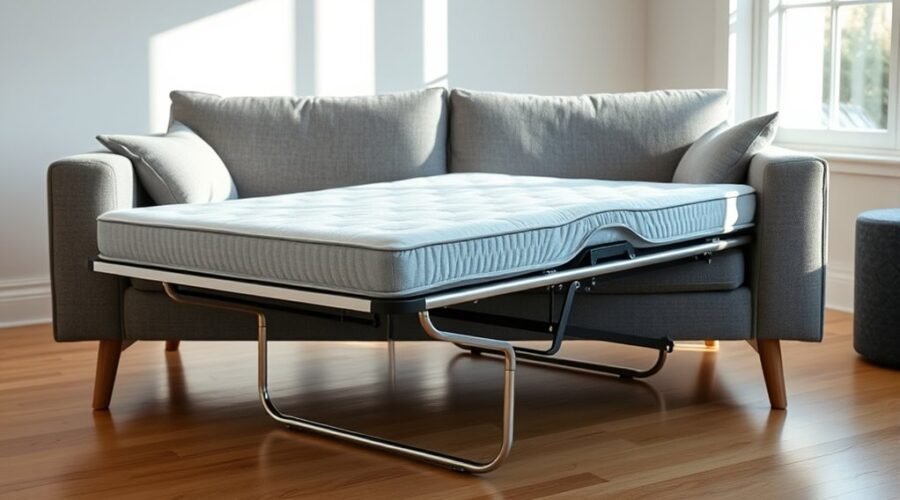
A sleeper sofa combines everyday seating with a sleeping surface, but the way it changes from sofa to bed depends on the mechanism inside. Traditional models unfold a hidden mattress and frame, while click-clack, platform, pop-up, and other designs move different parts of the sofa itself. Understanding that mechanism helps you judge setup effort, sleeping comfort, room clearance, safety, and long-term maintenance before you buy or operate one.
Quick Answer
A sleeper sofa works by moving part of the sofa frame into a sleeping position. Traditional pull-outs unfold a hidden mattress and support frame; click-clack models flatten the seat and back; platform and easy-open systems extend a sleep deck with fewer steps. The exact motion, support legs, and clearance vary by model, so follow its manual.
Key Takeaways
- A sleeper sofa is a dual-purpose couch that converts from seating to a sleeping surface.
- Common designs include traditional pull-outs, click-clack or fold-flat sofas, platform systems, pop-up or trundle sleepers, and dual-fold arrangements.
- The mechanism name alone does not determine comfort; mattress construction, padding, support deck, bed dimensions, and frequency of use matter just as much.
- Use the manufacturer’s fully open dimensions instead of relying on a universal clearance rule.
- Never force a stuck mechanism, and follow the model’s manual for operation, maintenance, lubrication, and repair.
At a Glance
| Time Required | A few movements for simple fold-flat models; multi-stage pull-outs require additional steps. Exact setup time varies by model and user. |
| Difficulty | Easy to moderate when the mechanism is operating correctly. |
| Tools Needed | None for normal conversion; a tape measure is useful when checking room and delivery clearance. |
| Cost | No cost for normal operation; replacement mattresses, parts, and professional repairs vary by brand and model. |
What Is a Sleeper Sofa Bed?
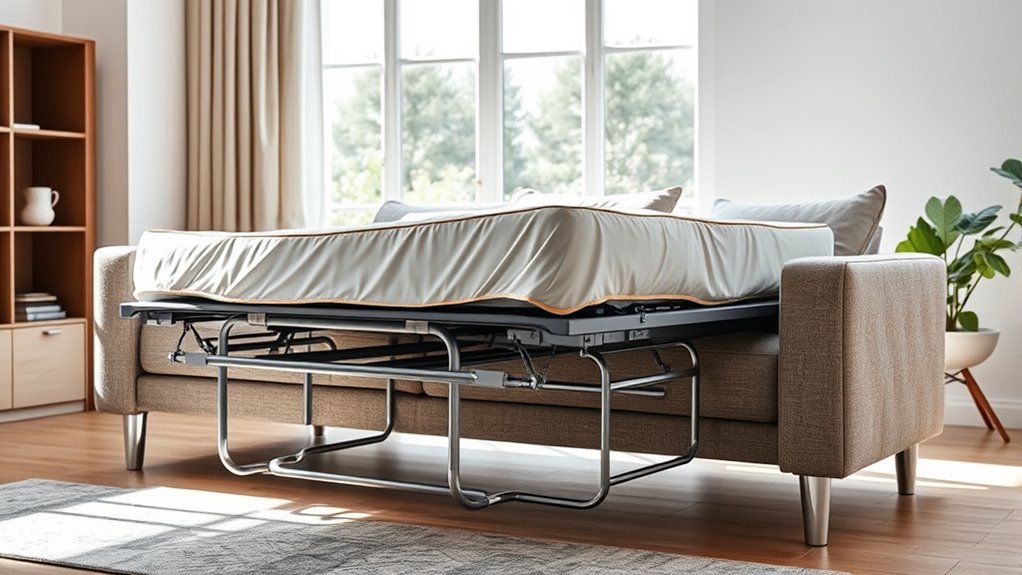
A sleeper sofa bed is a couch designed to provide both daytime seating and a sleeping surface. The terms sleeper sofa and sofa bed are often used interchangeably, although some retailers use “sleeper sofa” more specifically for designs with a hidden or extending bed mechanism.
The important part is not the label but how the sleep surface is created. A traditional sleeper may hide a separate folded mattress beneath removable seat cushions. A click-clack sofa may flatten its backrest and seat. Other systems use sliding platforms, trundles, pop-up sections, or independently extending seats.
That difference affects the sofa’s open footprint, the number of steps required to convert it, the height and feel of the bed, and the type of support under the sleeper.
Do not assume that one mechanism automatically gives you a thicker or more comfortable mattress. For example, IKEA’s NYHAMN sleeper sofa uses a click-clack design and is offered with a dedicated foam mattress, while traditional pull-outs and platform sleepers use several different mattress and support constructions.
How Sleeper Sofa Mechanisms Open and Fold
Sleeper sofa mechanisms do not all open the same way. The safest approach is to identify the model and use its operating instructions rather than applying one set of steps to every sofa bed.
On a traditional pull-out sleeper, the seat cushions commonly come off first. The concealed bed frame is then lifted and pulled out in stages before its support sections or legs are lowered. La-Z-Boy’s current sleep-sofa operating instructions, for example, tell users to remove the loose cushions, lift the deck handle, pull the mechanism to its first extended position, and then lower the front support leg.
Traditional pull-outs unfold a separate bed structure, while fold-flat and platform designs create the bed by repositioning sections of the sofa itself.
A click-clack model works differently. On IKEA’s NYHAMN, the underframe is pulled upward and the backrest folds down to create the sleeping position. Other click-clack sofas may use a somewhat different hinge or ratchet sequence, so the product instructions still matter.
Platform, pop-up, trundle, dual-fold, and branded easy-open systems vary even more. Some slide forward, some rise to seat height, and some unfold individual sections. Room & Board’s sleeper comparison guide, for example, distinguishes pull-out, pop-up platform, fold-out, Day & Night, and dual-fold systems.
Warning: Keep fingers, loose bedding, children, and pets away from moving hinges, rails, and folding sections. La-Z-Boy specifically warns users not to sit or lie on its sleep-sofa mattress until the bed is fully extended and never to close the unit with a person or animal inside.
Common Sleeper Sofa Mechanism Types
Sleeper sofa terminology is not completely standardized. Retailers may use different names for similar designs, so compare the actual opening motion and sleep surface instead of shopping by mechanism name alone.
| Mechanism | How It Creates a Bed | Space Consideration | What to Check |
|---|---|---|---|
| Traditional pull-out | A separate mattress and frame unfold from inside the sofa. | Usually extends substantially forward. | Open depth, mattress dimensions, support deck, and leg operation. |
| Click-clack / fold-flat | The backrest, seat, or underframe changes position to form a flat sleep surface. | May need space behind, in front, or both, depending on the hinge path. | Flat dimensions, wall clearance, center seam, mattress/padding type. |
| Platform / easy-open | A platform or hidden sleep deck extends from the sofa, sometimes with the mattress already positioned on it. | Varies widely; some systems need little or no rear wall clearance. | Opening path, support structure, whether cushions stay attached, and model-specific clearance. |
| Pop-up / trundle | A lower section rolls or slides out and may rise to meet the seat. | Needs clear floor area in front of the sofa. | Wheel or rail travel, locking position, seam between surfaces, and open footprint. |
| Dual-fold / modular sleeper | One or more sofa sections extend or unfold independently. | Useful where only part of the sofa needs to convert. | Section-by-section dimensions, support placement, and walkway access. |
Pull-Out Sleeper Sofas
A traditional pull-out sleeper sofa stores a folded mattress and support frame beneath the seat cushions. On many models, you remove the loose cushions, lift a handle or front rail, and guide the folded frame outward before opening its final section.
Some designs use metal legs, center supports, webbing, a platform, or another suspension system beneath the mattress. Do not assume that the legs automatically “lock” unless the manufacturer’s instructions say so; on some designs they simply unfold or rest on the floor in their operating position.
Pull-outs are often a good fit when you want a clearly defined mattress separate from the sofa’s seat cushions. However, mattress thickness, material, length, and support system vary by model, so inspect those specifications rather than judging comfort from the word “pull-out.”
Click-Clack Conversions
A click-clack sleeper sofa changes the angle or position of the seat and back until they form a sleeping surface. Some use ratcheting hinges; others combine a hinged backrest with a moving underframe.
A typical sequence may look like this:
- Clear pillows, blankets, and nearby objects from the opening path.
- Move the seat, underframe, or backrest in the direction specified by the manufacturer.
- Continue through the hinge or ratchet sequence until the bed reaches its fully open position.
- Check visually and by gentle pressure that the intended supports are seated before lying down.
Do not rely only on hearing a “click” to decide that every model is safely positioned. Use the operating instructions and make sure the frame is in its intended final position.
Click-clack systems can work well in multipurpose rooms because they avoid storing a large folded bed frame beneath the cushions. Their comfort still depends on the actual sleep surface. Some have integrated upholstery; others, such as the IKEA NYHAMN, use a dedicated mattress over the folding frame.
Easy-Open and Platform Mechanisms
Easy-open is not one universal engineering standard. Manufacturers use the term for different systems designed to reduce the effort or number of steps required for conversion.
Some systems keep cushions attached, while others require removing cushions. Some use support legs, while others extend onto a platform or integrated base. American Leather’s Naomi Comfort Sleeper, for example, uses the company’s platform sleep system and is specified for zero wall clearance. That is a feature of that system, not a rule for all easy-open sleepers.
When comparing these models, check exactly what moves, whether the sleeping surface has seams, how high the bed sits, and how much floor space the fully opened unit occupies.
Pop-Up, Trundle, and Dual-Fold Sleepers
Modern sleeper sofas also include designs that do not fit neatly into the traditional pull-out or click-clack categories.
A pop-up or trundle sleeper generally slides a lower platform from beneath the seat and may raise that platform to create a larger sleeping surface. A dual-fold sleeper can allow individual sections to extend separately, which may be useful in a sectional or a room where you sometimes need only one sleeping position.
These designs can reduce the number of folded mattress layers inside the sofa, but they may introduce seams between cushions or platforms. Test the fully opened surface when possible rather than evaluating only the sofa in seating mode.
How to Open and Close a Sleeper Sofa
The exact procedure depends on the model, but a safe general sequence is straightforward.
- Identify the mechanism. Check the product label, manual, or manufacturer’s instructions before forcing an unfamiliar sleeper.
- Clear the area. Remove loose pillows, bedding, toys, cords, and nearby objects that could enter the moving mechanism.
- Remove cushions only when required. Traditional pull-outs often require this; many fold-flat systems do not.
- Use the intended handle or frame section. Pull or lift smoothly instead of jerking one side.
- Guide the mechanism through its full travel. Deploy supports or legs exactly as the model requires.
- Verify the bed is fully supported. Check that the frame is level and intended support points are seated before use.
- Close it in the reverse sequence. Remove thick bedding if the manufacturer does not allow it to remain inside, keep hands clear of hinges, and never force the frame into the sofa cavity.
Pro Tip: If one side of a pull-out starts moving before the other, stop and re-center your grip. Twisting or yanking a partly misaligned frame can make binding worse.
Which Sleeper Sofa Fits Your Space?
Choose a sleeper sofa by its fully open footprint, not only by its dimensions in seating mode. Two sofas with similar closed dimensions can require very different amounts of floor or wall clearance once converted.
A traditional pull-out often travels a long distance forward. A fold-flat model may need room for the backrest to pivot. A pop-up or trundle needs unobstructed floor area in front. Some specialized platform systems are designed for very little rear wall clearance.
Measure Room Clearance
There is no reliable universal rule such as “leave 30 inches around every sleeper.” Instead, find the manufacturer’s published open dimensions and map that rectangle in your room.
For example, La-Z-Boy lists its Leah Queen Sleep Sofa at 38.5 inches deep in sofa form and 90.5 inches from the back of the sofa to the front of the sleeper when fully extended. Other models can be shorter, longer, or open in a completely different direction.
Use this process before buying:
- Record the sofa’s closed width, depth, and height.
- Record its fully open width and depth.
- Mark the open footprint on the floor with removable painter’s tape if practical.
- Check doors, drawers, tables, vents, radiators, outlets, and normal walking routes.
- Measure the complete delivery path, including doorways, hallways, stairs, landings, and elevators.
Room & Board’s furniture delivery measuring guide recommends checking doorway and hallway width and height, stairway clearances, elevator dimensions, handrails, light fixtures, and other fixed obstacles before delivery.
Match Mechanism to Layout
Once you know the available space, match the sleeper’s actual travel path to the room rather than choosing by appearance alone.
| Mechanism | Layout It Often Suits | Main Space Check |
|---|---|---|
| Pull-out | Rooms with clear floor area in front | Full forward extension |
| Click-clack | Studios, offices, dens, multipurpose rooms | Backrest pivot and wall clearance |
| Easy-open / platform | Frequent-conversion spaces | Model-specific opening path |
| Modular / dual-fold | L- or U-shaped seating arrangements | Which individual sections extend |
| Pop-up / trundle | Rooms where a lower platform can roll forward | Clear floor and rail travel |
Mattress and Support Matter as Much as the Mechanism
The mechanism determines how the sofa opens, but it does not by itself determine whether the bed will feel comfortable.
Compare the following before buying:
- Sleep-surface dimensions: Check actual width and length instead of relying only on labels such as twin, full, or queen.
- Mattress or cushion construction: Foam, pocket springs, innerspring, and integrated upholstered surfaces feel different.
- Support below the sleeper: Platforms, slats, webbing, frames, and other suspension systems distribute weight differently.
- Seams and joints: Fold-flat and pop-up designs may place a seam between sections of the sleep surface.
- Frequency of use: A bed used every night deserves more scrutiny than one opened several times a year for guests.
- Replacement options: Before replacing a mattress, verify the exact dimensions, thickness, foldability, and weight allowed by the mechanism.
Note: A thicker replacement mattress is not automatically an upgrade. If it is thicker, stiffer, heavier, or less foldable than the original design allows, the sleeper may no longer close correctly. Follow the sofa manufacturer’s replacement specifications.
Common Sleeper Sofa Problems and Fixes
If a sleeper sofa becomes difficult to open, close, or support evenly, stop forcing it and identify the cause first. Repeatedly applying more force can bend rails, damage hinges, distort supports, or trap upholstery in the mechanism.
| Problem | What to Check | Safe Next Step |
|---|---|---|
| Mechanism will not open fully | Bedding, cushions, debris, furniture, or a wall blocking the travel path | Clear the area and try again with smooth, even force. |
| One side moves farther than the other | Uneven pulling, bent hardware, shifted rails, or an obstruction | Stop, inspect both sides, and arrange service if the frame appears bent or displaced. |
| Bed feels unstable | Support legs, platform sections, locks, or floor contact | Do not sleep on it until every required support is correctly positioned. |
| Frame squeaks or feels stiff | Loose hardware, dry contact surfaces, debris, or worn parts | Clean accessible debris and consult the model’s maintenance instructions before applying lubricant. |
| Mechanism will not close | Mattress or bedding folded incorrectly, supports not retracted, trapped fabric, or misalignment | Reopen it, remove the obstruction, and repeat the closing sequence. Never force it into the cavity. |
| Sleeping surface is uncomfortable | Worn mattress, sagging cushions, damaged support deck, or unsuitable replacement mattress | Inspect both the mattress and underlying support before assuming the mattress alone is the problem. |
Routine upholstery care can also help keep dirt from accumulating around moving parts. Follow the cleaning code and care instructions for your exact fabric and frame.
Do not spray general-purpose oil or lubricant into a sleeper mechanism simply because it squeaks. If lubrication is required, use only the product and locations specified by the manufacturer. Persistent binding, bent metal, cracked welds, loose pivots, abnormal movement, or damaged support hardware are reasons to stop using the bed and obtain qualified service.
Frequently Asked Questions
What Are the Disadvantages of a Sleeper Sofa?
Sleeper sofas are usually heavier and mechanically more complex than ordinary sofas. Some require significant floor clearance when open, some use thinner or segmented sleep surfaces, and traditional pull-outs may require removing cushions before setup. Moving parts can also need service over time. The trade-offs vary by design, so compare the open footprint, sleep surface, setup steps, weight, warranty, and replacement-part availability before buying.
How Does the Sofa Bed Mechanism Work?
A sofa bed mechanism moves the sofa from seating mode into a supported sleeping position. Traditional pull-outs unfold a separate mattress and frame; click-clack designs reposition the seat and back; platform and trundle systems slide, lift, or unfold additional sections. The exact sequence, supports, and locking points are model-specific.
How Does a Sofa Sleeper Work?
A sofa sleeper stores or creates a bed within the footprint of a couch. Depending on the design, you may pull a hidden mattress from under the cushions, fold the backrest flat, slide out a lower platform, or extend individual sofa sections. Once fully opened, the mattress or upholstered sections rest on the mechanism’s intended frame, platform, legs, slats, or other support system.
What Is the Average Lifespan of a Sleeper Sofa?
There is no dependable universal lifespan for sleeper sofas. Useful life depends on frame construction, mechanism quality, mattress and cushion wear, user weight, conversion frequency, maintenance, and whether repair parts remain available. Instead of relying on a fixed number of years, watch for looseness, bent or cracked hardware, uneven opening, support failure, severe mattress deterioration, and repairs that exceed the value of the sofa. Also review the manufacturer’s component-specific warranty, which is not the same as a predicted lifespan.
How Much Clearance Does a Sleeper Sofa Need?
Use the exact fully open dimensions published for the model. Traditional pull-outs may extend far forward, fold-flat sofas may need room for the backrest to pivot, and some platform systems require very little rear wall clearance. After mapping the open footprint, leave enough additional space for the circulation your room requires.
Can You Sleep on a Sleeper Sofa Every Night?
Some sleeper sofas are designed and marketed for frequent or nightly sleeping, while others are better suited to occasional guests. Check the manufacturer’s intended use, mattress or sleep-surface construction, dimensions, support system, weight limits, and warranty. For frequent use, test the bed in its fully open position if possible rather than judging comfort from the sofa seat alone.
Should You Lubricate a Sleeper Sofa Mechanism?
Only if the manufacturer or service instructions for your exact mechanism call for lubrication. Different mechanisms use different pivots, finishes, bushings, and fasteners, and applying the wrong product can stain upholstery or attract debris. Clean visible debris first and consult the manual or manufacturer before applying oil, grease, silicone, or another lubricant.
Conclusion
A sleeper sofa gives you seating and a bed in one footprint, but there is no single mechanism that works the same way in every model. Traditional pull-outs unfold a separate mattress and frame, click-clack sofas reposition the seat and back, and modern platform, pop-up, trundle, and dual-fold systems use their own opening paths.
The best choice depends on the fully open dimensions, sleep-surface construction, support system, conversion effort, intended frequency of use, and the room around it. Measure the actual open footprint, follow the manufacturer’s operating instructions, keep people and objects clear of moving parts, and stop rather than forcing a mechanism that binds or appears damaged.
Sources
- La-Z-Boy Furniture Instructions — Sleep Sofa Operating Instructions — traditional pull-out operation and safety guidance.
- IKEA NYHAMN Sleeper Sofa — click-clack operation, mattress construction, dimensions, and care.
- American Leather Naomi Comfort Sleeper — platform sleep system and model-specific zero-wall-clearance specification.
- Room & Board Sleeper Sofa Comparison Guide — pull-out, platform, fold-out, Day & Night, and dual-fold mechanism examples.
- Room & Board Measuring for Furniture Delivery — doorway, hallway, stairway, elevator, and room-fit measurements.
- La-Z-Boy Leah Queen Sleep Sofa — example of closed dimensions, fully extended length, mattress dimensions, and care information.