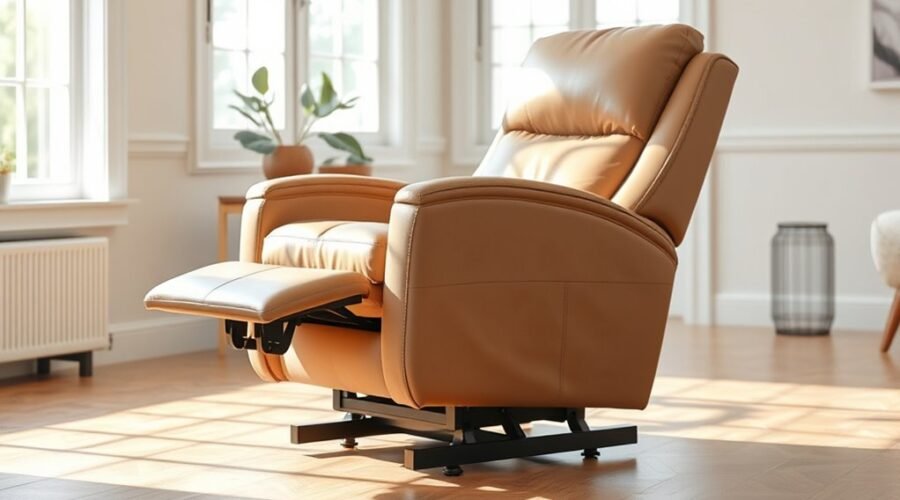
A glider recliner combines the forward-and-back motion of a glider with a reclining backrest and, on most models, an extending leg rest. Unlike a traditional rocking chair that tips through an arc on curved runners, a glider moves the seat relative to a more stationary base. The exact mechanism, swivel range, recline controls, and whether the chair can glide at every recline angle depend on the individual model.
Quick Answer
A glider recliner is an upholstered chair that combines a smooth forward-and-back gliding motion with a reclining backrest and leg rest. Some models also swivel or use power controls. It differs from a rocker because the chair glides through its base mechanism instead of tipping on curved runners.
Key Takeaways
- A glider recliner combines forward-and-back motion with an adjustable reclining backrest and leg rest.
- Gliding mechanisms vary by manufacturer, so not every model uses the same track, bearings, locking system, or range of motion.
- Manual, power, swivel, USB, adjustable-lumbar, and adjustable-headrest features are optional rather than standard.
- A traditional rocker tips through an arc on curved runners; a glider moves through a mechanism attached to its base.
- Before buying, check body fit, fully reclined dimensions, glide clearance, weight capacity, cleaning requirements, warranty, and moving-part safety.
What Is a Glider Recliner?
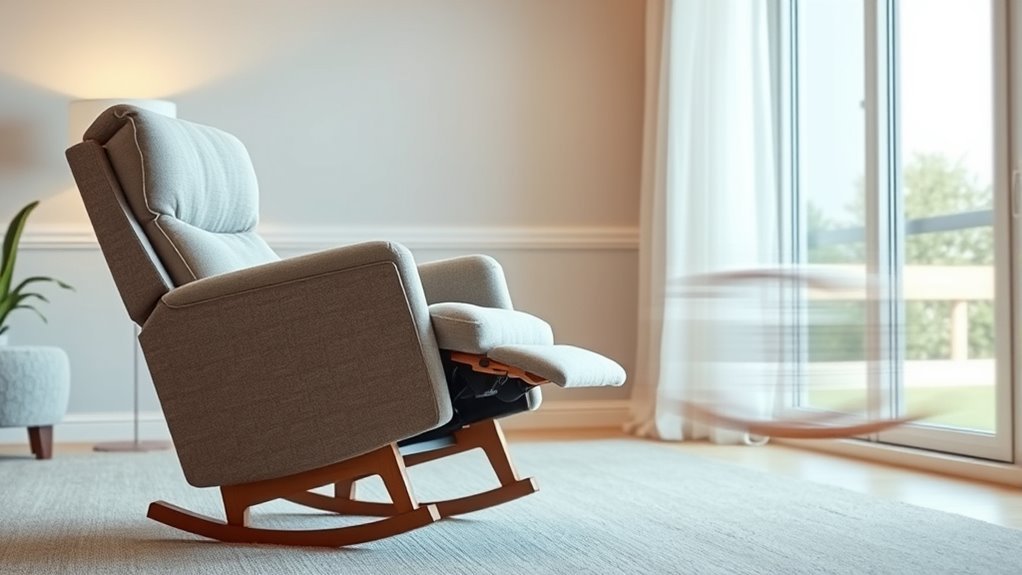
A glider recliner combines two separate chair functions: the controlled forward-and-back movement of a glider and the adjustable lounging position of a recliner. Depending on the model, you may also get a swivel base, power controls, an adjustable headrest or lumbar support, charging ports, or other convenience features.
The important point is that gliding, swiveling, rocking, and reclining are different functions. Manufacturers can combine several of them in one chair. For example, current La-Z-Boy swivel gliding recliners are designed to swivel, glide, and recline, while other chairs may glide and recline without swiveling.
Glider recliners are common in living rooms, bedrooms, reading areas, and nurseries because one chair can provide an upright seating position, rhythmic movement, and a leg-supported reclining position.
In short, this type of recliner blends motion, adjustable seating, and multiple-use comfort. The best choice depends less on the category name and more on how the specific chair fits your body and room.
How Does a Glider Recliner Work?
A glider recliner uses a mechanical assembly between the seat and its base to let the seated portion travel forward and backward without relying on the long curved runners found on a traditional rocking chair. The precise linkage, bearings, springs, frame, and travel path vary by manufacturer, so it is better to think of “glider” as a type of motion rather than one standardized internal mechanism.
| Feature | What it does |
|---|---|
| Gliding mechanism | Lets the seat move forward and backward relative to the base. |
| Reclining mechanism | Changes the backrest angle and usually raises a leg rest. |
| Swivel base | Allows rotation when that function is built into the model. |
| Manual or power control | Operates the recline through a handle, pull tab, push-back action, buttons, or an electric motor. |
Some chairs let the backrest recline independently from the leg rest. Others move the back and leg rest together. A power model may stop at many positions along its range, while a manual model may use a handle, pull control, or body pressure.
Note: Do not assume a chair will glide, swivel, or lock in exactly the same way when fully reclined. Motion can change as the backrest and leg rest move. Check the specific model’s manual and test the chair through its full operating range.
Optional features such as USB ports, adjustable lumbar support, power headrests, memory settings, or rechargeable battery packs can make a chair more convenient, but they are not part of the basic definition of a glider recliner.
Glider Recliner vs. Rocking Chair
Both chairs create forward-and-back movement, but they produce that movement differently. A traditional rocking chair rests on curved runners, so the whole chair tips forward and backward through an arc. A glider recliner uses a base-mounted mechanism that moves the seat forward and backward without depending on those curved floor runners.
A glider recliner also adds a reclining backrest and leg rest. A basic traditional rocker usually keeps a fixed backrest and has no integrated leg rest, although modern furniture categories overlap and manufacturers also sell rocker recliners.
| Feature | Glider Recliner | Traditional Rocking Chair | Stationary Recliner |
|---|---|---|---|
| Movement | Forward-and-back glide | Arcing rock on curved runners | No intentional rocking or gliding |
| Reclining back | Yes | Usually no | Yes |
| Integrated leg rest | Usually | Usually no | Usually |
| Swivel | Available on some models | Uncommon on traditional designs | Available on some models |
| Best reason to choose it | You want both rhythmic motion and recline | You prefer simple, traditional rocking | You want recline without continuous chair movement |
Neither type is automatically better. A glider recliner makes sense if you want both motion and a supported reclining position. A rocker is a simpler choice if you primarily want the familiar rocking sensation and do not need an integrated footrest.
Glider Recliner vs. Standard Recliner
A stationary recliner focuses on changing the backrest and leg-rest position while the chair base remains essentially fixed. A glider recliner adds a separate forward-and-back motion function.
The extra motion mechanism can add weight, moving parts, and cost. It also means you need to consider glide clearance in addition to normal recline clearance. On the other hand, that movement may be appealing if you enjoy rhythmic motion while reading, feeding a baby, talking, or relaxing.
Do not rely only on the product name. Furniture categories often overlap: a chair can be a swivel glider recliner, rocker recliner, power glider, or another combination. Look at the manufacturer specifications to see exactly which movements the chair performs.
Manual vs. Power Glider Recliners
Glider recliners can use either manual or power reclining systems. Manual models normally operate without electricity through a handle, pull tab, or push-back mechanism. Power models use an electric motor and buttons to change the seating position.
A manual chair avoids power cords and may have a simpler control system. A power chair can make small positioning changes easier and may add powered headrest or lumbar adjustments, but it needs an electrical source unless the model supports a compatible battery pack.
When considering power, check where the outlet is located, how the cord will be routed, what happens during a power outage, and whether USB or charging features operate only while the chair is connected to power.
Why Choose a Glider Recliner?
A glider recliner can be useful when you want one chair to provide both gentle movement and a supported lounging position. Instead of buying a separate upright glider and reclining chair, you get both functions in one piece of furniture.
The movement can be pleasant for reading, conversation, watching TV, feeding a baby, or simply changing position during a long sitting session. Reclining also gives you a way to raise your legs rather than keeping your feet on the floor.
Comfort, however, depends on fit. A chair is more likely to work well when your lower back contacts the backrest comfortably, the armrests let your shoulders stay relaxed, the seat supports your thighs without pressing hard behind your knees, and you can operate the leg rest and stand up without struggling.
Construction quality also varies widely. Rather than assuming every glider recliner is durable, compare the frame, mechanism warranty, upholstery warranty, weight limit, service options, customer-support availability, and return policy.
Where Does a Glider Recliner Work Best?
Glider recliners can work in nurseries, living rooms, bedrooms, reading areas, and multi-purpose rooms, but their moving parts require more planning than a stationary chair.
In a nursery, the gliding motion can be useful while feeding or soothing a baby. In a living room, the same chair can provide an upright conversation position and a reclined TV or reading position. In a bedroom or reading corner, it can serve as a dedicated chair without requiring a separate ottoman.
A glider recliner is not automatically a small-space chair. Some models are relatively compact, while others become much longer when the footrest and backrest are fully extended. Always compare the upright dimensions with the fully reclined or fully extended dimensions.
Warning: Keep children, pets, fingers, feet, loose clothing, toys, and other objects away from the leg rest, underside, base, and other moving gaps while operating a recliner. CPSC has documented entrapment, pinching, and crushing hazards involving recliners and glider recliners. Inspect the chair regularly and follow the manufacturer’s operating instructions.
Using a Glider Recliner in a Nursery
A glider recliner can provide a comfortable place for awake feeding, cuddling, reading, and soothing. Arm height, easy controls, a supportive backrest, quiet motion, washable upholstery, and an easy exit from the chair are particularly practical features for nursery use.
However, an upholstered recliner is not an infant sleep surface. The American Academy of Pediatrics advises parents and caregivers not to let babies sleep on couches or armchairs and warns against falling asleep in an armchair while holding a baby. After feeding or soothing, move the baby to an appropriate firm, flat sleep surface such as a compliant crib or bassinet. See the American Academy of Pediatrics safe-sleep guidance for current recommendations.
What to Look for in a Glider Recliner
When shopping for a glider recliner, compare body fit, movement, room clearance, controls, upholstery, weight capacity, and warranty rather than choosing solely by appearance.
Comfort and Support
For comfort and support, sit in the chair long enough to notice how your body rests instead of judging it after a few seconds.
Your lower back should make comfortable contact with the backrest without forcing you into a slouched position. The headrest should support you where you actually need it rather than pushing your head forward.
Check seat depth by sitting fully against the backrest. Your legs should feel supported without the front edge pressing sharply into the backs of your knees. Your feet should be able to rest securely when the chair is upright.
Armrest height matters too, especially for reading, feeding, or holding a baby. Your shoulders should remain relaxed rather than lifting toward your ears.
Finally, extend the leg rest completely. Make sure it supports your legs comfortably and does not stop at an awkward point.
Motion and Swivel Options
Test every movement the chair claims to provide. A smooth showroom glide does not tell you how the chair feels when partly reclined, fully reclined, or turned on its swivel base.
- Check the glide for unwanted scraping, binding, knocking, or sudden stops.
- Test the recline from upright to fully extended and back again.
- Check whether gliding changes or stops at different recline angles.
- If the chair swivels, confirm its rotation range and whether it has a stop or lock.
- Check whether manual controls can be reached comfortably while seated.
- On power models, test all buttons, headrest/lumbar functions, and charging ports.
Pro Tip: Test the chair while getting in and out as well as while sitting. A recliner that feels comfortable once you are settled may still be awkward if the footrest is difficult to close or you need excessive effort to stand.
Size and Room Fit
A glider recliner should fit your room in every operating position, not just when it is upright.
Published dimensions vary substantially. For example, Babyletto currently lists its Kiwi Electronic Recliner and Swivel Glider at 38 inches long, 29 inches wide, and 41 inches high, with a 64-inch fully reclined length. La-Z-Boy lists the Finley Swivel Gliding Recliner at 34 inches wide, 39 inches deep, and 43 inches high, with a 67-inch fully extended dimension. Those examples show why one “standard” recliner size is not reliable.
Before ordering, measure:
- The chair’s upright width, depth, and height.
- Its fully reclined or fully extended length.
- The manufacturer’s required wall clearance.
- Space in front for the leg rest.
- Additional room needed for the gliding travel.
- Swivel clearance if the chair rotates.
- Doorways, hallways, stair turns, and elevators along the delivery route.
A “wall-hugger” or “wall-away” reclining design can reduce rear clearance on some chairs, but do not assume that label applies to a glider recliner unless the manufacturer specifically says so.
Weight Capacity and Construction
Check the manufacturer’s stated maximum user weight rather than assuming that all recliners support the same load. Also check whether the warranty covers the frame, reclining mechanism, electrical components, upholstery, and labor for the same length of time.
If the chair will see daily use, pay attention to looseness in the arms, sideways movement in the seat, noises from the base, stitching quality, cushion recovery, and how easily replacement parts or service can be obtained.
Fabric, Cleaning, and Power Features
For a nursery or high-use living room, upholstery maintenance can matter as much as cushioning. Read the manufacturer’s cleaning code before buying. Some fabrics tolerate water-based spot cleaning, while others require solvent-based methods or professional care.
For power chairs, inspect the location of the transformer, cable, controls, and charging ports. Route cords where they will not become a trip hazard or interfere with the chair’s moving mechanism.
Safety and Compliance
For upholstered chairs sold in the United States, look for the permanent flammability-compliance labeling required for covered furniture under 16 CFR Part 1640. CPSC states that covered upholstered furniture manufactured, imported, or reupholstered on or after June 25, 2021 must meet the specified requirements, with the federal certification-label requirement applying to covered products manufactured, imported, or reupholstered on or after June 25, 2022.
Also check the CPSC recall database for the exact brand and model, especially when buying used furniture. A chair’s age, condition, missing parts, previous repairs, and mechanism wear can affect how safely it operates.
How Do You Test a Glider Recliner?
To test a glider recliner, start in the normal upright position and sit naturally with your back against the backrest. Check whether the seat depth, back height, lumbar contour, arm position, and foot position suit your body.
Next, glide forward and backward several times. The movement should feel predictable and controlled, without obvious grinding, binding, metal-on-metal scraping, or unexpected sideways looseness.
Then operate the recliner through its available range.
- Move from upright to partly reclined and fully reclined.
- Check how the glide behaves at each position.
- Open and close the leg rest several times.
- Check that your hands do not naturally fall near pinch points while using the controls.
- If the chair swivels, rotate it through its permitted range.
- Sit for several minutes to judge cushion firmness and pressure points.
- Stand up and sit down repeatedly to judge ease of entry and exit.
- Listen for unusual knocks, scraping, or motor strain.
If you are testing a floor model, remember that its cushions and mechanism may already have substantial use. A new chair may initially feel firmer, so ask the manufacturer or retailer about break-in expectations and the return policy.
Is a Glider Recliner Right for You?
A glider recliner is a strong candidate when you want both forward-and-back motion and a reclining leg-supported position in the same chair. It can suit reading, TV viewing, feeding a baby, conversation, or general relaxation.
It may be less appealing if you want the simplest possible mechanism, need a very lightweight chair, have extremely limited operating clearance, or prefer a completely stationary seat.
Before buying, compare the specific chair’s movement, fit, dimensions, weight limit, controls, upholstery care, warranty, and safety information. Those details matter more than whether the product description simply calls it a “glider recliner.”
Frequently Asked Questions
Which Is Better, a Rocker or a Glider?
Neither is universally better. Choose a glider if you prefer a controlled forward-and-back movement through a base mechanism. Choose a traditional rocker if you prefer the familiar arcing motion created by curved runners. If you also want an integrated leg rest and adjustable backrest, compare a glider recliner or rocker recliner rather than a basic chair.
Does a Glider Chair Move Back and Forth?
Yes. A glider moves forward and backward, but it does so through a gliding mechanism rather than tipping on curved floor runners like a traditional rocking chair. The movement path and amount of travel vary by model.
What Is the Main Difference Between a Glider Recliner and a Regular Recliner?
A glider recliner adds forward-and-back gliding movement to the reclining function. A basic stationary recliner changes the backrest and leg-rest position without intentionally gliding. Some modern chairs combine glide, swivel, rocking, and power functions, so always check the specifications for the exact model.
Can You Make a Glider Chair Not Glide?
Only if the chair is designed to let you do so. Some models include a manufacturer-provided glide lock or another approved method. Floor pads and furniture coasters can keep the base from sliding across the floor, but they generally do not disable the internal gliding mechanism. Do not block, remove, or modify moving parts unless the manufacturer specifically permits it, because doing so could damage the chair or affect its warranty and safety.
Can a Glider Recliner Glide While It Is Reclined?
It depends on the model. Some chairs retain some gliding movement in certain reclined positions, while other mechanisms limit, change, or stop the glide as the backrest or leg rest moves. Test the exact chair or consult its operating manual instead of assuming all glider recliners behave the same way.
Do All Glider Recliners Swivel?
No. Swiveling is a separate feature. Some glider recliners rotate through part or all of a circle, while others only glide and recline. Check the manufacturer’s specifications for swivel range and any locking or stopping mechanism.
Is a Glider Recliner Safe for a Nursery?
A properly assembled glider recliner can be used for awake feeding, cuddling, reading, and soothing, but moving mechanisms require supervision around children and pets. Keep fingers and bodies away from the footrest, underside, and other moving gaps. A recliner is also not a safe infant sleep surface; move a sleeping baby to an appropriate firm, flat sleep space.
Conclusion
A glider recliner combines reclining support with forward-and-back movement in one chair, making it a versatile option for living rooms, bedrooms, reading spaces, and nurseries. The category includes many different mechanisms, sizes, controls, and feature combinations, so do not assume two glider recliners will behave the same way.
For the best fit, test the glide and recline together, check your body position, measure the chair when fully extended, leave enough operating clearance, review the weight limit and warranty, and keep children and pets away from moving parts. Those checks will tell you far more than the product name alone.
Sources
- U.S. Consumer Product Safety Commission — Upholstered Furniture — federal upholstered-furniture flammability and labeling requirements.
- U.S. Consumer Product Safety Commission — Glider Recliner Recall — documented entrapment, pinching, and crushing hazards involving moving glider-recliner components.
- U.S. Consumer Product Safety Commission — 2026 Recliner Leg-Rest Entrapment Meeting Log — current work on child-entrapment test methods for recliners and other motion furniture.
- La-Z-Boy — Wynne Swivel Gliding Recliner — example of a current chair combining swivel, glide, and recline functions.
- Babyletto — Kiwi Electronic Recliner and Swivel Glider — current power-glider specifications, dimensions, weight limit, and optional-feature example.
- American Academy of Pediatrics — Safe Sleep Guidance — guidance against infant sleep on sofas and armchairs and against caregivers falling asleep there while holding a baby.