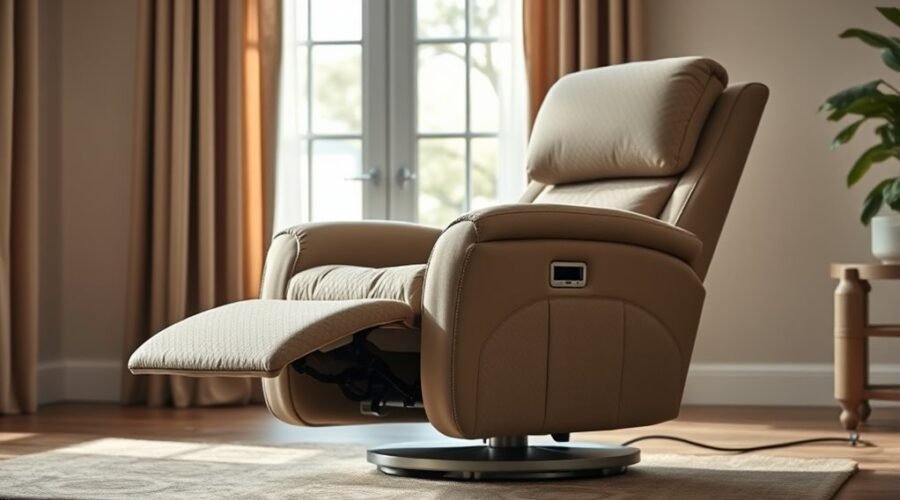
If you’re comparing seating options, a power recliner uses an electric mechanism to move the backrest, legrest, or other adjustable sections at the press of a button. The main advantage is controlled positioning with little physical effort. Features vary widely, though, so it helps to understand the motor system, controls, safety requirements, and differences from both manual recliners and power lift chairs.
Quick Answer
A power recliner is a reclining chair that uses an electric actuator or motorized mechanism instead of a manual lever or body pressure. Buttons, a control panel, or a handset move the reclining sections through their designed range. Some models also add powered headrests, lumbar adjustment, memory positions, USB charging, heat, massage, or battery backup.
Key Takeaways
- A power recliner uses an electric actuator and reclining linkage to move the chair with buttons or a handset.
- Powered adjustment usually allows more precise intermediate positioning than a basic manual recliner.
- Headrest, lumbar, memory, USB, heat, massage, wireless controls, and backup batteries are optional features rather than universal equipment.
- A standard power recliner reclines; a power lift recliner adds a seat-lift function designed to help raise the occupant toward standing.
- Powered models generally cost more and contain more electrical parts to maintain than comparable manual recliners.
- Before buying, check seat fit, weight capacity, fully reclined depth, wall clearance, outlet location, warranty coverage, and local service availability.
What Is a Power Recliner?
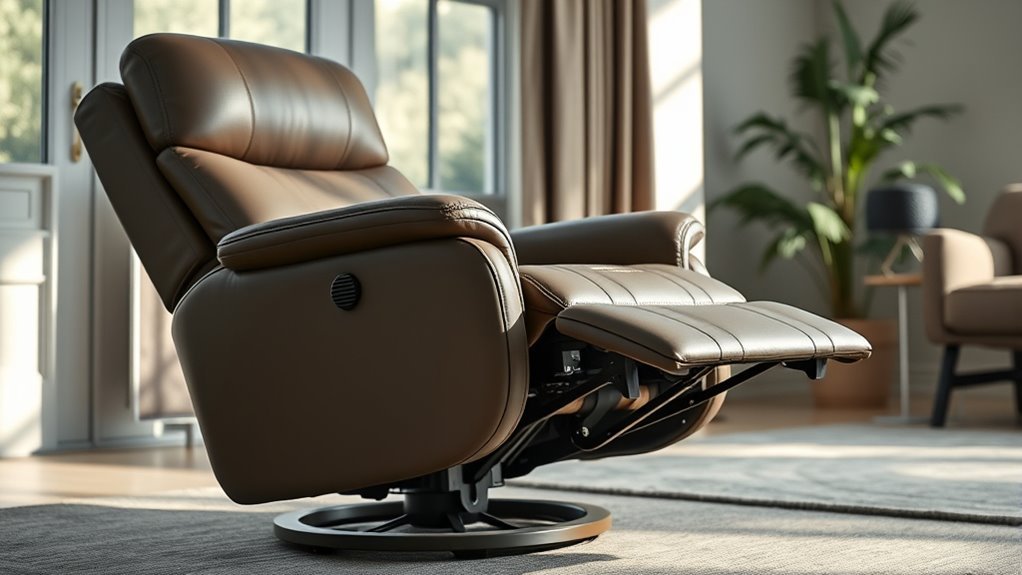
A power recliner is an electric reclining chair that uses one or more powered actuators to move the backrest, legrest, or other adjustable sections. Instead of pulling a lever or pushing against the chair with your body, you operate the mechanism with buttons, a side control panel, a wired handset, or, on some models, a wireless remote.
The main benefit is controlled adjustment. Many powered mechanisms can stop at numerous points within their designed travel, letting you make small changes to back angle or leg elevation instead of relying only on a few mechanical positions.
The defining feature of a power recliner is not a specific comfort position; it is powered, button-controlled adjustment through the chair’s designed reclining range.
Some models add independently powered headrests or lumbar sections. Others include USB charging, memory positions, heat, massage, cup holders, wireless controls, or rechargeable power options. These features vary by model and should not be assumed from the words “power recliner” alone.
Note: A standard power recliner and a power lift recliner are not the same thing. A regular powered recliner changes the reclining position. A lift-equipped chair additionally raises or tilts the seat to assist the occupant toward standing.
How a Power Recliner Motor Works
A power recliner converts electrical energy into controlled linear movement. In a common design, household power feeds a power supply, which provides the electricity required by one or more actuators beneath the chair. When you press a control, the actuator extends or retracts and moves the reclining linkage attached to the backrest, legrest, or another powered section.
The exact layout depends on the chair. A simpler design may coordinate the back and legrest through one powered reclining system. More advanced models can have separate powered functions for the back, legrest, headrest, lumbar area, or lift mechanism.
Main Power Recliner Components
- Power supply: Connects the chair’s electrical system to its approved power source.
- Actuator or motor assembly: Produces the force that moves an adjustable section.
- Reclining linkage: Transfers actuator movement to the backrest, legrest, or seat mechanism.
- Control system: Receives commands from buttons, a handset, control panel, or compatible wireless remote.
- Optional accessories: May include powered lumbar support, powered headrest, memory controls, USB charging, heat, massage, or backup power.
Because designs differ, there is no universal motor count, voltage, operating speed, or duty cycle for every power recliner. The owner’s manual is the correct source for the electrical specifications and operating limits of a particular model.
Single-Function and Multi-Function Power Recliners
A basic powered chair may move the backrest and legrest together. A more adjustable chair may let you move those sections separately. Additional actuators can control the headrest or lumbar area independently.
Independent adjustment can be useful when, for example, you want your legs elevated while keeping your upper body more upright for reading. The tradeoff is that additional powered sections add controls, wiring, connectors, and components that may eventually require service.
Power Recliner Controls
You will usually control a power recliner through buttons mounted on the chair or through a handset. Some models offer a wireless remote. The number of buttons depends on how many powered sections and convenience features the chair has.
Basic controls may simply extend and retract the reclining mechanism. More advanced controls can independently adjust the back, legrest, headrest, or lumbar section and may include memory or return-to-home functions.
Remote And Handset Types
A wired handset is connected physically to the chair and is common on lift chairs and some powered recliners. Other chairs place rocker switches or buttons on the outer arm. Selected models use wireless remotes.
A more advanced controller may operate several powered sections and save preferred positions. Some control panels or remote cradles also contain USB charging ports for small electronic devices.
Do not assume these functions are standard. Compare the actual control layout before buying, especially if the primary user needs large buttons, simple operation, or controls that can be reached without twisting.
One-Touch Position Adjustments
Some power recliners include memory buttons or a one-touch return function. These can automatically move the chair toward a saved or home position. Other chairs require you to hold the control while the mechanism moves.
This distinction matters for both convenience and safety, so check how the specific control system works rather than assuming every powered chair has automatic movement.
If a model includes powered headrest or lumbar adjustment, those functions may have separate buttons so you can fine-tune upper-back, neck, or lower-back support without changing the main reclining angle.
Power Recliner Vs. Manual Recliner
The central difference between a power recliner and a manual recliner is how the mechanism moves. A power model uses electrical components and controls. A manual chair relies on a lever, pull handle, push-back mechanism, or body pressure.
| Feature | Power Recliner | Manual Recliner |
| Operation | Electric actuator and buttons | Lever, handle, push-back action, or body pressure |
| Adjustment | Usually allows fine intermediate positioning | Depends on the mechanical design and may offer fewer stop points |
| Physical effort | Low button-operating effort | Requires some mechanical or body effort |
| Electricity | Required for normal powered operation unless an approved battery system is being used | Not required |
| Extra features | May include headrest, lumbar, memory, USB, heat, massage, or lift functions | Usually focused on basic reclining functions |
| Maintenance | Adds power supplies, switches, wiring, controls, and actuators | Mechanically simpler with no powered reclining components |
Control and Adjustability
Control is the strongest practical difference. A powered mechanism lets you make small position changes without pulling a lever or shifting your body against the chair.
This can be useful if you frequently change between reading, watching TV, resting, and sitting upright. It may also be easier to operate for someone who finds a manual lever or footrest difficult to move.
Manual recliners remain practical when you prefer mechanical simplicity, do not need fine adjustment, or want to place the chair without planning around a power source.
Cost and Maintenance
Power recliners generally cost more than comparable manual chairs because they add actuators, wiring, controls, power supplies, and sometimes additional powered features.
Those parts also create more potential service points. A manual recliner can have mechanical problems with handles, cables, springs, or linkages, while a powered chair can additionally develop issues with switches, handsets, connectors, power supplies, wiring, batteries, or actuators.
A powered mechanism does not automatically mean a chair will last longer or shorter. Overall durability also depends on the frame, mechanism quality, cushioning, upholstery, user weight, frequency of use, and whether the chair is operated within its specifications.
Before buying, read the warranty by component. Check how long the frame, reclining mechanism, electrical components, upholstery, and labor are covered and whether local warranty service is available.
How Power Recliners May Help With Back Comfort
If sitting in one position is uncomfortable, a power recliner may make it easier to change your posture or leg position in small increments. Models with supportive cushioning or adjustable lumbar sections can also help you find a position that feels more comfortable.
The important distinction is that powered adjustment is a comfort and positioning feature. It does not make the chair a treatment for back pain, and the best sitting position varies by person and by the cause of discomfort.
Good lower-back support and regular position changes are generally more important than simply reclining farther. Remaining in one position for a long period can still become uncomfortable even in a supportive chair.
Note: A power recliner is furniture, not medical treatment. If back pain is persistent, severe, worsening, or associated with concerning symptoms, get advice from an appropriate healthcare professional rather than relying on a chair to correct the problem.
If standing up is the main difficulty, look specifically for a power lift recliner. A standard powered reclining mechanism does not necessarily raise the seat or assist the transition toward standing.
How To Choose a Power Recliner
Choosing a power recliner involves more than testing whether the cushion feels soft. The chair must fit the user, fit the room, reach a suitable power source, and provide the adjustment features that will actually be used.
Check the Seat Fit
Sit in the chair in both upright and reclined positions. Your lower back should feel supported, your shoulders should not be forced forward, and the seat should not place uncomfortable pressure behind your knees.
Compare the seat height, seat depth, and seat width with the primary user’s body size. When the chair is upright, the user should be able to enter and exit it comfortably.
Check the Weight Capacity
Every chair has a specified occupant or seat-weight limit. Stay within the manufacturer’s rating. Using the chair above its stated capacity can place extra stress on the frame and reclining mechanism and may affect warranty coverage.
Measure the Room Before Buying
Measure more than the chair’s upright footprint. Check the manufacturer’s fully extended depth and required wall clearance, then make sure the legrest and back can move without hitting a wall, table, rug, or another piece of furniture.
Leave a clear route around the chair so the power cord does not cross a walking path or pass through a moving section of the mechanism.
Pro Tip: Mark the chair’s fully reclined footprint on the floor with painter’s tape before buying. This gives you a much better idea of real clearance than measuring only the upright dimensions.
Choose the Features You Will Use
Useful options can include independently powered back and leg sections, powered headrest, adjustable lumbar support, memory positions, USB charging, heat, massage, a lift function, wireless controls, or rechargeable power.
More features are not automatically better. Prioritize the functions the primary user will operate regularly and make sure the control layout is easy to understand and reach.
Check Power and Backup Options
Plan where the chair will receive power before delivery. Follow the specific manufacturer’s instructions for outlet connection, approved batteries, extension cords, adapters, power strips, and surge protection.
If outages are a concern, find out whether the chair includes a backup system, accepts an optional rechargeable battery pack, or has no backup provision at all. Also check exactly which functions remain available on backup power.
Compare Upholstery, Warranty, and Service
Choose upholstery based on feel, cleaning requirements, pets, children, heat, sunlight, and expected daily use. Leather and fabric can both be durable, but their maintenance requirements differ.
Finally, compare warranty coverage and parts availability. A power chair is easier to own long term when compatible controls, power supplies, and service support can be obtained if something eventually fails.
Power Recliner Care and Backup Power
Keeping a power recliner working properly means caring for both the upholstery and its electrical and mechanical components.
Vacuum fabric or remove surface dust as recommended for the upholstery type. Clean spills promptly using products and methods approved for the chair’s cleaning code. Do not automatically apply a fabric protector, leather conditioner, solvent, or household cleaner unless the upholstery manufacturer allows it.
Inspect accessible cords, plugs, power supplies, handset cables, and connectors periodically. A cord should not be stretched, pinched by the moving mechanism, trapped under the frame, or placed where people can trip over it.
Do not repeatedly run the mechanism beyond the duty cycle specified in the owner’s manual. Some actuator systems require a resting period after continuous operation, and those limits vary by product.
Warning: Recliners contain moving linkages and pinch or entrapment areas. Keep children, pets, fingers, hands, clothing, cords, and other objects clear of the mechanism before moving the chair. Stop using the chair if a power cord, control, connector, frame, or mechanism is visibly damaged.
What to Do if a Power Recliner Stops Working
If the recliner suddenly stops moving, begin with simple external checks rather than assuming the motor has failed.
- Stop operating the chair and make sure nobody is near the moving mechanism.
- Check for an obstruction around the legrest, back, linkage, rug, or nearby furniture.
- Check the power source and confirm that the outlet supplying the chair is working.
- Inspect accessible connections between the outlet, power supply, chair, and handset. Do not continue using visibly damaged wiring.
- Check the controls. A wireless remote may need batteries, while a wired controller may have a loose accessible connection.
- Follow the model’s reset procedure if the manufacturer’s manual provides one.
- Arrange service if the problem remains. Do not open a sealed power supply, actuator, or motor assembly unless the manufacturer specifically instructs the owner to do so.
If the legrest stops while closing, do not force it. Look for an obstruction and follow the manufacturer’s instructions before continuing operation.
What Battery Backup Can and Cannot Do
Battery backup is not standardized across power recliners. On some models, small backup batteries are intended mainly to return a reclined chair toward its upright or closed position during an outage. They may not support normal reclining or accessories such as USB charging.
Other furniture can use a rechargeable battery pack that supports cordless operation for a limited period. If backup power matters to you, verify the exact functions, battery type, replacement schedule, charging procedure, and expected behavior in the owner’s manual.
Frequently Asked Questions
Do Power Recliners Have to Be Plugged In?
Most power recliners need an approved electrical power source for normal operation. Depending on the model, that may mean a direct household connection through the supplied power adapter. Some chairs can also use an optional rechargeable battery system. Follow the manufacturer’s instructions for power strips, surge protectors, extension cords, batteries, and adapters rather than assuming they are permitted.
What Are the Disadvantages of Power Recliners?
The main disadvantages are higher purchase cost, dependence on electrical components, additional wiring and controls, and more potential service points than a simple manual mechanism. Placement also requires planning for the power source and reclining clearance. Powered furniture can be heavier as well, which may matter when moving or rearranging a room.
How Does a Power Recliner Work?
When you press a control, the chair’s electrical system activates an actuator. The actuator extends or retracts and moves a linkage connected to the backrest, legrest, or another powered section. Releasing the control usually stops movement, although some models also have automatic home or memory functions. Multi-function chairs can use separate actuators for different adjustable sections.
Is It Better to Get a Power or Manual Recliner?
It depends on how the chair will be used. A power recliner offers low-effort adjustment and usually finer positioning, while a manual recliner avoids electrical dependence and has a simpler mechanism. Compare seat comfort, control effort, room placement, features, maintenance expectations, and budget rather than choosing only by the reclining mechanism.
What Happens to a Power Recliner if the Electricity Goes Out?
A chair without backup power normally stops moving until power returns. Some models have batteries intended to move the chair toward an upright position during an outage, while others can run from an optional rechargeable battery pack. Backup capability varies, so check the instructions for the exact model before depending on it.
Is a Power Recliner the Same as a Power Lift Chair?
No. A power recliner uses electricity to adjust its reclining position. A power lift chair adds a mechanism that raises or tilts the seat to help move the occupant toward a standing position. Some lift chairs also function as full-featured power recliners, but an ordinary power recliner does not automatically include lift assistance.
Conclusion
A power recliner gives you button-controlled adjustment without requiring the physical effort of a manual reclining mechanism. Its real advantages are fine positioning and the ability to add features such as independently powered sections, headrest or lumbar adjustment, memory controls, USB charging, and backup power.
The best model is not simply the one with the most motors or features. It is the chair that fits the user’s body, room, weight requirements, preferred controls, and service expectations. Measure the fully reclined space, plan the power connection, check the warranty, keep the moving mechanism clear, and confirm whether any battery system actually provides the outage protection you need.
Sources
- La-Z-Boy PowerRecline Operating Instructions — power supply, motor connections, controls, USB charging, backup-battery behavior, placement, troubleshooting, and electrical safety.
- U.S. Consumer Product Safety Commission — recliner moving-part and child-entrapment safety information.
- MedlinePlus Guide to Good Posture — lower-back support, sitting posture, and the importance of changing sitting positions.
- U.S. Food and Drug Administration medical-device records — distinction between electrically powered positioning/lift chairs and ordinary reclining functions.