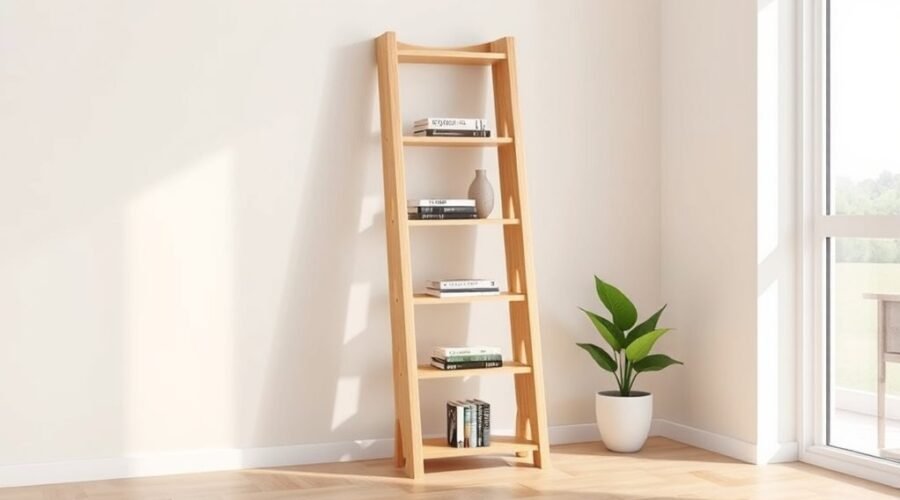
A ladder bookcase is a tall, open shelving unit with a ladder-inspired frame and shelves arranged vertically. Depending on the design, it may lean against a wall, attach directly to the wall, or stand on its own with a ladder-shaped profile. Its narrow footprint makes it useful for books, plants, framed art, baskets, and decor, but dimensions, shelf spacing, and weight limits vary by model.
Quick Answer
A ladder bookcase is an open vertical shelving unit with a ladder-like frame. Some models lean, some mount to the wall, and others are freestanding. They work well where you want useful storage without the visual bulk of a box-style bookcase. Always check the specific shelf dimensions, load limits, and wall-anchoring instructions before use.
Key Takeaways
- A ladder bookcase uses a ladder-inspired vertical frame with multiple shelves for books, decor, plants, baskets, and other household items.
- Designs may be leaning, wall-mounted, or freestanding, so not every ladder bookcase relies on the wall in the same way.
- Shelf width, depth, spacing, thickness, and weight capacity are product-specific rather than universal.
- Common construction includes solid wood, engineered wood, metal, or mixed wood-and-metal designs.
- For safety, follow the manufacturer’s anti-tip instructions, keep heavier items lower, and securely anchor furniture when required or recommended.
What Is a Ladder Bookcase?
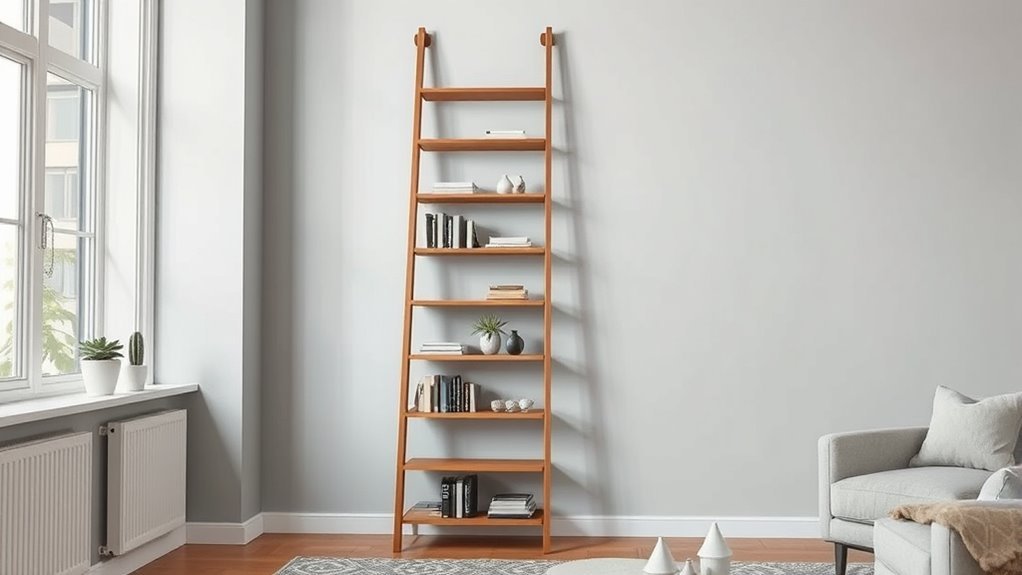
A ladder bookcase is a vertical shelving unit whose frame resembles a ladder. The shelves form a tiered display for books, plants, framed photos, storage baskets, and decorative objects.
Its open profile can make a room feel less visually crowded than a solid-sided cabinet. That makes ladder shelving especially useful in smaller living areas, bedrooms, offices, reading corners, and narrow wall spaces where floor area matters.
The exact shape varies. Some designs use progressively deeper shelves toward the bottom, while others use shelves of equal width or depth. You will also find wall-mounted models with fixed shelves and freestanding units whose frames simply borrow the ladder look.
“Ladder bookcase” describes a style of shelving, not one standardized set of dimensions or construction rules.
That variety is important when shopping. Instead of assuming every ladder bookcase has the same shelf depth, spacing, or load capacity, compare the manufacturer’s measurements and instructions for the exact model you are considering.
Types of Ladder Bookcases
Ladder bookcases generally fall into three construction styles. Knowing which type you have affects placement, assembly, and anchoring.
Leaning Ladder Bookcases
A traditional leaning ladder bookcase has angled uprights that rest against or approach the wall while the feet remain farther out on the floor. The shelves may become shallower toward the top, creating the classic tapered ladder shape.
A leaning appearance does not mean the unit should simply be placed against a wall and left unsecured. Follow the manufacturer’s instructions for any supplied brackets, straps, or anti-tip hardware.
Wall-Mounted Ladder Bookcases
A wall-mounted ladder bookcase uses the wall connection as an intentional part of the installation. Current designs such as the Nathan James Theo 5-Shelf Ladder Bookshelf use fixed shelves and a wall-mounted frame.
This style can create a streamlined look because the upper frame is secured rather than merely leaning loosely against the wall.
Freestanding Ladder-Style Bookcases
Some shelves stand independently but use angled sides, stepped tiers, or an A-frame shape to create a ladder-inspired appearance. These can be moved like conventional furniture, although tall or narrow units may still include an anti-tip restraint.
Note: Product names are not perfectly standardized. Retailers may use “ladder shelf,” “ladder bookshelf,” “etagere,” and “ladder bookcase” for overlapping designs, so check the construction and installation instructions rather than relying on the name alone.
Main Parts of a Ladder Bookcase
The exact parts depend on the design, but most ladder bookcases combine a frame, multiple shelves, hardware, and some form of bracing or wall connection.
Uprights and Support Rails
Two uprights commonly form the sides or backbone of a ladder bookcase. On leaning models they may be angled, while wall-mounted or freestanding models can use straighter frames.
Horizontal rails, brackets, bolts, shelf supports, or welded metal sections connect the frame and support the shelves. Some designs also include cross-bracing or back supports that reduce side-to-side movement.
Wood can create a warm furniture look, while powder-coated steel or other metal frames give the unit a slimmer industrial or contemporary profile. Mixed designs often combine an engineered-wood shelf surface with a metal frame.
Tiered Shelves and Trim
The shelves create the usable storage and display area. On some classic leaning designs, lower shelves are deeper than the shelves above them. On other ladder bookcases, the shelves are the same width and depth from top to bottom.
Shelf spacing may also be fixed or adjustable. Fixed shelves are common because they can form part of the structure. Adjustable designs provide more flexibility for tall objects, but you should only reposition shelves where the manufacturer allows it.
Wooden shelves may use solid wood, plywood, MDF, particleboard, veneer, laminate, or painted engineered wood. Edge trim can hide exposed sheet-material edges and give the shelf a cleaner finished appearance.
How Ladder Bookcase Shelves Are Sized
There is no single standard ladder-bookcase shelf size. Width, depth, spacing, thickness, number of tiers, and load capacity all depend on the individual design.
For example, the current Nathan James Theo 5-Shelf model lists a width of 23.6 inches, shelf spacing of 11.6 inches, fixed shelves, and a manufacturer-rated limit of 50 lb per shelf. Those numbers are useful as a real-world example, but they should not be treated as universal ladder-bookcase dimensions.
| Measurement | Why It Matters |
|---|---|
| Overall width | Determines whether the unit fits the available wall space. |
| Overall depth | Shows how far the feet or shelves project into the room. |
| Usable shelf depth | Determines whether books, baskets, plants, or decor will sit fully on the shelf. |
| Vertical spacing | Controls the height of objects that fit between tiers. |
| Per-shelf load limit | Tells you how much weight the manufacturer allows on an individual tier. |
| Total load limit | Prevents the combined load from exceeding the frame or mounting system’s rating. |
The lower tiers are often convenient for larger books or baskets because they may be deeper and keep heavier loads closer to the floor. Upper shelves are usually better for lighter decor, especially on tapered designs.
Pro Tip: Measure the actual usable shelf surface, not just the overall width of the bookcase. Frames, side rails, and angled uprights can reduce the space available for books or storage bins.
Common Ladder Bookcase Materials
Ladder bookcases are commonly made from solid wood, plywood, engineered wood, metal, or mixed materials. Material affects appearance, maintenance, weight, and how the unit responds to moisture or wear, but material alone does not tell you how much weight a shelf can safely hold.
Wood and Metal Choices
Solid wood such as pine, oak, walnut, rubberwood, or similar species can give the bookcase a warm furniture-like appearance. Plywood and engineered wood provide a more uniform surface and are often finished with veneer, laminate, or paint.
Steel and iron frames can create a thinner visual profile and are common in industrial and contemporary ladder shelves. Mixed designs pair wood or engineered-wood shelves with metal frames to combine texture with a slim structure.
Do not choose between wood and metal based on an assumed weight capacity. Shelf span, board construction, fasteners, frame geometry, wall mounting, and overall engineering all affect the final rating. Use the specific manufacturer’s published load limit instead.
Finish and Durability
Finish affects both appearance and day-to-day maintenance. Common finishes include paint, stain, clear coating, laminate, veneer, and powder coating on metal components.
- Solid wood can be durable and may allow refinishing depending on the coating.
- Engineered wood can offer a smooth, affordable surface but should generally be protected from prolonged moisture.
- Metal frames can provide a slim, rigid structure, although scratches or damaged coatings may expose the underlying metal.
- Glass shelves, where used, create a lighter visual effect but require careful handling and must be used within the manufacturer’s stated load limits.
For maintenance, use the cleaning method specified for the finish. Avoid soaking engineered-wood surfaces, clean spills promptly, and periodically inspect hardware and mounting points.
How to Choose and Measure a Ladder Bookcase
Before buying a ladder bookcase, measure the room and decide what you actually plan to store. A shelf that looks narrow in a product photo can project farther into a walkway than expected once its angled feet are included.
- Measure available wall width. Leave enough space beside trim, doors, curtains, switches, and nearby furniture.
- Check overall height. Confirm there is clearance below ceilings, wall art, lights, and molding.
- Measure floor depth. Use the bookcase’s maximum depth or foot projection, not only the shelf depth.
- Account for baseboards. A thick baseboard can prevent a frame from sitting in the position intended by the manufacturer.
- Check shelf dimensions. Make sure your books, baskets, plants, or equipment fit the usable shelf surface.
- Read the load ratings. Check both per-shelf and total limits where provided.
- Check the anchoring method. Determine whether the unit requires screws, brackets, straps, or another wall connection and whether the supplied hardware is appropriate for your wall.
- Check nearby obstacles. Keep the unit clear of vents, frequently used outlets, door swings, and wet or high-heat areas.
When planning multiple units on one wall, measure the combined width before ordering. Nathan James, for example, advises measuring the wall and dividing by the bookshelf width when planning side-by-side units.
How to Keep a Ladder Bookcase Stable
Start with the manufacturer’s assembly and installation instructions. Build the unit on a level surface, tighten connections as directed, and install every required wall bracket, strap, or anti-tip component.
Warning: Unsecured furniture can tip over. The U.S. Consumer Product Safety Commission recommends anchoring furniture such as bookcases securely to the wall. Follow the manufacturer’s instructions and use hardware suitable for the wall construction. Keep children from climbing on shelves and place heavier objects on lower tiers.
The U.S. Consumer Product Safety Commission’s Anchor It! guidance specifically identifies unsecured furniture as a tip-over hazard and recommends securing furniture properly.
Use weight distribution to improve stability: put heavier books and objects on lower shelves and lighter decor higher up. Avoid loading one side much more heavily than the other.
Non-slip furniture pads or floor protectors can help prevent sliding and protect flooring, but they are not a substitute for an anti-tip restraint when the manufacturer calls for wall attachment.
Do not exceed stated shelf capacities, sit or climb on the shelves, or place heavy objects where children may be tempted to climb for them. CPSC also recommends keeping tempting items away from high furniture surfaces in homes where children are present.
Recheck fasteners and the wall connection after moving the bookcase and during routine maintenance.
Ladder Bookcase vs. Traditional Bookcase
A ladder bookcase and a traditional bookcase provide vertical storage, but their shapes and intended uses often differ.
| Feature | Ladder Bookcase | Traditional Bookcase |
|---|---|---|
| Profile | Usually open, narrow, angled, stepped, or ladder-inspired. | Usually rectangular with straight vertical sides. |
| Shelf layout | May use different shelf depths or a tapered frame. | Often uses shelves with similar depth from top to bottom. |
| Installation | Can be leaning, wall-mounted, or freestanding. | Often freestanding, although wall anchoring may still be recommended. |
| Best use | Mixed books, plants, baskets, and decorative display. | Often better suited to continuous rows of books or denser storage, depending on its load rating. |
| Visual effect | Open and visually light. | More substantial and furniture-like. |
Neither design is automatically stronger. If you plan to store many heavy books, compare shelf span, construction, anchoring, and manufacturer-rated capacity instead of choosing based only on the shape.
Popular Ladder Bookcase Styles
Ladder bookcases come in several styles, so you can match the shelving to the rest of the room rather than treating it purely as storage.
Classic wooden designs use stained or painted frames for a warm, traditional, farmhouse, Scandinavian, or mid-century look.
Industrial designs commonly combine dark metal frames with wood-look shelves. Their thin frames work well in contemporary rooms, offices, and open-plan spaces.
Wall-mounted ladder shelves create a cleaner profile by fixing the upper frame to the wall. Some models can also be installed side by side to create a wider storage wall.
Multi-tiered designs provide four, five, six, or more levels, while hybrid versions may combine open shelves with drawers, doors, cabinets, or baskets for concealed storage.
The familiar angled ladder form can work particularly well where you want vertical storage without a visually heavy cabinet.
How to Style a Ladder Bookcase
Styling a ladder bookcase works best when you balance useful storage with open space. Start with the items you actually need to store, then add decorative pieces rather than filling every available surface.
- Place heavier books, baskets, and larger objects on the lower shelves.
- Stack some books vertically and others horizontally to vary the arrangement.
- Put larger decorative objects behind or beside smaller pieces to create depth.
- Repeat a few colors, materials, or shapes from shelf to shelf so the display feels connected.
- Leave open areas instead of filling every gap.
- Keep especially fragile or valuable objects away from shelf edges.
You can mix books with vases, framed art, plants, ornaments, boxes, or collectibles. Varying heights and textures keeps the display interesting without making it look crowded.
If the unit has progressively deeper lower shelves, use those larger surfaces for baskets, bigger books, or substantial decor and reserve shallower upper tiers for smaller objects.
Best Rooms for a Ladder Bookcase
Because ladder bookcases emphasize vertical storage, they work particularly well in rooms where you want shelving without a large solid cabinet.
In a living room, a ladder bookcase can hold books, framed photographs, ceramics, small plants, and decorative objects while leaving more of the wall visible.
In a home office, it can organize books, stationery, storage boxes, folders, and light equipment without crowding the desk.
In a bedroom, shelves can hold books, photos, baskets, and personal items while using relatively little wall width.
In a kitchen or dining area, a suitable model can hold cookbooks, bowls, containers, or serving pieces. Keep furniture away from excessive heat, splashes, and moisture unless the manufacturer specifically rates the materials for those conditions.
A hallway or landing can also work if there is enough walking clearance. Measure the bookcase’s deepest point before placing it in a narrow route.
The best location is one where the unit can stand or mount exactly as intended, remain clear of traffic, and be securely anchored where required.
Care and Maintenance
Routine maintenance helps a ladder bookcase remain stable and keeps its finish looking better.
- Dust regularly with a soft cloth.
- Clean spills promptly, especially on engineered wood or unfinished wood edges.
- Avoid excess moisture unless the manufacturer’s care instructions specifically permit it.
- Avoid harsh or abrasive cleaners on painted, laminated, veneered, or coated surfaces unless approved by the manufacturer.
- Inspect screws, bolts, brackets, and shelf connections periodically and re-tighten them when the instructions permit.
- Check the wall anchor or anti-tip restraint after moving the unit or if the bookcase begins to wobble.
- Do not drag a loaded bookcase. Remove the contents before moving it and reinstall any required anchoring hardware afterward.
Current care instructions for the Nathan James Theo, for example, recommend wiping spills promptly, limiting excess moisture, and periodically inspecting and re-tightening hardware connections.
Frequently Asked Questions
Are ladder bookshelves worth it?
A ladder bookshelf can be worth it when you want open vertical storage, a relatively light visual profile, and space for a mix of books and decor. It may be less suitable if you need very deep shelves or dense storage for a large collection of heavy books. Compare dimensions, shelf capacity, anchoring requirements, and construction before buying.
How do you assemble a ladder bookshelf?
Follow the instructions supplied with the exact model because frame connections and wall hardware vary. In general, unpack and identify the parts, assemble the frame on a clean level surface, attach the shelves in the specified order, square and tighten the frame as directed, position the unit, and install the required wall or anti-tip hardware. Assembly time varies; one current Nathan James Theo model lists about 35 minutes.
Are ladder shelves outdated?
Ladder shelves are not tied to one decorating period. Current versions are sold in wood, painted, industrial metal-and-wood, minimalist, wall-mounted, and mixed-storage designs. Whether one looks current depends more on its finish, proportions, styling, and surrounding room than on the ladder format itself.
What is the difference between a ladder shelf and a bookcase?
The terms overlap. A ladder shelf describes shelving with a ladder-inspired frame, while “bookcase” is a broader term for furniture designed to hold books and other items. A ladder bookcase is therefore a type of bookcase or shelving unit. Unlike a conventional rectangular bookcase, it may use angled sides, stepped shelf depths, or wall-mounted rails.
Does a ladder bookcase need to be anchored to the wall?
Follow the manufacturer’s instructions for the specific unit. Many ladder bookcases include or require wall-mounting or anti-tip hardware. The U.S. Consumer Product Safety Commission recommends anchoring bookcases and other furniture securely to the wall to reduce tip-over hazards, particularly in homes where children may climb on furniture.
How much weight can a ladder bookcase hold?
There is no universal ladder-bookcase weight limit. Capacity depends on the shelves, frame, span, fasteners, mounting system, and overall design. Check the manufacturer’s per-shelf and total load ratings. As one current example, Nathan James lists a 50 lb per-shelf limit for its Theo 5-Shelf model, but that rating should not be applied to other bookcases.
Conclusion
A ladder bookcase combines vertical storage with an open, ladder-inspired profile that can work well in living rooms, bedrooms, offices, kitchens, reading corners, and other compact spaces. Designs range from leaning shelves to wall-mounted and freestanding frames, so measurements and installation requirements vary considerably.
Choose a model by checking its actual dimensions, usable shelf space, manufacturer-rated load limits, materials, and anchoring instructions. Place heavier items lower, keep the unit within its stated capacity, and secure it as directed. With the right fit and installation, a ladder bookcase can provide practical storage without the visual bulk of a conventional cabinet-style bookcase.
Sources
- U.S. Consumer Product Safety Commission — Anchor It! — furniture tip-over prevention and wall-anchoring guidance.
- U.S. Consumer Product Safety Commission — 2026 furniture tip-over safety reminder — anchoring furniture and keeping heavier items lower.
- Nathan James — Theo 5-Shelf Ladder Bookshelf — current example of ladder-bookcase dimensions, fixed shelf spacing, materials, load capacity, assembly estimate, and care guidance.
- Nathan James — Theo assembly instructions — model-specific installation and assembly documentation.