A bowing IKEA BILLY bookcase shelf usually points to too much sustained weight, a damaged shelf or support point, or a shelf that has gradually deflected under load. For the current U.S. 31½-inch-wide BILLY, IKEA lists a maximum load of 66 lb per shelf, but older, narrower, and regional versions can differ. Reinforcement works best after the shelf is unloaded, inspected, and the bookcase is securely anchored to the wall.
Quick Answer
To reinforce a bowing IKEA BILLY bookcase, first unload the shelf and confirm the bookcase is anchored to the wall. Reseat the shelf pins, reduce the load, and add a rigid hardwood front-edge stiffener or center support if needed. Replace shelves that are cracked, swollen, or permanently deformed.
Key Takeaways
- The current 31½-inch BILLY is rated by IKEA for a maximum of 66 lb per shelf; check your exact model before relying on that figure.
- A shelf can bow even below its maximum rating when weight is concentrated near the middle or the shelf has already been weakened.
- Front-edge stiffening, a properly supported midpoint, or a stronger replacement shelf can reduce future deflection.
- Cracked, swollen, delaminated, or badly deformed particleboard should usually be replaced rather than reinforced.
- Shelf reinforcement does not replace the bookcase’s required anti-tip wall anchoring.
At a Glance
| Time Required | About 30–90 minutes for inspection and basic reinforcement, plus any adhesive curing time |
| Difficulty | Beginner to intermediate, depending on the reinforcement method |
| Tools Needed | Tape measure, level, screwdriver or drill/driver; clamps and a saw if adding a custom hardwood stiffener |
| Cost | Varies by repair; a simple stiffener or support uses fewer materials than a custom replacement shelf |
Warning: Unload the bookcase before repairing it. IKEA states that the BILLY must be securely anchored to the wall because of tip-over risk. Use wall fasteners appropriate for your wall construction, and seek professional advice if you are unsure how to anchor it safely. Shelf reinforcement is not a substitute for the anti-tip attachment.
Why Your BILLY Bookcase Is Bowing
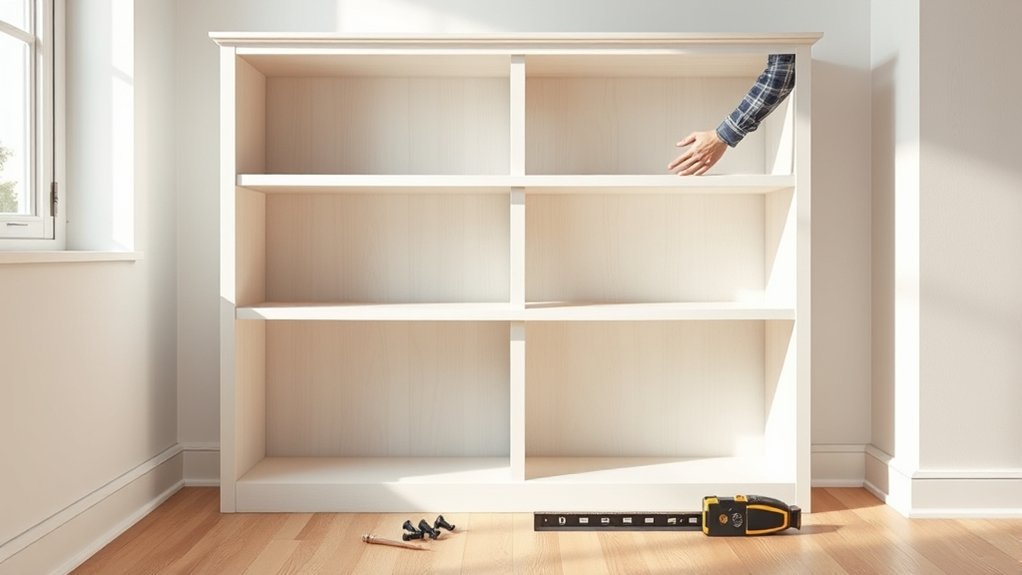
A BILLY shelf can bow when the load produces more long-term deflection than the shelf can resist. The amount of sag depends on several factors, including the shelf material, span, thickness, total weight, where that weight sits, and whether the shelf has any stiffening at its edges.
The current U.S. 31½-inch-wide BILLY uses particleboard for its main components and lists a maximum load of 66 lb per shelf. The current compatible extra shelf is about 29⅞ inches wide, 10¼ inches deep, and 1 inch thick. Those figures are model-specific, so check your own BILLY before using them as a limit.
Weight distribution also matters. A row of heavy books concentrated near the middle can create more visible deflection than the same total weight distributed closer to the supported ends. The WoodBin Sagulator, a shelf-deflection calculator, demonstrates how material, span, load distribution, shelf thickness, attachment, and edge stiffening all affect sag.
Loose or poorly seated shelf pins can also allow one corner or edge to sit lower than the others. Damaged pin holes, a cabinet that is out of square, or water-swollen particleboard can make the problem worse.
Note: The lower shelves are not automatically weaker than the upper shelves. They often appear to bow first simply because people tend to store heavier books and objects lower in the bookcase.
Unload and Inspect the Shelf Before Reinforcing It
Remove all books and objects from the bowed shelf before making any adjustment. This lets you see whether the shelf springs back toward flat or remains permanently deformed.
- Remove the affected shelf and place it on a flat surface.
- Check both faces and all edges for cracks, swelling, crushed areas, peeling foil, or separation of the particleboard.
- Inspect every shelf pin and the holes in the side panels. The pins should sit fully and evenly without excessive movement.
- Check the bookcase with a level and make sure the cabinet is not leaning or twisted.
- Confirm the back panel and other assembly components are installed as intended for your version.
- Confirm that the bookcase itself is securely attached to the wall before loading it again.
If the shelf is cracked, badly swollen, crumbling around an edge, or no longer rests securely on its supports, replacement is safer than adding more load to the damaged panel.
Add Center Support to a Bowing Shelf When Needed
A center support can reduce midspan sag by shortening the unsupported distance between bearing points. It is an option when a shelf remains structurally sound but continues to deflect under the intended load.
For a BILLY, do not treat a generic “36-inch rule” as a manufacturer requirement. The current 31½-inch BILLY shelf spans less than 30 inches, and IKEA does not specify a universal midpoint-bracket requirement for it. Whether extra support is useful depends on the actual shelf, load, and condition.
One practical approach is a rigid vertical support beneath the middle of the shelf, extending down to a solid bearing surface below. Another option is a properly installed bracket that reaches a structural support behind the bookcase. If a wall-mounted bracket is used, it must not rely only on the thin back panel for strength.
Do not confuse this shelf support with the bookcase’s anti-tip restraint. The entire BILLY still needs to be anchored according to IKEA’s instructions.
Pro Tip: Before adding hardware, reduce the load and move the heaviest books closer to the shelf’s supported ends or directly over an added center support. A better load path may solve mild sag without a more invasive modification.
Reinforce the Shelf Front for Heavy Books
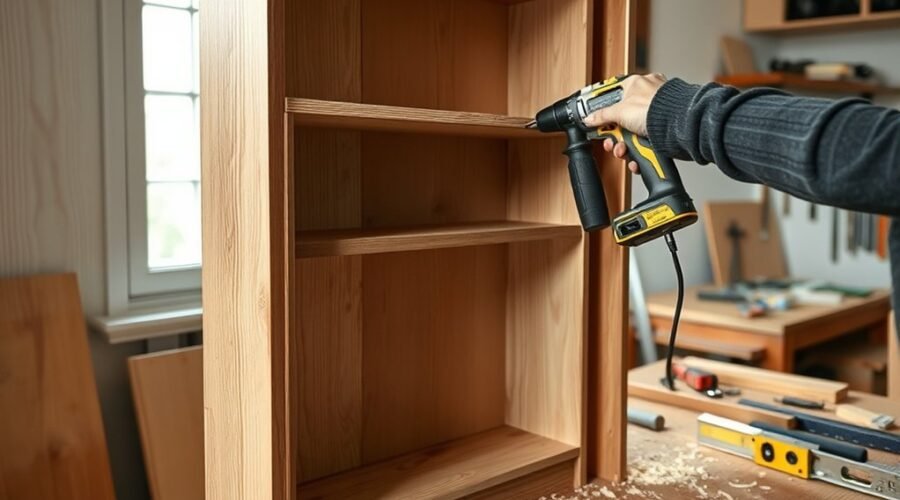
Another effective way to resist sag is to stiffen the shelf’s front edge. A solid hardwood strip attached along the underside of the front edge acts like a deeper beam and can make the shelf harder to bend.
The stiffener should run across most or all of the shelf width and sit straight against the shelf. Its exact dimensions depend on the shelf, available clearance, material, and desired stiffness; there is no IKEA rule requiring a particular 1-inch, 1½-inch, or ¾-inch strip.
- Unload and remove the shelf.
- Measure the shelf width accurately.
- Cut a straight hardwood stiffener to fit without interfering with the side panels or shelf pins.
- Dry-fit it under the front edge and confirm that the shelf can still be installed normally.
- Use an adhesive appropriate for the materials involved and clamp the stiffener straight while the adhesive cures according to its instructions.
- Reinstall the shelf only after the joint has fully cured.
A deeper vertical stiffener generally resists bending more effectively than a very thin decorative edging strip. The WoodBin shelf-deflection model also allows an edging strip to be included when estimating sag, illustrating why edge reinforcement can improve stiffness.
Routing a deep groove into a current particleboard BILLY shelf to bury steel is a more invasive modification and can remove material from the panel. If much more capacity is required, a properly made replacement shelf is usually a cleaner solution than cutting deeply into weakened particleboard.
Check Shelf Pins and Side Panels
Shelf pins should be inspected before more reinforcement is added. A pin that is not fully seated can let one side of a shelf drop, making ordinary deflection look worse.
Remove the shelf and confirm that all four supports are the correct type, inserted to the same depth, and sitting at matching heights. Replace damaged or missing supports with parts suitable for the exact bookcase version.
Next, examine the side panels for loose joints, enlarged shelf-pin holes, cracking, swelling, or movement. Tighten normal assembly fasteners only as required by the furniture’s assembly system. Avoid overtightening fasteners in particleboard, because crushed material will not become stronger by applying more torque.
Place a level across the top and shelves after reassembly. If the case is leaning, rocking, or visibly out of square, correct the assembly and wall anchoring before judging whether an individual shelf needs reinforcement.
If a shelf-pin hole is badly enlarged or the surrounding particleboard is breaking apart, simply installing a stronger shelf will not correct the damaged support point.
Replace Bowed Shelves for More Support
A shelf that remains noticeably bowed after it has been unloaded may have taken a permanent set. Replacement is generally the better choice when the shelf also has cracks, swollen edges, crumbling particleboard, delamination, or damaged bearing areas.
The current BILLY replacement shelf for the 31½-inch-wide bookcase is approximately 29⅞ inches wide, 10¼ inches deep, and 1 inch thick, with a stated maximum load of 66 lb. IKEA also notes that this current shelf does not fit BILLY bookcases purchased in spring 2014 or earlier, so measure and identify an older unit before ordering a replacement.
A custom shelf can also be made from quality plywood or solid wood when an original replacement is unavailable or greater stiffness is desired.
- Use the original shelf as a dimensional reference only if it still fits the cabinet correctly.
- Match the width and depth carefully so the replacement rests fully on all four shelf supports without binding against the sides.
- Use flat, structurally sound material appropriate for shelving.
- If using plywood, consider a hardwood front-edge stiffener for additional resistance to deflection.
- Check that the shelf pins and side-panel holes remain sound before loading the new shelf.
- Reload gradually while watching for movement or deflection.
Do not assume that a custom plywood or hardwood shelf automatically carries IKEA’s published 66 lb rating. That rating applies to the specified IKEA configuration. The capacity of a custom shelf depends on its material, thickness, span, supports, fasteners, workmanship, and load distribution.
Cutting mortises into current BILLY particleboard side panels is normally unnecessary for a shelf replacement and can weaken the surrounding material. Use the existing shelf-support system when it remains in good condition.
When Should You Replace Instead of Reinforce?
Reinforcement is most appropriate when the shelf is still intact and the problem is mainly deflection. Replacement is the better choice when damage has already reduced the panel’s integrity.
- Replace it: the shelf is cracked, swollen from moisture, delaminating, crumbling, or permanently distorted.
- Replace or repair the support area: shelf-pin holes are enlarged or breaking apart.
- Reinforcement may work: the shelf is intact but develops a mild center sag under books.
- Reduce the load first: the shelf is carrying more than the published limit for your exact model or visibly bends under a dense center load.
- Correct the whole cabinet first: the bookcase leans, racks sideways, rocks, or is not properly anchored.
For the current U.S. 31½-inch BILLY, IKEA lists a maximum load of 66 lb per shelf. Verify the specification for your own BILLY size and production version before loading it.
Load Your BILLY Bookcase to Reduce Future Sag
After the repair, return books gradually instead of immediately filling the shelf to capacity. Place especially heavy objects on lower shelves where practical and distribute dense books instead of stacking a large concentrated load at the middle of one shelf.
The U.S. Consumer Product Safety Commission recommends anchoring bookcases and other heavy furniture to the wall and keeping heavier items lower to reduce tip-over hazards. IKEA likewise requires the BILLY to be securely anchored and advises using wall hardware suitable for the home’s wall construction.
Inspect the bookcase periodically. A shelf that begins bowing again soon after reinforcement may be overloaded, damaged, inadequately supported, or better suited to replacement.
Frequently Asked Questions
How do you reinforce a bowing shelf?
Unload it first and inspect the shelf and supports. If the panel is still sound, reduce and redistribute the load, reseat the shelf pins, and consider a hardwood front-edge stiffener or a properly bearing center support. Replace the shelf instead if it is cracked, swollen, delaminated, or permanently deformed.
How do you fix a warped BILLY bookshelf?
First determine whether the shelf itself is bowed or the entire bookcase is leaning or out of square. Unload the unit, check its wall anchoring, shelf pins, side-panel joints, and back panel, then inspect the shelf on a flat surface. Permanently warped or damaged particleboard is usually better replaced than forced back into service.
Why are my bookshelves bowing?
Common causes include excessive or concentrated weight, long-term material deflection, damaged shelf supports, moisture damage, or a cabinet that is not square. Particleboard shelves can gradually take a permanent set when they remain heavily loaded for long periods.
How do you support a shelf in the middle?
Use a support that transfers the shelf load to a reliable bearing point, such as a rigid vertical support below the shelf or an appropriately installed structural bracket. Do not rely on the thin bookcase back panel alone. A center support is an optional reinforcement method, not a universal BILLY requirement.
How much weight can a BILLY shelf hold?
IKEA currently lists a maximum load of 66 lb per shelf for the U.S. 31½-inch-wide BILLY bookcase and its compatible current replacement shelf. Other BILLY sizes, older versions, and regional products can have different specifications, so verify the product information for your exact unit.
Sources
- IKEA — BILLY Bookcase, 31½ × 11 × 79½ inches — current materials, dimensions, maximum shelf load, and anti-tip warning.
- IKEA — BILLY Replacement Shelf — current shelf dimensions, thickness, load rating, and pre-2014 compatibility note.
- IKEA — Wall Anchoring Guide — selecting wall attachment hardware for different wall types.
- U.S. Consumer Product Safety Commission — Furniture Tip-Over Guidance — anchoring bookcases and placing heavier items lower.
- WoodBin — Sagulator — how shelf material, span, load distribution, thickness, attachment, and edging affect deflection.
Conclusion
A bowed BILLY shelf is usually a load, support, or material-deflection problem rather than something that requires rebuilding the entire bookcase. Start by unloading and inspecting the shelf, checking the pins and cabinet alignment, and confirming the bookcase is securely anchored. An intact shelf may benefit from better load distribution, a front-edge stiffener, or center support, while cracked, swollen, or permanently deformed particleboard should be replaced. For current 31½-inch BILLY models, keep IKEA’s 66 lb-per-shelf limit in mind and verify the specification for your exact version before reloading it.