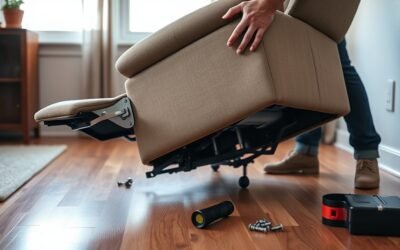
A coffee table can wobble even when the floor looks perfectly flat. The usual causes are a loose leg or joint, stripped hardware, uneven feet or leg lengths, a twisted frame, or wood that has moved as its moisture content changed. Start by finding exactly where the movement comes from before sanding, drilling, or changing any leg.
Quick Answer
If a coffee table wobbles on a flat floor, first tighten its legs, screws, bolts, and joints. Then press opposite corners to find the gap or loose connection. Use a shim for a small height difference, repair stripped or failed joints when necessary, or install compatible adjustable feet for a permanent leveling solution.
Key Takeaways
- Test the table on more than one known-flat area before blaming the floor or modifying a leg.
- Loose fasteners and joints should be repaired before trying to compensate with pads or levelers.
- A rocking table does not always have one simple “short leg”; a twisted frame or loose joint can create the same symptom.
- Felt pads and shims are useful for small gaps, while adjustable feet provide a more durable leveling method when the legs can safely accept them.
- Do not use extra weight on the tabletop to hide a wobble. Find and correct the cause instead.
At a Glance
| Time Required | About 10–30 minutes for diagnosis and basic tightening; adhesive repairs need additional curing time according to the product instructions. |
| Difficulty | Easy for tightening and shimming; moderate for drilling levelers or rebuilding damaged wood joints. |
| Tools Needed | Screwdriver or Allen key, wrench if required, straightedge or level, tape measure, felt/shims, and repair hardware or wood glue as needed. |
| Cost | Usually low if you already own basic tools; the final cost depends on whether you need pads, replacement hardware, levelers, replacement parts, or professional repair. |
Warning: If the coffee table has a heavy stone top, loose glass top, fragile insert, or unusually high weight, do not simply flip it upside down by yourself. Remove detachable pieces when the manufacturer allows it and get another person to help support the table safely.
Why Coffee Tables Wobble

A four-legged coffee table is stable only when its feet make firm contact with the supporting surface and its frame stays rigid. If one contact point sits slightly high or low, pressing the tabletop can shift the load from one pair of legs to another and create a rocking motion.
Common causes include uneven leg or foot height, a worn floor protector, a loose leg-to-apron connection, a stripped screw hole, failed glue, cracked joinery, or a frame that has twisted out of alignment.
Wood movement can also contribute. Wood is hygroscopic, so it exchanges moisture with the surrounding air. The USDA Forest Products Laboratory explains that changes in wood moisture content affect dimensional stability. Seasonal humidity changes are therefore a more useful explanation than simply saying that temperature makes a wooden table change shape.
Note: Do not assume a rocking table needs one leg shortened. A loose joint or twisted frame can lift the same corner even when all four legs are physically the same length.
Check the Legs and Joints
Before adding pads or modifying the legs, inspect the structure. Gently press each corner of the tabletop and watch the feet. Then hold each leg near its connection point and try to move it sideways. Movement at the joint points to a connection problem rather than a simple height difference.
Check for visible gaps, cracked wood, loose dowels, worn mounting plates, damaged corner blocks, bent brackets, stripped holes, or hardware that turns without becoming tight.
Inspect Loose Leg Joints
Loose leg joints are a common source of wobble because they let the legs, apron, and tabletop move relative to one another.
- Examine each leg-to-frame connection for gaps, cracks, or movement.
- Check whether a leg rotates or flexes independently of the rest of the table.
- Press opposite tabletop corners and watch the joints while the table rocks.
- Compare all four connections instead of assuming the corner that lifts has the damaged leg.
If a joint is cracked or badly separated, avoid repeatedly rocking the table because the movement can enlarge the damage.
Tighten Hardware Connections
If the joints use screws, bolts, threaded inserts, cam fittings, or brackets, tighten them with the correct screwdriver, Allen key, or wrench. Work gradually around the table rather than fully tightening one connection while the others remain loose.
The USDA Forest Products Laboratory’s guidance on wood fastenings explains that the strength and stability of wood assemblies depend heavily on appropriate fastenings and joint design.
Hardware should be snug, but do not keep turning a wood screw after it has stopped holding securely. Excessive torque can strip the surrounding wood or engineered panel material.
Reinforce Weak Table Joints
A traditional glued wood joint may need to be re-glued if its adhesive bond has failed. For the most durable repair, separate the joint when practical, remove loose or failed adhesive without changing the fit of the parts, apply an appropriate wood adhesive to clean mating surfaces, and clamp the joint correctly.
The USDA Forest Products Laboratory’s wood-adhesive guidance explains the principles behind reliable wood bonding. Always follow the adhesive manufacturer’s instructions for preparation, temperature, clamping, and cure time.
For example, Titebond states that most of its wood glues require roughly 30 minutes to one hour of clamping for an unstressed joint, while stressed joints may require longer clamping, and it recommends not stressing a newly glued joint for at least 24 hours.
L-shaped brackets or corner blocks can add stiffness where the construction allows them, but choose screw lengths carefully so they cannot penetrate the visible tabletop or split a thin component. Predrill when appropriate for the wood and fastener.
Pro Tip: Do not automatically add glue to knock-down or flat-pack hardware. Some tables are designed to be disassembled and rely on cam locks, bolts, threaded inserts, or proprietary connectors. Repair those connections with compatible hardware unless the manufacturer specifically allows adhesive.
Is the Floor the Problem?
A floor can look flat while having a small local dip, so test before modifying the table. Place the coffee table in another part of the room or on another known-flat surface. If the same corners rock in the same way, the table is the more likely source.
| Checkpoint | What It Suggests |
|---|---|
| Wobble changes when the table is moved | Floor variation or a combination of floor and table issues |
| Same corners rock on several flat areas | Leg, foot, joint, or frame problem |
| Leg moves at its joint | Loose hardware or weakened joinery |
| Hardware is tight but one foot has a clear gap | Height difference, worn pad, or frame twist |
A spirit level can help you examine the floor and tabletop, but it does not by itself identify the cause of rocking. The key question is whether all supporting feet make firm contact without the frame shifting.
Fix Loose or Stripped Screws and Fasteners
Loose hardware is often one of the easiest problems to correct. Inspect every accessible screw, bolt, bracket, threaded insert, and leg mounting point, especially after the table has been moved or reassembled.
Check All Fasteners
- Use the correct tool so you do not round the screw head or damage a fitting.
- Hold the adjoining pieces in their proper position while tightening.
- Snug the connection without forcing it beyond the point where it is secure.
- Replace bent, cracked, missing, or badly worn hardware with compatible parts.
If a screw spins continuously instead of becoming snug, tightening harder will not solve the problem. The receiving material may be stripped.
Repair Stripped Screw Holes and Re-Tighten Table Joints
For solid wood, a durable repair may involve removing the screw, restoring sound wood with a properly fitted wood plug or dowel and wood adhesive, allowing the repair to cure, and then drilling a correctly sized pilot hole for the fastener.
Particleboard, MDF, hollow-core legs, threaded inserts, and proprietary flat-pack fittings require different repairs. In those materials, a compatible replacement insert, larger approved fitting, or manufacturer replacement part may be safer than a traditional dowel repair.
| Problem | Typical Response |
|---|---|
| Loose screw that still grips | Re-tighten carefully |
| Screw spins without tightening | Repair the hole or replace the fitting |
| Failed traditional wood joint | Clean, re-glue, and clamp when appropriate |
| Cracked structural member | Repair or replace the damaged part before leveling |
Fix a Wobbly Coffee Table Step by Step
Use this order so you correct the actual fault instead of hiding it.
- Put the table on a known-flat area. Test another location if you are unsure about the floor.
- Press opposite corners. Note which foot lifts and whether the frame or a joint visibly moves.
- Wiggle each leg. A leg that moves independently needs its connection repaired first.
- Inspect and tighten hardware. Replace damaged fittings and repair stripped holes instead of overtightening them.
- Check the feet and pads. A missing, crushed, or mismatched floor protector can create a height difference.
- Re-test the table. Only continue to leveling adjustments after the structure is rigid.
- Shim a remaining small gap. Use a thin, stable pad or shim to confirm the amount of correction required.
- Choose a permanent solution. Install compatible adjustable feet, replace a damaged foot, or repair the frame if necessary.
Measure the legs if the structure is tight, but do not shorten a leg merely because one corner lifts. Confirm that the leg itself is actually too long and that the frame is not twisted first. Cutting or sanding a leg is difficult to reverse.
Use Adjustable Feet to Level It
Adjustable furniture feet can provide a neat, repeatable way to correct small height differences. Turning the threaded foot raises or lowers that corner until all feet contact the floor.
Some leveler kits use threaded inserts or T-nuts installed in the bottom of a wooden leg. For example, Anwenk’s furniture leveler system lists T-nuts, threaded levelers, and felt floor-contact surfaces for its cited model.
Before drilling, make sure the leg is thick and structurally sound enough for the required hole and insert. Measure the drilling depth so the bit cannot break through the side of a tapered leg. Hollow metal legs, thin wooden legs, stone bases, molded components, and some engineered furniture need compatible manufacturer-specific fittings instead.
After installation, adjust the feet a little at a time and retest the table from more than one direction.
Try Temporary Fixes First
A temporary shim is useful when the structure is sound and the remaining wobble comes from a very small contact gap.
- Use a thin felt pad, rubber pad, or firm furniture shim beneath the foot with the gap.
- Trim or position the shim so it does not protrude far enough to become a trip or snag hazard.
- Recheck the table after the pad has been compressed by normal use.
Folded cardboard can confirm how much correction you need, but it compresses and absorbs moisture, so it is better as a diagnostic or short-term measure than a permanent repair.
Clear wedges, rubber bumpers, cork, and adhesive felt can also work for small discrepancies if they remain secure and do not damage the flooring.
Do not add extra weight to the tabletop to suppress the wobble. Weight may change how the movement feels, but it does not repair the underlying gap or loose joint and may place more stress on a damaged connection.
When to Stop DIY Repair
Basic tightening, shimming, and compatible levelers are reasonable DIY jobs for many coffee tables. More serious structural damage deserves greater caution.
Consider professional furniture repair or replacement of the damaged component when you find:
- A leg split through a load-bearing area.
- A badly cracked apron or corner block.
- Loose joinery in valuable antique furniture where disassembly may damage the piece.
- Weld failure or cracking in a metal frame.
- A stone or glass component that is cracked, inadequately supported, or unsafe to move.
- A failed proprietary fitting for which no compatible replacement can be identified.
Brackets and shims should not be used to hide a broken structural member.
Keep Your Coffee Table Stable
Once the table is stable, check it periodically and whenever it is moved, disassembled, reassembled, or begins rocking again. There is no universal need to tighten every table on a fixed monthly or yearly schedule.
Keep floor protectors in similar condition on all legs, replace missing pads, and avoid dragging the table sideways when moving it. Lifting it reduces stress on leg joints.
For wooden furniture, normal seasonal moisture changes may slightly affect fit and dimensions. Keeping the indoor environment reasonably stable can reduce extreme wood movement, although finishes slow moisture exchange rather than eliminating it completely.
The goal is simple: rigid joints, sound fasteners, and firm contact at every supporting foot.
Frequently Asked Questions
How do you fix a wobbly coffee table?
Test the table on a flat area, press opposite corners, and check every leg and joint for movement. Tighten sound hardware, repair stripped fasteners or failed joints, and then correct any remaining height difference with a stable shim, replacement foot, or compatible adjustable leveler.
How do you balance a table on an uneven floor?
First make sure the table itself is structurally sound. Then place a firm shim or furniture pad beneath the foot with the gap. For a permanent solution, compatible adjustable feet let you raise or lower individual corners to match the floor.
Why are tables sometimes wobbly?
A table may wobble because a fastener or joint is loose, a foot is worn or missing, the legs do not contact the floor evenly, the frame has twisted, or wood movement has changed the fit of a joint. A properly made and assembled table should normally stand steadily on a flat surface.
What can be used to stabilize a table that wobbles?
Depending on the cause, you can use properly tightened or replacement hardware, repaired wood joints, felt or rubber pads, firm shims, compatible adjustable levelers, corner blocks, or correctly installed brackets. Fix structural looseness before trying to level the feet.
Should I sand or cut a coffee table leg to stop wobbling?
Only after confirming that the leg itself is too long and that the joints and frame are sound. A twisted frame or loose connection can imitate an uneven leg. Because removing material is permanent, test with shims and measurements before cutting or sanding.
Can humidity make a wooden coffee table wobble?
It can contribute. Wood gains and loses moisture as surrounding conditions change, and those moisture changes can cause small dimensional changes. If a joint was already marginal or the frame is sensitive to movement, seasonal changes may make the wobble more noticeable.
Sources
- USDA Forest Products Laboratory — Moisture Relations and Physical Properties of Wood — supports wood moisture, dimensional stability, shrinkage, and swelling guidance.
- USDA Forest Products Laboratory — Chapter 8: Fastenings — supports guidance on screws, connections, rigidity, and fastening wood components.
- USDA Forest Products Laboratory — Wood Adhesives: Bond Formation and Performance — supports guidance on bonded wood joints.
- Titebond — Wood Glue Use and FAQ — supports product-specific clamping and cure guidance.
- Anwenk — Adjustable Furniture Levelers — supports the cited leveler, T-nut, and felt-pad example.
Conclusion
A coffee table that wobbles on a flat floor usually has a contact or structural problem rather than a mysterious balance issue. Start with the simplest checks: test another flat area, press opposite corners, inspect the feet, and tighten any sound hardware. Repair loose or stripped joints before trying to level the table.
If the structure is rigid but one foot still has a small gap, a pad, shim, replacement foot, or compatible adjustable leveler can restore stable contact. Avoid permanently shortening a leg until you have ruled out frame twist and joint movement. With the cause correctly identified, most minor coffee-table wobble can be fixed without replacing the table.