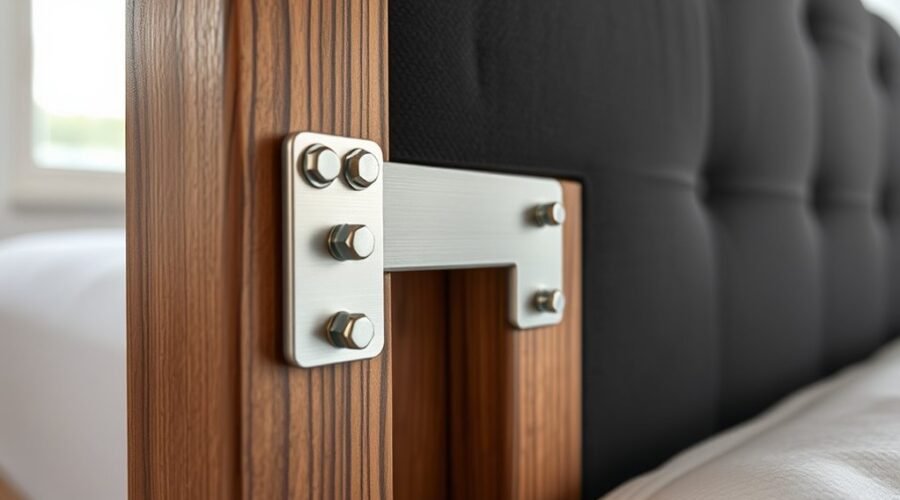
A headboard bracket connects a compatible headboard to a bed frame or base so the headboard stays aligned and stable. The important part is matching the hardware to the mounting system you actually have. Bolt holes, hook-in slots, adjustable-base kits, and wall-mount systems are not interchangeable, so check the frame, hole spacing, hardware, and manufacturer instructions before tightening anything.
Quick Answer
Headboard brackets secure a compatible headboard to a bed frame or adjustable base. Common setups use bolt-on plates, hook-on fittings, or model-specific bracket kits. Match the mounting style and hole spacing first, loosely assemble adjustable parts, align the headboard, then tighten the specified hardware evenly. Never force mismatched brackets or drill an adjustable base unless its manufacturer permits it.
Key Takeaways
- A headboard bracket is mounting hardware that connects a compatible headboard to a bed frame or base.
- Bolt-on and hook-on fittings are common, but adjustable bases may require model-specific bracket assemblies.
- Check mounting style, hole spacing, headboard width, frame design, and supplied hardware before installation.
- Use bolts, nuts, washers, lock washers, or other fasteners exactly as the manufacturer specifies rather than assuming every bracket uses the same hardware stack.
- Leave adjustable bracket connections loose enough for alignment, then tighten them evenly after the headboard is centered and level.
- Treat powered adjustable bases and wall-mounted headboards as model-specific installations with additional safety requirements.
At a Glance
| Time Required | Varies by frame, bracket type, access, and alignment; do not rush a heavy or powered-base installation. |
| Difficulty | Easy to moderate when the headboard and frame already have compatible mounts; more involved for adjustable bases or wall mounting. |
| Tools Needed | Tape measure, level, and the correct wrench, socket, hex key, or screwdriver specified for your hardware. A second person is useful for large headboards. |
| Cost | No additional cost when compatible mounting hardware is included; otherwise it depends on the bracket or manufacturer-specific accessory kit required. |
What Is a Headboard Bracket?
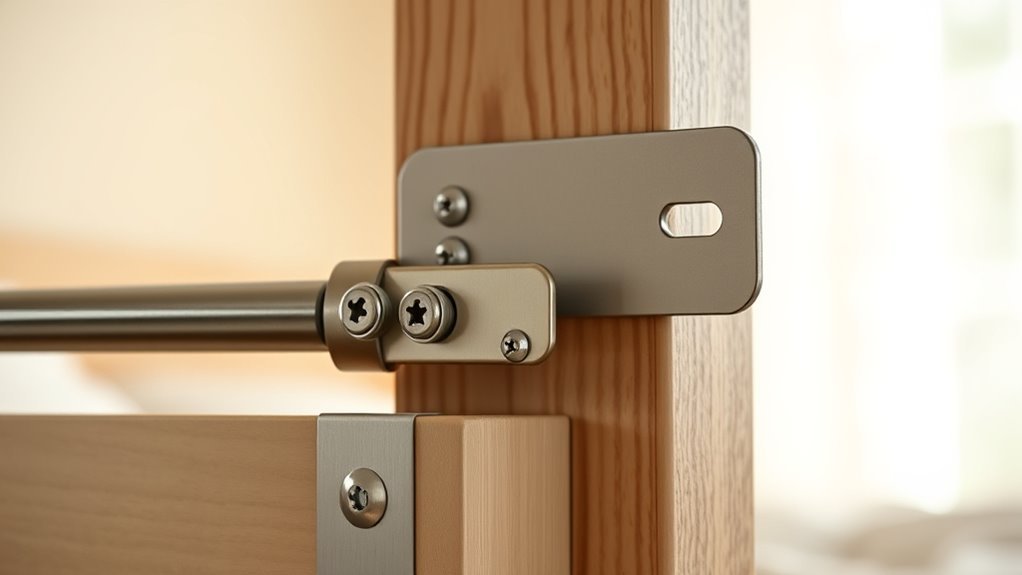
A headboard bracket is mounting hardware that helps connect a headboard to a compatible bed frame, foundation, or adjustable base. Most frame-mounted systems use metal plates, channels, flanges, hooks, or similar hardware positioned at the head end of the bed.
The bracket’s job is to hold the headboard in the correct position while transferring movement through secure mounting points rather than letting the headboard rock against the wall. The exact design varies considerably. A conventional metal bed frame may have simple mounting plates, while a powered adjustable base can use a multi-piece accessory kit designed specifically for that model.
For example, Sleep Number’s FlexFit headboard instructions use dedicated connectors, channels, flanges, and specified hardware. That is why compatibility matters more than finding a bracket that simply looks similar.
How Do Headboard Brackets Attach?
Headboard brackets attach according to the mounting system built into the frame and headboard. Some systems use bolts through aligned holes or slots. Others use hooks that engage matching slots. Adjustable bases may require a dedicated kit that first attaches to the base and then provides mounting points for the headboard.
The safest sequence is to identify the system, measure the mounting points, assemble adjustable brackets loosely, align the headboard, and only then complete the final tightening.
Bracket Types And Fit
Bolt-on brackets are common on metal frames and accessory kits. They use aligned holes or elongated slots with the hardware specified by the manufacturer. Slotted holes can provide some lateral or height adjustment, but their available range depends on the bracket.
Hook-on brackets use projecting hooks or tabs that engage compatible slots. A hook-on frame needs a matching headboard interface; a bolt-on headboard cannot automatically be attached to it without an appropriate compatible adapter or conversion system.
Adjustable-base bracket kits deserve their own category. They may use channels, flanges, plates, spacers, or mounting tracks and are often specific to a family of bases. Do not assume a generic bracket is safe merely because its holes appear to line up.
Wall-mounted headboards bypass the bed frame and attach to the wall through the mounting system supplied for the headboard. These require appropriate structural support for the wall type.
Freestanding headboards should be treated as freestanding only when their design and manufacturer instructions specifically allow it.
Securing Bolts And Washers
When a bracket system uses bolts, first align the mounting holes or slots without forcing them. Insert the bolts in the orientation specified by the hardware instructions and add the supplied nuts, washers, lock washers, spacers, or locking hardware in the specified order.
Do not automatically add a washer to every connection. Hardware arrangements differ by product. Some assemblies use flat washers or lock washers, while others specify only bolts and nuts.
Leave adjustment points slightly loose while positioning the headboard. Tempur-Pedic’s bracket instructions, for example, call for some bracket connections to remain loose enough for adjustment before the final alignment and tightening. The same basic approach helps prevent a headboard from being pulled crooked by tightening one side too early.
For final tightening, use the correct wrench, socket, hex key, or other specified tool. Tighten the hardware firmly according to the manufacturer’s instructions without stripping threads, crushing wood, deforming a bracket, or overtightening a threaded insert.
Pro Tip: Start every adjustable connection by hand and leave it slightly loose. Center and level the headboard first, then alternate between the left and right sides as you complete the final tightening. This reduces the chance of pulling the headboard out of alignment.
What Should You Check Before Buying Headboard Brackets?
Before buying a bracket or conversion kit, inspect both the headboard and the bed frame. A few measurements can prevent most compatibility problems.
- Mounting style: Determine whether the frame uses bolt holes, elongated slots, hook-on fittings, accessory mounting points, or a model-specific bracket system.
- Hole spacing: Measure center-to-center between the headboard mounting holes and compare that measurement with the bracket’s adjustment range.
- Bed size: Confirm the kit is approved for your Full, Queen, King, California King, Twin XL, or other frame size.
- Headboard design: Check that its legs or mounting rails reach the frame’s mounting area without forcing the headboard into the mattress or wall.
- Hardware requirements: Identify the correct bolt diameter, thread, length, nuts, washers, spacers, or other hardware from the product instructions.
- Base model: For powered or adjustable beds, verify the exact model and compatible accessory kit before ordering.
Note: Hole spacing alone does not prove compatibility. A bracket can appear to fit while interfering with a moving base, using the wrong thread, or placing the headboard at an unsafe height. Check the complete mounting system, not just one measurement.
How Do You Check Your Bed Frame for Mounts?
Inspect the head end of the bed frame before buying hardware. You are looking for factory-provided mounting plates, threaded holes, open holes, elongated slots, hooks, or dedicated accessory mounting points.
Locate Frame Brackets
Look at both side rails near the head of the bed. Conventional frames often place headboard mounting points at the end of each side rail. If brackets are already installed, check whether they are fixed or adjustable and whether they sit square to the frame.
On an adjustable base, consult the model instructions before reaching underneath or operating the base. Some bases require you to raise the head section to access designated bracket mounting points.
Do not drill new holes into an adjustable base, cut its frame, or attach hardware to an arbitrary rail unless the manufacturer specifically permits that modification.
Identify Mount Hole Types
Round mounting holes normally provide a fixed bolt location. Elongated slots can provide adjustment within the slot’s range. Hook-on systems use shaped slots or receiving plates designed for matching hooks.
Measure the center-to-center spacing between mounting points. If bolts are already present, identify their diameter, thread type, and usable length from the manufacturer documentation or original hardware rather than substituting a bolt that merely fits through the opening.
If your bracket has several holes or slots, do not assume every opening is intended for every bed size. Some manufacturer kits specify different positions for different sizes.
Confirm Bed Frame Compatibility
Compatibility depends on the complete connection between the bed frame, bracket, headboard, and hardware. Confirm that the headboard’s mounting legs or rails reach the frame brackets at the intended height and that both sides can align without twisting or spreading the frame.
Follow the fastener type specified for the actual mounting system. A wooden component may use bolts, threaded inserts, or screws depending on its construction, while a metal frame can use bolts, threaded holes, hooks, or proprietary hardware.
If the frame and headboard are different brands, compare their mounting measurements and instructions carefully. When compatibility cannot be confirmed, use a purpose-built adapter recommended for the products rather than improvising with undersized bolts, random holes, or stacked hardware.
Which Headboard Bracket Fits Your Frame?
The right headboard bracket is the one designed to match both your frame’s mounting interface and your headboard’s attachment points. Use the table below as a starting point, then verify the exact dimensions and manufacturer requirements.
| Bracket or mounting type | Common application | What to verify |
|---|---|---|
| Bolt-on | Frames and headboards with compatible holes or slots | Hole spacing, bolt size/thread, bracket adjustment range, and hardware stack |
| Hook-on | Frames/headboards designed with matching hooks and slots | Hook dimensions, slot position, engagement, and headboard height |
| Adjustable-base kit | Powered or articulating bases | Exact base model, approved kit, bed size, moving-part clearance, and manufacturer instructions |
| Wall mounting system | Headboards designed to attach independently of the bed | Wall construction, structural support, supplied rail/cleat/bracket, and fastener requirements |
| Freestanding design | Headboards specifically engineered to stand independently | Manufacturer-approved freestanding use, base stability, placement, and tip/movement risk |
Do not choose a bracket solely by bed size. Two Queen frames, for example, can use completely different mounting systems.
What If the Headboard and Frame Do Not Match?
If the headboard holes and frame mounts do not line up, stop before enlarging holes or forcing bolts at an angle. First confirm that the headboard is centered and facing the correct direction and that adjustable bracket plates have been positioned through their full intended range.
If the mismatch remains, check whether the frame or headboard manufacturer offers an adapter, conversion plate, extension bracket, or dedicated headboard kit. An appropriate adapter can bridge compatible mounting patterns while keeping the load on intended mounting points.
Avoid improvised stacks of washers, undersized bolts, partially engaged nuts, or hardware that pulls the headboard legs sideways. Those fixes can loosen quickly and may damage the frame or headboard.
For an adjustable base, do not create new attachment points unless the base manufacturer specifically authorizes it. A bracket that interferes with articulation, wiring, motors, linkages, or other moving components can create a safety problem.
How Do You Install a Frame-Mounted Headboard?
A compatible frame-mounted headboard is usually straightforward to install when both the frame and headboard already provide matching mounting points. Large, heavy, or upholstered headboards are easier to position with a second person.
- Prepare the bed. Remove bedding or move the mattress if necessary to reach the head-end mounting points safely. If you have a powered adjustable base, follow its shutdown and access instructions.
- Confirm the parts. Match the bracket pieces and fasteners to the product instructions before assembly.
- Measure the mounting points. Compare the center-to-center spacing on the headboard with the frame brackets or accessory flanges.
- Position the brackets. Install any required frame-side bracket components, leaving designated adjustment connections loose enough to move.
- Bring the headboard into position. Have a helper support a large headboard while you align the headboard holes with both brackets.
- Insert the specified hardware. Use the supplied or manufacturer-specified bolts, nuts, washers, spacers, or locking hardware in the correct order.
- Center and level the headboard. Check left-to-right position and make sure neither side is being forced inward or outward.
- Tighten evenly. Alternate between both sides until the connections are firmly secured according to the manufacturer’s instructions.
- Test for movement. Gently check the headboard for side-to-side wobble and inspect all mounting points before replacing the mattress or putting the bed back into service.
Warning: Powered adjustable bases need extra precautions. Keep people, children, pets, hands, tools, bedding, and loose objects clear of moving components. Use only mounting locations and compatible bracket kits specified for your model. Some manufacturers also specify a maximum permitted gap between the mattress and headboard cross member, so follow your base’s manual rather than using a universal clearance number.
Current Sleep Number adjustable-base instructions illustrate why model-specific guidance matters: bracket position, mounting holes, components, and clearance requirements can vary by base type and size.
How Do Wall-Mounted Headboards Attach?
Wall-mounted headboards attach independently of the bed frame through the brackets, rails, cleats, or other mounting system specified by the headboard manufacturer. Start by identifying the required finished height and the structural mounting locations in the wall.
Use a level to mark the mounting system accurately. For a heavy headboard, the attachment should transfer the load to appropriate structural support rather than relying on unsupported drywall or plaster. FEMA’s furniture-anchoring guidance similarly emphasizes fastening heavy furnishings to structural framing instead of depending on the wall surface alone.
For a wall-mounted headboard, the wall structure and mounting system matter more than the bed frame. Follow the headboard manufacturer’s fastener, support, and wall-type requirements.
For wood-stud walls, position the mounting system where the manufacturer’s required fasteners can engage suitable framing. Masonry, concrete, and metal-stud walls require hardware appropriate to those materials and to the headboard load. If the supplied instructions require a particular anchor or mounting rail, use that system rather than substituting generic hardware based only on appearance.
Before drilling, make sure you understand what is behind the mounting area and follow appropriate precautions for electrical wiring, plumbing, and other concealed services.
After mounting the bracket or rail, verify that it is level and firmly attached before hanging the headboard. Once the headboard is installed, confirm that it is fully engaged with the mounting system and cannot lift, slide, or rock unexpectedly.
How Do Freestanding Headboards Stay Put?
A true freestanding headboard is designed with a base, legs, or structure that allows it to remain upright without relying on a conventional bed-frame bracket. Its weight, footprint, and construction provide the stability intended by the manufacturer.
Do not assume that any unattached headboard becomes freestanding simply because it can be leaned between a bed and a wall. If a product is designed to bolt to a frame or mount to a wall, use its intended attachment method.
Some freestanding designs may also include optional frame connections, straps, anti-tip hardware, or other stabilizing components. Install those components when the manufacturer requires them.
A freestanding design can make rearranging a bedroom easier, but convenience should not replace stability. If the headboard rocks, tips, shifts away from the wall, or depends entirely on the mattress to hold it upright, review the installation instructions before continuing to use it that way.
How Do You Fix Loose or Misaligned Brackets?
Start by finding the actual source of the movement rather than simply tightening every fastener harder. Remove bedding or move the mattress if necessary so you can see both sides of the headboard connection.
| Problem | Likely cause | What to do |
|---|---|---|
| Headboard wobbles side to side | Loose fasteners, unused bracket adjustment, or mismatched mounting points | Realign both sides and tighten the specified hardware evenly |
| Headboard sits crooked | One bracket tightened before alignment or unequal bracket positions | Loosen adjustment points, center and level the headboard, then retighten |
| Bolt keeps spinning | Damaged threads, wrong fastener, or damaged threaded insert | Stop tightening and replace or repair the correct component |
| Bracket bends or twists | Wrong bracket, excessive force, poor alignment, or overloaded hardware | Do not straighten and reuse questionable hardware unless the manufacturer permits it; replace damaged parts |
| Connection loosens repeatedly | Wrong hardware, incomplete thread engagement, movement, or damaged mount | Compare the assembly with the manufacturer instructions and replace incorrect or damaged parts |
| Adjustable base hits the bracket | Incorrect kit, position, or clearance | Stop operating the base and correct the installation using the model-specific instructions |
If the fasteners are simply loose, hold the hardware with the correct wrench or socket and tighten it to the manufacturer’s specification. Avoid using pliers on nuts or bolt heads when the proper tool is available, because pliers can round or damage the fastener.
Where the original assembly specifies washers, lock washers, locking nuts, spacers, or other retaining hardware, make sure those components are present and correctly positioned. Do not add random hardware to compensate for a bracket that does not fit.
For persistent wobble, inspect the headboard itself as well as the brackets. Loose headboard legs, cracked wood, damaged threaded inserts, bent frame rails, or worn mounting slots can create movement that bracket tightening alone cannot solve.
Note: Recheck the mounting hardware after the bed has been used, especially after a new installation or adjustment. If a fastener repeatedly works loose, investigate the cause instead of continually tightening it harder.
Frequently Asked Questions
How do you use headboard brackets?
Match the brackets to the mounting system on your bed frame and headboard, confirm the hole spacing, then assemble the parts with the specified hardware. Leave adjustable connections slightly loose while you center and level the headboard. After everything aligns correctly, tighten both sides evenly and check for movement.
What kind of brackets do I need to attach my headboard to my bed frame?
You need a bracket or adapter compatible with both mounting interfaces. Common choices include bolt-on brackets, hook-on fittings, and model-specific adjustable-base kits. Check the mounting style, center-to-center hole spacing, adjustment range, bed size, and required fasteners before buying.
How are headboards attached to beds?
Frame-mounted headboards commonly attach with bolts or compatible hook-on fittings. Adjustable bases may use dedicated accessory brackets, while wall-mounted headboards attach to structural wall supports instead of the bed. The correct method depends on the headboard and base design.
Can you just attach a headboard to a bed frame?
Yes, when the frame and headboard provide compatible mounting points or an approved adapter is available. Do not force mismatched holes, use undersized hardware, or drill a powered adjustable base unless its manufacturer specifically permits the modification.
Do headboard brackets fit every bed frame?
No. Bed size alone does not make a bracket universal. Frames can use different hole spacing, slot patterns, hooks, threads, adjustment ranges, and accessory systems. Verify the exact mounting dimensions and compatibility before purchasing a bracket.
Can you attach a headboard to an adjustable bed base?
Many adjustable bases can accept a headboard through a compatible accessory bracket kit, but the kit and installation method are model-specific. Check the base manufacturer’s instructions, keep hardware clear of moving components, and follow any specified headboard-to-mattress clearance requirement.
Sources
- Sleep Number — Traditional FlexFit Accessories Installation Guides — adjustable-base headboard bracket components, alignment, mounting positions, tightening, and safety guidance.
- Sleep Number — How to Assemble a Modular Base — optional headboard/footboard bracket installation and hardware checks.
- Tempur-Pedic — Headboard Accessory Kit Tools — manufacturer guidance showing that tool requirements depend on the base and headboard.
- Tempur-Pedic — EASE 2.0 Adjustable Base Manual — bracket adjustment, hardware, measurement, and installation examples.
- FEMA — Anchor Tall Bookcases and File Cabinets — structural wall-anchoring principles for heavy furnishings.
Conclusion
The right headboard bracket is not simply the one that fits your bed size. It must match the frame or base mounting system, the headboard’s attachment points, the required hardware, and any adjustment or clearance requirements. Measure before buying, assemble adjustable parts loosely, align the headboard before final tightening, and replace damaged or mismatched hardware rather than forcing it.
For a conventional compatible frame, that usually produces a solid, straightforward installation. For wall-mounted headboards and powered adjustable bases, follow the product-specific mounting and safety instructions so the headboard stays stable without interfering with the wall structure or moving bed components.