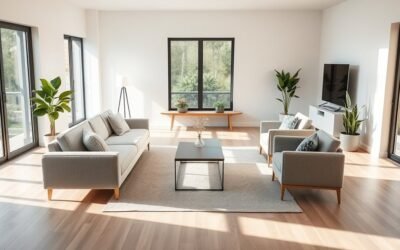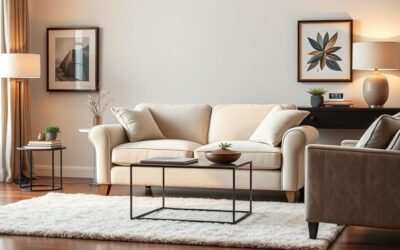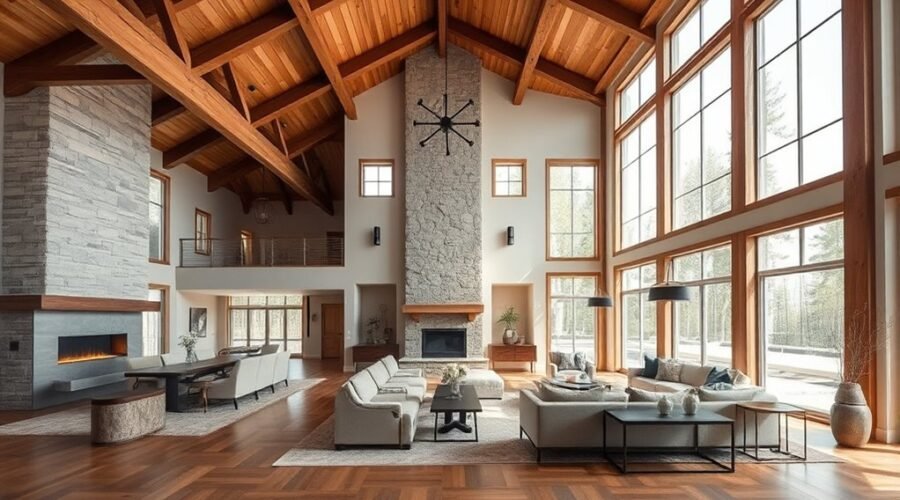
A great room and a living room can both serve as places to relax and entertain, but they organize home life differently. A great room is usually a larger, more open, multifunctional space that may connect living, dining, and kitchen areas. A living room is generally more defined, giving you greater separation, privacy, and control over how the space is used.
Quick Answer
A great room is typically a large, open gathering space that combines several functions, such as lounging, dining, and sometimes cooking. A living room is usually a more clearly defined room focused on seating, conversation, relaxing, or entertaining. Great rooms favor connection and flexibility; living rooms offer more separation and privacy.
Key Takeaways
- A great room combines several activities in one open gathering space, while a living room is usually more clearly defined.
- High ceilings, large windows, fireplaces, and kitchen connections are common in great rooms, but none is required for every great room.
- Great rooms make conversation, entertaining, and movement between zones easier, but noise, cooking smells, visible clutter, and privacy can become concerns.
- Living rooms provide stronger visual and acoustic separation and can be easier to furnish for conversation, reading, or quiet relaxation.
- Neither layout is automatically better. The right choice depends on how many people use the space, how much privacy you need, and how you prefer to entertain.
What Is a Great Room?
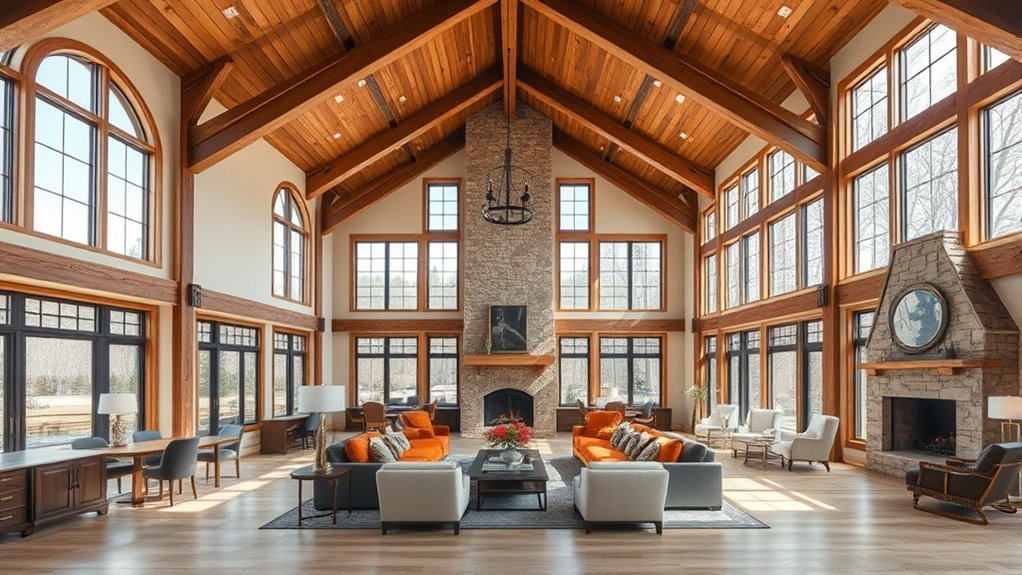
A great room is a spacious, multifunctional gathering area that combines roles traditionally handled by several separate rooms. Depending on the floor plan, it may include a main seating area, dining space, reading corner, play area, or an open connection to the kitchen.
The defining idea is not a specific ceiling height or square footage. It is the way several everyday activities share one visually connected space. That is why a great room can work as the home’s central hub for conversation, meals, entertainment, homework, and relaxation.
Great rooms often feature architectural details that reinforce the feeling of openness, such as vaulted ceilings, broad sightlines, large windows, fireplaces, or wide openings to adjoining spaces. Those features are common rather than mandatory.
The modern residential great-room concept grew alongside increasingly open home layouts during the second half of the 20th century. A history of kitchen and bath design published by Wiley describes the 1970s as a period when the great-room idea gained broader attention as walls between kitchens and adjacent living spaces were removed. By the early 1990s, the layout had become a familiar feature in American housing.
Great Room vs. Living Room at a Glance
| Feature | Great Room | Living Room |
| Main purpose | Multiple activities and larger gatherings | Relaxing, conversation, TV, reading, or entertaining |
| Layout | Usually open or visually connected to other zones | Usually more clearly defined by walls, openings, or circulation |
| Typical size | Often larger because it supports several functions | Often smaller and focused on one main seating function |
| Kitchen connection | Common, but not required | Usually separate or less directly integrated |
| Privacy | Lower when several activities happen together | Usually easier to create visual and acoustic separation |
| Furniture planning | Often requires multiple furniture zones | Usually easier to organize around one focal point |
| Best fit | Households that value connection, flexibility, and entertaining | Households that value quiet, separation, and defined rooms |
Great Room vs. Living Room Size
A great room is often larger than a traditional living room because it needs enough space for more than one activity. Instead of fitting only a sofa group and a coffee table, it may need to accommodate dining furniture, circulation paths, kitchen seating, a media area, or another functional zone.
The important difference is not a required number of square feet. A great room uses one larger area for several functions, while a living room usually concentrates on one primary seating function.
Living rooms are commonly more compact and easier to arrange around a fireplace, television, view, or conversation area. Their boundaries also make it simpler to select furniture that feels appropriately scaled to the room.
There is no universal minimum size that turns a room into a great room. Floor-plan relationships and function matter more than a specific width, length, or ceiling height.
Great Room Layout and Flow
Great rooms are designed around connection and circulation. Instead of moving through doors between separate rooms, people can usually move from seating to dining or kitchen areas without leaving the main space.
That openness can make everyday family life more social. Someone preparing dinner can remain part of a conversation in the seating area, while children doing homework at a table stay within sight.
The challenge is keeping the room from feeling like one oversized, undefined space. Furniture placement should create clear zones while preserving comfortable walking paths.
Pro Tip: Define each activity zone with a visual anchor. An area rug can establish the seating area, pendant lights can identify the dining zone, and a kitchen island can create a natural boundary without adding a full wall.
Avoid placing furniture where people have to cut through a conversation area to reach another part of the home. Leaving clear pathways around sofas, tables, islands, and doors makes a great room feel organized instead of crowded.
Great Room Light and Windows
Large windows and open sightlines can make a great room feel brighter and more spacious. Because fewer interior walls block the light, daylight entering one part of the room can often reach adjoining dining or kitchen zones.
Vaulted or taller ceilings may increase the sense of volume, and clerestory windows or high glazing can bring light deeper into the space. However, more glass does not automatically make a home more energy efficient.
The U.S. Department of Energy’s Building Science Education guidance explains that carefully designed daylighting can reduce reliance on artificial lighting, but window orientation, shading, glazing, glare, and unwanted solar heat also need to be controlled.
DOE also notes that heat gain and heat loss through windows account for roughly 25% to 30% of residential heating and cooling energy use. Energy performance therefore depends more on the quality and placement of the windows than on simply making them larger.
Note: If glare or overheating is a problem, properly chosen shades, overhangs, low-emissivity glazing, and orientation-specific window treatments can help without sacrificing the open feel.
How Living Rooms Work
A living room is usually a more clearly defined seating space used for relaxing, conversation, reading, television, or entertaining guests. It may be formal or casual depending on the household.
Because the room is separated visually or physically from other activities, it can provide more control over noise, furniture arrangement, lighting, and clutter.
Purpose and Function
Living rooms work well when you want a room with one strong purpose instead of several overlapping ones. A seating arrangement can focus on face-to-face conversation, a fireplace, a television, a view, or a combination of those elements.
The defined setting can also make the room feel calmer because kitchen preparation, dining activity, toys, work materials, and other household functions do not automatically occupy the same visual field.
A living room does not have to be formal. Many homes use it as the primary everyday lounge, while others reserve it for guests or quieter activities.
Layout and Privacy
Walls, doorways, wide cased openings, or simply greater distance from the kitchen can give a living room more visual and acoustic separation than an open great room.
That can be useful when different people want to do different things at the same time. A conversation or reading session is easier to separate from television noise, kitchen appliances, or a busy dining area.
A defined room can also conceal everyday kitchen or dining clutter when guests arrive, although the level of privacy depends on the actual floor plan. Not every living room has a door or is completely enclosed.
Formal and Cozy Use
Some living rooms are designed as polished guest spaces, while others are intentionally comfortable and casual. Their smaller scale often makes it easier to create an intimate atmosphere.
- Arrange seating so people can talk without sitting unusually far apart.
- Use layered lighting instead of depending on one overhead fixture.
- Choose rugs and furniture that match the scale of the room.
- Use curtains, upholstered furniture, rugs, and other soft surfaces when you want a quieter acoustic environment.
The result can be a room that feels focused and welcoming without needing the size or openness of a great room.
Advantages of a Great Room
A well-planned great room can make everyday interaction easier because several household activities remain connected.
- Better social connection: people cooking, dining, relaxing, and talking can remain part of the same gathering.
- Flexible furniture planning: zones can change as household needs change.
- Useful for entertaining: guests can circulate between seating, food, and dining areas without crowding a doorway.
- Broader sightlines: fewer walls can make the interior feel more spacious.
- Shared daylight: windows serving one zone can often brighten adjoining areas as well.
These advantages help explain why great rooms remain relevant rather than being only a past design fad. In 2025, the National Association of Home Builders described the great room as a consistently popular feature among home buyers across generations.
Advantages of a Living Room
Living rooms offer a different kind of flexibility: instead of combining activities, they make it easier to separate them.
- More privacy: conversations and quiet activities can be separated from busier parts of the home.
- Better noise control: walls and doors can reduce sound movement between spaces.
- Clearer furniture arrangement: one primary purpose often makes furnishing simpler.
- Less visible clutter: activity elsewhere in the home does not automatically dominate the room.
- Comfortable scale: a smaller room can feel cozy without requiring large furniture to fill it.
Separate rooms can be particularly useful when people regularly work, study, watch television, cook, and socialize at the same time.
Why Great Rooms Became a Trend
Great rooms grew from a broader shift toward more informal and connected residential layouts. A Wiley design-history excerpt describes the 1970s as an important period for the concept, when designers increasingly removed walls between kitchens and adjoining living spaces and treated the kitchen as part of the home’s public and social area.
The idea fit changing preferences for casual entertaining and family interaction. Instead of keeping cooking, dining, and relaxation in completely separate rooms, one larger area could support all three.
By the early 1990s, the layout had become especially prominent in American housing. Large suburban homes often paired great rooms with tall ceilings, broad windows, fireplaces, and open kitchens.
The layout has continued to evolve rather than simply disappearing. Current design research reflects interest in flexible, multifunctional homes alongside renewed appreciation for privacy and defined rooms. The American Institute of Architects Home Design Trends Survey, which gathers data from more than 300 residential architecture firms, continues to track changing preferences for home layouts and features in 2026.
Drawbacks of Great Rooms Today
Great rooms offer connection and flexibility, but the same openness creates tradeoffs.
- Noise travels farther: television, conversations, kitchen appliances, and children’s activities may all share one acoustic space.
- Less privacy: it can be difficult to separate quiet activities from social ones.
- Cooking smells spread: an open kitchen allows food odors and kitchen noise to reach the seating area easily.
- Clutter stays visible: dishes, toys, papers, and everyday activity can be seen from much of the room.
- Large volumes can be harder to furnish: undersized rugs, lighting, or furniture may feel lost in a large room.
- Heating and cooling design matters: tall ceilings, extensive glazing, solar exposure, air distribution, insulation, and HVAC zoning can all affect comfort and operating costs.
- Maintenance may require more effort: tall windows, high light fixtures, ceiling fans, and upper walls can be harder to reach.
The cost of building or remodeling a great room cannot be reduced to one reliable national price per square foot. Structural changes, ceiling height, window area, electrical work, HVAC changes, finishes, labor rates, and local permit requirements can change the budget substantially.
For an existing home, removing walls to create a great room may also involve load-bearing structure, electrical wiring, ductwork, plumbing, or mechanical systems. A qualified contractor or structural professional should evaluate those conditions before demolition begins.
How to Make a Great Room Feel More Private
You do not always have to choose between a completely open plan and fully enclosed rooms. A semi-open layout can preserve visual connection while making individual zones feel more distinct.
Useful options include placing the sofa with its back toward the dining area, using bookcases or slatted partitions, adding large rugs, hanging acoustic curtains, varying ceiling treatments, or installing pocket or sliding doors where the structure allows.
An AIA residential design example describes a hybrid approach that maintains visual openness while giving individual areas clearer identities and addressing acoustic and comfort problems that can occur when too many walls are removed.
Soft furnishings can also reduce the hard, echoing quality that sometimes develops in large rooms. Rugs, fabric window treatments, upholstered seating, and acoustic wall or ceiling treatments absorb more sound than large expanses of hard flooring, glass, and drywall.
Which Room Is Better for Your Home?
A great room usually fits best when you want everyday activities to overlap. It works particularly well for people who entertain frequently, want the kitchen connected to the main gathering area, or need one room to adapt to several uses.
A living room may be the better fit when household members frequently need separate spaces for work, study, television, conversation, or quiet time. Defined rooms can also make it easier to hide kitchen activity and control noise.
You do not necessarily have to choose only one. Larger homes may include both: an open kitchen-family or great-room area for everyday use and a separate living room for quiet conversation, reading, music, or guests.
Note: Think about simultaneous activities rather than appearance alone. If one person regularly watches television while another works, studies, cooks, or entertains, some physical separation may be more valuable than maximum openness.
Frequently Asked Questions
Is a Great Room the Same as a Living Room?
No. A great room is usually a larger, more open, multifunctional gathering area, while a living room is generally a more clearly defined seating room. Both can be used for relaxing and entertaining, but great rooms commonly connect several activities or zones within one space.
What Makes a Room a Great Room?
A great room is defined mainly by its open, multifunctional role. It normally acts as a major gathering space and may combine living, dining, entertainment, or kitchen-related functions. High ceilings, large windows, fireplaces, and open kitchens are common features, but they are not required.
Does a Great Room Have to Include a Kitchen?
No. Many modern great rooms open directly to a kitchen, but the kitchen does not have to be physically inside the great room. A large connected living-and-dining area can still function as a great room if it serves several gathering purposes.
What Is Another Word for Great Room?
Terms such as open-concept living area, main living area, or multipurpose living space may describe a similar layout. “Family room” is sometimes used loosely in real-estate descriptions, but it is not an exact synonym: a family room is generally an informal relaxation room and may be completely separate from the dining room or kitchen.
What Is the Difference Between a Family Room, Living Room, and Great Room?
A family room is usually an informal room for everyday relaxation, television, and family activities. A living room is a defined seating area that may be formal or casual. A great room is typically larger and combines several functions or connects multiple zones within one open gathering space.
Can a House Have Both a Great Room and a Living Room?
Yes. Some homes use a great room as the main everyday hub and keep a separate living room for quiet conversation, reading, music, guests, or other activities that benefit from more privacy.
Conclusion
The central difference between a great room and a living room is how each space handles household activities. A great room keeps people and functions connected within one open area. A living room gives those activities clearer boundaries and usually offers more privacy and noise control.
Choose based on how your household actually uses space. If cooking, dining, entertaining, and relaxing often happen together, a great room can make that interaction easier. If people frequently need quiet or separate activities at the same time, a defined living room can be more practical. Many homes successfully combine both approaches.
Sources
- U.S. Department of Energy — Home Upgrades — residential window heat-gain and heat-loss guidance.
- U.S. Department of Energy Building Science Education — Natural Light and Daylighting — daylighting, orientation, glare, shading, and energy considerations.
- American Institute of Architects — Home Design Trends Survey — current residential design and floor-plan trend research.
- National Association of Home Builders — 2025 Home Buyer Trends — current buyer preferences and continued popularity of great rooms.
- American Institute of Architects — Responsive Family Home — residential guidance on balancing open layouts with privacy, acoustics, and defined spaces.
- Wiley — A Brief History of Kitchen and Bathroom Design — historical development of open kitchens and the great-room concept.