Are seed oils bad for you? Online, they are blamed for inflammation, obesity and heart disease. In clinical research, the picture is much less dramatic: controlled studies do not show that omega-6 fats raise inflammation, and major heart groups still recommend these oils over animal fats. A few older findings and legitimate concerns keep the debate alive, so this article lays out both sides.
Quick Answer
The best current evidence does not support the claim that seed oils, as a group, cause inflammation or heart disease. Controlled feeding studies show no increase in inflammatory markers from omega-6 fats, and the AHA recommends them in place of saturated fat. Real caveats remain around ultra-processed foods, old trans-fat margarines and one contested trial.
Key Takeaways
- Seed oils include soybean, canola, sunflower, safflower and corn oil, rich in omega-6 linoleic acid.
- Controlled feeding studies have not found that omega-6 fats increase inflammatory markers.
- Harvard reports the omega-6 to omega-3 ratio is not a useful measure of how healthy a food is.
- A re-analysis of the Sydney Diet Heart Study found higher deaths with safflower oil, but it had notable limits.
- Carnivore eaters mostly avoid seed oils, yet the evidence does not prove that avoiding them is necessary for health.
What Counts as a Seed Oil
The term usually covers soybean, canola, corn, sunflower, safflower, cottonseed and grapeseed oils. The AHA lists canola, corn, olive, nut, safflower, soybean and sunflower oils as liquid plant oils that are healthier than foods high in saturated fat. These oils supply polyunsaturated fat, including omega-6 linoleic acid, an essential fat the body cannot make.
The Inflammation Claim
The argument is built on biology. The NIH notes that compounds made from omega-6 fats are generally more potent mediators of inflammation than those made from omega-3 fats, and the two compete for the same enzymes. From there, some commentators conclude that eating more omega-6 must drive chronic inflammation.
Human trials do not bear that out. Harvard’s Nutrition Source cites a 2017 meta-analysis of randomized trials and states that carefully controlled feeding studies do not show that omega-6 fats increase inflammatory factors. It also says the omega-6 to omega-3 ratio is not a useful indicator of a food’s healthfulness. The NIH adds that no optimal ratio has been defined and that raising EPA and DHA from fish matters more than cutting linoleic acid.
What Heart Studies Show
The AHA recommends replacing saturated and trans fats with polyunsaturated and monounsaturated fats to lower LDL cholesterol. Harvard also describes a large prospective study in which the highest omega-6 intakes were linked to lower death rates from cardiovascular disease and cancer. These are observational findings, not proof.
The best-known contrary finding is a BMJ re-analysis of the Sydney Diet Heart Study, run from 1966 to 1973 in 458 men with recent heart events. Men told to eat safflower oil and safflower margarine had higher death rates than controls (all-cause 17.6 percent versus 11.8 percent). The authors cautioned that the results may not apply to lower intakes, to women or to people without heart disease, noted missing data, and could not capture all trans fat exposure.
Are Seed Oils Bad for You? Where Concerns Are Legitimate
- Ultra-processed food: chips, fried fast food and pastries often contain seed oils, but the AHA notes that evidence linking ultra-processed foods to poor health does not by itself establish cause.
- Old margarines: partially hydrogenated oils were a major source of artificial trans fat. The FDA ruled them not generally recognized as safe in 2015, with compliance by January 2021.
- Omega-3 balance: most people get little fish, so eating more omega-3 can matter more than avoiding omega-6.
- Quality and heating: critics raise refining and oxidation concerns. These are largely mechanistic, and the sources reviewed here did not show harm from typical home use.
Strength of the Evidence
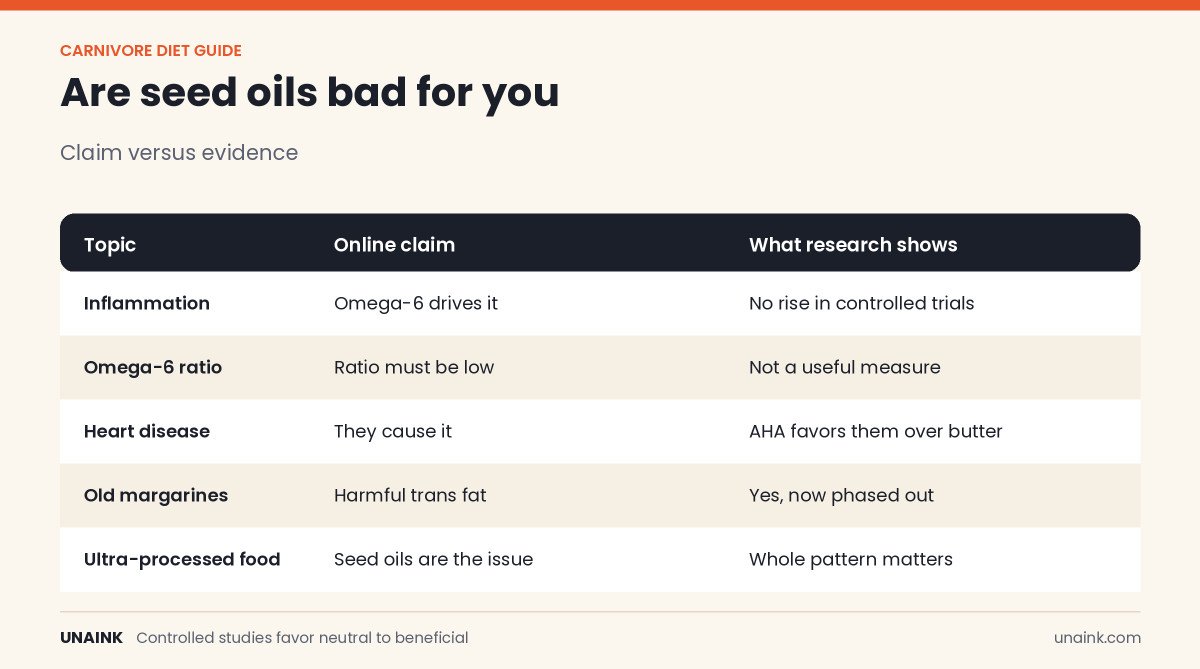
| Claim | What the evidence shows | Strength |
|---|---|---|
| Seed oils raise inflammation | Controlled feeding studies show no increase in markers | Fairly strong against the claim |
| They cause heart disease | AHA recommends them over saturated fat; one trial re-analysis disagrees | Mixed, favors benefit |
| The omega-6 ratio matters | Harvard: ratio is not a useful indicator | Weak support for the claim |
| Trans fat margarines are harmful | FDA removed partially hydrogenated oils | Strong |
What This Means on a Carnivore Diet
Carnivore eaters cook with animal fats instead, so seed oil intake is low. That choice is legitimate for those who prefer it, though the evidence reviewed here does not show it is required for health. Replacing plant oils with butter or tallow raises saturated fat, which the AHA links to higher LDL. See saturated fat, tallow vs butter and inflammation on carnivore.
Fish are a source of omega-3, as covered in seafood on carnivore. Olive oil is not a seed oil, though see olive oil on carnivore.
Practical Takeaways
- Focus on the whole diet pattern, not a single ingredient.
- Limit fried and ultra-processed foods whatever oil they use.
- Include fish or other omega-3 sources regularly.
- If you have high cholesterol, ask your clinician how cooking fats fit your numbers.
Are Seed Oils Bad for You: The Short Version
Are seed oils bad for you? Current evidence says no for the inflammation claim and generally no for heart health, with caveats about ultra-processed foods and one contested trial. Anyone asking are seed oils bad for you should look at the whole diet, not one ingredient.
Frequently Asked Questions
Do seed oils cause inflammation?
Controlled feeding studies have not shown that omega-6 fats raise inflammatory markers, according to Harvard’s Nutrition Source.
Which oils are seed oils?
Usually soybean, canola, corn, sunflower, safflower, cottonseed and grapeseed oils.
Is olive oil a seed oil?
No. Olive oil comes from the fruit of the olive tree, though like seed oils it is unsaturated and recommended by the AHA.
Should I avoid seed oils on a carnivore diet?
Most carnivore eaters do, using animal fats. The evidence does not prove avoidance is necessary, so personal preference and your lipid results matter.
What about the Sydney Diet Heart Study?
A re-analysis found higher deaths with safflower oil in men with heart disease, but it had limits including trans fat exposure and missing data.
Conclusion
Evidence from controlled studies and heart-health groups does not back the strongest anti-seed-oil claims, though sensible concerns remain about ultra-processed food. Talk with a doctor or dietitian about which fats suit your health goals and cholesterol.
Medical note
This article is for general education and is not medical advice. Talk with a doctor or registered dietitian before making major diet changes, especially if you have a health condition, take medication, or are pregnant or breastfeeding.
Keep Reading
- Is Saturated Fat Bad for You?: The debate explained simply.
- Beef Tallow vs Butter: How the two fats compare.
- Carnivore Diet and Inflammation: What is known and unknown.
- Olive Oil on Carnivore: Where it fits and where it does not.
Sources
- Harvard Nutrition Source: Omega-3 Fats: Omega-6, inflammation and ratio evidence
- NIH Office of Dietary Supplements: Omega-3 Fatty Acids: Eicosanoids and the omega-6 to omega-3 ratio
- American Heart Association: Fats in foods: Plant oils in place of saturated fat
- BMJ: Sydney Diet Heart Study data recovery: Safflower oil trial and meta-analysis
- FDA: Trans fat: Partially hydrogenated oils removed
- Baking Business: AHA 2026 dietary guidance: AHA view on ultra-processed food evidence