Plenty of carnivore diet myths circulate online, from the idea that humans are built to eat only meat to the fear that any red meat is as dangerous as smoking. Some claims hold up in part, and others fall apart under scrutiny. This article checks ten of them against the best available evidence and rates each one as supported, partly supported or unsupported.
Quick Answer
Of ten common claims, one is supported (short-term weight loss and fullness in small studies), four are partly supported and five are unsupported. The common thread is thin evidence: a 2026 scoping review found only nine human studies, mostly small, short and uncontrolled, and concluded that long-term use cannot be recommended.
Key Takeaways
- Only one claim, short-term weight loss, is supported, and even that rests on small, low-quality studies.
- Meat covers many nutrients, but versions without dairy, seafood or plants risk gaps in vitamin C, calcium, magnesium and fiber.
- Claims that the diet cures disease rest on self-reported surveys and tiny case series.
- Comparing meat to smoking misreads how the WHO cancer agency ranks evidence, but a risk signal for processed meat is real.
- The honest answer to many myths is that long-term carnivore data simply does not exist yet.
How These Claims Were Rated
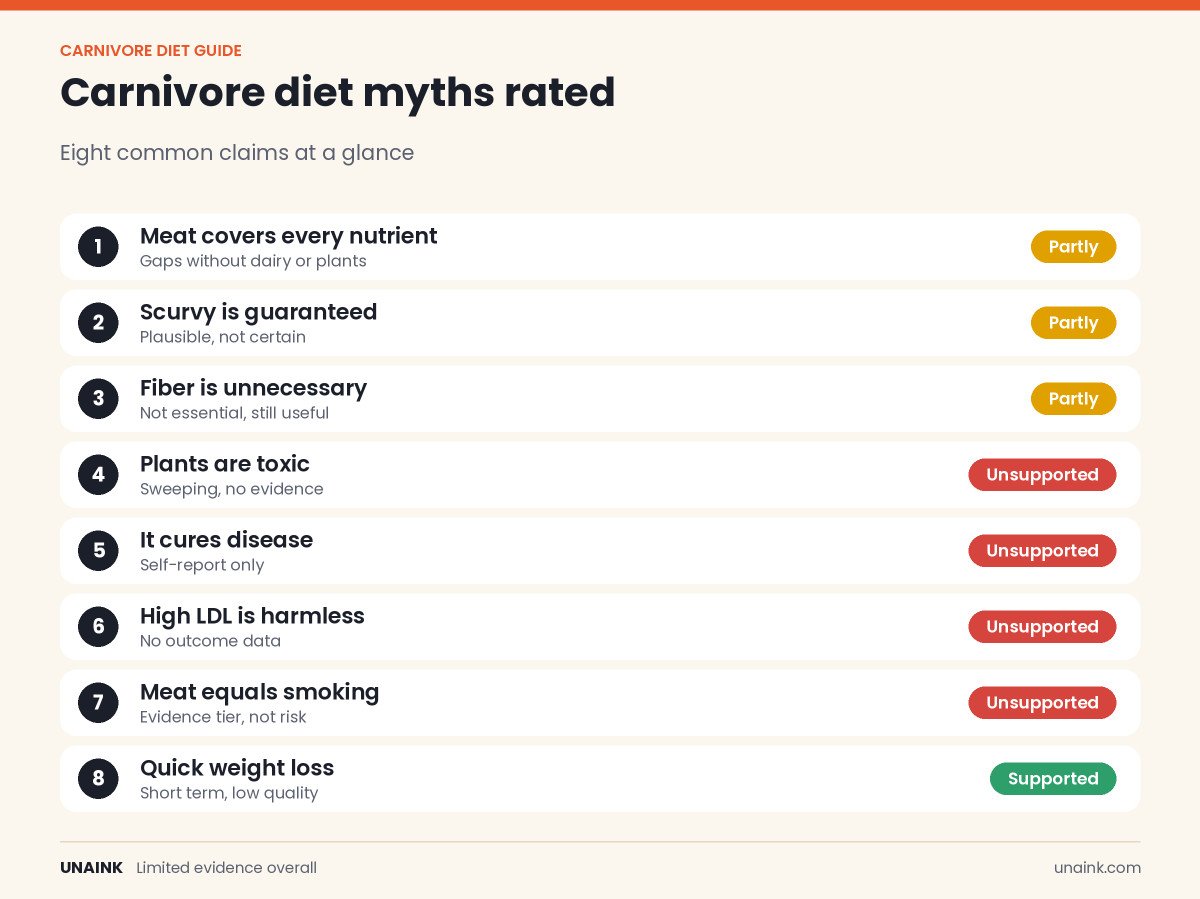
Supported means human research points the same way, even if the studies are small. Partly supported means a kernel of truth sits inside an overstated claim. Unsupported means the evidence does not back the claim or points the other way.
The main anchors are the 2026 Nutrients scoping review of nine human studies (scoping review) and the 2021 survey of 2,029 self-selected adults (survey study). For background, see what the carnivore diet is.
Carnivore Diet Myths About Nutrients
Myth 1: Meat alone supplies everything you need. Partly supported.
A review of the science notes that all essential nutrients can come from animal sources, yet the mix varies by food. Versions that exclude dairy, seafood and plants tend to fall short. The scoping review flagged vitamin C, vitamin D, calcium, magnesium, iodine and fiber, and noted vitamin A intake far above recommendations in some liver-heavy plans. See nutrient deficiency on carnivore.
Myth 2: Meat-only eating guarantees scurvy. Partly supported.
Meat holds little vitamin C, and raw meat retains more than cooked meat, though raw meat brings food-poisoning risks. Scurvy is not guaranteed, but it is plausible on a poorly planned plan: singer James Blunt reportedly developed it after about two months of eating only meat. Details are in vitamin C on carnivore.
Myth 3: You do not need fiber. Partly supported.
Fiber is not an essential nutrient the way vitamin C is, so you will not get a classic deficiency disease. Still, the adequate intake is 25 to 30 grams a day, and some modeled carnivore plans delivered under 1 gram. Higher fiber intake is linked to lower LDL and blood pressure in other research. Read do you need fiber on carnivore.
Myths About Evolution and Plant Foods
Myth 4: Humans evolved to eat only meat. Partly supported.
Animal foods, especially fat and organs, were important to many ancestral diets. But anthropologists generally describe those diets as varied and shaped by place and season, not as meat-only. Evolutionary history also says little about long-term health in modern life, so it cannot settle the question on its own.
Myth 5: Plants are full of toxins that harm you. Unsupported.
Some individuals do react to certain plant compounds, such as oxalates in people prone to kidney stones. That is different from saying plants are poison. Fiber and varied plant foods are tied to lower LDL, lower blood pressure and benefits in inflammatory bowel disease in the studies cited by a Science Feedback review. See oxalate dumping.
Myths About Disease and Cures
Myth 6: The diet cures disease. Unsupported.
A claim of a 90 percent reduction in all diseases was rated unsupported by Science Feedback. The 2021 survey recruited adults through social media who had followed the diet for at least six months. It relied on self-report, collected no baseline data, and could not capture people who quit after feeling worse. The scoping review did describe remission in seven people with inflammatory bowel disease, but that was a small case series.
Anyone with diabetes should never change insulin or other medicines without their care team. See carnivore and type 2 diabetes.
Myths About Fat, Cholesterol and Cancer
Myth 7: High LDL on carnivore is harmless. Unsupported.
Harvard Health notes that animal fat is mostly saturated and that keto-style diets tend to raise LDL. The scoping review found higher LDL and total cholesterol in several studies. No long-term trial tracks heart attacks in carnivore eaters, so neither harm nor safety is proven, but the claim of harmlessness has no solid backing. See high cholesterol on carnivore and the saturated fat debate.
Myth 8: Red meat is as deadly as smoking. Unsupported.
The WHO cancer agency IARC classes processed meat as Group 1 and red meat as Group 2A, probably carcinogenic, based on limited human evidence. Group 1 reflects strength of evidence, not size of risk. Each 50 gram daily portion of processed meat raised colorectal cancer risk by about 18 percent, while tobacco causes roughly 1 million cancer deaths a year against about 34,000 linked to processed meat. See the WHO Q and A and is red meat bad for you.
Myths About Weight Loss and Safety
Myth 9: It produces quick weight loss. Supported.
The scoping review reported short-term weight loss and greater fullness, which makes sense with a high-protein, no-snack pattern. The support stops there: studies were small, short and had no control groups. A Harvard physician says he would not recommend it for weight loss. See weight loss in a month.
Myth 10: It is safe for everyone long term. Unsupported.
The scoping review authors concluded that long-term adherence cannot be recommended. Cleveland Clinic lists heart, kidney and digestive concerns, and the review described one patient with kidney stones whose urine profile worsened and gout flares increased, improving after stopping. See who should not do the carnivore diet.
Ratings at a Glance
| Claim | Rating | Main reason |
|---|---|---|
| Meat alone covers every nutrient | Partly supported | Gaps without dairy, seafood or plants |
| Scurvy is guaranteed | Partly supported | Low vitamin C, risk is plausible |
| Fiber is unnecessary | Partly supported | Not essential, but linked to benefits |
| Humans evolved on meat only | Partly supported | Diets were varied |
| Plants are toxic | Unsupported | Sweeping claim, no evidence |
| It cures disease | Unsupported | Self-report and case series only |
| High LDL is harmless | Unsupported | No outcome data, LDL rises |
| Meat equals smoking | Unsupported | Group 1 is not equal risk |
| Quick weight loss | Supported | Short term, low quality |
| Safe for all, long term | Unsupported | Experts advise against |
Carnivore Diet Myths: The Short Version
Sorting carnivore diet myths shows that many contain a small truth wrapped in a big overstatement. The best-supported carnivore diet myths to retire are the cure claims, the smoking comparison and the idea that long-term safety is settled.
Frequently Asked Questions
Is the carnivore diet scientifically proven?
No. Evidence is limited to small, short studies and self-reported surveys. The scoping review authors say long-term use cannot be recommended.
Can you really get scurvy on a carnivore diet?
It is possible, especially on a plan without fresh organ meats or other vitamin C sources. It is not guaranteed, but it has been reported.
Does the carnivore diet raise cholesterol?
Several studies found higher LDL and total cholesterol, and animal fat is mostly saturated. Individual responses vary, so lab testing with a clinician matters.
Is red meat classified as a carcinogen?
IARC lists red meat as probably carcinogenic (Group 2A) and processed meat as carcinogenic (Group 1), based on colorectal cancer evidence.
Why do so many people report feeling better?
Self-reported surveys cannot rule out regression to the mean, selection bias or the effect of cutting ultra-processed foods and calories.
Conclusion
Few claims about meat-only eating are entirely true or entirely false. Short-term weight loss and fullness are reported, while cure claims, equating meat to smoking and promises of long-term safety are not backed by the evidence. Talk with a doctor or registered dietitian before making major diet changes, especially with a health condition. Checking carnivore diet myths one by one is the best way to separate useful ideas from hype. Most carnivore diet myths hold a grain of truth wrapped in an overreach.
Medical note
This article is for general education and is not medical advice. Talk with a doctor or registered dietitian before making major diet changes, especially if you have a health condition, take medication, or are pregnant or breastfeeding.
Keep Reading
- Is the Carnivore Diet Healthy?: A balanced look at benefits and risks.
- Carnivore Diet Long-Term Effects: What little we know beyond a few months.
- Carnivore Diet Nutrient Deficiency: Which nutrients can run low.
- Who Started the Carnivore Diet?: Origins and key figures.
Sources
- Carnivore Diet: A Scoping Review of the Current Evidence: Nine human studies, risks and conclusion
- Behavioral Characteristics and Self-Reported Health Status among 2029 Adults: 2021 self-reported survey
- Harvard Health: What is the carnivore diet?: LDL, kidney and gout concerns
- Cleveland Clinic: The carnivore diet: Risks and dietitian view
- Science Feedback: balanced diet eating only meat: Nutrient and fiber evidence review
- Science Feedback: 90 percent reduction claim: Fact-check of cure claims
- IARC press release on red and processed meat: Classification and risk per portion
- WHO Q and A on red meat and cancer: Group meanings and death estimates