
A carnivore diet for athletes promises simple eating, steady energy, and fast recovery, yet it removes the nutrient that sports dietitians usually rely on most to fuel hard training. The research on low-carbohydrate eating and performance is mixed, and almost none of it tests a meat-only plan. Here is what the evidence supports, where the risks sit, and how athletes can decide.
Quick Answer
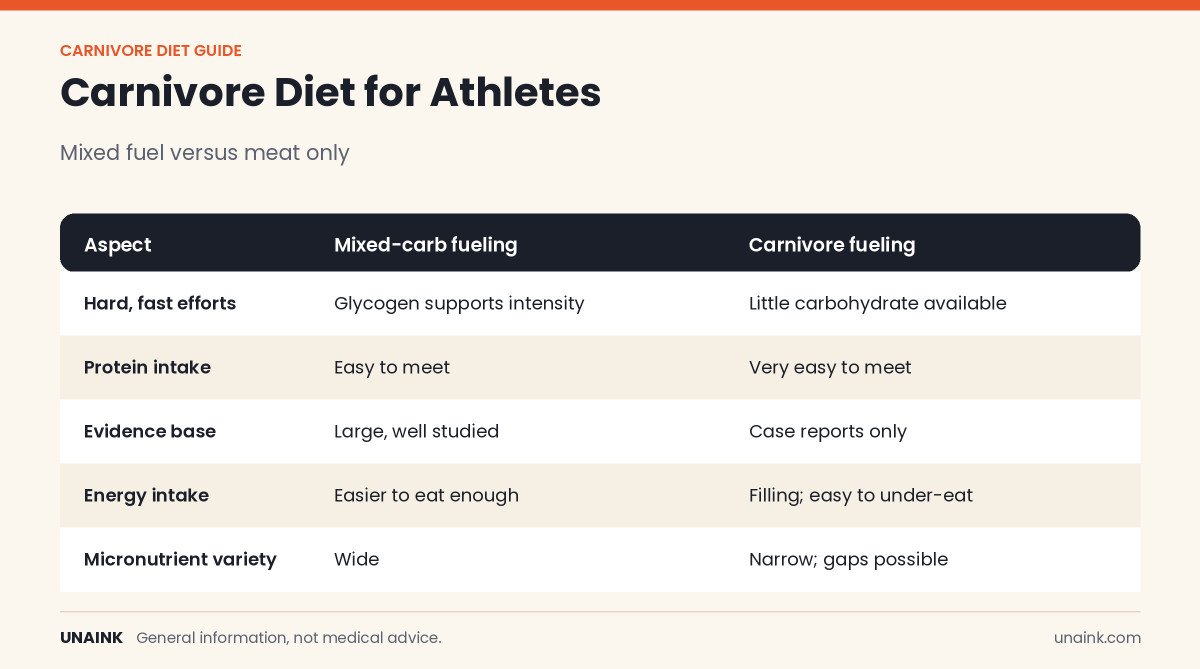
There is no controlled evidence that a carnivore diet for athletes improves performance. Protein and fat needs are easy to meet, but very low carbohydrate intake can hurt high-intensity work, and under-eating can harm recovery and bone health. Endurance and team-sport athletes in particular should work with a sports dietitian before trying it.
Key Takeaways
- Carbohydrate is the main fuel for hard, fast efforts, and carnivore eating nearly removes it.
- Low-carb diets burn more fat, yet studies do not show a reliable performance gain.
- Meat makes the high protein intakes athletes need easy to reach.
- Under-eating, low electrolytes, and thin variety are the common practical problems.
- The only carnivore athlete data so far are case reports, not controlled trials.
How Athletes Fuel Performance
Muscles burn a mix of carbohydrate and fat. As intensity climbs, they lean harder on carbohydrate stored as glycogen. The 2016 joint position statement from the Academy of Nutrition and Dietetics, Dietitians of Canada, and ACSM ties carbohydrate intake to training load, and recommends 1.2 to 2.0 grams of protein per kilogram of body weight and about 20 to 35 percent of calories from fat.
A carnivore plan sits at the far end of that spectrum: plenty of protein and fat, almost no carbohydrate. That is workable for some sports and a poor match for others.
What Research Says About Low-Carb Performance
A debate between exercise scientists, summarized by the American Society for Nutrition, shows the split. Louise Burke reports that elite race walkers burned more fat on a ketogenic diet yet performed worse. Timothy Noakes argues that trained athletes perform similarly after four to six weeks of adaptation.
A 2020 review of ketogenic diets for endurance athletes found only seven studies, mostly small and non-randomized, and said the findings were too limited and varied for firm conclusions. Keto is not the same as carnivore, but it is the closest research available.
Carnivore Athlete Reports Versus Trials
Social media is full of athletes who feel great on meat. Published data are scarce. One case study followed a single college soccer player over 22 games, and her workload measures looked weaker than her teammates until she added small amounts of carbohydrate before games. One person, no control group, and a changing season make that story a hint at best.
Protein: The Diet’s Real Strength
The International Society of Sports Nutrition position stand says 1.4 to 2.0 grams of protein per kilogram daily is generally enough for exercising people to build and maintain muscle. A meat-based diet reaches that without effort. The question is whether you can get there without giving up the carbohydrate that powers the training itself.
Energy, Recovery, and Bone
Meat is filling, and some athletes eat less than they burn. The IOC describes relative energy deficiency in sport, or RED-S, as affecting metabolism, menstrual function, bone strength, immunity, and the heart. Warning signs include stalled progress, frequent illness, injuries, and missed periods.
Sweat, Salt, and Electrolytes
Athletes lose sodium and fluid in sweat, and people commonly report needing more salt in the first weeks of very low-carb eating. Plan for it, especially in heat. Our guide to carnivore diet electrolytes covers the basics.
Who Might Consider It
| Athlete type | Fit with carnivore eating |
|---|---|
| Strength and power sports | Protein is easy; training volume on low carbohydrate needs monitoring |
| Team and intermittent sports | Repeated sprints rely on carbohydrate; risky in-season |
| Long endurance events | Fuel needs during events are high; discuss with a sports dietitian |
| Weight-class or aesthetic sports | Higher risk of under-eating; seek professional support |
| Teen athletes | Not advised; growth and bone building come first |
A Cautious Way to Test It
- Try it in the off-season, never right before a key event.
- Get baseline labs, including lipids, ferritin, and vitamin D.
- Track training quality, sleep, mood, and body weight weekly.
- Eat enough: add fatty cuts rather than only lean meat.
- Return to a mixed diet if performance, recovery, or health slips.
Carnivore Diet for Athletes: The Short Version
The carnivore diet for athletes has strong protein but weak performance evidence, and the risks grow with training intensity. Treat a carnivore diet for athletes as a monitored experiment with a sports dietitian, not a proven shortcut.
Frequently Asked Questions
Can you perform well on a carnivore diet?
Some athletes say yes, but controlled evidence is lacking. Low-carb diets have not reliably beaten higher-carb diets in trained athletes.
Is it good for endurance sports?
Research on ketogenic diets is mixed and small. Fuel needs during long events are high, so planning with a sports dietitian is wise.
Will I lose strength?
It varies. Under-eating or poor training quality can cost strength, while adequate calories and protein help protect it.
How much protein do athletes need?
The ISSN says 1.4 to 2.0 g per kg daily is generally enough, and individual needs differ.
Is it safe for young athletes?
It is not recommended for growing teens. Ask a pediatrician or sports dietitian for guidance.
Conclusion
Athletes will always chase an edge, but the best evidence points to matching food to training, not removing a food group. If curiosity wins, test carefully, watch the data, and keep your doctor in the loop.
Medical note
This article is for general education and is not medical advice. Talk with a doctor or registered dietitian before making major diet changes, especially if you have a health condition, take medication, or are pregnant or breastfeeding.
Keep Reading
- Carnivore Diet for Muscle Gain: Protein, calories, and lifting.
- Carnivore Diet and Endurance Training: Running on fat, with caveats.
- Carnivore Diet Electrolytes: Salt, potassium, and magnesium.
- Carnivore Diet for Women: Hormones, cycles, and nutrient gaps.
Sources
- Academy of Nutrition and Dietetics, Dietitians of Canada, ACSM: Nutrition and Athletic Performance: Joint position statement
- ISSN position stand: protein and exercise: Protein recommendations
- American Society for Nutrition: Does a low-carb diet impede endurance performance?: Expert debate
- Review of the ketogenic diet for endurance athletes (2020): Seven small studies
- IOC consensus statement on RED-S, 2018 update: Low energy availability
- Carnivore Diet and Athletic Performance: A Case Study: Single soccer player