The carnivore diet is an eating pattern built on animal foods alone. Meat, fish and eggs make up the plate, some versions add dairy, and every plant food is removed: no fruit, vegetables, grains, beans, nuts or seeds. It has moved from fringe forums into everyday conversation, and it now draws strong opinions from fans and nutrition professionals alike. This guide explains what the carnivore diet is, how it is supposed to work, what the research really shows, and who might reasonably consider it.
Quick Answer
The carnivore diet is an all-animal eating plan that excludes plant foods and relies on meat, fish, eggs and animal fats, with dairy in some versions. People try it for weight loss, appetite control and symptom relief, but the evidence is thin. A 2026 review found only nine human studies, mostly small and short, and concluded that long-term use cannot be recommended. Treat it as a short, supervised experiment, not a permanent default.
Key Takeaways
- The carnivore diet removes all plant foods and is built around beef, other meat, fish, eggs and animal fats.
- Fans report easier weight loss, steadier appetite and fewer digestive complaints, but most of that evidence is self-reported.
- Researchers flag possible shortfalls in vitamin C, calcium, magnesium and fiber, plus higher LDL cholesterol.
- Several groups should avoid it, including people who are pregnant, have kidney disease, or have a history of disordered eating.
- If you still want to try it, get baseline blood tests first and set a review date with a clinician.
What Is the Carnivore Diet?
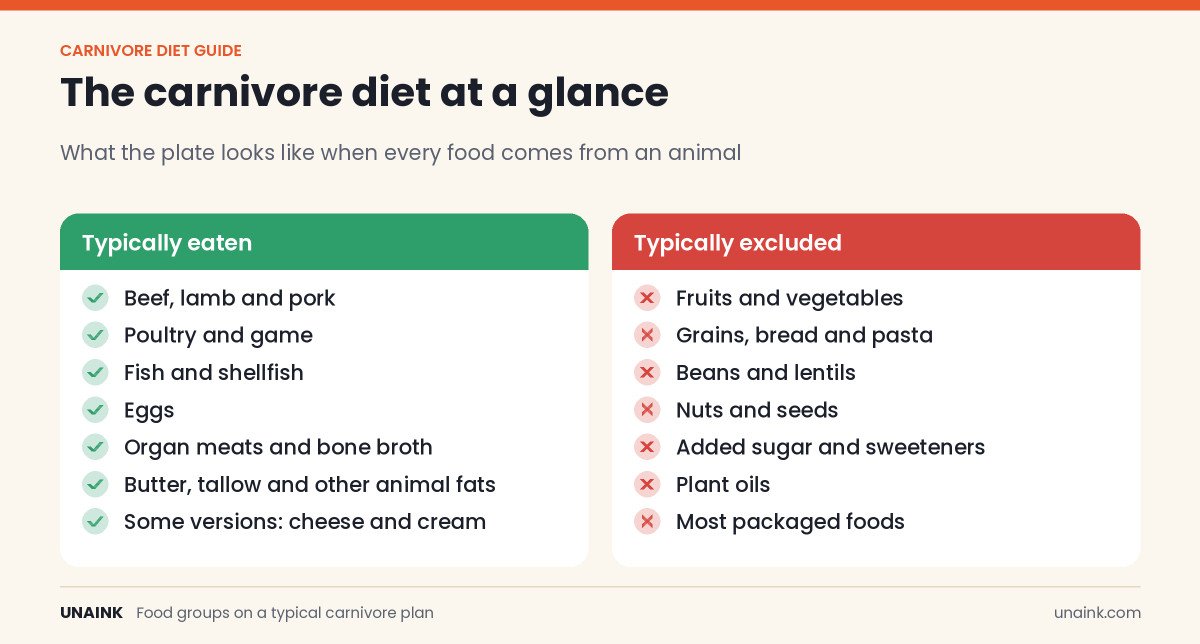
At its simplest, the carnivore diet means eating only foods that come from animals. Beef is the usual centerpiece, followed by lamb, pork, poultry, fish, shellfish and eggs. Many followers also eat organ meats and cook with butter, tallow or lard. Dairy is a grey area: some people keep cheese, cream and butter, while stricter followers drop them.
Because the diet has no official definition, it comes in several flavors. Knowing the main ones helps you read claims online more critically:
- Standard carnivore: meat, fish, eggs and animal fats, often with some dairy. Coffee, tea and salt are common extras. See the full carnivore diet food list for details.
- Lion diet: only meat from ruminants such as beef and lamb, plus salt and water. Read more in our guide to the lion diet.
- Dirty carnivore: animal-based but relaxed about seasonings, sauces and processed meats. We cover the trade-offs in the dirty carnivore diet article.
- Raw carnivore: animal foods eaten uncooked, which adds serious food safety concerns. See the raw carnivore diet risks.
- Nose-to-tail: leans on organ meats, bone broth and fatty cuts instead of only muscle meat.
Plans that add fruit, honey or a few low-carb vegetables are not strictly carnivore. They belong to relatives such as the animal based diet and the ketovore diet.
Where the Carnivore Diet Came From
Meat-heavy eating is not new. Early case reports, including those of Arctic explorer Vilhjalmur Stefansson, are often cited by supporters as proof that people can live on animal foods. The modern movement took off around 2018, helped by a book from orthopedic surgeon Dr. Shawn Baker and a wave of social media testimonials about weight loss, calmer digestion and clearer thinking.
Popularity is not proof, though. Most of what circulates online is personal stories from people who stuck with the diet and felt well, which tells us little about how the average person would fare.
How the Carnivore Diet Works
Nobody has shown a single mechanism that explains every reported benefit. These are the explanations researchers and clinicians discuss most:
- Very low carbohydrate intake. With almost no carbs, blood sugar and insulin swings tend to settle, and the body may start producing ketones. That does not always happen, as we explain in our guide on whether the carnivore diet puts you in ketosis.
- High satiety. Protein and fat are filling, so many people eat fewer calories without counting them.
- Elimination effect. Cutting every plant food and nearly every processed food at once removes many possible triggers. If symptoms improve, you still cannot tell which food was responsible.
- Simplicity. A short list of foods means fewer decisions, which makes the plan easy to follow in the short term.
What the Research Says About the Carnivore Diet
The research base is small. The most cited study is a 2021 online survey of 2,029 adults who had followed a carnivore diet for at least six months. The authors reported few adverse effects, high satisfaction and improvements in several self-rated health conditions, while noting that some cardiovascular risk factors, including LDL cholesterol, were affected in mixed ways.
That survey has clear limits. Everything was self-reported, there was no control group, and anyone who felt worse and quit would never have been counted. About 85 percent of respondents ate red meat daily, so the group was also highly committed. Science Feedback reviewed how the findings were being shared and concluded that the survey cannot be generalized to the public.
A 2026 scoping review in the journal Nutrients looked at human studies published between 2021 and 2025 and found only nine that qualified. Most were small, short and lacked control groups. The reviewers saw possible short-term gains in weight and metabolic markers. They also flagged potential shortfalls in vitamins C and D, calcium, magnesium, iodine and fiber, plus higher LDL and total cholesterol. Their conclusion was that long-term adherence cannot be recommended.
| Question | What we know so far |
|---|---|
| Does it cause weight loss? | Short-term loss is plausible because it is low in carbs and filling, but no strong trials show it beats other plans over the long run. |
| Does it improve blood sugar? | Some people with diabetes reported better numbers in a survey, which needs proper trials and medical supervision. |
| Is it safe long term? | Unknown. The best available review says it cannot be recommended. |
| Does it cure autoimmune or mental health conditions? | There is no strong evidence for this, and claims of cures go beyond the data. |
Risks and Nutrient Gaps to Know About
Removing whole food groups raises the odds of missing nutrients. The risks most often raised by researchers and clinicians are:
- Fiber and plant compounds. No fiber can mean constipation and a less varied gut microbiome.
- Vitamin C, magnesium, calcium and iodine. These can run low without plants, dairy or fortified foods, and the 2026 review flagged them specifically.
- Higher LDL cholesterol. Harvard Health notes that animal fat is mostly saturated and that very low carb diets tend to raise LDL.
- Kidney and bone concerns. The same Harvard piece lists a higher risk of kidney stones, gout and osteoporosis, and warns that very high protein can strain kidney function.
- Processed meat. The World Health Organization classifies processed meat as carcinogenic to humans, so bacon and deli meats deserve caution. Our dirty carnivore diet guide goes deeper.
Registered dietitian Kate Patton, speaking to Cleveland Clinic, said she would not recommend trying the diet. The same article notes that the plan itself steers away from highly processed meats such as sausage and deli cuts because of their additives. You can read her full comments on the Cleveland Clinic site.
Who the Carnivore Diet May Suit, and Who Should Avoid It
For most healthy adults, a plant-inclusive diet has far better long-term evidence. Still, some people will want to try carnivore eating for a short period. The table below sets out a cautious way to think about it.
| Group | Suggested approach |
|---|---|
| Healthy adults curious about a short experiment | Reasonable only as a time-limited trial, with baseline labs and a plan to review results. |
| People with food-related symptoms | An elimination plan guided by a doctor or dietitian is safer than going fully carnivore alone. |
| Pregnant or breastfeeding people, children and teens | Avoid. Nutrient needs are higher and the risks are not worth it. |
| Kidney disease, kidney stones, gout or heart disease | Avoid unless a specialist approves it. |
| High LDL or a family history of early heart disease | Speak with a doctor first, because LDL often rises. |
| Anyone with a history of disordered eating | Avoid. Extreme food rules can trigger relapse. |
| People on diabetes or blood pressure medicine | Do not change the diet without medical advice, because doses may need adjusting. |
How to Try the Carnivore Diet More Safely
- Get baseline tests. Ask for lipids, kidney function, liver enzymes, fasting glucose, vitamin B12 and vitamin D, then repeat them after a few weeks.
- Set an end date. Choose a trial length, such as 30 days, and decide in advance how you will judge the result.
- Cover the nutrient gaps. Include eggs, fatty fish and organ meats, and ask a dietitian whether you need supplements.
- Watch hydration and salt. Early fatigue and headaches are common, and fluids and sodium often help.
- Plan the exit. Reintroduce foods one at a time so you can see what, if anything, bothers you.
- Stop and call a clinician if you notice chest pain, severe fatigue, dizziness, dark urine, or any worrying change.
Carnivore Diet vs Other Low-Carb Plans
| Diet | Plant foods | Strictness |
|---|---|---|
| Keto | Low-carb plants such as leafy greens, nuts and avocado | Moderate |
| Ketovore | A few low-carb plants, mostly animal foods | Moderate to high |
| Animal based | Fruit and honey, with meat and organs as the base | Moderate |
| Carnivore | None | High |
| Lion diet | None, and only ruminant meat, salt and water | Very high |
Frequently Asked Questions
Is the carnivore diet healthy?
The honest answer is that nobody knows for the long term. Short-term changes in weight and symptoms are plausible. However, major health bodies and the 2026 scoping review point to nutrient gaps and cholesterol risks, and they do not recommend it as a lasting pattern.
Can you eat vegetables on the carnivore diet?
No. A strict carnivore diet excludes all plant foods. People who add vegetables or fruit are usually following a relative such as ketovore or an animal-based diet.
How much weight can you lose on the carnivore diet?
It varies a lot. Many people eat fewer calories because meat is filling, so they lose weight at first. There is no reliable data showing the loss is greater or more lasting than on other plans.
Is the carnivore diet the same as keto?
No. Both are very low in carbohydrate, but keto allows low-carb plant foods and sets a high fat target, while carnivore removes all plants and does not set macros. Carnivore also does not guarantee ketosis.
How long can you stay on the carnivore diet?
There is no safe maximum established by research. Most clinicians who accept it at all suggest a short, supervised trial with blood tests before and after.
Conclusion
The carnivore diet is simple, filling and surprisingly popular, but its reputation runs ahead of its evidence. The studies we have are small, short and mostly self-reported, and the nutrient and cholesterol concerns are real. If you are curious, treat it as a limited experiment with medical oversight rather than a permanent identity. If your goal is steady weight loss or better health, a varied diet with plenty of protein and plants has far stronger support.
Medical note
This article is for general education and is not medical advice. Talk with a doctor or registered dietitian before making major diet changes, especially if you have a health condition, take medication, or are pregnant or breastfeeding.
Keep Reading
- Carnivore Diet Food List: exactly what to eat and what to skip
- 9 Carnivore Diet Benefits: what the science says about each claim
- Does the Carnivore Diet Put You in Ketosis?: how ketones respond to an all-meat plate
- What Is the Lion Diet?: the strictest form of carnivore
Sources
- Lietz, Dapprich and Fischer. Carnivore Diet: A Scoping Review of the Current Evidence, Potential Benefits and Risks. Nutrients, 2026: nine human studies, nutrient and cholesterol concerns
- Lennerz et al. Behavioral Characteristics and Self-Reported Health Status among 2029 Adults Consuming a Carnivore Diet. Current Developments in Nutrition, 2021: the main survey and its limits
- Harvard Health Publishing. What is the carnivore diet?: LDL, kidney stones, gout and osteoporosis concerns
- Cleveland Clinic. Carnivore Diet: What Is It and Is It Healthy?: dietitian view on risks and processed meat
- Science Feedback. Claim review of carnivore diet survey results: limits of the self-reported survey
- Harvard T.H. Chan School of Public Health. Report says eating processed meat is carcinogenic: WHO classification of processed meat