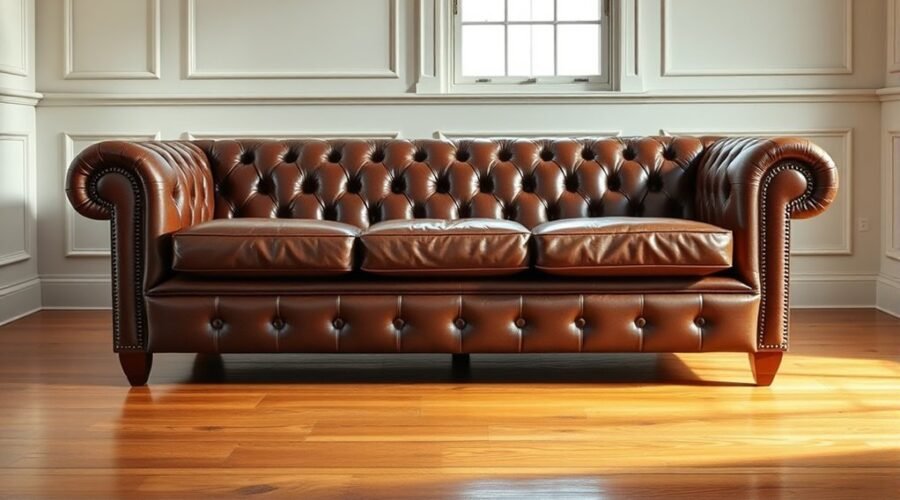
You might call a Chesterfield sofa a quiet statement, but its distinctive shape is hard to miss. Deep button tufting, rolled arms, and a low, structured profile give the design its familiar character. Traditional versions are closely associated with leather, while modern Chesterfields also appear in velvet, woven fabrics, and other upholstery.
Quick Answer
A Chesterfield sofa is a traditional upholstered sofa best known for deep button tufting, rolled arms that typically rise to about the same height as the back, and a low, structured silhouette. Leather is the classic covering, but today’s Chesterfields also come in velvet, woven fabric, and many contemporary variations.
Key Takeaways
- A Chesterfield is identified mainly by its deep button tufting, rolled arms, and structured profile, with the arms traditionally close to the height of the back.
- Leather is the classic upholstery, but velvet and other fabrics can create a softer or more contemporary look.
- The design is traditionally linked with Philip Dormer Stanhope, 4th Earl of Chesterfield, but the famous origin story is better treated as an attribution than a proven commission.
- Comfort varies significantly between models, so check seat depth, cushion filling, suspension, and back angle instead of judging by appearance alone.
- Before buying, check construction, upholstery specifications, dimensions, delivery access, warranty terms, and the return policy.
What Is a Chesterfield Sofa
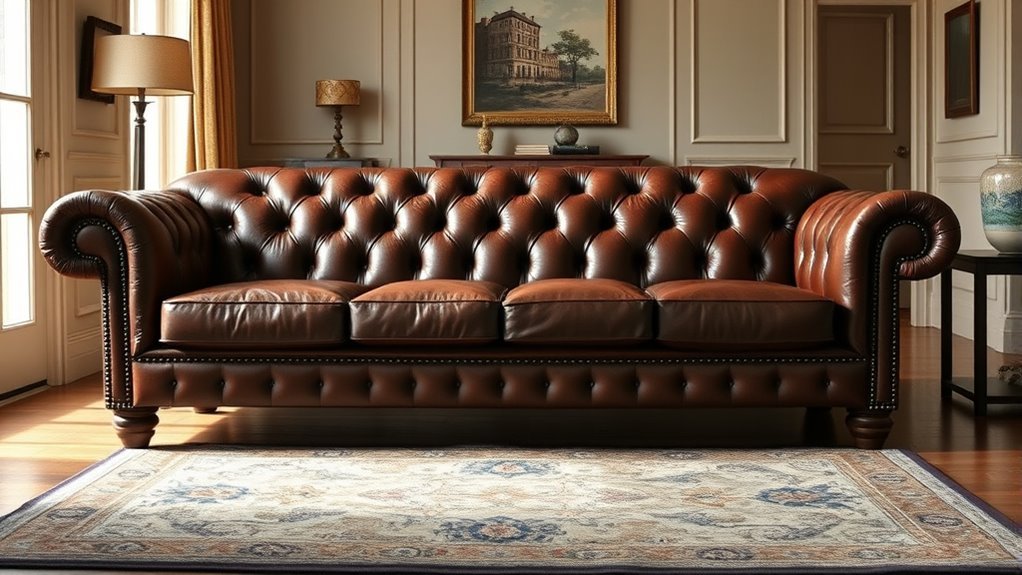
A Chesterfield sofa is a recognizable upholstered sofa style built around a structured, symmetrical silhouette. The most familiar versions have deep button tufting, generously rolled arms, and arms that rise to roughly the same level as the back.
Traditional Chesterfields are strongly associated with leather upholstery, especially dark brown, oxblood, or similar rich tones. Leather is not mandatory, however. Modern versions may use velvet, wool blends, linen-look fabrics, performance textiles, or synthetic upholstery while retaining the basic Chesterfield shape.
Deep buttoning and high rolled arms create the visual identity of a Chesterfield; leather, nailheads, and particular leg styles are traditional details rather than universal requirements.
The name describes a furniture style rather than a single brand, so two sofas sold as Chesterfields can differ greatly in dimensions, comfort, upholstery, internal construction, and price. That makes the details underneath the familiar shape especially important when you shop.
Chesterfield Sofa Design Features
Beyond its heritage, the Chesterfield’s design features are what make it so distinctive. Some elements are central to the look, while others vary from maker to maker.
| Feature | What to Expect |
| Deep button tufting | Buttons pull the upholstery inward to create the characteristic diamonded or pleated surface, most often across the back and arms. |
| Rolled arms | Large rounded arms form the sides of the sofa and traditionally sit close to the height of the back. |
| Structured silhouette | The back and arms usually look tailored and substantial rather than loose or pillow-like. |
| Leather or fabric upholstery | Leather is traditional, but contemporary Chesterfields are available in many fabrics. |
| Optional details | Nailhead trim, turned feet, casters, tufted seats, loose seat cushions, and different leg shapes vary by model. |
A hardwood frame can be a positive construction feature, but the species of wood alone does not tell you whether a sofa is well made. Joint construction, reinforcement, suspension, cushion materials, upholstery work, and overall stability also matter.
Likewise, deep buttoning should look consistent and intentional. Uneven folds, loose buttons, puckered seams, or obvious changes in tension can signal rushed upholstery work.
Chesterfield Sofa Origins and History
The Chesterfield has a famous origin story, but it helps to separate tradition from documented history.
The design is commonly linked with Philip Dormer Stanhope, 4th Earl of Chesterfield, who lived from 1694 to 1773. According to the traditional story, he commissioned an upholstered seat that allowed a gentleman to sit upright without disturbing his clothing.
Note: The Stanhope commission is a widely repeated attribution, not a firmly documented furniture commission with a surviving designer, order, or dated original sofa. It is more accurate to describe it as part of Chesterfield tradition than as proven fact.
The name itself has clearer later evidence. The Dictionary of Canadianisms on Historical Principles records chesterfield as a name for a buttoned upholstered couch and cites printed use from the late 19th century. Etymological references likewise place the sofa sense of the word in the 19th century.
That matters because the Chesterfield we recognize today was not necessarily created in one finished form on one specific day. Furniture styles evolve through makers, changing upholstery methods, regional preferences, and later reinterpretations.
Was Freud’s Famous Couch a Chesterfield?
Sigmund Freud’s couch is often pulled into discussions of classic upholstered furniture, but it should not be used as proof of Chesterfield history. The Freud Museum London documents that the couch was given to Freud by a patient around 1890 and was covered with a Qashqa’i rug. The museum does not identify it as a Chesterfield.
The distinction is useful: a famous antique couch, a buttoned sofa, and a Chesterfield are not automatically the same thing.
Why Is “Chesterfield” Sometimes Used to Mean Any Sofa?
The word has also had a broader regional meaning. In Canadian English, chesterfield was historically used as a general word for a couch or sofa, although that usage declined as couch and sofa became more common. That is why an older Canadian speaker may use “chesterfield” without referring specifically to the button-tufted British style.
Why Chesterfield Sofas Became a Status Symbol
By the time Chesterfield sofas became well established in popular design culture, their substantial proportions, labor-intensive buttoning, and association with leather gave them a formal presence that worked naturally in traditional drawing rooms, offices, clubs, libraries, and other interiors intended to look established and polished.
The deep button tufting, rolled arms, and tailored silhouette create strong light and shadow across the upholstery, so the piece tends to command attention even without bright colors or patterns.
Leather strengthened that impression. A large leather sofa can develop surface character as it is used, and darker finishes have long suited traditional interiors. However, calling every Chesterfield a status symbol would overstate the case. Today the design appears across a wide range of prices, materials, and manufacturing methods.
Its modern appeal comes less from one social meaning and more from the fact that the shape is immediately recognizable. You can use it to reinforce a classic room or deliberately contrast it with cleaner contemporary furniture.
Chesterfield Sofa Comfort and Materials
A Chesterfield can be comfortable, but the silhouette alone does not determine comfort. Traditional-looking models are often more structured than deep, pillow-heavy lounging sofas, while modern versions may use softer seat cushions and deeper proportions.
When comparing sofas, pay attention to:
- Seat depth: A shallower seat generally favors upright sitting, while a deeper seat gives you more room to lounge.
- Seat height: Your feet should be able to rest comfortably when seated if upright comfort matters to you.
- Cushion filling: Foam, fiber, feather blends, and layered combinations feel different and require different amounts of maintenance.
- Suspension: Springs, webbing, and other support systems affect how the seat responds under your weight.
- Back angle: Two Chesterfields can look similar from the front but provide very different posture because of their internal back angle and padding.
- Arm shape: High rolled arms create the signature outline but may feel less convenient than lower arms if you regularly stretch out across the sofa.
Pro Tip: If comfort is a priority, sit on the exact model before buying when possible. A Chesterfield’s appearance tells you very little about its seat firmness, depth, cushion recovery, or back support.
Leather Chesterfield Sofas
Leather gives the Chesterfield its most traditional look. Before paying a premium, ask exactly what type of leather is used and which parts of the sofa are leather. Terms such as full-grain, top-grain, corrected leather, split leather, bonded leather, and synthetic leather describe different materials or constructions.
Do not treat the phrase “genuine leather” by itself as a complete quality specification. Ask for the upholstery description in writing and follow the manufacturer’s cleaning instructions for that particular finish.
Fabric and Velvet Chesterfields
Velvet emphasizes the shadows created by deep tufting and can make the Chesterfield feel less formal. Woven fabrics can create a warmer, softer appearance and may offer a wider range of colors and patterns.
Fabric performance varies widely, so consider abrasion resistance, stain-cleaning instructions, sunlight exposure, pets, children, and whether cushion covers can be removed before choosing a material.
Modern Chesterfield Sofa Styles
Modern Chesterfield sofas now come in a broad range of looks, from classic leather to colorful fabrics and cleaner contemporary interpretations.
You are not limited to one mood. A dark leather model with turned wood feet can lean strongly traditional, while velvet, lighter upholstery, slim legs, or simplified trim can make the same basic silhouette feel more contemporary.
Choose the Chesterfield’s upholstery, scale, and details to suit the room rather than assuming the traditional dark-leather version is the only authentic-looking option.
Some versions use overstuffed cushions for a softer sit, while others stay firm and tailored. You can also find loveseats, chairs, sofa beds, modular pieces, and sectional designs that borrow Chesterfield elements.
Because there is no single manufacturer controlling the name, customization options vary widely. One maker may offer dozens of fabrics and custom dimensions, while another may offer only a few fixed combinations.
That flexibility lets you create a Chesterfield that feels traditional or current without relying on unverified model names or manufacturer-specific claims.
How to Choose Chesterfield Upholstery
The best upholstery depends on how you will use the sofa rather than on appearance alone.
| Material | Why You Might Choose It | What to Check |
| Leather | Traditional appearance and a surface that is easy to wipe when the finish allows it. | Leather type, finish, cleaning instructions, sunlight exposure, and which panels are actually leather. |
| Velvet | Rich texture and strong color with dramatic tufting. | Pile marking, cleaning code, stain resistance, and pet suitability. |
| Woven fabric | A softer, more casual look with many textures and patterns. | Abrasion rating, weave tightness, cleaning method, and fading resistance. |
| Synthetic leather | Can provide the leather look at a lower initial price. | Exact material composition, warranty coverage, heat exposure, cracking or peeling risks, and care instructions. |
How to Measure for a Chesterfield Sofa
Chesterfields often look visually heavier than simpler sofas because the rolled arms and thick back consume space. Measure the actual model instead of relying on a label such as “two-seater” or “three-seater,” because those terms do not guarantee standardized dimensions.
Before ordering, record the sofa’s overall width, depth, height, seat height, and seat depth. Then compare those numbers with the usable room area rather than only the wall length.
- Measure door openings, hallway widths, stair turns, elevators, and any tight corners along the delivery path.
- Check whether removable legs or other detachable parts reduce the delivery dimensions.
- Leave enough space for normal walking routes and nearby doors, drawers, or cabinets to open.
- Use painter’s tape on the floor to mark the sofa’s full footprint before buying.
- If the sofa must pass through a difficult turn, ask the retailer for packaged dimensions as well as assembled dimensions.
Pro Tip: Measure the narrowest point of the complete delivery route, not just your front door. Rolled arms and a fixed back can make a Chesterfield harder to maneuver than its seat width suggests.
How to Spot a Quality Chesterfield Sofa
A well-made Chesterfield does not just look handsome from across the room—it shows its quality in the details.
Start with deep button tufting. The buttons and folds should look consistently spaced, firmly secured, and intentional. Look closely at the pleats around curves and corners, where weak upholstery work is easier to notice.
Next, check the frame. Solid hardwood can be an excellent material, but ask how the frame is joined and reinforced rather than accepting “hardwood frame” as a complete quality guarantee. The sofa should feel stable when you sit, shift your weight, or gently test the arms.
Then study the covering. With leather, ask for the actual leather type and finish instead of relying on vague labels. With fabric, ask for the fiber content, care code, and available durability information.
You will also want the classic silhouette: substantial rolled arms, deep upholstery detailing, and the characteristic high-arm/low-back visual line. Exact proportions differ among makers, so judge the complete shape rather than one measurement.
Finally, read the warranty rather than judging quality by warranty length alone. A lifetime guarantee or long frame warranty can sound impressive, but what matters is what the warranty actually covers, what it excludes, whether labor and shipping are included, and whether coverage is transferable.
Chesterfield Sofa Quality Checklist
- Frame: Stable, square, and free of noticeable flex or wobble.
- Joints: Ask how the frame is joined and reinforced.
- Suspension: Find out whether the model uses springs, webbing, or another support system.
- Cushions: Check filling type, firmness, recovery, and whether cushions are reversible or removable.
- Tufting: Buttons should be secure and folds should look consistent.
- Seams: Stitching should be straight, tight, and clean around curved areas.
- Upholstery: Request the exact leather or fabric specification.
- Legs: Check attachment, stability, and whether they are removable for delivery.
- Warranty: Read covered components, exclusions, labor terms, and claim procedure.
- Returns: Check whether custom upholstery or made-to-order sizes are returnable.
U.S. Upholstered-Furniture Safety Label
If you are buying a new upholstered Chesterfield in the United States, check the permanent compliance label when applicable. The U.S. Consumer Product Safety Commission explains that covered upholstered furniture manufactured, imported, or reupholstered on or after June 25, 2021 must meet the federal smolder-resistance requirements in 16 CFR Part 1640. The permanent labeling requirement applies to covered furniture manufactured, imported, or reupholstered on or after June 25, 2022.
Note: Furniture regulations differ by country. The CPSC requirement above applies to covered products in the United States and should not be treated as a worldwide standard.
How to Care for a Chesterfield Sofa
The deep folds that make a Chesterfield attractive also create places where dust, crumbs, and pet hair can collect. Regular light cleaning is easier than allowing debris to build up around buttons and pleats.
- Vacuum tufted areas gently with an upholstery attachment or soft brush.
- Blot spills instead of rubbing them deeper into the upholstery.
- Follow the manufacturer’s cleaning instructions for the exact leather or fabric.
- Avoid assuming that a household cleaner is safe simply because it works on another sofa.
- Protect upholstery from unnecessary direct sunlight and heat when the manufacturer warns that these can cause fading, drying, or other damage.
- Rotate or reposition removable cushions when the maker recommends it so wear develops more evenly.
- Inspect buttons, seams, and cushion edges periodically so small problems can be addressed before they worsen.
Leather care deserves particular caution because different finishes tolerate different products. Use the cleaner or conditioner recommended for your specific upholstery rather than applying oils, polishes, or homemade mixtures without checking compatibility.
Frequently Asked Questions
What Are the Disadvantages of Chesterfield Sofas?
Chesterfields can feel firmer and more upright than deep lounging sofas, and their rolled arms and substantial frames can take up considerable space. Deep tufting also collects dust in its folds, while some upholstery requires specialized cleaning. Large fixed-frame models may be difficult to move through narrow halls or doorways, so measuring before purchase is important.
What Is the Difference Between a Sofa and a Chesterfield?
A sofa is the broad furniture category. A Chesterfield is a particular sofa style traditionally associated with deep button tufting, rolled arms, a structured profile, and arms that rise close to the height of the back. A standard sofa can use almost any back, arm, cushion, or upholstery design.
Why Was a Sofa Called a Chesterfield?
The name is traditionally connected with the Earls of Chesterfield, especially Philip Dormer Stanhope, the 4th Earl. A popular story says he commissioned an upright upholstered seat, but that story is not securely documented. The word chesterfield is clearly recorded as a sofa term in 19th-century usage.
Are Chesterfield Sofas Outdated?
No single furniture style suits every room, but Chesterfields are still produced in both traditional and contemporary forms. Leather, velvet, neutral fabrics, brighter colors, simplified trim, and different leg styles let the familiar tufted silhouette work in interiors ranging from traditional libraries to more modern living rooms.
Are Chesterfield Sofas Comfortable?
They can be, but comfort varies significantly. Traditional versions often favor structured, upright seating, while modern models may use deeper seats and softer cushions. Check seat depth, seat height, cushion filling, suspension, and back angle, and try the exact model before buying when possible.
How Can You Tell Whether a Chesterfield Sofa Is Well Made?
Look for a stable frame, secure and evenly tensioned tufting, clean stitching, well-supported cushions, consistent upholstery, and sturdy legs. Ask for details about frame joints, suspension, cushion materials, upholstery type, warranty coverage, and return terms instead of relying only on appearance or a brand’s marketing language.
Conclusion
When you choose a Chesterfield sofa, you are choosing one of furniture’s most recognizable silhouettes: deep button detailing, substantial rolled arms, and a structured profile that can look traditional or surprisingly contemporary depending on the upholstery and finish.
The design’s famous link to the 4th Earl of Chesterfield is best understood as a long-standing attribution rather than perfectly documented origin history. For a modern buyer, the more important questions are practical: whether the sofa fits your room and delivery route, whether the seat feels comfortable to you, what materials and construction are actually used, and what the warranty covers. Get those details right and the familiar Chesterfield shape can work as much more than a decorative statement.
Sources
- Dictionary of Canadianisms on Historical Principles — “chesterfield” — documents the furniture meaning, early printed usage, and the broader Canadian use of the word for a sofa.
- UK Parliament Heritage Collections — Philip Dormer Stanhope, 4th Earl of Chesterfield — confirms Stanhope’s identity and dates, 1694–1773.
- Freud Museum London — Every Piece of Dust on Freud’s Couch — documents the history and covering of Freud’s famous couch without identifying it as a Chesterfield.
- U.S. Consumer Product Safety Commission — Upholstered Furniture — explains current U.S. upholstered-furniture flammability and labeling requirements under 16 CFR Part 1640.