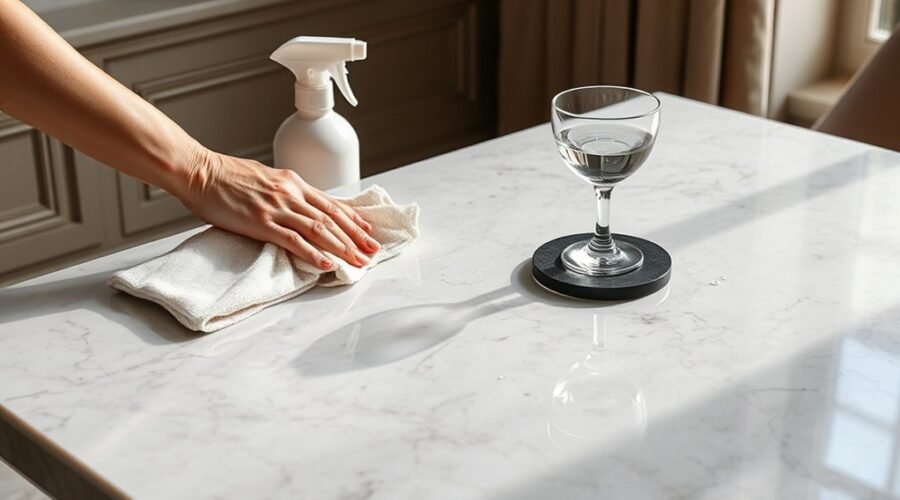
Marble tabletops can stay beautiful for years, but they need fast spill cleanup and the right cleaning products. Acidic liquids such as lemon juice, vinegar, wine, and tomato-based foods can chemically etch marble, while oils, coffee, wine, and other liquids may leave stains. Use a soft cloth, a marble-safe cleaner, coasters, trivets, and an appropriate penetrating sealer when the stone needs one.
Quick Answer
Protect a marble tabletop by blotting spills immediately, cleaning with a neutral or marble-safe product, keeping acidic liquids off the stone, and using coasters and trivets. A penetrating sealer can slow staining but will not stop acid etching. Test absorbency periodically and follow the sealer manufacturer’s reapplication instructions.
Key Takeaways
- Acid etching and staining are different problems: etching changes the finish, while a stain changes the stone’s color.
- Blot spills rather than wiping them across the surface, then clean, rinse, and dry the area.
- Avoid vinegar, lemon-based cleaners, abrasive powders, and products not approved for marble.
- A penetrating sealer improves stain resistance but does not make marble acid-proof or stain-proof.
- Use an absorption test and the sealer manufacturer’s instructions instead of assuming every marble table needs resealing every 6 to 12 months.
- Light etching may respond to a marble polishing product, but large, deep, honed, or uneven areas are better handled by a stone-restoration professional.
At a Glance
| Time Required | A few minutes for routine cleanup; about 20 minutes for an absorption test; longer for stain treatment |
| Difficulty | Easy for routine care; moderate for stain or etch correction |
| Tools Needed | Soft white or microfiber cloths, warm water, marble-safe cleaner, coasters, trivets, and an appropriate sealer or polishing product when needed |
| Cost | Low for routine care; varies for sealers, polishing products, poultices, or professional restoration |
What Causes Marble Tabletop Etching?
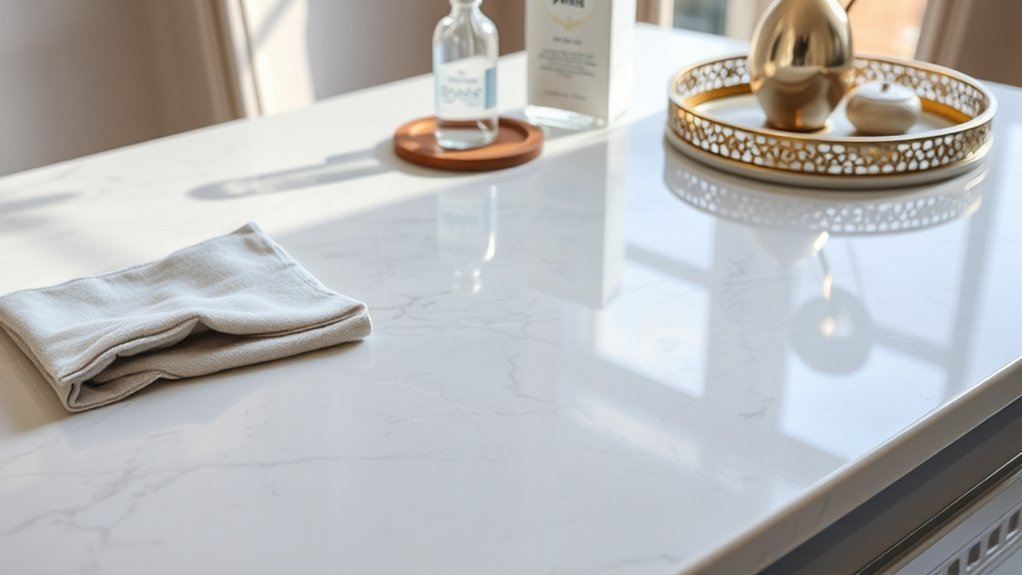
Marble tabletop etching occurs when an acidic substance reacts with the stone’s calcium-carbonate minerals and changes the surface finish. Common household sources include lemon and other citrus juices, vinegar, wine, tomato products, and acidic cleaning products.
The Natural Stone Institute classifies marble as a calcareous stone and notes that calcium-carbonate stone is sensitive to acidic solutions. On polished marble, an etch usually appears as a pale, dull, or less reflective area.
Etching vs. Staining
An etch mark is chemical damage to the finish. A stain is material that has entered the pores and changed the stone’s color. The same spill can sometimes cause both problems. For example, wine may discolor a porous surface while its acidity also affects the finish.
- Dull or whitish area: often points to etching.
- Darkened or colored area: more often indicates absorbed liquid or a stain.
- Scratch you can see or feel: mechanical damage rather than chemical etching.
Longer contact generally gives an acidic spill more opportunity to damage the finish, so the safest response is immediate cleanup rather than waiting to see whether a mark develops.
Note: A penetrating marble sealer can slow the absorption of staining liquids, but it does not stop the chemical reaction between an acid and marble.
Clean Marble Tabletop Spills Right Away
Spills on a marble tabletop should be handled as soon as practical. The goal is to remove the liquid without spreading it over a larger area or scrubbing particles into the finish.
Wipe Spills Immediately
For a fresh spill, use this simple routine:
- Blot the liquid. Press a clean, soft cloth or paper towel onto the spill. Do not wipe it across the table.
- Remove residue. Clean the area with warm water and a marble-safe neutral cleaner or a small amount of mild liquid dish detergent suitable for the stone.
- Rinse. Remove remaining cleaner with clean water so it does not leave a film.
- Dry thoroughly. Use a clean soft cloth rather than leaving standing water on the surface.
- Inspect after drying. Check for discoloration, a dull patch, or a visible scratch so you know whether you are dealing with a stain, etch mark, or physical damage.
The Natural Stone Institute likewise recommends blotting spills immediately, rinsing after cleaning, and drying the stone thoroughly.
Prevent Stains Fast
Different spills create different risks. Acidic liquids deserve immediate attention because they may etch the finish, while oils and strongly colored liquids can penetrate absorbent marble and leave discoloration.
| Spill type | Main risk | First response |
|---|---|---|
| Water | Temporary darkening or water marks on absorbent stone | Blot and dry |
| Wine | Etching plus possible organic staining | Blot immediately, clean, rinse, and dry |
| Citrus juice or vinegar | Rapid acid etching | Blot immediately, clean with a marble-safe product, rinse, and dry |
| Coffee or tea | Organic staining | Blot, clean, rinse, and inspect after drying |
| Cooking oil | Dark oil-based stain | Blot without spreading; use stain-specific treatment if a dark mark remains |
| Unknown liquid | Variable | Blot, clean gently, rinse, dry, and identify any remaining mark before treating it |
Choose a Marble-Safe Cleaner
For routine care, use a cleaner specifically labeled as safe for marble or natural stone. A neutral stone cleaner is the simplest choice. The Natural Stone Institute also permits a mild liquid dishwashing detergent with warm water for general stone cleaning, provided the surface is rinsed and dried afterward.
Avoid assuming that a cleaner is safe just because it is marketed as “natural,” “all-purpose,” or “glass cleaner.” Check the exact product label and its compatibility with marble.
- Usually appropriate: neutral stone cleaner, stone soap, or a mild cleaner specifically approved for marble.
- Avoid: vinegar, lemon-based cleaners, acidic bathroom products, abrasive scouring powders, and products that are not approved for marble.
- Test first: when trying a new compatible product, test a small inconspicuous area before cleaning the whole tabletop.
- Use a soft applicator: microfiber or another non-abrasive cloth reduces scratch risk.
Warning: Never mix bleach and ammonia. The combination can create dangerous toxic gases. Also keep acidic cleaners such as vinegar away from marble unless a stone professional specifically directs otherwise.
Using extra cleaner does not necessarily improve cleaning. Too much soap can leave a film, so follow the product’s dilution and application instructions and rinse away residue when required.
Protect Marble With Coasters and Trivets
Daily prevention is easier than repairing an etched or stained tabletop. Put coasters beneath beverages, especially citrus drinks, wine, soda, and other liquids that may be acidic or strongly colored.
Choose coasters with a clean, non-abrasive underside and enough coverage to catch condensation. Cork, silicone, felt-backed, and similar materials can work when they are clean and do not trap grit against the marble.
Use trivets or mats beneath hot cookware and serving dishes. The Natural Stone Institute recommends trivets or mats for natural-stone surfaces even though many stones tolerate heat.
The easiest marble repair is the one you prevent: block acidic liquids, condensation, grit, and hot cookware before they contact the surface.
Also check the bottoms of decorative objects, bowls, vases, and serving pieces. Dust or grit trapped underneath can scratch polished marble when an object is dragged across the table.
Seal Your Marble Tabletop When It Needs It
A penetrating or impregnating sealer can reduce the rate at which water- and oil-based substances enter absorbent marble. It should be viewed as stain resistance, not as a waterproof coating or an acid barrier.
The Natural Stone Institute notes that sealing does not make stone stain-proof and that the need for sealing varies. Follow the instructions from your stone supplier and the manufacturer of the specific sealer applied to your table.
That means a blanket “reseal every 6 to 12 months” rule is not reliable for every marble tabletop. Frequency depends on the marble’s absorbency, finish, sealer chemistry, application quality, cleaning practices, and amount of use. Some products call for relatively frequent maintenance; others have much longer expected service intervals.
Pro Tip: Keep the name of the sealer used on the table. Its technical data sheet is more useful than a generic resealing calendar because it tells you compatibility, curing time, expected wear, and reapplication instructions.
If the tabletop is used for food preparation, confirm that the chosen sealer is appropriate for that application and use it exactly as directed.
Check If Your Marble Seal Still Works
A controlled water-absorption test can help show how readily the marble is taking up moisture. However, it cannot by itself prove that a sealer is present because naturally dense stone may also absorb very little water.
Water Bead Test
LATICRETE’s stone-testing guidance describes a simple water test using small areas of water observed for about 20 minutes. For a tabletop, first confirm that this test is compatible with your marble and sealer instructions.
- Choose two or three clean, inconspicuous test areas.
- Place a small amount of water on each area.
- Leave the water undisturbed for about 20 minutes, or for the period specified by your sealer manufacturer.
- Observe whether the stone darkens or the water visibly absorbs.
- Blot the water and dry the area completely.
- Little or no absorption: the surface is resisting water well, although the test alone cannot tell whether that is because of a sealer or naturally dense stone.
- Slow darkening or absorption: the stone may have limited protection or may simply be moderately absorbent.
- Rapid darkening or absorption: consult the existing sealer’s instructions or a stone professional to determine whether resealing is appropriate.
Repeat the test only as needed and in line with the sealer manufacturer’s maintenance guidance.
Note: Good water repellency does not mean the marble is protected from lemon juice, vinegar, wine, or another acid. Etching and liquid absorption are different mechanisms.
Signs Of Seal Wear
The most useful sign that stain protection may have declined is a change in absorption compared with the stone’s previous performance. If water or oil darkens the marble substantially faster than it did after sealing, review the sealer manufacturer’s reapplication instructions.
Dull spots and loss of gloss should not automatically be blamed on seal wear. On marble, dull areas often indicate etching or physical wear that requires a different treatment.
Likewise, a rough patch, scratch, chip, or crack is a surface-damage problem rather than evidence that an impregnating sealer has simply worn out.
Prevent Stains on Marble Tabletops
Stain prevention starts with controlling how long liquids remain on the surface. Blot spills promptly, use coasters and protective mats, and keep oil, cosmetics, strongly colored foods, and beverages from sitting on the marble.
- Place coasters beneath beverages and moisture-producing décor.
- Use protective pads beneath soap dispensers, oil bottles, cosmetics, plant containers, and similar items.
- Use only products compatible with marble.
- Do not assume sealing makes the tabletop stain-proof.
- Dry standing moisture rather than allowing it to remain on the stone.
- Lift objects rather than dragging them across the finish.
What to Do If a Stain Remains
If discoloration remains after normal cleaning, identify the stain before treating it. The Natural Stone Institute’s stain-removal guidance separates stains into categories such as oil-based, organic, metallic, biological, ink, and paint because each type may require a different treatment.
Deep or stubborn stains may require a poultice. A poultice combines an absorbent material with an appropriate cleaning agent so the stain can be drawn from the stone while the mixture dries. Do not improvise with random chemicals: using the wrong chemical can discolor or etch marble.
If the stain source is unknown, if the tabletop is valuable, or if an attempted treatment could alter the finish, use a professional stone-restoration service.
Fix Light Etching on Marble Surfaces
Some light etching on polished marble can be improved with a marble polishing powder or another product specifically designed for the stone and finish. The Natural Stone Institute describes marble polishing powder as one method for addressing etch marks that remain after staining has been removed.
| Step | Action | Purpose |
|---|---|---|
| 1 | Clean and rinse the marble | Removes residue that could interfere with repair |
| 2 | Identify the finish and test an inconspicuous area | Reduces the risk of creating an uneven sheen |
| 3 | Apply a marble polishing product exactly as directed | Targets a light etched area |
| 4 | Stop if the sheen becomes uneven | Prevents a small repair from becoming a larger refinishing problem |
Do not treat every dull spot with abrasive polishing. Honed marble intentionally has a lower-sheen finish, and aggressive spot-polishing can create a shiny patch that looks different from the surrounding surface.
Likewise, routine polishing is not necessary simply because the tabletop is marble. Polish only when the finish requires correction and when the product is appropriate for that finish.
Call a Professional for Deep Marble Damage
Professional restoration is the safer choice when the problem extends beyond a small, superficial mark. Stone-restoration technicians can assess the finish and use controlled honing and polishing methods to blend a damaged area with the surrounding surface.
Consider professional help when:
- etching covers a large area or is visibly deeper than the surrounding finish
- a DIY polishing attempt produces an uneven shine
- the tabletop has a honed, satin, textured, or specialty finish that must be matched
- deep scratches, chips, cracks, or edge damage are present
- a stain remains after appropriate cleaning or poultice treatment
- you do not know what caused the stain or discoloration
- the stone is valuable enough that experimenting with chemicals is not worth the risk
Deep scratches and stubborn etch marks usually require refinishing rather than stronger household cleaner. Stronger chemicals can make marble damage worse instead of fixing it.
Frequently Asked Questions
How Can I Protect My Marble Countertops From Etching?
Keep acidic liquids such as vinegar, citrus juice, wine, and acidic cleaners away from the marble, use coasters, and blot spills promptly. Clean with a product approved for marble. A penetrating sealer can reduce staining but cannot stop the chemical reaction that causes acid etching.
How to Fix Etching on Marble Countertops?
First confirm that the mark is etching rather than a stain. Some small etch marks on polished marble can respond to a marble polishing product used according to its instructions. Deep, widespread, honed, or uneven damage is better refinished by a professional stone-restoration specialist.
What Are the Downsides of Marble Dining Tables?
Marble is more sensitive to acidic foods and cleaners than many common tabletop materials. It can etch, stain, scratch, chip, and require periodic maintenance. Protective coasters, trivets, careful cleaning, and appropriate sealing can reduce problems, but they do not make marble maintenance-free.
Can I Use Windex on My Marble Countertop?
Do not treat all Windex products as interchangeable. SC Johnson currently recommends using a Windex Multi-Surface product rather than Windex Original Glass Cleaner on marble countertops and describes its multi-surface cleaner for sealed marble. However, Windex Vinegar contains vinegar and should be avoided on acid-sensitive marble. For routine care, a dedicated marble-safe or neutral stone cleaner remains the simplest choice. Always follow the exact product label.
Does Sealing Marble Prevent Etching?
No. Penetrating sealers are designed mainly to reduce absorption and improve stain resistance. They do not prevent acids from reacting with the calcium-carbonate minerals in marble. Coasters, correct cleaners, and immediate spill removal remain essential even on sealed marble.
How Often Should a Marble Table Be Sealed?
There is no single schedule that fits every marble table. Follow the sealer manufacturer’s expected-wear and reapplication instructions and check how quickly the stone absorbs water. Dense marble or a long-lasting sealer may need attention less often than a highly absorbent, heavily used surface.
Conclusion
Marble tabletop etching is chemical damage caused when acids react with the stone, while stains occur when substances penetrate and discolor it. Protect the surface by blotting spills quickly, using marble-safe cleaners, placing coasters and trivets where needed, and avoiding vinegar and other acidic products. Use penetrating sealers to improve stain resistance when appropriate, but do not expect them to prevent etching. Test absorption and follow the sealer manufacturer’s maintenance instructions instead of relying on a universal resealing schedule. Small etch marks may be repairable, while deep or uneven damage is best handled by a stone-restoration professional.
Sources
- Natural Stone Institute — Care & Cleaning of Natural Stone — marble composition, acidic cleaners, spill cleanup, coasters, trivets, cleaners, sealing, and general stone care.
- Natural Stone Institute — Stain Removal — stain identification, poultices, etch marks, polishing powder, and professional restoration.
- Natural Stone Institute — Sealing Natural Stone Countertops — when natural-stone counters may benefit from penetrating sealers.
- LATICRETE — Sealed Stone Testing and Treatment — water-absorption testing and interpretation of stone/sealer performance.
- SC Johnson — Windex Original Glass Cleaner — current manufacturer guidance directing marble-countertop users to a multi-surface product.