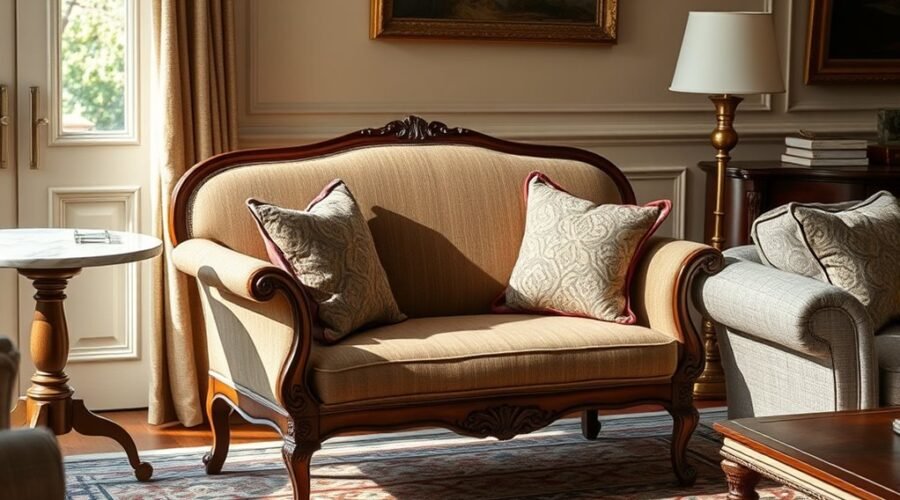
A settee and a small sofa can describe very similar furniture, and the terms sometimes overlap. The practical difference is usually in design and intended use: furniture sold as a settee often has a slimmer, more upright or decorative profile, while a small sofa is more likely to emphasize deeper cushions and everyday lounging. Size alone does not define either one.
Quick Answer
A settee is essentially a sofa-like seat for two or more people, but the name often suggests a compact, upright, or decorative design. A small sofa usually prioritizes relaxed everyday comfort. There is no official width that separates them, so compare the actual dimensions, seat depth, cushioning, and intended use rather than the label alone.
Key Takeaways
- In everyday English, settee, sofa, and couch can overlap; “settee” is not a completely separate technical furniture category.
- Historically, many settees had relatively upright backs and chair-like frames, while deeper sofas developed for more relaxed sitting and reclining.
- There is no universal 48-, 60-, or 70-inch cutoff that determines whether a piece is a settee or small sofa.
- A settee often works well as compact or accent seating in an entry, bedroom, dining area, office, or conversation space.
- For daily lounging, judge seat depth, cushion construction, back support, usable seat width, and overall footprint rather than relying on the product name.
Settee Vs Small Sofa: The Main Difference
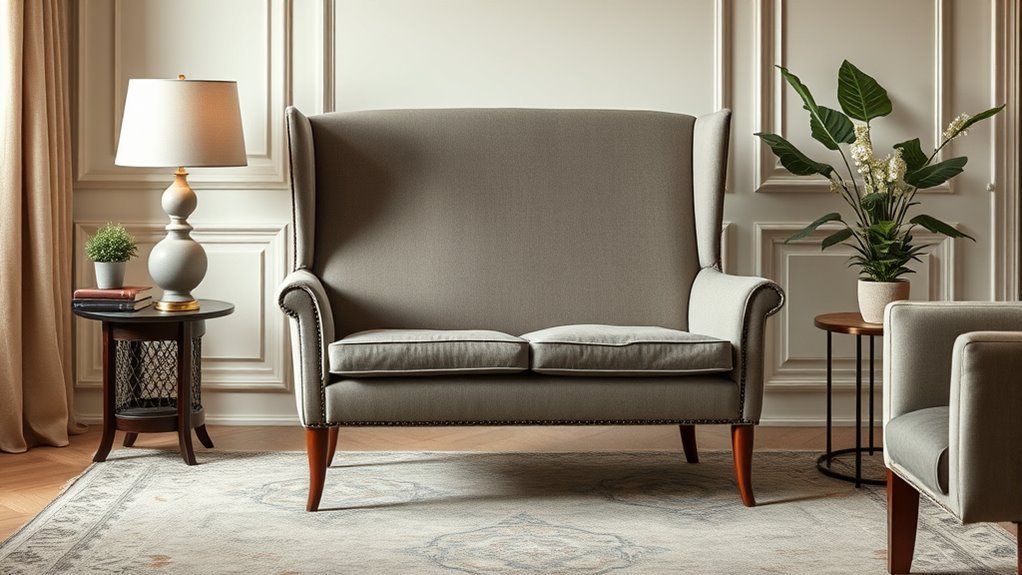
The clearest difference between a settee and a small sofa is usually how the individual piece is designed, not what a strict dictionary rule says it must be. Furniture marketed as a settee often has a visually lighter frame, relatively upright seating, exposed legs, decorative woodwork, or a shallower profile. A small sofa may have deeper cushions, broader arms, and a more relaxed shape.
The terminology is flexible. The Oxford Advanced Learner’s Dictionary defines a settee as comfortable seating for two or more people and gives sofa and couch as synonyms. That means two retailers could describe similar pieces with different names.
Think of “settee” as a useful design clue, not a regulated size category: it often suggests a more upright or decorative seat, while “small sofa” usually emphasizes everyday lounging.
| Feature | Settee | Small Sofa |
|---|---|---|
| Terminology | Can mean a sofa-like seat; often used for compact, decorative, or historically styled seating | General retail term for a sofa with a smaller footprint |
| Typical visual character | Often tailored, light, upright, or accent-oriented | Often fuller, softer, or lounge-oriented |
| Dimensions | No fixed standard; compact and large examples both exist | No single industry cutoff for “small” |
| Seating feel | May encourage upright sitting, depending on depth and cushions | Often designed for longer, relaxed sitting |
| Common role | Accent seating, conversation seating, dining, bedroom, entry or office | Primary or secondary living-room seating |
What Is a Settee?
A settee is a seat with a back for more than one person. Many settees are upholstered and have arms, although furniture carrying the name has appeared in a wide variety of forms.
In modern interiors, the label often appears on pieces that feel more compact, decorative, or chair-like than a conventional full-size sofa. That is a design tendency rather than a mandatory definition.
Settee Definition
Modern dictionaries show why the word can be confusing. Oxford describes a settee as a long, comfortable seat with a back and arms for two or more people and lists sofa and couch as synonyms. Cambridge Dictionary similarly uses the term for seating for two or more and identifies it as a synonym for sofa in British English.
In furniture retail and interior design, however, settee can carry a narrower stylistic implication. A product with a slim frame, exposed legs, tailored upholstery, or a relatively upright seat is more likely to receive the settee label than an overstuffed lounging sofa.
Note: Furniture names are not a substitute for specifications. Two pieces called “settees” can have very different widths, depths, arm styles, cushion firmness, and seating capacity.
Settee Origins
The history is more precise than simply saying the settee began as a medieval upholstered sofa. The older settle was a high-backed wooden bench. The word settee appeared later; Oxford dates it to the early 18th century and describes it as perhaps a variant of settle.
By the 18th century, upholstered settees were established furniture forms. A ca. 1765 American settee in The Metropolitan Museum of Art, for example, has a high back and low arms. The museum notes that such settees supported multiple seated occupants, while the larger and deeper sofas that followed were better suited to informal lounging and reclining.
That historical distinction helps explain the modern association between the word settee and a more upright, composed piece. It should not, however, be treated as a rule covering every contemporary product.
Settee Meaning And Word Origins
The words settle, settee, and sofa describe related but historically different ideas. A settle is the older bench-like form. Settee emerged later, probably from or alongside that term, while sofa has a separate linguistic origin and developed into a broad name for upholstered multi-person seating.
| Term or Feature | Historical or Modern Meaning |
|---|---|
| Settle | Older wooden bench form with a back; an important linguistic and furniture ancestor of the settee |
| Settee | Multi-person seating; historically associated with chair-like frames and today often used for compact or decorative sofa-like pieces |
| Wooden frame | Common in many historic settees and still used to create a lighter, more tailored profile |
| Upholstery | Added comfort and decorative possibilities; it does not by itself distinguish a settee from a sofa |
| Decorative detailing | Carved wood, exposed legs, shaped backs, and refined fabrics can give a settee its formal or accent-oriented character |
This history explains why the word can evoke heritage and formality without requiring every modern settee to look antique. Contemporary versions range from traditional carved frames to clean-lined upholstered pieces.
Settee Size, Shape, And Seat Depth
There is no single standard settee width. Historical museum examples alone demonstrate substantial variation. The Met records an American settee from 1760–90 at about 57.5 inches wide, another American example from 1740–60 at 62 inches, and a ca. 1765 example at 75 inches. Larger historical pieces also exist.
Modern furniture varies just as much by manufacturer. The current Lexington Hampstead Settee, for example, is listed at 60 inches wide and 25.5 inches deep, with an 18-inch inside depth and 19-inch seat height. Those figures are useful as a real product example, not a definition of what every settee must measure.
Seat depth matters more to comfort than the label. A shallower seat can make it easier to sit upright with your feet supported, while a deeper seat gives more room to curl up or recline. Back angle, cushion firmness, lumbar support, and a person’s height also change how the same depth feels.
Pro Tip: Compare the inside seat depth and inside seat width, not just the overall furniture dimensions. Thick arms and a deep back can make two pieces with the same exterior width feel very different when you actually sit on them.
Settee Design: Arms, Legs, And Upholstery
Settees appear with high arms, low arms, slim arms, and sometimes armless designs, so arm style alone does not define the category. What often creates a characteristic settee look is the combination of proportion, frame visibility, upholstery, and posture.
Exposed legs can make a settee feel visually lighter and help a compact room feel less crowded. Traditional examples may use turned, tapered, cabriole, or carved legs, while modern pieces often simplify the shape.
Upholstery can range from velvet and damask to linen-look fabrics, leather, performance textiles, and modern synthetics. Attached cushions can create a smooth, tailored silhouette, while loose cushions make a piece feel softer and more sofa-like.
The result may be poised and decorative, but comfort still depends on the individual frame and cushions. A settee can be soft; a small sofa can be firm. The product name does not decide the seating experience.
Best Places To Use A Settee At Home
A settee is especially useful when you want multi-person seating without giving the room the visual weight of a large sofa.
- Entryway: A compact settee can give guests a place to sit while putting on shoes, provided it does not block the walking path or door swing.
- Hallway or landing: A shallow model can create a pause point in a wide passage, although narrow circulation routes should remain clear.
- Bedroom: It can form a reading area, sit at the foot of a large bed, or provide a place for dressing.
- Dining area: A suitable settee can replace chairs along one side of a table, but seat height, table clearance, and ease of getting in and out need to match.
- Home office: It can provide secondary seating for conversation, reading, or short informal meetings.
- Living room: A settee can face a larger sofa or sit perpendicular to it to create a compact conversation group.
In each case, measure the actual piece instead of assuming that anything called a settee will automatically be shallow enough for the location.
Settee Vs Loveseat: Are They the Same?
A settee and a loveseat can overlap, but they are not exact synonyms. The Oxford Advanced Learner’s Dictionary defines a love seat as a comfortable seat with a back and arms for two people. That two-person function is the clearest part of the term.
A settee may also seat two, but the word is not limited as neatly to a two-person retail category. Historical settees and current products can be wider, and the term often communicates a particular visual style rather than a precise capacity.
When shopping, a loveseat is therefore useful shorthand for a two-seat sofa-like piece. A settee may occupy the same space, but check the actual seating width and specifications before treating the names as interchangeable.
Small Sofa Vs Settee: Style Differences
Style is where the distinction becomes most useful. Furniture sold as a settee often looks visually lighter or more decorative, while a small sofa more often resembles a scaled-down version of conventional living-room seating.
Neither description guarantees comfort, dimensions, or construction. It simply gives you a clue about what the designer or retailer is emphasizing.
Design And Shape
A settee may use a visible wooden frame, elevated legs, a shaped back, narrow arms, or tighter upholstery. Those details create a cleaner outline and can help the piece work as an accent without dominating the room.
A small sofa often uses thicker arms, deeper upholstery, larger cushions, or a lower and broader shape. That can make it look more relaxed and substantial even when its overall width is modest.
Modern designs blur these lines. You can find streamlined sofas with exposed legs and deeply cushioned settees with minimal visible wood, so use these characteristics as tendencies rather than rules.
Comfort And Form
The most important comfort difference is usually seat geometry. A shallower seat, firmer cushion, and more upright back can support conversation or shorter periods of sitting. A deeper seat, softer cushion, and more reclined back may suit reading, television, or long evenings.
That distinction appears historically as well. The Metropolitan Museum of Art notes that the high-backed settees represented by one 18th-century example supported seated occupants, while larger and deeper sofas served more informal lounging.
For a modern purchase, however, test or compare the actual seat depth, back angle, cushion firmness, and usable width. Those details tell you more than whether the product page says “settee” or “sofa.”
Small Sofa Vs Settee: Comfort And Use
| Feature | Settee Tendency | Small Sofa Tendency |
|---|---|---|
| Seating posture | Often more upright | Often more relaxed |
| Cushioning | May be tailored or relatively firm | Often thicker or plusher |
| Visual weight | Often lighter because of exposed legs or a slimmer frame | Can look fuller because of arms and cushions |
| Best use | Accent seating, conversation, compact secondary seating | Everyday sitting, reading, television, lounging |
| What to verify | Actual depth, seat height, usable width, cushion firmness | The same specifications; “small” has no fixed dimensional cutoff |
A settee can therefore be an excellent refined statement piece, while a small sofa can be practical primary seating. But the reverse is possible too: a well-cushioned settee may be comfortable for long sitting, and a compact sofa with tight upholstery may feel quite upright.
How To Choose Between Them?
Choose between a settee and a small sofa by starting with what your room and your body need, not the category name.
If the piece will be used for television, reading, naps, or several hours of daily sitting, pay close attention to seat depth, back support, cushion construction, and arm comfort. A lounge-oriented small sofa may make more sense.
If you mainly need occasional seating in a bedroom, entry, office, dining area, or formal conversation space, a visually lighter settee may fit more naturally.
Measure the Room and Delivery Path
Start with the maximum footprint the room can accept. Record the available wall width and floor depth, then compare them with the furniture’s overall width, overall depth, and height.
Do not stop at the final position. Measure the route from the exterior door to the room, including door openings, hallways, stairways, landings, elevators, and tight turns. A compact-looking sofa can still be difficult to deliver if its frame is deep or its legs and arms are not removable.
Also check how the piece affects circulation. Leave enough space for doors, drawers, cabinets, and people to move comfortably around it.
Compare the Seat, Not Just the Frame
Two pieces with the same overall width can provide very different usable seating. Wide arms consume interior space; thick back cushions reduce usable depth; and high or low seats affect how easily a person can stand.
For the most useful comparison, record:
- Overall width: the full side-to-side footprint.
- Overall depth: how far the piece projects into the room.
- Inside seat width: the actual space available between the arms.
- Seat depth: the sitting surface from the front edge toward the back.
- Seat height: the distance from the floor to the top of the seat cushion.
- Back height and angle: important for shoulder, neck, and lounging support.
Then choose the piece that balances proportion, comfort, function, and the atmosphere you want to create.
Modern Settee Styles
Modern settees are not limited to antique reproductions. Designers use the name for pieces ranging from traditional upholstered frames to curved contemporary seating and minimal two-person accent furniture.
What many share is a sense of deliberate proportion: they provide useful seating while keeping the silhouette controlled enough for a smaller room or a decorative placement.
Compact Elegant Frames
Many contemporary settees use relatively slender frames, elevated legs, restrained arms, or shaped backs. These features expose more floor area and can make the furniture feel less visually heavy.
Tapered or turned legs can reinforce that effect, while a curved back or subtle wood detail gives the piece enough character to work as an accent.
- A lighter frame can reduce visual bulk in a compact room.
- Defined proportions can make a settee work well between larger furniture pieces.
- Decorative craftsmanship allows the seating itself to contribute to the room’s design.
Compact does not necessarily mean tiny, however. Always use the manufacturer’s stated measurements rather than assuming the word settee guarantees a narrow footprint.
Upholstery And Silhouette
Fabric and silhouette do much of the visual work. Velvet or damask can give a traditional settee a formal character, while linen-look or performance fabrics can make the same basic form feel casual and contemporary.
Exposed legs create an airy outline. A continuous upholstered base looks more substantial. A single bench cushion feels cleaner and more tailored, while separate loose cushions make the seat look softer.
The best choice is the one that supports both the way you sit and the visual role you want the furniture to play.
Frequently Asked Questions
Is a settee the same as a sofa?
The terms can overlap. Major dictionaries list settee as a synonym for sofa or couch, especially in British English. In furniture design and retail, however, “settee” often suggests a more compact, decorative, chair-like, or upright piece. Treat the distinction as a design tendency rather than a strict technical rule.
Is a settee a small sofa?
It can be. Many modern settees are essentially compact sofa-like seats, but size alone does not define the word. Historic and contemporary settees vary substantially in width, depth, style, and seating capacity, so check the actual specifications.
Is a settee the same as a loveseat?
Not exactly. A loveseat is specifically seating designed for two people. A settee can also seat two and may look very similar, but the term has broader historical and stylistic uses. The two categories frequently overlap in modern furniture stores without being perfect synonyms.
What do Americans call settees?
In American English, sofa and couch are common general terms, but settee is also recognized. A two-person piece may be sold as a loveseat, although a loveseat and a settee are not automatically the same type of furniture.
Do posh people say sofa or settee?
There is no dependable modern rule that identifies someone’s social class from choosing sofa or settee. Historical British commentary has attached social associations to furniture vocabulary, but current dictionaries treat the words primarily as regional or overlapping terms. “Sofa” is broadly understood, while “settee” remains common enough to be standard English.
Conclusion
A settee can be a polished alternative to a conventional small sofa, but the name alone does not tell you its exact size, firmness, or comfort. In everyday English, settee and sofa overlap; in furniture design, settee often signals a lighter, more upright or decorative character.
If you want occasional seating for an entry, bedroom, dining area, office, or formal conversation space, that settee-like profile can be ideal. If you want a seat for long evenings and relaxed lounging, a deeper small sofa may suit you better. Either way, compare the actual width, depth, usable seat dimensions, cushioning, and delivery path before deciding.
Sources
- Oxford Advanced Learner’s Dictionary — “settee” — definition, synonyms, regional usage, and early-18th-century word origin.
- Cambridge Dictionary — “settee” — current UK and US definitions and the relationship between settee and sofa.
- The Metropolitan Museum of Art — American settee, ca. 1765 — historical form, dimensions, and the museum’s distinction between upright settees and deeper sofas used for lounging.
- The Metropolitan Museum of Art — American settee, 1740–60 — documented historical dimensions and early American settee design.
- Lexington Home Brands — Hampstead Settee — current real-world overall, inside-seat, and seat-height dimensions.
- Oxford Advanced Learner’s Dictionary — “love seat” — two-person loveseat definition used to distinguish it from the broader settee term.