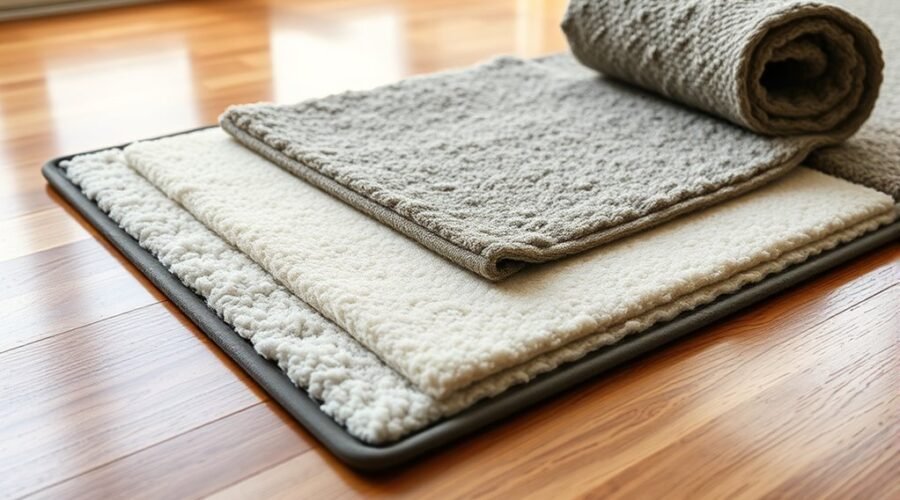
If you’ve ever watched a rug creep across the floor or felt one bunch underfoot, you already know why a rug pad can matter. The right pad can improve grip, add cushioning, reduce abrasion between the rug and floor, and help the rug lie flatter. The best choice depends on your rug, flooring, traffic level, and the care instructions for the floor underneath.
Quick Answer
Most area rugs benefit from a rug pad because the right pad can improve grip, add cushioning, reduce rug movement, and protect the rug and floor from abrasion. Choose the pad by floor type, rug size, traffic, and door clearance. On vinyl or LVP, use only a pad the flooring manufacturer approves.
Key Takeaways
- A rug pad can reduce slipping and bunching when it is designed to grip the floor beneath it.
- Felt adds cushioning, while slip-resistant materials add grip; combination pads can provide both.
- A pad can reduce abrasion between a rug backing and the floor, but it does not replace furniture protectors.
- Floor compatibility matters more than the material name alone, especially with vinyl, LVP, newly finished wood, and specialty coatings.
- A common starting point is to trim the pad about 1 inch inside each rug edge so it stays hidden and the rug can taper to the floor.
- Small, lightweight rugs on smooth floors may need more slip protection, not less.
What Does a Rug Pad Do?
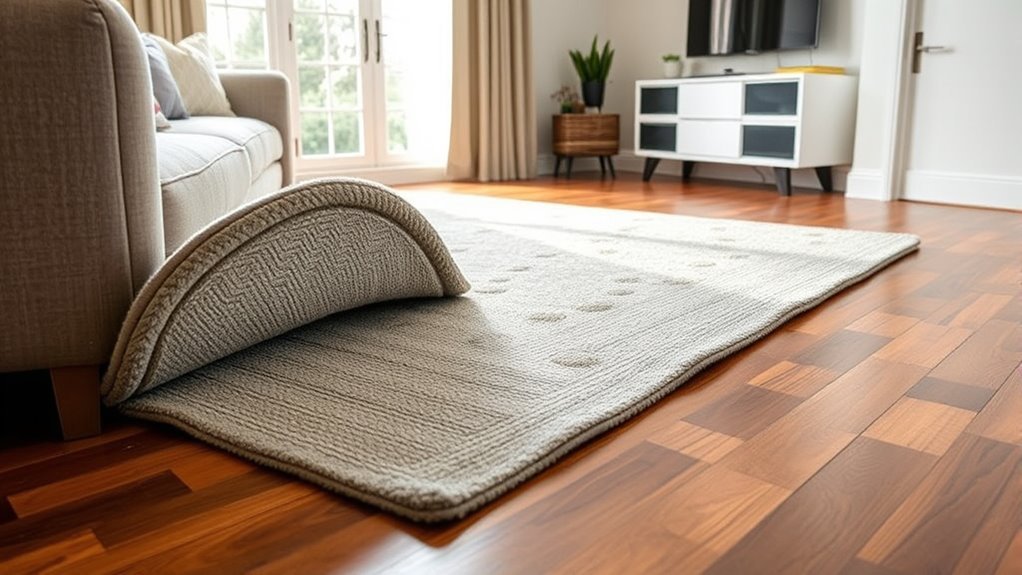
A good rug pad creates a controlled layer between your rug and the surface below it. Depending on its construction, it can help keep the rug stable, add cushioning, protect the floor from abrasion, and reduce wear on the rug itself.
Mohawk Home recommends rug pads for benefits that include slip resistance, cushioning, floor protection, noise absorption, and reduced wear on rug fibers.
The exact benefit depends on the pad. A thin natural-rubber-style grip pad prioritizes traction and a low profile. Dense felt prioritizes cushioning. A felt-and-grip combination pad can provide both functions when its backing is approved for the floor beneath it.
Rug pads can also help a rug lie more evenly and make vacuuming easier because the rug is less likely to move while you clean it.
Note: No rug pad is automatically safe for every floor finish. Check the care and warranty instructions for your exact flooring product before placing rubber, latex, PVC, adhesive-backed, or other synthetic materials against it.
Why Use a Rug Pad on Hard Floors?
Hard surfaces such as hardwood, laminate, tile, and stone give a rug less natural resistance than carpet does. A compatible rug pad can improve stability while adding a softer layer between the rug and the hard surface.
The three main benefits are grip, cushioning, and abrasion protection. However, the pad still has to be compatible with the exact floor finish.
Added Grip On Hard Floors
A rug that slides, wrinkles, or curls can become annoying and may create a trip hazard. A properly selected non-slip rug pad adds traction between the rug and a smooth hard floor, reducing routine movement.
This is particularly useful for runners, entry rugs, kitchen rugs, and other lightweight rugs that are not anchored by furniture.
The National Institute on Aging recommends keeping carpets firmly secured and warns about loose throw rugs as part of fall prevention at home.
Warning: A rug pad can improve stability, but it does not make a loose rug completely slip-proof. Replace pads that have lost their grip, keep rug edges flat, and use extra caution where older adults, children, or people with mobility problems walk.
Cushion For Comfort
Beyond keeping a rug steadier, a rug pad can add noticeable comfort on hard floors. Dense felt and combination pads are especially useful beneath thin or flat-woven rugs when you want a softer step.
The extra layer can also reduce some footfall noise and absorb part of the impact created by walking. How much difference you notice depends on the material, thickness, density, rug construction, and subfloor.
More thickness is not always better. A very thick pad can raise the rug edge, interfere with a swinging door, or make dining chairs harder to move.
Protect Floors From Wear
A compatible rug pad forms a buffer between the rug backing and your floor. That can reduce abrasion caused by the rug moving against hardwood, laminate, tile, or another finished surface.
It may also keep dirt and grit from being ground directly between the rug backing and floor, although you still need to vacuum and periodically clean underneath the rug.
Do not rely on the rug pad to prevent dents from heavy furniture. Use suitable, non-staining furniture protectors under concentrated furniture legs and follow your flooring manufacturer’s instructions.
Moisture needs separate attention. If water reaches the rug or pad, lift both layers and allow the rug, pad, and floor to dry completely before putting them back.
When Can You Skip a Rug Pad?
You may be able to go without a rug pad when a large rug is already stable, the floor manufacturer does not require additional protection, and slipping is not a practical concern. However, skipping a pad should be a deliberate choice rather than an assumption that low traffic automatically makes a loose rug safe.
Low-Traffic Accent Rugs
Low traffic alone is not a good reason to skip a pad. Small accent and throw rugs are often lightweight, which can make them easier to move on smooth flooring.
If the rug is on a walking path, test it by pushing the edge gently with your foot. If it slides, wrinkles, or curls, use a compatible non-slip pad or another floor-approved securing method.
If the rug is purely decorative and sits completely outside normal walking areas, grip may matter less. You should still make sure the backing itself is compatible with the floor.
Anchored By Furniture
A large rug held securely beneath substantial furniture is less likely to travel across the room. In that situation, you may not need as much slip resistance.
A pad can still be useful, though. Felt can add cushioning and provide a buffer between a coarse rug backing and a finished floor.
Do not assume furniture makes every part of the rug stable. Check exposed corners and walking edges for movement or curling.
Decorative-Only Placement
A decorative rug that is outside normal walking paths may not need the same level of grip as a hallway runner or entry rug.
Examples include a rug beneath a console where no exposed edge crosses the walking path, or a large rug that is substantially covered and anchored by furniture.
However, a small loose rug on an open floor is different. Even if it receives little traffic, its ability to move can still create a trip or slip concern.
Which Rug Pad Material Is Best?
The best rug pad material depends on what you need most—grip, cushioning, a low profile, or a combination—and whether the pad is approved for your flooring.
| Pad Type | Main Strength | Best Use | Watch For |
|---|---|---|---|
| Felt | Cushioning and floor buffering | Large rugs that are already anchored | Felt alone may provide limited grip |
| Natural rubber | Grip with relatively little added height | Small rugs and runners on compatible hard floors | Do not assume rubber is approved for every floor |
| Felt + grip backing | Cushioning plus traction | Living rooms, bedrooms, and many hard-floor installations | Verify the backing composition with the floor maker |
| PVC or synthetic mesh | Low-profile grip | Only where explicitly compatible | Some flooring instructions prohibit certain PVC, rubber, or synthetic backings |
| Foam | Softness | Comfort-focused applications when approved | Compression, grip, thickness, and floor compatibility vary |
Natural rubber is often chosen when strong grip and minimal height are priorities. Felt provides more cushion but may not hold a small rug securely by itself. A felt-and-grip combination can balance the two.
Do not rely on labels such as “natural,” “non-slip,” or “floor safe” without checking the product specifications and your flooring warranty. The backing or binder that actually touches the floor is what matters.
How Thick Should a Rug Pad Be?
Choose thickness according to the rug and room rather than automatically buying the thickest pad available.
- Thin, low-profile pads: useful beneath runners, flatweaves, entry rugs, or doors with limited clearance.
- Medium-density pads: a practical choice when you want both noticeable cushioning and manageable height.
- Thicker felt pads: useful where plushness matters and the rug is already securely anchored.
Before choosing a thick pad, check door clearance, transitions to surrounding flooring, dining-chair movement, and the total height of the rug plus pad.
Pro Tip: Open any nearby door over the bare floor and measure the available clearance before buying a thick pad. A comfortable pad is not useful if the finished rug prevents the door from opening freely.
What Size Rug Pad Should You Buy?
A rug pad should normally be slightly smaller than the area rug so the pad stays hidden and the rug edges can taper naturally to the floor. A common starting point is about 1 inch inside each edge, which makes the pad about 2 inches shorter in both overall length and width.
Some pad manufacturers recommend a larger inset, so follow the sizing directions for the specific pad you buy. Mohawk Home, for example, recommends trimming its pads so they sit inside the rug edge rather than extending beyond it.
| Fit | Likely Result |
|---|---|
| Pad extends beyond the rug | Pad is visible and can interfere with the rug edge lying flat. |
| Pad is slightly smaller | Pad remains hidden while supporting most of the rug. |
| Pad is far too small | Large unsupported edges may move, curl, or feel uneven. |
Measure the actual rug instead of relying only on the label. Handmade and textile products may vary slightly from their nominal dimensions.
How to Install and Trim a Rug Pad
Installation is straightforward, but the pad should be flat, correctly oriented, and sized before you return heavy furniture to the room.
- Clean and dry the floor. Remove grit, dust, and moisture so debris is not trapped underneath.
- Measure the actual rug. Decide how far the pad should sit inside each edge according to the pad manufacturer’s instructions.
- Lay the pad flat. Allow curled or folded material to relax if necessary.
- Orient it correctly. For reversible dual-surface pads, follow the maker’s instructions for which side faces hardwood or another hard floor and which side is intended for carpet.
- Trim if required. Use sturdy scissors or the cutting method recommended for that pad.
- Center the rug over the pad. Make sure no pad shows around the perimeter.
- Smooth the rug. Remove wrinkles or folds and test exposed edges for movement before replacing furniture.
Mohawk Home’s trimming instructions similarly recommend sizing the pad inside the rug edge and using suitable scissors to trim its dual-surface pad.
Best Rug Pads by Floor Type
Your floor type should guide your rug-pad choice, but the floor manufacturer’s care instructions should have the final say.
| Floor | What to Look For | Main Caution |
|---|---|---|
| Hardwood | A non-staining pad approved for the specific finish; felt, approved grip material, or a combination may work. | Avoid unapproved adhesive or backing materials, especially on newly finished floors. |
| Laminate | A floor-approved, non-staining pad that provides the amount of grip you need. | Do not assume a material is safe merely because it is marketed for hardwood. |
| Tile or stone | Slip resistance is usually the priority; add felt if you also want cushioning. | Check compatibility with sealed or specialty stone finishes. |
| Vinyl or LVP | A specifically approved, non-staining pad or mat backing. | Some manufacturers prohibit rubber or latex because prolonged contact can discolor the floor. |
| Bamboo | A pad approved by the bamboo-floor manufacturer and compatible with its finish. | Bamboo finishes vary, so avoid universal material assumptions. |
| Carpet | A rug-on-carpet pad designed to resist movement and wrinkling. | A hard-floor grip pad may not perform properly on carpet. |
Rug Pads on Hardwood
For hardwood, prioritize a pad that the flooring or finish manufacturer identifies as non-staining. Felt can provide cushioning under a large anchored rug, while an approved grip layer can help smaller rugs stay in place.
If the floor was recently refinished, follow the finish manufacturer’s cure-time instructions before covering it with any rug or pad.
Rug Pads on Vinyl and LVP
Vinyl and luxury vinyl need extra caution because backing materials that are harmless on one floor may discolor another.
Shaw Floors advises using entrance mats without latex or rubber backings to reduce possible discoloration. Armstrong Flooring has likewise advised against rubber- or latex-backed mats on its vinyl products.
Warning: Do not choose a rug pad for vinyl or LVP based only on a generic “safe for floors” label. Check your exact flooring manufacturer’s warranty and care instructions first.
Rug Pads on Carpet
A rug placed over wall-to-wall carpet needs a pad designed for rug-on-carpet use. Its job is different from a hard-floor pad: it should reduce creeping, wrinkling, and bunching without creating an unstable layer.
If the rug already lies flat and is fully anchored, you may need less additional grip, but using the correct carpet-specific pad can still improve stability.
Common Rug Pad Mistakes to Avoid
- Buying by material name alone: Two pads described as “rubber” or “felt” may have different coatings, binders, or backings.
- Ignoring the flooring warranty: A pad that works on tile may not be suitable for vinyl or a specialty wood finish.
- Using a pad that is too large: Exposed edges can look untidy and prevent the rug edge from tapering properly.
- Choosing too much thickness: Excess height can interfere with doors or create an awkward floor transition.
- Assuming furniture eliminates movement: Exposed rug corners can still curl or shift.
- Putting a rug back while damp: Always dry the floor, pad, and rug after spills or cleaning.
- Never checking underneath: Periodically lift the rug to inspect for dust, residue, staining, moisture, or pad deterioration.
Rug Pad Maintenance and Replacement
A rug pad does not need complicated maintenance, but it should not be forgotten underneath the rug.
Vacuum the rug regularly and occasionally clean the exposed floor according to the flooring manufacturer’s instructions. When the rug is moved for cleaning, inspect the pad for cracking, crumbling, hardened areas, sticky residue, stains, odors, or permanently compressed sections.
Replace the pad when it no longer holds the rug securely or when its material begins to deteriorate. There is no universal replacement schedule because lifespan depends on pad construction, traffic, furniture load, heat, moisture, cleaning, and floor conditions.
Note: After a spill, lift the rug and pad rather than assuming the surface is dry. Moisture can remain trapped between layers after the visible top of the rug feels dry.
Frequently Asked Questions
What Is the Difference Between a Rug Pad and a Rug Grip?
A rug pad may provide cushioning, floor protection, and grip, depending on its construction. A thin rug grip is primarily intended to reduce movement and usually adds little cushioning. Choose according to your floor, rug weight, desired comfort, and the amount of traction you need.
What Type of Rug Pad Is Best?
There is no single best pad for every room. Felt is useful when cushioning is the priority, an approved grip pad suits rugs that tend to slide, and a combination pad can provide both. Floor compatibility comes first, so check the flooring manufacturer’s instructions before choosing the backing material.
Do Cushioned Rug Pads Work?
Yes. A dense cushioned pad can make a thin rug feel softer and can reduce some impact and footfall noise. Cushioning alone does not guarantee slip resistance, though, so use a pad with appropriate grip if the rug moves on the floor.
Do Rug Pad Grippers Work?
A properly matched non-slip pad or gripper can reduce rug movement on a compatible surface. Performance varies with the rug’s weight, floor finish, pad construction, dust, wear, and placement, so test the rug after installation and replace the grip material if it stops holding securely.
Can a Rug Pad Damage Vinyl or LVP Flooring?
Yes, an incompatible backing can discolor some vinyl or LVP products. Several flooring manufacturers caution against prolonged contact with rubber or latex-backed mats. Use only a non-staining pad approved for your exact flooring product and follow its warranty and care instructions.
How Often Should You Replace a Rug Pad?
There is no universal replacement interval. Inspect the pad whenever you move the rug. Replace it if it becomes brittle, crumbly, sticky, permanently flattened, stained, damaged, or no longer keeps the rug stable.
Conclusion
A rug pad can do much more than stay hidden beneath an area rug. The right one can improve stability, add cushioning, reduce abrasion, and help the rug sit more neatly on the floor.
The key is choosing for the specific situation rather than assuming one material works everywhere. Consider the rug’s size and weight, how much grip and cushioning you need, door clearance, and—most importantly—the care requirements for the floor underneath. Small rugs that move usually need more attention, while large furniture-anchored rugs may need cushioning more than grip.
When in doubt, verify that the pad is approved for your flooring before installation, size it slightly inside the rug edges, keep all layers dry, and inspect it periodically for wear.
Sources
- Mohawk Home — Why Buy an Area Rug Pad — rug-pad benefits, sizing, cushioning, floor protection, and slip resistance.
- Mohawk Home — How to Trim an Area Rug Pad — trimming and installation guidance.
- National Institute on Aging — Preventing Falls at Home — guidance on securing carpets and reducing hazards from loose rugs.
- Shaw Floors — Vinyl Care and Maintenance — vinyl-floor care and caution regarding rubber or latex-backed mats.
- Armstrong Flooring — Flooring FAQs — guidance on rug and mat backing compatibility with vinyl flooring.