Protecting a wood table from heat is mostly about stopping direct contact between the finish and hot cookware, serving dishes, or drinks. For everyday use, keep coasters and placemats at each place setting and use a properly sized trivet or hot pad beneath anything noticeably hot. For broader protection, a manufacturer-rated table pad or a correctly installed glass top can shield more of the surface.
Quick Answer
To protect a wood table from heat, put a heat-rated trivet or hot pad under hot cookware and use coasters beneath hot drinks. Placemats help with warm plates and scratches but may not insulate against very hot pans. For full-table coverage, use a purpose-made table pad or properly installed glass top.
Key Takeaways
- Never place a hot pot, pan, casserole dish, or serving dish directly on finished wood.
- Use a trivet or hot pad that supports the entire base of the hot item and is rated by its manufacturer for the expected temperature.
- Placemats, runners, and coasters are useful for normal dining but should not automatically be treated as high-heat barriers.
- If you want full-table protection, choose a purpose-made table pad or a correctly installed glass top rather than assuming a thin plastic cover is heat-proof.
- A durable wood finish adds protection against ordinary wear, but it does not replace a physical barrier under hot cookware.
What to Put on a Wood Table to Protect It From Heat
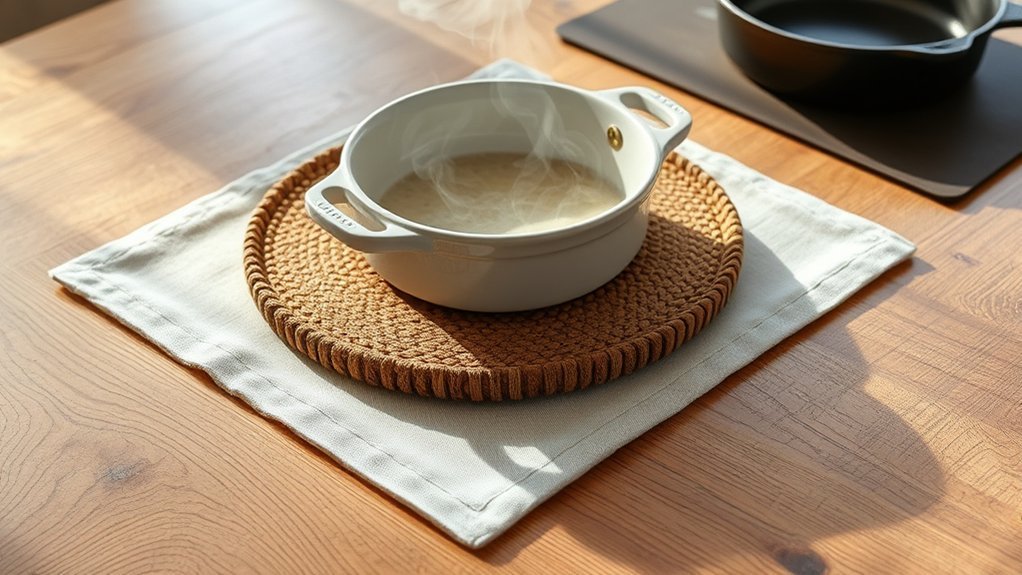
The most dependable protection is a physical barrier between the hot item and the wood finish. Furniture manufacturers such as Ethan Allen recommend trivets or hot pads beneath pots, pans, and hot serving dishes, along with coasters or placemats beneath beverages.
For cookware and serving dishes, choose a trivet made for heat rather than relying on a thin decorative placemat. Silicone, ceramic, bamboo, wood, cork, metal, and wool-felt protectors are available, but their actual heat performance varies. Check the manufacturer’s stated heat rating instead of assuming every product made from the same material can handle the same temperature.
For hot drinks, coasters help reduce both direct heat and moisture exposure. For normal place settings, placemats and chargers help with warm plates, spills, scratches, and abrasion.
If you want to cover most or all of the tabletop, a purpose-made table pad can provide stronger protection. Some table pads include a dense insulating core and carry specific manufacturer heat ratings. A fitted glass top can also protect against spills and scratches, but hot cookware should still be placed on a trivet.
Warning: Do not assume a tablecloth, thin placemat, clear vinyl sheet, glass top, or protective wood finish makes a table safe for cookware straight from a stove or oven. Use a heat-rated trivet or hot pad beneath very hot items.
Use Placemats, Runners, and Chargers
Placemats provide a useful everyday barrier against warm plates, spills, crumbs, and scratches. Used consistently, they can reduce wear on a dining-table finish without hiding the whole tabletop.
Table runners add coverage along the center of the table, where serving dishes and centerpieces are often placed. Chargers can also protect the area immediately beneath dinnerware and help prevent minor scratches or moisture marks.
These layers work well for normal dining, but thickness and material matter. A thin fabric, woven, or decorative mat should not automatically be treated as protection for a pan or casserole dish that has just come from a stove or oven.
Use placemats for everyday dining and a dedicated trivet or hot pad for concentrated heat from cookware and serving dishes.
For the best routine, use placemats at each setting and keep several trivets near the dining area so a hot dish never has to be placed directly on the wood while the table is being set.
Choose Trivets for Hot Dishes and Pans
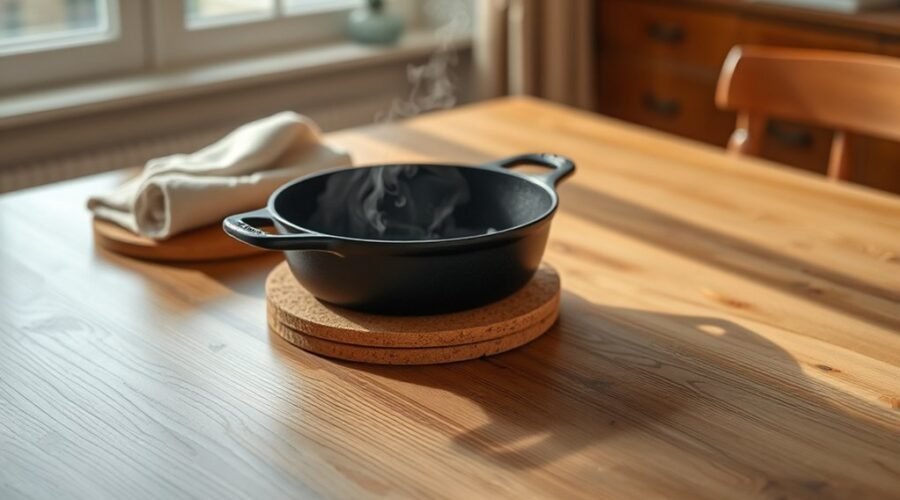
Trivets provide the most important spot protection for a wood table because they separate concentrated heat from the finish. They are especially useful under pots, pans, Dutch ovens, casserole dishes, kettles, and hot serving bowls.
A good trivet should remain stable, support the full base of the hot item, and be suitable for the temperature involved. A non-slip or non-scratch bottom is helpful because sliding a hard protector across a finished table can create a second problem: scratches.
Why Use Trivets
Heat can affect the clear finish on a wood table before the wood itself visibly burns. University of Georgia Extension notes that heat can soften and damage some finishes. Keeping hot cookware raised or insulated reduces heat transfer and lowers the chance of cloudy marks, discoloration, or more serious damage.
| Trivet Feature | Why It Matters | What to Look For |
|---|---|---|
| Thermal barrier | Reduces direct heat transfer | Manufacturer-rated heat protection |
| Adequate size | Supports the full hot base | No exposed hot edges touching wood |
| Stable surface | Reduces spills and tipping | Flat, non-slip construction |
| Table-friendly underside | Reduces scratches | Smooth, felted, cork, or other non-abrasive contact surface |
Temperature ratings should be checked product by product. For example, IKEA lists a 536°F heat-resistance specification for one of its specific bamboo trivets. That rating applies to that product; it should not be treated as a universal rating for every bamboo or wood trivet.
Best Trivet Materials
Several trivet materials can work well when they are designed for the job:
- Silicone: Flexible, easy to clean, and often grippy. Verify the listed maximum temperature before use.
- Wool felt: Provides a soft insulating layer and is gentle on many table finishes. Choose a dense product intended for hot serving ware.
- Cork: Lightweight and naturally insulating, but very thin cork sheets may offer less protection than a thicker purpose-made trivet.
- Wood or bamboo: Creates separation between hot cookware and the table. Raised designs can add an insulating air gap.
- Ceramic or stone: Durable and decorative, but the underside should be smooth or padded so it does not scratch the table.
- Metal: Strong and stable, particularly when raised on feet, but a hard or rough underside should not sit directly against a delicate finish.
Pro Tip: Choose a trivet slightly larger than the contact area of the pot or serving dish. That makes it easier to set the item down without accidentally leaving a hot edge resting on the tabletop.
Use Table Covers and Table Pads Carefully
PVC or vinyl table covers are convenient for spills and everyday messes, while purpose-made table pads can provide more substantial protection from heat, moisture, scratches, and impact. They should not be treated as interchangeable products.
A thin PVC or vinyl cover should only be exposed to hot items within the temperature limits stated by its manufacturer. Do not assume that every clear or fitted cover is safe for a hot pan or casserole dish.
Purpose-made table pads can include a rigid insulating core, soft backing, and wipe-clean surface. Because construction varies, compare the manufacturer’s heat rating, backing material, thickness, and care instructions before choosing one.
PVC Tablecloth Options
PVC and vinyl covers are useful where spill resistance and easy cleaning are the main goals. They can provide broad protection from food, craft activities, moisture, and light abrasion while leaving the dining surface easy to wipe down.
Heat performance, however, varies by product. A generic PVC sheet should not be described as automatically safe to a fixed temperature. If heat protection is important, look for an explicit manufacturer’s temperature rating and follow its instructions.
Long-term use also deserves care. Purdue University Extension advises against leaving plastic protectors on wood for prolonged periods because they can trap heat and humidity. The safest approach is to follow the table manufacturer’s care instructions and inspect the finish periodically if a plastic or vinyl cover is used.
Note: A vinyl or PVC cover may be excellent for spills without being suitable for very hot cookware. Spill resistance and heat resistance are separate performance characteristics.
Table Pad Benefits
A purpose-made table pad provides broader protection than a trivet because it covers a large section or the entire tabletop. Depending on its construction, it can reduce heat transfer, absorb minor impacts, block spills, and prevent scratches.
| Benefit | What It Helps With |
|---|---|
| Heat insulation | Reduces heat transfer when used within the pad’s stated rating |
| Full-surface coverage | Protects more than a spot trivet |
| Moisture protection | Helps keep spills away from the finish |
| Soft backing | Can reduce scratches and abrasion |
| Impact protection | Helps protect against dishes, crafts, and everyday use |
Heat ratings vary. For example, some current custom table-pad manufacturers specify ratings around 550°F for particular multilayer products. That demonstrates why the correct number must come from the actual product rather than from a generic claim about all table pads.
Heat Protection Fit
Fit matters for both safety and appearance. A properly sized table pad should lie flat without unstable overhangs or gaps where a hot serving dish could partly contact exposed wood.
Custom pads can be made for rectangular, round, oval, and irregular tables. Before ordering, follow the pad maker’s measuring instructions and confirm whether the product is designed for the type of finish on your table.
If a cover or pad has a non-slip backing, make sure that backing is compatible with the table finish. Materials left against a finish for long periods can behave differently with heat, humidity, age, and cleaning products.
Add Glass Protection Without Hiding the Wood
A glass topper can protect a wood table from spills, scratches, and everyday wear while leaving the grain visible. It can be especially useful when the appearance of the wood is important but the table receives frequent use.
When glass is installed over wood, spacer pads can create a small air gap. Commercial furniture-care guidance from Woodcraft Hospitality recommends spacer pads beneath protective glass to allow the wood surface to breathe.
If selecting glass for furniture, discuss the application, thickness, edge finishing, and safety requirements with a qualified glass supplier. Toughened or tempered glass has greater resistance to mechanical and thermal stress than ordinary annealed glass, but it is not unbreakable. Pilkington notes that toughened glass has increased resistance to thermal stress but can still fail under severe loads or impact.
A glass top is useful broad-surface protection, but it does not eliminate the need for a trivet beneath very hot cookware.
Clean spills that reach beneath the glass promptly. Avoid dragging the glass or its spacers across the wood, and keep glass-cleaning products from contacting the furniture finish unless the table manufacturer says they are safe.
Compare Wood Table Heat-Protection Options
At a Glance
| Best for very hot cookware | Manufacturer-rated trivet or hot pad |
| Best for hot drinks | Coaster with a heat- and moisture-resistant design |
| Best for everyday place settings | Placemats plus coasters, with separate trivets for hot serving dishes |
| Best for full-table protection | Purpose-made table pad with a documented heat rating |
| Best for showing the wood grain | Properly specified glass top with suitable spacers; continue using trivets for very hot items |
| Best for spills and crafts | Removable vinyl/PVC cover compatible with the table finish; do not assume high-heat protection |
Treat the Wood Finish as Secondary Protection
A durable clear finish can help a tabletop resist stains, moisture, scratches, and normal wear, but it should not be used as the primary defense against hot cookware.
For example, Rust-Oleum’s Varathane polyurethane guidance describes scratch and stain protection for interior wood projects. It does not mean a finished table should be used as a landing surface for a hot pan.
If the table already has a factory finish, follow the furniture manufacturer’s care instructions before adding wax, polish, polyurethane, polyacrylic, oil, or another coating. Applying an incompatible product can change the sheen, create adhesion problems, or complicate future refinishing.
If you are finishing an unfinished or refinished table, choose a coating based on the manufacturer’s directions for that product and allow it to cure fully. Continue using coasters and trivets after curing.
Set Up a Simple Heat-Protection Routine
- Check the table-care instructions. If the manufacturer lists special restrictions for the finish, follow those first.
- Keep coasters at every seat. Use them for both hot drinks and cold drinks that produce condensation.
- Use placemats for regular dining. They help reduce scratches, spills, and moderate heat from plates.
- Put trivets where serving dishes will go. Set them out before hot food reaches the table.
- Check the trivet’s size and rating. Make sure the entire base of the hot item will be supported.
- Use broader protection when needed. For crafts, large gatherings, or heavy daily use, add a suitable table pad or removable cover.
- Blot spills promptly. Do not leave moisture trapped beneath mats, pads, plastic covers, or glass.
- Lift instead of sliding. Moving dishes, trivets, and decorations by lifting helps prevent scratches.
Avoid Common Heat-Stain Mistakes
The biggest mistake is placing a hot dish directly on the wood because it will only be there “for a second.” Heat can affect a finish quickly, and visible damage may not appear until after the item is removed.
Do not assume that a thin tablecloth, decorative placemat, folded napkin, or generic plastic cover is equivalent to a heat-rated trivet. These products may help with spills and scratches while providing limited thermal insulation.
A trivet should sit flat and support the full base of the cookware. Avoid a protector that rocks, slides, has sharp feet, or exposes part of a hot dish to the tabletop.
Do not depend on polyurethane, polyacrylic, lacquer, wax, oil, or another furniture finish as permission to place cookware directly on the table. A finish is a secondary layer of protection, not a substitute for insulation.
With a glass top, continue using trivets for concentrated heat. Pilkington explains that thermal stress develops when parts of a glass pane reach different temperatures; sufficiently high stress can crack glass.
Finally, wipe up spills promptly. Heat and moisture together can be especially troublesome for a furniture finish, and moisture trapped beneath a cover or glass top can remain against the surface longer than an exposed spill.
What to Do If a Heat Mark Appears
If you discover a white, cloudy, or dark mark after a hot object was placed on the table, remove the heat source and let the surface return to room temperature. Do not immediately scrape, sand, or apply strong chemicals.
Check the furniture manufacturer’s care instructions before attempting a home remedy. Different finishes react differently to heat, moisture, solvents, oils, abrasives, and additional heat. A treatment that works on one finish can worsen another.
If the mark is dark, the finish has blistered or cracked, the veneer has lifted, or the table is valuable or antique, professional furniture repair is the safer option.
Frequently Asked Questions
How do you heat-proof a wood table?
You cannot make an ordinary wood table completely heat-proof, but you can protect it effectively. Use heat-rated trivets or hot pads beneath cookware, coasters beneath hot drinks, and placemats for normal place settings. For broader coverage, consider a purpose-made table pad or properly installed glass top. A protective finish is secondary protection and does not replace these barriers.
What is the best heat-resistant table protector for a dining table?
For a hot pot, pan, or serving dish, a stable trivet or hot pad with a documented manufacturer heat rating is the simplest choice. If you want full-table coverage, a purpose-made insulated table pad is more appropriate. Use placemats and coasters for everyday dining, but do not assume thin decorative materials are rated for cookware straight from an oven or stove.
Can you put hot plates directly on a wood table?
It is better not to put hot plates directly on finished wood. Even when a plate is cooler than cookware, repeated heat and moisture can affect some finishes. A placemat, coaster-style mat, or other suitable barrier is inexpensive protection. Very hot serving dishes should go on a heat-rated trivet or hot pad.
What can you put on a table to protect it from heat?
Use trivets or hot pads for cookware, coasters for hot drinks, and placemats for regular dinnerware. A purpose-made table pad provides broader protection, while a properly installed glass top helps with scratches and spills. Whatever you choose, use the manufacturer’s heat rating rather than assuming a material is safe at any particular temperature.
Can I use a PVC or vinyl cover to protect a wood table from heat?
A PVC or vinyl cover can be useful for spills and everyday wear, but its heat resistance depends on the specific product. Use it for hot items only when the manufacturer provides an appropriate temperature rating. Avoid leaving an unsuitable plastic protector against a sensitive wood finish for prolonged periods because heat and humidity can become trapped beneath it.
Does polyurethane protect a wood table from hot pans?
Polyurethane can improve resistance to stains, scratches, moisture, and general wear, but it should not be treated as protection for direct contact with hot cookware. Continue using a trivet or hot pad even on a polyurethane-finished table.
Conclusion
Protecting a wood table from heat does not require complicated treatment. The most important habit is to keep concentrated heat away from the finish. Use a heat-rated trivet or hot pad for cookware and hot serving dishes, coasters for drinks, and placemats for everyday place settings.
For heavier use, a purpose-made table pad can protect a larger area, while a correctly installed glass top can reduce scratches and spill exposure without hiding the wood. Treat coatings and finishes as secondary protection rather than substitutes for these barriers. A few consistent habits can prevent heat marks, moisture damage, scratches, and unnecessary refinishing.
Sources
- Ethan Allen — Dining Table Care — supports using coasters, placemats, trivets, and hot pads on wood furniture.
- Purdue Extension — Home Environment Furniture Care — supports avoiding extreme heat and prolonged plastic protectors that can trap heat and humidity.
- Rust-Oleum Varathane Ultimate Water-Based Polyurethane — documents polyurethane protection against scratches and stains without presenting it as a substitute for hot-item barriers.
- Woodcraft Hospitality — Care and Maintenance — supports using spacer pads beneath protective glass on wood furniture.
- Pilkington — Toughened Glass — supports the increased mechanical and thermal-stress resistance of toughened glass while noting that it can still break.
- IKEA ELDSTJÄRT Trivet — illustrates why heat-resistance specifications should be checked for the specific trivet product being used.