
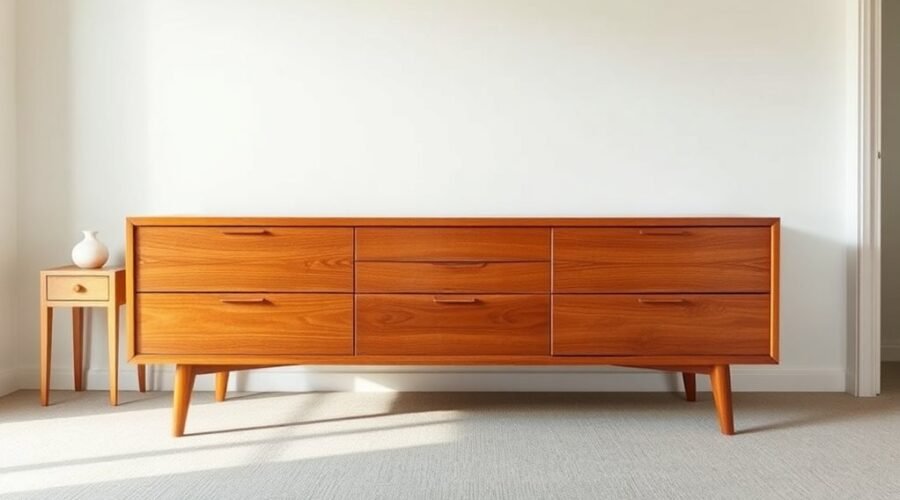
A lowboy dresser is generally a low, wide piece of drawer furniture that gives you clothing storage plus a broad top surface. The term has both a historical and a modern meaning, so there is no single required drawer count or standard width. The best size depends on your wall, window height, drawer clearance, storage needs, and how you plan to use the top.
Quick Answer
A lowboy dresser is a low, horizontal drawer unit with a useful top surface. Antique lowboys were often dressing tables on legs, while modern furniture sellers use the name more broadly for low, wide dressers. Sizes vary, so measure the room, drawer-opening space, and height before choosing one.
Key Takeaways
- Historically, a lowboy was a low dressing table or chest with drawers, often made to complement a highboy.
- Modern “lowboy dresser” is a looser retail term for a short, wide horizontal dresser, so dimensions and drawer counts vary.
- Many horizontal dressers are roughly 18 to 24 inches deep, but always use the manufacturer’s exact measurements.
- A lowboy works especially well on a wide wall or beneath a sufficiently high window because it uses horizontal rather than vertical space.
- Measure drawer-opening and walking clearance, not just wall width, and secure clothing-storage furniture according to the manufacturer’s anti-tip instructions.
What Is a Lowboy Dresser?
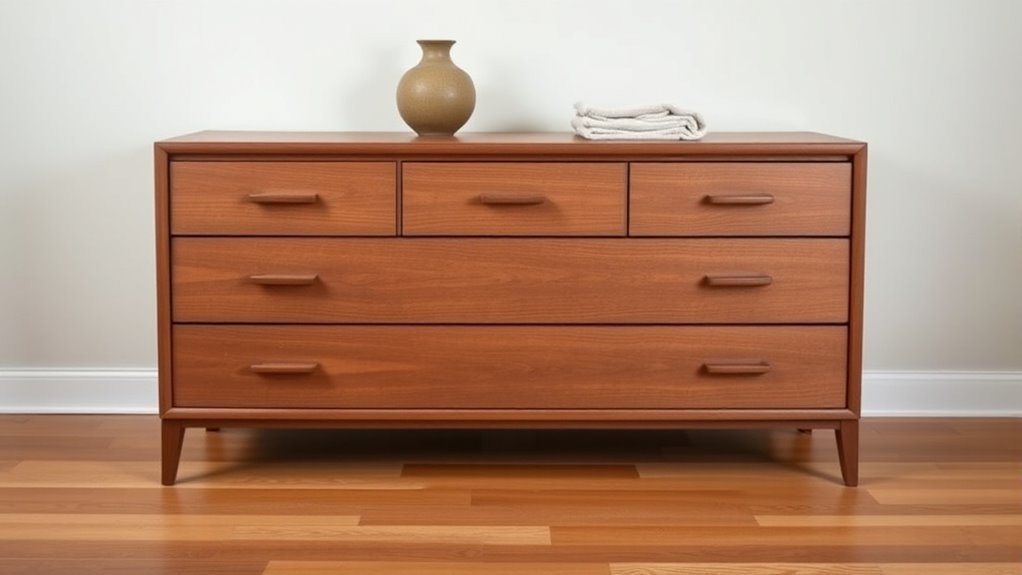
A lowboy dresser is best understood as low, horizontal drawer furniture rather than a piece with one fixed number of drawers. Modern versions can hold folded clothing, accessories, linens, and other bedroom essentials while providing a broad top for a lamp, tray, mirror, or decor.
The name has an older meaning, however. In antique furniture, a lowboy was commonly a dressing table or low chest on legs. Eighteenth-century examples often had one or two rows of drawers and decorative legs rather than the box-like form of many modern dressers.
Note: Furniture terminology varies by country, retailer, and period. A product sold today as a “lowboy,” “lowboy dresser,” “horizontal dresser,” or “low dresser” may serve essentially the same bedroom-storage role even though it does not resemble an antique lowboy.
The low profile is the main practical advantage. You get easier access to the top surface, broad drawers, and more usable wall space above the furniture. That can make a lowboy a good fit below artwork, beneath a mirror, or under a window when the sill is high enough.
A lowboy may also work as a dressing surface or general storage piece. If you want to place a television on it, use it only when the furniture manufacturer specifically allows that use and the unit can safely support the television.
How Wide Is a Lowboy Dresser?
There is no universal lowboy dresser width. Modern low dressers are sold in many sizes, and historical lowboys can be considerably smaller than today’s multi-drawer bedroom furniture.
As general context, modern horizontal dressers commonly fall around 40 to 80 inches wide, roughly 30 to 35 inches high, and about 18 to 24 inches deep. These are shopping-reference ranges rather than rules for every lowboy.
If you are comparing widths, the following checkpoints can help you picture the scale:
- Around 30 inches: a compact low chest or smaller vintage-style piece that can work where wall width is limited.
- Around 40 inches: a modest horizontal dresser suitable for many smaller bedrooms or guest rooms.
- Around 50 inches: a medium-width piece with more drawer and top-surface space.
- Around 60 inches: a common size range for broader multi-drawer dressers, provided the room has enough wall and walking space.
Do not choose by width alone. A 50-inch dresser that is too deep for the room can be harder to live with than a 60-inch dresser on a wider, unobstructed wall.
A lowboy’s best size is the one that still leaves enough room to open every drawer fully and move comfortably through the bedroom.
How to Measure for a Lowboy Dresser
Start with the wall where the dresser will sit, but measure the entire usable zone rather than only the empty wall surface.
- Measure the available wall width. Account for door trim, baseboards, outlets, vents, curtains, closet doors, and other furniture.
- Measure the available height. If the lowboy will sit beneath a window, measure from the finished floor to the bottom of the sill and check that the window can still open and function normally.
- Check dresser depth. Measure from the wall toward the bed or opposite furniture.
- Allow for open drawers. Find the manufacturer’s drawer-extension measurement when available and make sure you can stand in front of an open drawer.
- Check the walking path. About 36 inches between the dresser and an opposing bed or large piece of furniture is a useful planning target when the room allows it.
- Measure the delivery route. Check doors, hallways, stair turns, elevators, and bedroom entrances before buying a large assembled dresser.
Pro Tip: Mark the dresser’s width and depth on the floor with painter’s tape. Then mark where an open drawer would extend. This gives you a much better picture of the real footprint than the product dimensions alone.
When a Lowboy Dresser Beats a Tallboy
A lowboy dresser makes the most sense when you have enough horizontal wall space and want a large top surface. A taller chest or tallboy usually makes better use of a narrow wall because it stores more vertically.
| Feature | Lowboy / Low Dresser | Tallboy / Tall Chest |
| Shape | Lower and wider | Taller and narrower |
| Wall width needed | More | Less |
| Top surface | Broad surface for a mirror, lamp, tray, or decor | Smaller surface, often higher to reach |
| Under-window placement | Often possible if the sill is high enough | Usually less suitable |
| Best fit | Wide walls and rooms needing surface space | Narrow walls and rooms prioritizing vertical storage |
A lowboy also gives you wider drawers that can work well for folded shirts, jeans, sweaters, linens, and accessories. Drawer construction varies, though, so a wider dresser does not automatically mean every drawer is deeper or stronger than those in a tall chest.
If floor and wall width are limited, a taller dresser may be more efficient. If you have a broad wall and want storage plus an accessible display or dressing surface, the lowboy format has the advantage.
Best Rooms for Lowboy Drawers
Lowboy drawers work best where there is enough horizontal space for the cabinet and enough clearance in front for the drawers to open.
- Main bedrooms: A wider dresser can hold folded clothes while providing a large surface for a mirror, lamp, jewelry tray, or other daily items.
- Guest rooms: A moderate-size low dresser gives visitors drawer storage without requiring a tall cabinet.
- Children’s rooms: Lower drawers may be easier to reach, but the furniture should be properly secured against tip-over and children should not be encouraged to climb on drawers.
- Under-window walls: A low dresser can use space that is unsuitable for taller furniture, provided it stays below the sill and does not interfere with curtains, blinds, window operation, or required egress.
- Shared bedrooms: A wide dresser can divide drawer space between two people while providing one continuous top surface.
The lower profile can help keep more wall area visible, but it is not automatically a space-saving choice. Compared with a tall chest, a lowboy normally uses more horizontal wall and floor width.
How to Choose the Right Lowboy Size
Choose a lowboy dresser by starting with the room rather than a preferred drawer count. Measure the available width, maximum height, usable floor depth, and space needed to open the drawers.
Then consider how much you plan to store. Smaller drawers are useful for socks, underwear, accessories, and sleepwear. Wider or deeper drawers can be useful for jeans, sweaters, folded shirts, and linens. Check the actual internal drawer dimensions if storage capacity matters.
Construction matters as well. Look at the drawer slides, joinery, back panel, leg or base construction, manufacturer weight limits, and whether replacement hardware is available. Solid wood, veneer, engineered wood, and metal-frame designs can all work well when the piece is properly designed and assembled.
For placement beneath a window, compare the dresser’s finished height with the sill height rather than assuming every lowboy will fit. Leave enough space for window hardware, curtains, shades, and normal cleaning.
Warning: Dressers and other clothing-storage furniture can tip over, particularly when drawers are opened or climbed on. Follow the manufacturer’s assembly and anti-tip instructions and secure the unit as directed. In the United States, current safety requirements cover many freestanding clothing-storage units, but proper installation and anchoring still matter. Never let children climb or hang on drawers.
If you plan to put a television on top, confirm that the furniture is specifically designed or approved by its manufacturer for that purpose. A wide top alone does not make a dresser a safe television stand.
What to Look for Before Buying
Before ordering a lowboy, check the complete product specification rather than relying on the product name alone.
- Overall dimensions: width, height, and depth.
- Drawer dimensions: usable internal space and extension.
- Weight: important for delivery, flooring, and moving.
- Weight limits: for the top and individual drawers.
- Anti-tip hardware: confirm what is included and follow installation instructions.
- Assembly requirements: some pieces arrive fully assembled while others require substantial construction.
- Material: solid wood, veneer, engineered wood, metal, or mixed construction.
- Delivery dimensions: make sure the packaged or assembled unit will fit through the route to the bedroom.
If you are buying an antique, inspect the legs, drawer runners, joints, back boards, hardware, repairs, and evidence of moisture or insect damage. Antique dimensions and drawer layouts may differ considerably from modern bedroom dressers.
Frequently Asked Questions
What Does a Lowboy Dresser Look Like?
A modern lowboy dresser usually has a low, wide profile with several drawers and a broad top. Traditional antique lowboys look more like dressing tables: they often stand on decorative legs and have one or two rows of drawers beneath the top.
What Is a Low Height Dresser Called?
A low dresser may be marketed as a lowboy, lowboy dresser, horizontal dresser, or simply a low dresser. Historically, however, “lowboy” refers more specifically to a low dressing table or chest on legs, so the terms are not exact synonyms in antique furniture.
What Is a Good Low Dresser for the Foot of the Bed?
Choose a low dresser that leaves enough space to walk around the bed and open its drawers fully. Measure the dresser depth plus the drawer extension before buying. Avoid blocking the bedroom entrance or another necessary path, and secure the dresser according to its anti-tip instructions.
What Is a Good Width for a Dresser?
There is no single ideal width. A dresser around 48 inches wide can fit many bedrooms, but modern horizontal dressers may be narrower or considerably wider. Measure the available wall, nearby doors and windows, and the space required in front of the drawers before choosing.
Can a Lowboy Dresser Go Under a Window?
Yes, if the dresser is shorter than the window sill and does not interfere with the window, curtains, blinds, ventilation, or required emergency egress. Measure from the finished floor to the bottom of the sill before buying.
Can You Put a TV on a Lowboy Dresser?
Only when the furniture manufacturer says the piece is suitable for television use and its size and weight limits accommodate the TV. Follow the TV and furniture manufacturers’ anchoring instructions; a broad dresser top by itself does not prove that the piece is a safe TV stand.
Conclusion
A lowboy dresser gives you horizontal drawer storage and a useful top without the height of a tall chest. Historical lowboys were often dressing tables on legs, while today’s name is used more broadly for low, wide dressers. Instead of relying on a fixed width or drawer count, choose one by measuring the wall, sill height, dresser depth, open-drawer space, and walking clearance. Secure the furniture properly, and you will have a practical storage piece that fits the room rather than crowding it.
Sources
- The Metropolitan Museum of Art — Lowboy, Philadelphia, 1765–85. Supports the historical form, date, materials, and dimensions of an American lowboy.
- The Metropolitan Museum of Art — Recent Acquisitions: A Selection, 1994–1995. Supports the historical use of “lowboy” for an eighteenth-century dressing table.
- U.S. Consumer Product Safety Commission — Clothing Storage Units. Supports current U.S. stability requirements, anti-tip provisions, and the September 1, 2023 applicability date for covered clothing-storage units.
- U.S. Consumer Product Safety Commission — Anchor It!. Supports furniture anchoring and safe television-placement guidance.
- Costco — Bedroom Furniture Measuring Guide. Supports general horizontal-dresser dimension ranges and approximately 36 inches of clearance in front of a dresser where space allows.


