A recliner that will not close all the way usually has an obstruction, loose or misaligned hardware, a release-cable problem, a damaged spring or linkage, or—on powered models—an electrical or control issue. Start with the safest, simplest checks and identify whether the chair is manual, powered, or a power-lift model before touching the mechanism.
Quick Answer
If a recliner will not close fully, unplug powered models, clear anything blocking the footrest or linkage, check accessible cable connections, and look for loose fasteners or a disconnected release cable. Do not force the chair. Broken springs, bent linkage, damaged wiring, or unstable lift mechanisms usually require model-specific parts or professional service.
Key Takeaways
- First determine whether the chair is a manual recliner, standard power recliner, or power-lift recliner because the troubleshooting steps differ.
- Never put hands into a moving scissor mechanism or force a footrest that is binding.
- For powered chairs, check the outlet, breaker, transformer, hand control, and accessible plug connections before assuming the motor has failed.
- For manual chairs, inspect the release handle, pull cable, fasteners, springs, tracks, and linkage for disconnection, wear, or misalignment.
- Use the chair’s exact model manual for spring position, lubrication, synchronization, electrical repairs, and replacement parts.
At a Glance
| Time Required | About 15–30 minutes for basic inspection; longer if a part must be replaced |
| Difficulty | Easy to moderate for inspection; advanced repairs may require a technician |
| Tools Needed | Flashlight, owner’s manual, screwdriver or socket set if permitted by the manufacturer |
| Cost | Usually $0 for basic checks; replacement parts and labor vary by brand and model |
Warning: Recliners contain pinch and crush points. Unplug a powered chair before inspecting underneath it, keep children and pets away, and never place your fingers inside a scissor mechanism while anyone operates the chair. Stop using the chair if wiring is damaged, a component overheats or smells burned, the frame is cracked or bent, or the mechanism moves unexpectedly.
Identify the Recliner Type and Symptom
Before troubleshooting, identify how the chair operates. A manual recliner normally uses a handle, lever, cable, or push-back mechanism. A power recliner uses a motor, transformer, switch, or hand control. A power-lift recliner also raises the seat to assist the user in standing.
Next, note exactly what happens when you try to close the chair. This narrows the search much faster than replacing parts at random.
| Symptom | Likely Area to Check |
|---|---|
| No movement at all | Power supply, outlet, breaker, transformer, control, connections |
| Moves in only one direction | Hand control, switch, cable, controller, motor system |
| Footrest stops a few inches short | Obstruction, upholstery, track, loose fastener, linkage, spring |
| Handle feels loose or has no resistance | Release cable or handle connection |
| Mechanism is crooked or binds | Loose hardware, bent linkage, damaged track or frame |
| Chair stops after repeated operation | Possible duty-cycle or thermal-protection issue on some powered models |
Pro Tip: Find the model and serial number before ordering a spring, cable, switch, motor, transformer, or mechanism. Recliner components that look similar can have different dimensions, connectors, spring rates, and mounting points.
Check the Recliner Power and Cables
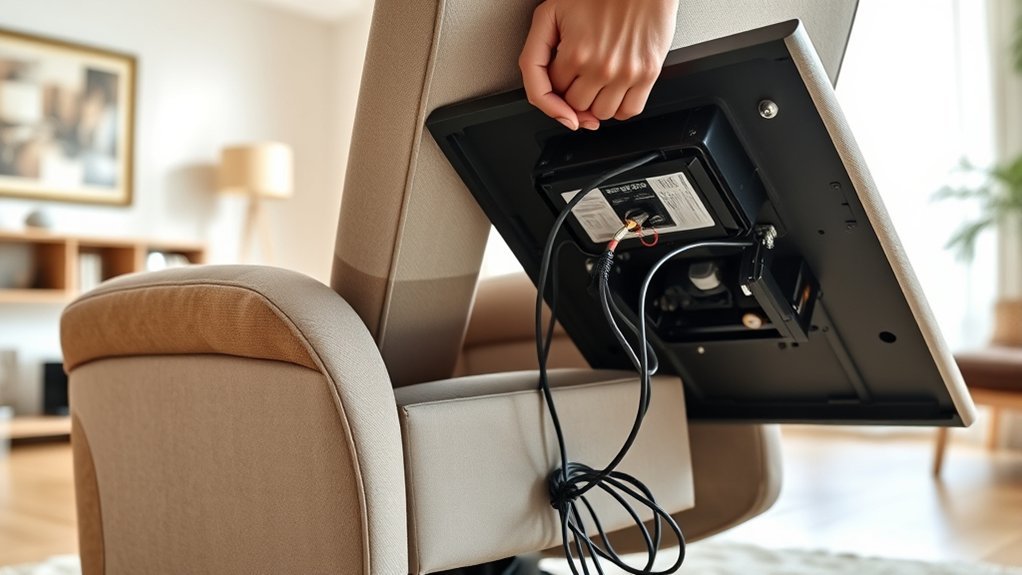
For a power recliner or power-lift chair, begin by confirming that the wall outlet works and that the chair’s power supply is fully connected. If the outlet is dead, check the circuit breaker or test the outlet with another known-good device.
Inspect the power cord, transformer lead, hand-control cable, and other accessible plug connections. Look for a connector that has pulled partly apart or a cord that has been pinched by the frame. Do this with the chair unplugged.
The current Pride Mobility Lift Chair Series owner’s manual, for example, tells users to verify the outlet, circuit breaker, low-voltage connection, and other cable connections when a chair will not operate. It also says damaged wiring should be unplugged and referred for service.
Do not assume that an extension cord is acceptable simply because its electrical rating appears high enough. Some recliner manufacturers specifically prohibit extension cords. Pride instructs owners of its current lift-chair series to connect the power system directly to the electrical outlet. Follow the manual supplied with your exact chair.
If the transformer has a status light, check what the light means in the model manual. A lit indicator may confirm incoming power but does not prove that the switch, controller, actuator, or motor is working correctly.
Check the Hand Control or Side Switch
If the chair moves in one direction but not the other, inspect the buttons or toggle switch. A button that remains physically stuck can prevent normal operation. Some manufacturers identify the hand control as a possible cause when a powered chair operates in only one direction.
Do not open a transformer, motor, control box, or switch housing unless the manufacturer provides a service procedure for the user. Electrical faults, burned smells, melted plastic, sparking, or repeated overheating are reasons to unplug the chair and obtain service.
Note: Do not use “unplug for 60 seconds” as a universal recliner reset. Reset, re-sync, calibration, and pairing procedures depend on the control system. Use only the procedure listed for your exact model.
Clear Blockages and Tighten Loose Bolts
If the recliner has power—or if it is a manual chair—but the footrest still will not close, inspect the movement path for an obstruction. Unplug powered models before looking underneath.
Common obstructions include toys, blankets, clothing, rugs, power cords, loose upholstery fabric, pet items, and debris caught between linkage arms. The Pride owner’s manual specifically warns users to keep objects, wires, loose clothing, children, and pets clear of lift and scissor mechanisms.
| Check | Condition | Action |
|---|---|---|
| Underside | Debris or fabric present | Remove the obstruction with power disconnected |
| Fasteners | Loose bolt, screw, or nut | Tighten only if accessible and allowed by the model instructions |
| Lock or latch | Worn, broken, or not engaging | Inspect for damage; replace with the correct part if required |
| Track/linkage | Crooked, bent, or binding | Stop forcing the chair and arrange repair |
Check accessible mechanism fasteners for obvious looseness. A loose mounting point can let a linkage shift enough to bind before the footrest reaches the closed position. Compare the left and right sides of the mechanism; they should generally move symmetrically unless the chair’s design says otherwise.
Do not try to straighten a seriously bent linkage while it is still installed. A damaged mechanism can be spring-loaded and may move suddenly when a fastener is loosened.
Inspect the Manual Recliner Release Cable
On a manual recliner, a handle that suddenly feels loose often points to the release cable or one of its attachment points. With the chair stable and no one sitting in it, inspect the visible cable routing and the connection between the handle and mechanism.
Look for a disconnected cable end, cracked handle housing, frayed cable, bent bracket, or cable sheath that has slipped out of its retaining point. Do not keep yanking the handle if the mechanism does not release; that can damage the handle or cable further.
If a replacement cable is needed, match it to the chair’s model, connection style, housing length, and exposed cable length. A cable that merely looks similar may not provide the correct amount of travel.
Fix the Recliner Footrest Springs
Inspect the footrest springs for obvious breakage, distortion, missing hooks, or loss of tension. Springs can help control the mechanism’s movement, but their size, attachment points, and preload vary between recliner designs.
Do not move a recliner spring to a different mounting hole unless the manufacturer’s service instructions specifically tell you to do so.
If a spring is broken or has come off, identify the recliner model and obtain the correct replacement or service instructions. Springs may store substantial energy, so keep your face and hands away from the spring’s possible travel path while working.
Do not assume every stiff recliner needs lubricant. If the manufacturer specifies lubrication, apply only the stated product to the stated pivot points. Keep lubricant away from upholstery, electrical connectors, motors, brakes, locking surfaces, and any area the manual says must remain dry.
Inspect the Recliner Release Mechanism
The release and locking mechanism should move without obvious binding. With the chair unplugged if powered, use a flashlight to look for bent linkage, displaced hardware, a disconnected cable, torn upholstery caught in the mechanism, or an object blocking the latch.
Check whether the footrest is being pulled crooked as it approaches the closed position. If one side reaches the chair before the other, a loose mounting point, bent component, damaged track, or linkage problem may be present.
The release lever or button should respond normally. If a manual handle moves without resistance, return to the cable inspection. If a powered control clicks or lights up but the chair does not move correctly, use the electrical troubleshooting procedure in the exact manufacturer manual.
Some multi-motor lift chairs have model-specific synchronization or timing procedures. For example, Pride provides a defined motor-timing procedure for applicable dual-motor lift chairs. Do not copy that procedure to a different brand or model unless its manufacturer specifies the same process.
When a Power Recliner Stops Partway
A powered chair that stops after repeated operation may not necessarily have a failed motor. Some models use a duty cycle or thermal protection to prevent overheating. Pride, for example, instructs users of applicable chairs to allow a cooling period if the transformer’s thermal shutoff activates.
If the chair works again after the manufacturer-specified rest period but repeatedly overheats or stops during normal use, discontinue troubleshooting and contact the manufacturer or an authorized service provider. Repeated thermal shutdown can point to excess load, binding, an electrical fault, or a failing component.
Check for Recliner Recalls
Before replacing electrical components, search the chair’s brand and model number in the U.S. Consumer Product Safety Commission recall database and on the manufacturer’s support site.
This is especially important when the symptoms include overheating, electrical odor, smoking, unexpected movement, or a damaged power switch. In May 2026, for example, CPSC announced a recall involving certain Talan and Royce powered sofas and recliners because a power switch could malfunction and overheat. Owners of affected furniture were instructed to stop using the powered switch, unplug the furniture, and obtain the recall repair.
Warning: If a recliner is included in a safety recall, follow the recall remedy instead of attempting an improvised repair.
Test the Recliner After Basic Repairs
After removing an obstruction, reconnecting an approved accessible plug, or tightening permitted hardware, return the chair to a stable upright position before testing it.
- Make sure tools, hands, clothing, children, and pets are clear of the mechanism.
- Reconnect power if the chair is electric.
- Operate the chair through a small amount of travel first.
- Watch both sides of the footrest and linkage for smooth, even movement.
- Stop immediately if the chair binds, twists, grinds, jumps, overheats, or makes an abnormal electrical smell.
- If movement is normal, run one complete open-and-close cycle without forcing the mechanism.
Repair or Replace?
The repair-or-replace decision should not depend on a fixed percentage of the price of a new chair. Instead, consider the condition of the frame, type of failure, repair quote, warranty status, availability of correct parts, chair age, and whether failures keep returning.
| Condition | Practical Next Step |
|---|---|
| Minor obstruction or accessible loose fastener | Basic repair may be reasonable |
| Sound frame with a replaceable cable, switch, spring, or actuator | Compare parts and labor with replacement cost |
| Repeated electrical or mechanical failures | Get a full repair quote before spending more |
| Bent, cracked, or unstable structural components | Stop using the chair and obtain professional evaluation |
| Unreliable mobility-assist or lift function | Prioritize safe professional repair or replacement |
| Recall-related defect | Follow the official recall remedy |
A motor, switch, cable, or other replaceable component can make sense to repair when the structure is sound and the correct part is available. Replacement becomes more attractive when the frame or mechanism is seriously damaged, parts are unavailable, the chair has repeated failures, or reliable operation is important for mobility assistance.
When to Stop DIY Troubleshooting
Stop using the chair and arrange manufacturer, dealer, or qualified repair service if you find any of the following:
- Frayed, melted, burned, or exposed electrical wiring
- Smoke, sparking, repeated overheating, or a burning odor
- A bent, cracked, or separated metal mechanism or frame
- A spring that must be removed under significant tension without a documented service procedure
- A power-lift chair that moves unpredictably or cannot reliably return the user to a safe position
- A motor, transformer, controller, or switch housing that must be opened for diagnosis
- A mechanism that continues to bind after visible obstructions and loose hardware have been ruled out
Frequently Asked Questions
What Is the Most Common Problem With Recliners?
There is no single documented failure that applies to every recliner. Common causes of a chair not closing include an obstruction, loose hardware, a disconnected release cable, damaged linkage or springs, and—on powered models—power-supply, control, connector, or actuator problems. The quickest diagnosis comes from matching the symptom to the chair type.
Is It Worth It to Repair a Recliner?
Often, yes. A sound chair with a replaceable cable, switch, spring, transformer, actuator, or other service part may be economical to repair. Compare the repair quote, warranty, parts availability, frame condition, age, and history of repeated failures. Structural damage or unreliable mobility-assist operation deserves a more cautious repair-versus-replacement decision.
How to Fix the Reclining Mechanism in a Recliner?
Disconnect power on an electric model, remove visible obstructions, inspect accessible fasteners, check the release cable on manual chairs, and look for bent or disconnected linkage. Replace damaged parts only with model-correct components. Do not force the footrest, alter spring positions, or open electrical components without the manufacturer’s service instructions.
How to Fix a Recliner That Won’t Stay Reclined?
Check for loose or damaged linkage, worn locking parts, release-cable problems, and fasteners that allow excessive movement. On powered chairs, verify that the control is not sticking and follow the model-specific troubleshooting procedure. A chair that slips unexpectedly or has a damaged locking mechanism should not be forced or used until repaired.
Why Does My Power Recliner Move One Way but Not the Other?
A sticking or failed hand-control button, loose connector, controller fault, or actuator problem can cause one-direction operation. Check accessible connections with the chair unplugged and inspect the control for a physically stuck button. Use the manufacturer’s troubleshooting guide before replacing a motor.
Should I Force a Recliner Footrest Closed?
No. Forcing a jammed footrest can bend linkage, damage a cable or latch, stress the frame, or put your hands near pinch points. Remove power on electric models, clear visible obstructions, and diagnose the cause of the resistance first.
Conclusion
A recliner that will not close fully is usually easier to diagnose when you work from the symptom instead of forcing the mechanism. Start with power and accessible connections on electric models, then check for obstructions, loose hardware, release-cable faults, damaged springs, and misaligned linkage. Use the exact model manual for resets, spring positions, lubrication, and electrical service. If the frame is bent, wiring is damaged, the mechanism is unstable, or the chair is subject to a recall, stop using it until the correct repair is completed.
Sources
- Pride Mobility — Lift Chair Series Owner’s Manual, Rev. Y — electrical safety, obstruction warnings, cable checks, controls, troubleshooting, and service guidance.
- La-Z-Boy — Product Manuals — model-specific operating and safety instructions for manual and powered reclining furniture.
- U.S. Consumer Product Safety Commission — Recliner Entrapment Safety Documentation — documented hazards involving recliner mechanisms and foot supports.
- U.S. Consumer Product Safety Commission — 2026 Talan and Royce Furniture Recall — power-switch overheating hazard and official recall remedy.