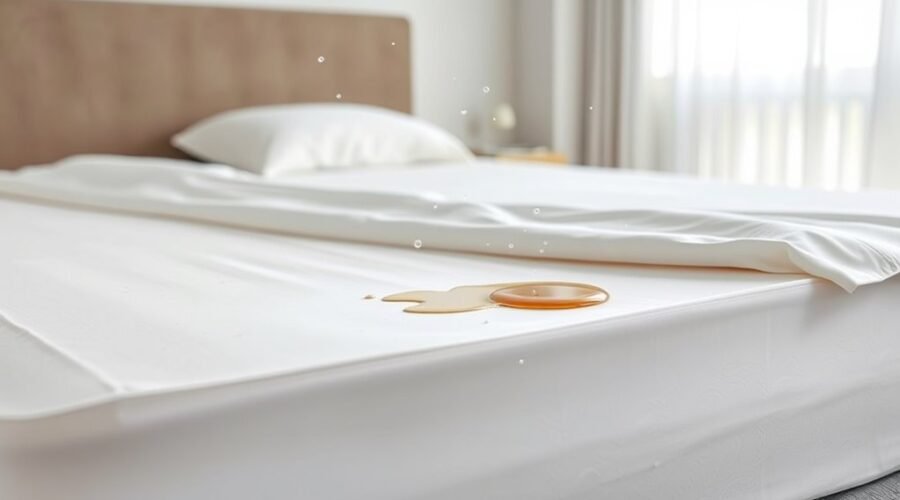
A mattress protector is a removable layer that sits between your mattress and fitted sheet to help keep spills, sweat, dirt, and everyday debris out of the mattress. Depending on its construction, it may also provide a barrier against allergens. However, waterproofing, allergen protection, and bed-bug protection are different features, so choosing the right type matters.
Quick Answer
A mattress protector helps keep sweat, spills, stains, dirt, and debris from reaching your mattress. Waterproof models provide the strongest liquid protection. For dust-mite allergies, look for an allergen-impermeable barrier, while bed-bug concerns usually call for a tested six-sided zippered mattress encasement rather than a standard fitted protector.
Key Takeaways
- A mattress protector is a removable barrier placed over the mattress and underneath your fitted sheet.
- A waterproof protector can keep sweat, drinks, urine, and other liquids from soaking into the mattress.
- Dust-mite and allergen protection depends on the construction; look for a product specifically described as allergen-impermeable or dust-mite-proof.
- A standard fitted protector is not the same as a bed-bug encasement. Bed-bug protection generally requires a secure six-sided zippered cover.
- Most protectors are designed for easy removal and cleaning, but washing and drying instructions vary by product.
What Is a Mattress Protector?
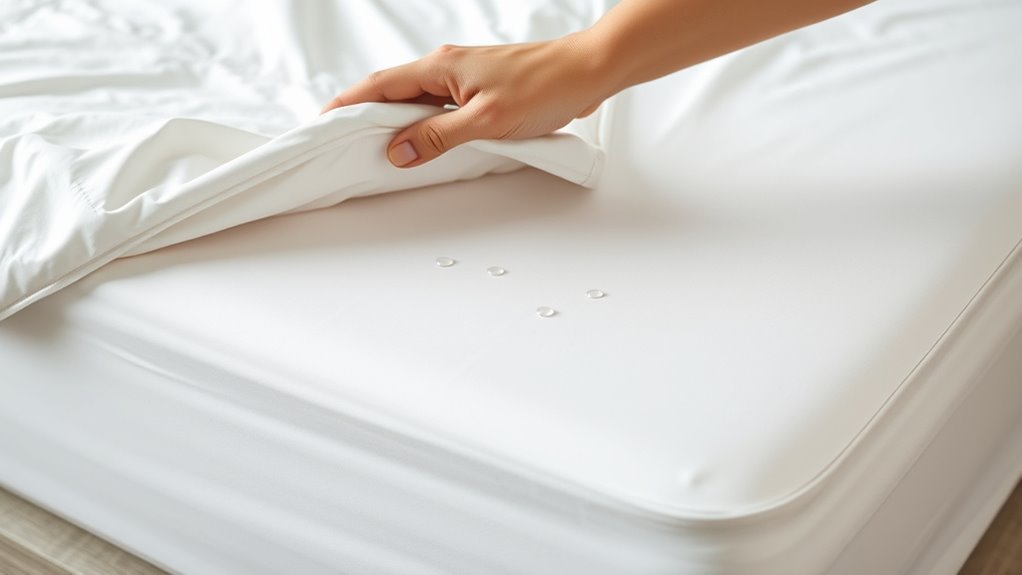
A mattress protector is a relatively thin, removable cover that goes directly over a mattress. Its main job is protection rather than changing the firmness or cushioning of the bed.
Many protectors fit like fitted sheets, with elastic around the edges or deep pockets that grip the mattress. Others use straps, while full mattress encasements surround all six sides and close with a zipper.
Protector materials vary. Common surface fabrics include cotton, polyester, rayon-derived fabrics, terry cloth, and blends. Waterproof versions usually add a thin barrier underneath the fabric surface.
The most useful feature for homes dealing with spills, bedwetting, pets, or heavy sweating is waterproof protection. A waterproof layer prevents liquid from passing through the protector and into the mattress when the product is working correctly.
Keeping the mattress dry also helps control one of the main conditions that encourages mold growth: moisture. The U.S. Environmental Protection Agency emphasizes that moisture control is central to preventing indoor mold growth.
A protector may also reduce the amount of skin flakes, pet hair, dust, and other debris that reaches the mattress. Because the protector is removable, cleaning it is usually far easier than trying to deep-clean the mattress itself.
A protector can also help prevent staining that may complicate a future warranty claim. Warranty rules are manufacturer-specific, however. For example, Tempur-Pedic and Sealy both state that liquid or stain damage may be excluded from mattress warranty coverage, so always check the terms for your particular mattress.
What Does a Mattress Protector Block?
What a mattress protector blocks depends on its design. A basic fabric cover, a waterproof fitted protector, an allergen barrier, and a bed-bug encasement should not be treated as interchangeable products.
| Hazard | What to Look For |
| Sweat, drinks, urine, and spills | A protector explicitly labeled waterproof |
| Dust, skin flakes, and pet hair | Most well-fitted removable protectors provide a useful physical layer |
| Dust mites and mite allergens | A specifically tested dust-proof or allergen-impermeable barrier |
| Bed bugs | A tested six-sided, bed-bug-proof zippered encasement |
Waterproof vs. Water-Resistant Protection
Waterproof and water-resistant do not mean the same thing. A waterproof protector is designed to stop liquid from passing through its barrier under the conditions specified by the manufacturer. A water-resistant product may repel a small amount of moisture but can eventually allow liquid through.
If your main concerns are bedwetting, pet accidents, heavy sweating, drinks in bed, or caring for a child, waterproofing is generally the more important specification.
Pro Tip: Do not assume a protector is waterproof because it looks thick or uses words such as “protective” or “moisture-wicking.” Check the product description for an explicit waterproof claim.
Dust Mites and Allergens
If allergies are your main concern, look beyond the word hypoallergenic. What matters more is whether the cover is specifically designed to prevent dust mites or their allergens from moving through the material.
The National Institute of Environmental Health Sciences recommends enclosing mattresses and pillows in dust-proof or allergen-impermeable covers as one method of reducing dust-mite exposure.
Research shows that allergen-impermeable mattress coverings can lower mite-allergen levels. However, reducing allergen exposure does not guarantee that a person’s asthma or allergic-rhinitis symptoms will improve. Mattress covers are one exposure-control measure, not a treatment for allergy or asthma.
Bed Bugs
A standard fitted mattress protector should not be relied on for bed-bug control because it normally leaves the underside of the mattress exposed.
For bed bugs, the U.S. EPA recommends bed-bug-proof encasements that surround the mattress and box spring. A proper encasement should close completely, resist tearing, and prevent bugs from using the mattress as a hiding place.
Warning: A mattress encasement can be useful in a bed-bug control plan, but it does not eliminate an infestation by itself. Bed bugs can also hide in frames, furniture, baseboards, luggage, and other areas of a room.
Mattress Protector vs. Mattress Encasement
A mattress protector and mattress encasement both create a barrier around part or all of the mattress, but they offer different levels of coverage.
Protection Level Differences
A fitted mattress protector usually covers the top and sides of the mattress. This makes it practical for everyday spills, sweat, dirt, and stains, especially when the protector is waterproof.
A mattress encasement surrounds the entire mattress, including the underside, and generally closes with a zipper. That six-sided design makes a suitable encasement the more appropriate choice when complete allergen containment or bed-bug protection is the priority.
For most households primarily concerned about accidental spills and ordinary mattress cleanliness, a fitted waterproof protector is simpler. For confirmed dust-mite sensitivity or bed-bug concerns, look for an encasement designed and tested for that specific purpose.
Ease of Cleaning
A mattress protector is usually easier to remove because it fits much like a fitted sheet. Many models are machine-washable, making them convenient for homes with children, pets, night sweats, or frequent spills.
Full encasements can take more effort to remove because the entire mattress must be uncovered. On larger or heavier mattresses, that can be inconvenient.
Do not assume every protector or encasement can be washed and dried the same way. Waterproof barriers can be damaged by inappropriate heat or harsh laundry products, so follow the care label supplied with the specific product.
Mattress Protector vs. Mattress Pad vs. Mattress Topper
These bedding products are often confused, but their main purposes are different.
| Product | Main Purpose |
| Mattress protector | Protects against stains, dirt, moisture, or allergens depending on design |
| Mattress pad | Adds a modest amount of cushioning and may provide some surface protection |
| Mattress topper | Changes the mattress feel, cushioning, or firmness |
| Mattress encasement | Surrounds all six sides for more complete barrier protection |
If your main goal is changing the feel of your bed, a pad or topper is usually more suitable. If your main goal is protecting the mattress, choose a protector or encasement.
How a Mattress Protector Can Improve Your Sleep Setup
A mattress protector can make the bed easier to maintain by separating everyday sweat, spills, skin flakes, pet debris, and other contaminants from the mattress itself.
That does not automatically mean the protector will make you sleep cooler or cure allergy symptoms. Comfort depends on the product materials, and allergy benefits depend on whether the barrier is appropriate for the allergen you are trying to control.
Sleep Temperature and Breathability
If you tend to sleep hot, pay attention to the protector’s construction instead of assuming every model is cooling.
Surface fabrics that move moisture and allow airflow may feel more comfortable to some sleepers. At the same time, a waterproof membrane adds another layer between your body and the mattress and may feel warmer or less breathable depending on its thickness and construction.
Some products are marketed with cooling yarns, phase-change materials, specialized fibers, or other temperature-management features. Their performance varies, so independent testing and a useful return policy can be more informative than marketing terms alone.
A thin protector generally changes the mattress feel less than a thick padded model. If preserving the exact feel of your mattress is important, look for a low-profile design.
A More Allergy-Conscious Sleep Surface
People with dust-mite sensitivity may benefit from reducing exposure to mite allergens, but an ordinary fitted protector is not automatically an allergen barrier.
For dust-mite control, choose a cover specifically identified as dust-proof or allergen-impermeable. NIEHS also recommends controlling indoor humidity, regularly washing bedding, and using other dust-control measures rather than relying on a mattress cover alone.
Controlled research has shown that mite-impermeable covers can reduce allergen levels in mattresses. However, clinical studies have found that covers used by themselves do not consistently improve allergic-rhinitis or asthma symptoms.
An allergen-impermeable cover can reduce exposure to dust-mite allergens, but reduced exposure should not be presented as a guaranteed improvement in allergy or asthma symptoms.
How to Choose the Right Mattress Protector
Choosing the right mattress protector starts with deciding what you actually need it to do.
- Choose the protection level. For spills and bedwetting, look for waterproof construction. For dust mites, look for a dust-proof or allergen-impermeable barrier. For bed bugs, choose a tested six-sided encasement.
- Check mattress depth. Measure the mattress from top to bottom, including any built-in pillow top. Deep-pocket protectors are useful only when their stated depth range matches your mattress.
- Consider the surface fabric. Cotton and other soft textile surfaces may feel more familiar, while synthetic performance fabrics may emphasize moisture management or stretch.
- Check the waterproof membrane. If liquid protection matters, verify that the product is actually waterproof rather than merely water-resistant.
- Consider noise and feel. A poorly designed protector may crinkle, bunch, or slightly change the feel of the mattress.
- Review care instructions. Confirm that the washing and drying requirements fit your routine.
- Read the warranty. Look for limits on leaks, staining, laundering, drying temperatures, and normal wear.
Note: Labels such as “hypoallergenic,” “cooling,” and “antimicrobial” describe different features. None automatically proves that a product is waterproof, dust-mite-proof, or bed-bug-proof.
How to Use and Care for a Mattress Protector
For a normal fitted protector, the usual layering order is:
- Mattress
- Mattress protector
- Fitted sheet
- Other bedding
The fitted sheet goes over the protector, so you normally sleep on the sheet rather than directly on the protector.
Washing and Drying
Wash the protector according to its care label. Many models are machine-washable, but recommended water temperature, detergent, and dryer settings vary.
Waterproof membranes deserve particular care. Excessive heat or unsuitable chemicals can shorten the life of some barriers. Never assume that the care instructions for your sheets also apply to your mattress protector.
If a spill reaches the protector, remove it promptly. If the mattress stayed dry, clean the protector as directed. If liquid passed through, dry the mattress thoroughly before remaking the bed.
The EPA notes that moisture control is the key to preventing mold growth and recommends drying wet materials promptly.
When Should You Replace It?
There is no universal replacement schedule. Replace the protector when its protective function is compromised. Signs include:
- Peeling or cracking waterproof material
- Liquid leaking through
- Torn fabric or damaged seams
- Elastic that no longer holds the protector securely
- A broken zipper on an encasement
- Persistent bunching that prevents a proper fit
If you rely on the protector for bedwetting, pet accidents, or other frequent spills, periodically check the barrier for deterioration rather than waiting for a leak to reach the mattress.
Who Needs a Mattress Protector Most?
Almost anyone who wants to keep a mattress cleaner can use a protector, but some households get more practical value from one.
If you’re a parent with young children, a waterproof protector can protect against spills, diaper leaks, bedwetting, and other accidents.
Parents with young children can make accident cleanup much easier by keeping a washable waterproof barrier between the child and the mattress.
Pet owners can use a waterproof protector to keep urine, drool, dirt, and other messes from reaching the mattress. The surface can also catch some pet hair and dander so it can be removed during laundering.
If you experience night sweats, a waterproof protector can keep repeated moisture from entering the mattress.
People concerned about dust-mite exposure should choose a cover designed specifically for allergen control rather than assuming any protector will provide the same barrier.
Anyone with an expensive mattress may also find a protector useful simply because stains and liquid damage can be difficult to remove and may be excluded by some mattress warranties.
Frequently Asked Questions
What Are the Downsides of Using a Mattress Protector?
A poorly fitting protector can bunch or slip, and some waterproof materials may add warmth or noise. Thick protectors can also slightly change the mattress feel. Waterproof layers eventually wear out, so proper laundering matters. Choosing the correct mattress depth, construction, and care requirements reduces most of these drawbacks.
Is a Mattress Protector Really Necessary?
A mattress protector is not required for sleeping, but it is useful if you want to keep sweat, spills, stains, dirt, or pet mess away from the mattress. It can also make cleanup easier. People concerned about dust mites or bed bugs should choose a barrier designed specifically for those purposes rather than relying on a basic fitted protector.
What Can You Use Instead of a Mattress Protector?
Alternatives include mattress pads, disposable underpads, washable absorbent pads, and full mattress encasements. A fitted sheet alone offers little protection from liquid. Mattress pads mainly add cushioning, while a six-sided encasement is the better alternative when complete allergen or bed-bug protection is needed.
Do You Put Sheets Over a Mattress Protector?
Yes. For a normal setup, place the mattress protector directly over the mattress and then put the fitted sheet over the protector. The protector creates the barrier while the fitted sheet provides the sleeping surface you normally feel against your body.
Are All Mattress Protectors Waterproof?
No. Some protectors are waterproof, some are only water-resistant, and others mainly protect against dirt and surface wear. If preventing liquid from reaching the mattress is important, check that the manufacturer specifically describes the product as waterproof.
Can a Mattress Protector Stop Bed Bugs?
A normal fitted protector should not be relied on to control bed bugs because it does not completely surround the mattress. For bed-bug protection, use a tested six-sided encasement with a secure zipper as part of a broader bed-bug management plan.
Conclusion
A mattress protector is a simple way to keep everyday sweat, dirt, debris, and accidental spills away from your mattress. For liquid protection, choose a waterproof model. If dust mites are your concern, look for an allergen-impermeable barrier. If bed bugs are the problem, use a tested six-sided encasement instead of relying on a standard fitted protector.
The best option is the one that matches your mattress depth, protection needs, comfort preferences, and laundry routine. Use it underneath your fitted sheet, follow its care instructions, and replace it if the barrier, elastic, seams, or zipper stops working properly.
Sources
- National Institute of Environmental Health Sciences — Dust Mites and Cockroaches — dust-mite exposure reduction and allergen-impermeable bedding guidance.
- U.S. Environmental Protection Agency — Preparing for Treatment Against Bed Bugs — mattress and box-spring encasement guidance.
- PubMed — Meta-analysis of impermeable dust-mite covers — evidence on allergen reduction and clinical allergy outcomes.
- U.S. Environmental Protection Agency — A Brief Guide to Mold, Moisture and Your Home — moisture-control and mold-prevention guidance.
- Tempur-Pedic — Staining and Spill Warranty Guidance — example of mattress liquid-damage and warranty considerations.