People living with MS often hunt for any lever they can pull, and the carnivore diet and multiple sclerosis has become part of that search. Online testimonials describe less fatigue and clearer thinking, but testimonials are not trials. This article explains what MS is, what researchers actually know about diet, and why a meat-only plan raises questions that your neurology team should help you weigh.
Quick Answer
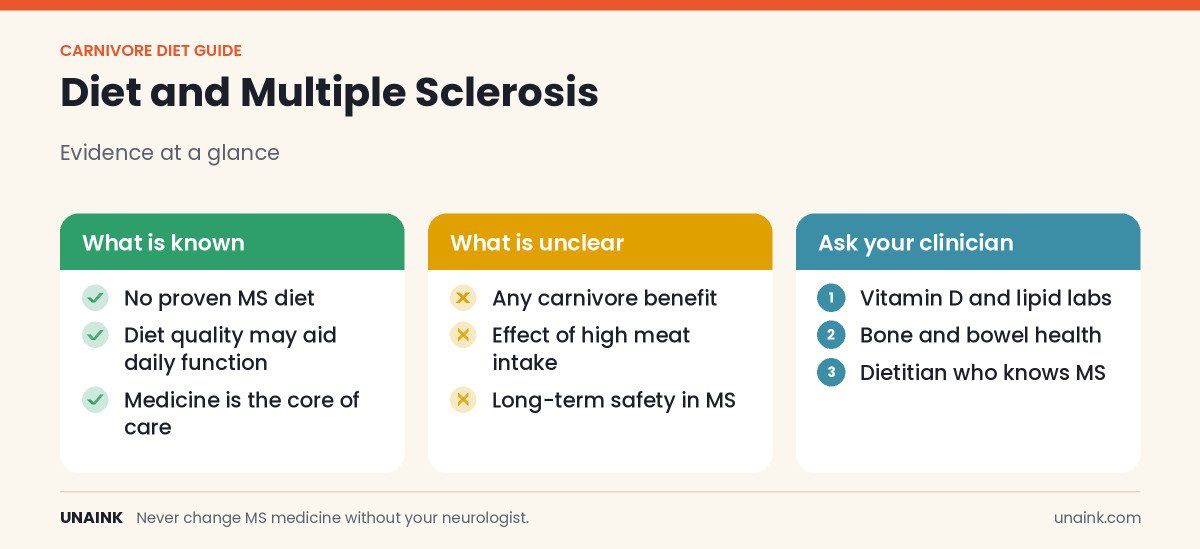
There is no evidence that a carnivore diet helps or treats multiple sclerosis. No clinical trial has tested it, and no diet has been shown to prevent relapses or stop disability from progressing. Overall diet quality may affect how you feel day to day. Disease-modifying therapy prescribed by a neurologist remains the core of MS care.
Key Takeaways
- MS is an immune-mediated disease of the brain and spinal cord, and it is treated mainly with disease-modifying medicines.
- No MS diet, including carnivore, has proven it can reduce relapses, lesions, or disability.
- Better overall diet quality is linked to less fatigue and better quality of life in observational research.
- Some studies link higher meat intake with worse outcomes, though these links do not prove cause.
- Never stop or change MS medicine because of a diet. Review any change with your neurologist.
What MS Is and How Treatment Works
In multiple sclerosis, the immune system attacks the protective coating around nerves in the brain and spinal cord. Symptoms vary widely and can include fatigue, numbness, vision problems, balance trouble, and bladder or bowel changes. Many people have relapses followed by recovery.
Modern care centers on disease-modifying therapies, symptom management, rehabilitation, and regular MRI follow-up. Diet is a supporting piece, not a replacement. Stopping a prescribed therapy can allow disease activity to return, so any diet experiment should happen alongside, not instead of, that treatment.
What Researchers Know About Diet and MS
A Weill Cornell MS Center review states that no specific diet has been shown to prevent relapses, reduce MRI lesions, or stop disability progression. It also notes that the National MS Society does not recommend a particular MS diet and advises healthy eating in line with national guidelines.
Studied approaches include Mediterranean, low-saturated-fat, Wahls, modified Paleo, ketogenic, and fasting diets. Mediterranean and Paleo-style eating were the most consistently linked to less fatigue and better quality of life, but trials are small and the evidence is limited.
What About Meat and the Carnivore Diet and Multiple Sclerosis?
The same review reports that, in one large observational analysis, people with the highest diet quality had a lower risk of disability worsening, while higher meat intake was linked with a greater risk of progression. Observational links like this cannot prove that meat causes worse outcomes, because people who eat more meat may differ in other ways.
Still, the finding means a meat-only plan is not a safe assumption. Researchers also warn that restrictive diets are hard to sustain and can cause nutrient gaps. The 2026 scoping review of the carnivore diet found only nine human studies, none in MS, and called the evidence very limited.
What People Report and Why It Is Hard to Trust
Some people with MS say they feel better after cutting sugar and processed foods. That can happen with any shift toward whole foods, weight loss, or better sleep. A 2021 survey of 2,029 carnivore dieters relied on self-reports, so it cannot show cause, and it was not designed to test MS outcomes. MS symptoms also naturally come and go, which makes it easy to credit a diet for a good stretch.
Specific Concerns for People With MS
- Bone health: MS, steroid courses, and low activity can weaken bones, so calcium and vitamin D matter. See calcium on the carnivore diet.
- Bowel changes: constipation is common in MS and may worsen without fiber or enough fluid. See carnivore diet constipation.
- Bladder symptoms: fluid and salt shifts early on can complicate bladder management.
- Fatigue and dizziness: early low-carb adaptation can feel like an MS flare, which makes symptoms hard to read.
- Cholesterol and heart risk: high saturated fat intake may raise LDL in some people. See carnivore diet and high cholesterol.
A Safer Way to Approach Diet With MS
- Tell your neurologist and primary care clinician what you are considering.
- Ask for vitamin D, lipid, and kidney labs before and after any change.
- Ask a registered dietitian who works with MS about evidence-supported patterns such as Mediterranean-style eating.
- Change one thing at a time, so you can tell what is helping.
- Keep taking prescribed medicines exactly as directed unless your prescriber says otherwise.
Carnivore Diet and Multiple Sclerosis: The Short Version
The carnivore diet and multiple sclerosis have never been tested together, so any claimed benefit is unproven. If you are curious about the carnivore diet and multiple sclerosis, treat it as a conversation to have with your care team, not a reason to alter treatment.
Frequently Asked Questions
Can the carnivore diet slow MS progression?
No evidence shows that. No diet has been proven to slow MS, and carnivore has not been studied in MS.
Is there an official MS diet?
The National MS Society does not recommend a specific diet. It points toward general healthy eating.
Which diets have been studied in MS?
Mediterranean, low-fat, Wahls, Paleo-style, ketogenic, and fasting diets, mostly in small trials.
Could a diet change affect my MS medicine?
Possibly, through weight, blood sugar, or blood pressure shifts. Ask your prescriber before changing how you eat.
Should I take supplements on a meat-heavy diet?
Vitamin D status is worth checking in MS. Do not start high-dose supplements without clinician advice.
Conclusion
The honest answer is that nobody knows whether eating only animal foods helps or harms people with MS. What is known suggests that overall diet quality matters, that restrictive plans carry nutrient risks, and that medicine remains the backbone of care. Bring your questions to your neurologist and dietitian before you change your plate.
Medical note
This article is for general education and is not medical advice. Talk with a doctor or registered dietitian before making major diet changes, especially if you have a health condition, take medication, or are pregnant or breastfeeding.
Keep Reading
- Carnivore Diet for Autoimmune Disease: What is known and unknown about autoimmune conditions.
- Carnivore Diet and Inflammation: What the research says about inflammation.
- Carnivore Diet Long-Term Effects: What we know about years on the diet.
- Who Should Not Do the Carnivore Diet: Groups that need extra caution.
Sources
- Weill Cornell MS Center: Food and Multiple Sclerosis, What Does the Research Say?: Summary of diet research in MS.
- Scoping Review of the Carnivore Diet (Nutrients, 2026): Nine human studies, very limited evidence.
- Self-reported survey of 2,029 carnivore dieters: Self-reported outcomes, cannot show cause.
- Harvard Health: What Is the Carnivore Diet?: Overview and cautions.