

The BBBE diet is a restrictive carnivore diet built around beef, butter, bacon and eggs, usually with water and salt. It excludes plant foods and, in its strict form, other animal foods. There is no reliable evidence that this four-food approach works better than other eating plans, and its long-term safety has not been established.
Quick Answer
BBBE means beef, butter, bacon and eggs. The short food list can simplify shopping, but it does not provide a proven weight-loss method or a nutritionally complete menu. No evidence-based duration or fat-to-protein ratio has been established for this specific diet.
Key Takeaways
- Strict BBBE limits food choice to four items. Cheese, fish, liver and coffee are modifications.
- Its practical appeal is a short shopping list. Benefits reported for broader low-carb diets do not prove benefits for BBBE.
- Review nutrient intake, processed-meat intake and cholesterol risk before considering it.
- People taking diabetes medicines need specific advice before sharply reducing carbohydrates.
What Is the BBBE Diet?
BBBE is an informal diet label, not a standardized medical protocol. Online versions vary in meal timing, portions, drinks and added seasonings. A plan described as a “30-day challenge” is a community routine, not proof that 30 days is safe or necessary.
It is narrower than the carnivore diet, which can include fish, poultry, seafood and dairy. The lion diet is another restrictive variant, usually based on ruminant meat, salt and water. These names describe food rules, not established health benefits.
BBBE Food List: What Fits the Strict Version?
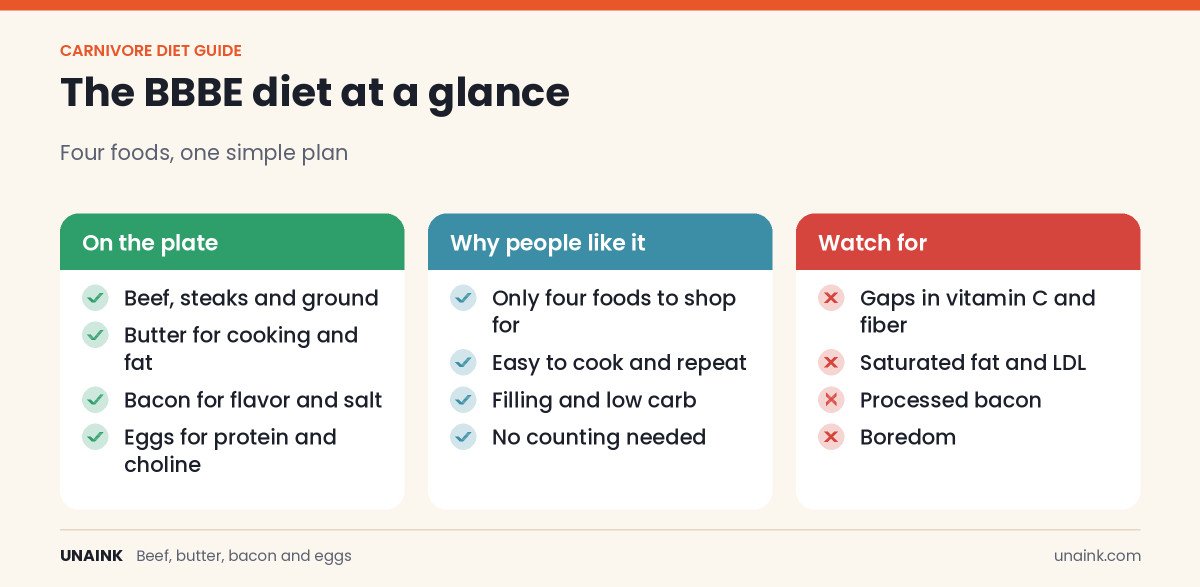
| Food | Common examples | What to check |
|---|---|---|
| Beef | Plain steak, roasts and ground beef | Cut, fat content and portion size vary. Pre-seasoned patties may contain other ingredients. |
| Butter | Salted or unsalted butter | Butter is mainly fat. Adding more is optional; it is not a required weight-loss step. |
| Bacon | Cured pork bacon | Read the ingredients and sodium information. Sugar-free bacon is still processed meat. |
| Eggs | Boiled, scrambled or fried eggs | Cook safely. Eggs and butter are unsuitable for people with the relevant food allergies. |
Outside strict BBBE: cheese, milk, yogurt, fish, poultry, organ meats, vegetables, fruit, grains, legumes, nuts and seeds. Adding foods changes the four-food version, but nutritional needs matter more than following a label. Our carnivore diet food list explains the wider variations.
Drinks and seasonings: water and salt are commonly included. Coffee, tea, spices and sweeteners depend on the version someone follows. There is no universal BBBE authority that approves them. Plain eggs contain small amounts of carbohydrate, and bacon ingredients vary, so “zero carb” is not an exact description of every menu.
A Sample Day on the BBBE Diet
This example shows the food rules. It is not a complete meal plan or a recommendation to eat this way.
- Breakfast: scrambled eggs cooked with butter, with bacon if included.
- Lunch: plain ground-beef patties and a boiled egg.
- Dinner: a beef steak or roast.
There is no established BBBE serving size, calorie target, fasting schedule or required number of meals. Nutrient totals depend on the amounts, cuts and brands you choose. Do not assume that eating until full will automatically meet your nutrient needs or produce weight loss.
Does BBBE Help With Weight Loss?
Some people may eat less when their food choices become limited. However, testimonials and before-and-after photos cannot show that BBBE caused the result or that it will last.
A 2026 scoping review of carnivore diets found a small, weak evidence base, including short studies and reports without control groups. It did not establish the effectiveness or long-term safety of a four-food BBBE plan.
Early weight loss on very-low-carb diets can include water loss. The National Lipid Association’s scientific statement explains this distinction. A lower scale reading does not show how much body fat was lost. BBBE has no proven “reset,” detox effect or special fat-burning advantage.
Practical Benefits and Limitations
| Possible convenience | Limitation |
|---|---|
| Fewer ingredients to buy and prepare | Little variety; eating out and family meals can be harder |
| Easy to repeat simple meals | Repetition does not ensure a balanced intake |
| Plain beef and eggs provide protein | Butter adds substantial energy without replacing a varied diet |
| Can exclude sweets and many packaged snacks | Bacon remains processed meat; a short ingredient list does not guarantee a healthy pattern |
Nutrient Gaps to Know About
These foods can supply protein and nutrients such as vitamin B12, iron, zinc and choline. That does not make the combination complete. A study modeling four broader carnivore menus found several nutrient shortfalls even when dairy or organ meats were included. It modeled menus rather than measuring deficiencies in people, and its menus were not strict BBBE.
- Fiber: the four basic foods provide essentially none.
- Vitamin C: a typical cooked BBBE menu is not a reliable way to meet requirements.
- Calcium, magnesium and potassium: adequacy depends on the full menu and amounts; sufficient intake should not be assumed.
- Iodine and vitamin D: amounts can vary with food selection, salt type and other factors.
The NIH vitamin C fact sheet identifies very limited food variety as a risk for inadequate intake. Eating fewer carbohydrates does not establish that you can ignore nutrient recommendations.
Adding fish or dairy can broaden nutrient intake, but neither supplies fiber. Liver is rich in preformed vitamin A, which can be harmful in excess. Do not use frequent liver meals or high-dose supplements to “balance” the diet without professional advice. See our guide to organ meats for context.
Bacon, Saturated Fat and Health Risks
The World Health Organization explains that processed meat causes colorectal cancer. Its Group 1 classification describes the strength of evidence, not the size of an individual’s risk.
The commonly cited estimate of about an 18% higher colorectal-cancer risk per 50 g of processed meat eaten daily is a relative increase from the studies reviewed. It is not an 18-percentage-point increase or a prediction of your personal risk. A safe threshold was not established. Avoiding added sugar does not remove the concerns linked to processed meat.
Butter and fatty beef can also make this diet high in saturated fat. The American Heart Association states that excess saturated fat can raise LDL cholesterol and recommends replacing it with unsaturated fats. Weight loss or feeling well does not rule out an unfavorable cholesterol change.
For more on processed-food choices within carnivore eating, see our dirty carnivore diet guide.
Who Should Avoid BBBE or Get Medical Advice First?
The American Diabetes Association’s 2026 guidance advises against very-low-carbohydrate plans for children, people who are pregnant or breastfeeding, people with kidney disease, and those with or at risk of disordered eating. A self-directed BBBE challenge is not a suitable approach for these groups.
Speak with your clinician first if you have high LDL cholesterol, cardiovascular disease, gout, a history of kidney stones, or a condition requiring a prescribed diet. Avoid foods to which you are allergic.
Medication warning
The NIDDK explains that sharply reducing carbohydrates can cause low blood glucose in people using insulin or medicines such as sulfonylureas. Arrange a monitoring and medication plan with the prescriber before changing your diet. Do not reduce or stop prescribed medicine yourself.
Very-low-carb diets should be avoided while taking SGLT2 inhibitors because of ketoacidosis risk. Follow Medsafe’s advice to seek urgent medical care for vomiting, abdominal pain, unusual exhaustion or difficulty breathing, particularly if you take one of these medicines. Blood glucose may not be very high during SGLT2-related ketoacidosis.
What to Review Before Changing Your Diet
- Define your goal. Weight management, convenience and digestive symptoms need different approaches. BBBE is not a validated food-allergy test.
- Review health conditions and medicines. Discuss whether restriction is appropriate and what monitoring you need.
- Check actual intake. A dietitian can assess your usual portions and identify nutrient gaps. Bone broth or electrolyte powders should not be assumed to correct them.
- Review symptoms and results. A clinician may recommend checking cholesterol, blood pressure or other measures based on your history. Normal results at one visit do not prove long-term safety.
- Choose a wider eating pattern when possible. Do not continue a challenge just to finish a set number of days if you feel unwell.
There is no evidence-based “safe trial” length for BBBE. Adding a few animal foods or taking supplements does not establish that the resulting diet is safe.
How to Cook Beef and Eggs Safely
Use a food thermometer for meat. FoodSafety.gov’s minimum temperatures include:
- Ground beef: 160°F (71°C).
- Beef steaks and roasts: 145°F (63°C), followed by at least a 3-minute rest.
- Eggs: cook until the white and yolk are firm. Egg dishes should reach 160°F (71°C).
- Leftovers: reheat to 165°F (74°C).
Do not use raw meat or raw eggs to try to preserve nutrients. Keep raw foods separate from cooked foods and follow package storage and cooking instructions for bacon.
Less Restrictive Alternatives
If you want simpler meals, repeat a few balanced breakfasts and dinners rather than limiting yourself to four ingredients. For a lower-carb approach, consider a varied menu that includes nonstarchy vegetables, suitable protein sources and unsaturated fats.
A Mediterranean-style pattern offers more food variety, including vegetables, legumes, nuts, olive oil and fish. The American Heart Association’s dietary guidance supports this broader approach. If a particular food seems to trigger symptoms, seek a structured assessment rather than removing many food groups indefinitely.
Frequently Asked Questions
What does BBBE stand for?
BBBE stands for beef, butter, bacon and eggs. Strict versions limit food choice to these four items, usually with water and salt.
Can you lose weight on the BBBE diet?
Weight may fall if you eat fewer calories, and early low-carb weight loss can include water. Reliable evidence has not established that BBBE works better than other eating plans.
Can you eat cheese or drink coffee on BBBE?
Cheese and coffee are outside the strict four-food definition. Some people include them as modifications. There is no standardized BBBE protocol.
Is the BBBE diet healthy long term?
Long-term safety has not been established. Nutrient gaps, processed-meat intake and saturated fat are reasons for caution. Feeling well does not confirm that the diet meets your needs.
How long should you follow the BBBE diet?
No evidence-based duration has been established. Online 30-day challenges do not prove that a month is safe or necessary. Discuss major diet changes with a clinician or registered dietitian.
Is BBBE the same as keto or carnivore?
BBBE is a narrower carnivore variant. Keto describes carbohydrate restriction aimed at ketosis and can include plant foods. Eating only the four BBBE foods does not guarantee a particular ketone level.
Should You Try the BBBE Diet?
The four-food rules are simple, but BBBE has no established advantage or proven safe duration. A varied eating plan and advice tailored to your health offer a more practical way to address weight, nutrition or digestive concerns.
Medical note
This guide provides general education, not a personal diet prescription. Talk with a doctor or registered dietitian before making major dietary changes, especially if you have a health condition or take medication.
Keep Reading
- What Is the Carnivore Diet?: the broader animal-food pattern and its limitations.
- Carnivore Diet Food List: how food choices differ between versions.
- Ground Beef Only Diet: another narrow food rule and its trade-offs.
- Dirty Carnivore Diet: processed-food choices and health concerns.
Sources
- Lietz, Dapprich and Fischer. Carnivore Diet: A Scoping Review of the Current Evidence, Potential Benefits and Risks. Nutrients, 2026.
- Assessing the Nutrient Composition of a Carnivore Diet: A Case Study Model.
- WHO: carcinogenicity of red and processed meat.
- American Heart Association: saturated fats.
- American Diabetes Association: Standards of Care in Diabetes, 2026, section 5.
- NIDDK: low blood glucose and diabetes medicines.
- Medsafe: risk factors and symptoms of SGLT2-related ketoacidosis.
- NIH Office of Dietary Supplements: vitamin C.
- NIH Office of Dietary Supplements: vitamin A.
- FoodSafety.gov: safe minimum internal temperatures.
- National Lipid Association: scientific statement on low-carbohydrate diets.
- American Heart Association: diet and lifestyle recommendations.


[…] cheap compared with steak, and it is filling. It sits next to other very narrow plans such as the BBBE diet and the lion […]