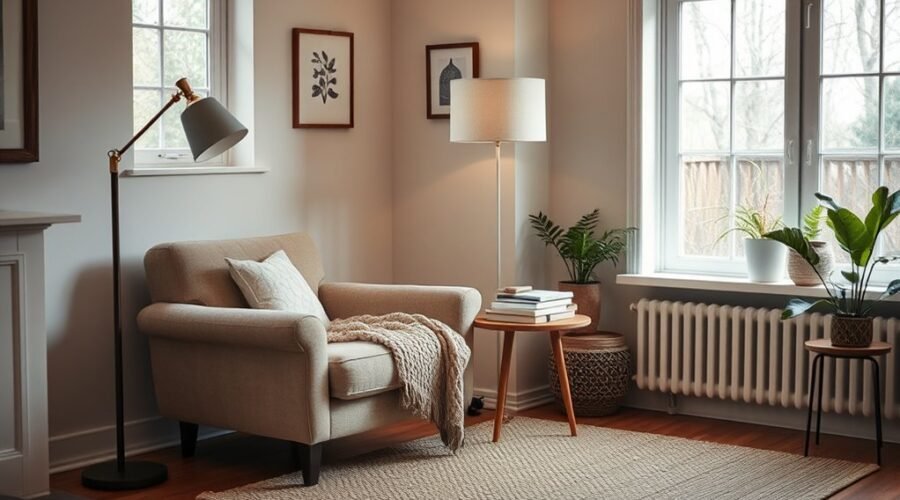
An unused living room corner can become a comfortable reading nook without making the room feel crowded. Start with the space itself: check the walking path, daylight, nearby outlet, and available floor area before choosing furniture. Then build around a supportive chair, focused reading light, small surface, and just enough storage to keep books close.
Quick Answer
To create a reading nook in your living room, choose a quiet corner that does not block traffic, measure it, and add a comfortable chair, adjustable task light, small side surface, and compact book storage. Keep cords out of walkways, control window glare, and use only a few soft, personal accents.
Key Takeaways
- Choose a low-traffic living room corner with useful daylight, a clear approach, and safe access to power.
- Measure the full chair footprint before buying and leave enough room to sit down, stand up, and pass the nook comfortably.
- Use an adjustable task light that illuminates the page without putting the bare bulb or strong reflections in your line of sight.
- Treat 2700–3000K as a warm-light choice for atmosphere, while selecting brightness by lumens and your own reading comfort.
- Use shelves, baskets, or a narrow bookcase for storage, but secure tall furniture and keep lamp cords out of walking paths.
- Add cushions, a throw, a side table, art, or plants only after the chair, lighting, access, and storage work well.
At a Glance
| Time Required | About 30–90 minutes to plan and measure; longer if you are mounting shelves, installing lighting, or assembling furniture. |
| Difficulty | Easy for a freestanding setup; moderate if wall-mounted storage or lighting is involved. |
| Tools Needed | Tape measure, painter’s tape, and optionally a level and the mounting tools specified by your shelf or furniture manufacturer. |
| Cost | Potentially $0 if you rearrange pieces you already own; buying a chair, lamp, table, and storage can range from a modest refresh to several hundred dollars or more. |
Choose the Best Living Room Corner
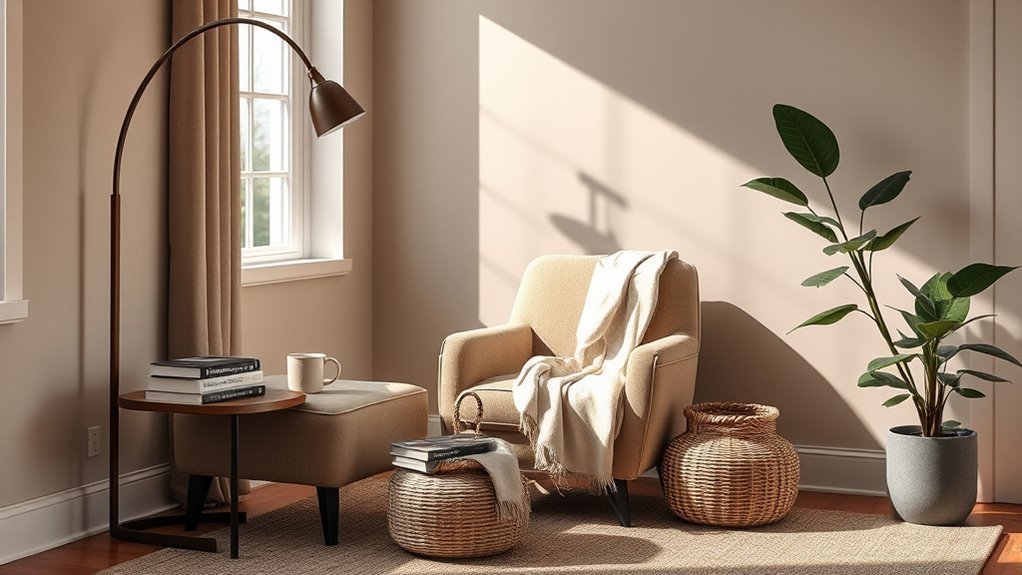
Start with a living room corner that feels slightly removed from the busiest part of the room. A window can provide useful natural light, but the brightest corner is not automatically the best one. Direct sunlight can create glare on glossy pages and screens, so consider how the light changes during the hours when you normally read.
If sunlight becomes distracting, a sheer curtain, blind, or adjustable shade can soften it without making the nook feel dark. Your evening lighting will matter just as much, so treat daylight as a bonus rather than the only light source.
Check whether the corner is close to a power outlet for a lamp or charging cable. Avoid solving the problem by stretching a cord through a normal walking path. Cords along floors can create a trip hazard, and the U.S. Consumer Product Safety Commission recommends keeping electrical cords out of foot traffic and using extension cords safely.
Then look at the room’s movement. Make sure the chair will not interfere with a doorway, cabinet door, curtain, heating or cooling vent, or the route people normally use to cross the living room. The nook should feel visually tucked in without becoming an obstacle.
Warning: Keep lamp and charging cords away from normal walking paths, follow the manufacturer’s limits for extension cords and power strips, and secure tall bookcases or other substantial furniture to the wall where appropriate. If you want a hardwired wall sconce and there is no suitable existing connection, use a qualified electrician rather than improvising household wiring.
Plan the Layout Before You Buy
A reading nook works better when you plan the footprint before shopping. Measure the usable width and depth of the corner, then note anything that projects into it, including baseboards, radiators, window trim, curtains, outlets, and nearby furniture.
Next, decide what the nook truly needs. For most living rooms, the core pieces are a chair, dedicated reading light, and a reachable surface for a book, drink, glasses, or phone. Storage, an ottoman, rug, plant, and art are secondary.
Use painter’s tape to mark the proposed chair, table, and lamp footprints on the floor. Walk past the taped layout, sit where the chair would go, and check whether you can enter and leave the nook naturally. This simple test is especially useful in a small living room because furniture can feel much larger in place than it looks online.
Pro Tip: Buy or place the chair first. It usually takes up the most room and determines where the lamp, table, ottoman, and shelves can go.
Pick a Chair That Fits the Space
Measure your corner first so the chair fits cleanly without crowding the room or disrupting the layout. A compact chair can work beautifully, but comfort depends on how the seat fits your body rather than on how small or stylish it looks.
Choose a compact seat with proportions that preserve an easy path around the nook. Slim arms, exposed legs, or an armless profile can make a small corner feel visually lighter.
Then test comfort, back support, seat depth, and how easily you can stand up. The best reading spot is one you can actually sit in for more than a few minutes.
Measure Corner Dimensions
Before you choose a chair, map the corner’s length and depth and include the space needed for any side table, floor lamp, ottoman, or basket. Measure the chair’s actual width, depth, and height rather than relying on a listing photo.
Use painter’s tape to trace the footprint on the floor. Then check the approach to the chair and make sure adjacent doors, drawers, curtains, and furniture can still function. In a compact living room, this helps you balance comfort, movement, and visual calm before you spend money.
Add accessories to the layout only after the chair fits. A smaller nook often looks better with one useful table and one light than with several pieces competing for space.
Choose a Compact Seat
With your corner dimensions mapped out, choose a compact seat that offers enough support without visually taking over the room. A slim-profile armchair, small swivel chair, or modest chaise may work, depending on the shape of the corner.
If you want more function, an ottoman or bench with hidden storage can hold blankets or books. Make sure an ottoman does not block the main walkway when it is in use.
Soft upholstery can make the nook more inviting, while raised legs can expose more floor and visually lighten the arrangement. A high back or armrests may feel comfortable to some readers, but neither is mandatory; fit matters more than a specific silhouette.
Prioritize Comfort and Style
Choose a chair that feels comfortable enough for longer reading sessions. Look for useful lower-back support, a seat depth that lets you sit against the backrest, and a position where your feet can rest comfortably on the floor or a stable footrest.
The Occupational Safety and Health Administration’s chair guidance recommends back support that follows the spine’s natural curve and provides appropriate lumbar support. Although that guidance is written for workstations, the basic principle of matching a chair to the person is useful when choosing a reading seat.
Match the chair’s style to your existing décor, whether your reading nook leans mid-century modern, contemporary, traditional, or cottage-inspired. Fabric can add softness; leather and performance materials may be easier to wipe clean. A restrained print or accent color can introduce personality without requiring extra décor.
Add Lighting That Makes Reading Easy
Use a floor lamp, table lamp, wall-mounted fixture, or clip light that directs illumination toward the book rather than simply brightening the whole room.
For a warm look, 2700–3000K LEDs are commonly described as warm or soft light. The U.S. Department of Energy’s Energy Saver guide also recommends judging brightness in lumens, not watts, because watts measure energy use rather than light output.
Place the lamp where it illuminates the page without putting the bare bulb in your direct line of sight or creating a bright reflection on a screen or glossy page.
Choose Task Lighting
Ambient room lighting sets the mood, but task lighting does the actual reading work. An adjustable floor lamp beside or slightly behind the chair can direct light toward your book without taking up table space.
If the corner is tight, a plug-in wall-mounted sconce or clip light can free the floor and side table. Renters can use plug-in fixtures or other removable options rather than drilling or altering electrical wiring where their lease does not allow it.
Choose a fixture with an adjustable head or arm when possible. This lets different readers change the direction of the light and helps you adapt as daylight changes.
A dimmable option can be useful for adjusting the overall mood, but confirm that both the bulb and fixture are compatible with the dimmer.
Use Warm Bulbs
Warm bulbs can make a reading nook feel calm and inviting. The Department of Energy classifies roughly 2700–3000K as warm or soft light, while higher Kelvin values appear progressively cooler.
Color temperature and brightness are separate choices. A warm-looking bulb can still be too dim for comfortable reading, so check the bulb’s lumen rating and choose enough light for your eyes, fixture distance, page size, and room conditions.
LED lighting is generally more energy-efficient and longer-lasting than traditional incandescent lighting, although actual performance varies by bulb. Check the product’s Lighting Facts information and make sure a bulb is approved for the fixture and any dimmer you plan to use.
Note: Warm color temperature creates atmosphere; it does not determine reading brightness. If a 2700K bulb feels too dim, increase usable light output or adjust the fixture before assuming you need a cooler color temperature.
Cut Screen Glare
Good lighting also helps control glare. Published research has found that direct glare can increase visual discomfort during screen reading and can negatively affect reading performance.
| Lighting choice | Practical effect |
|---|---|
| Warm/soft LED around 2700–3000K | Creates a warmer visual appearance |
| Adjustable lamp head or arm | Lets you direct light onto the page |
| Diffusing shade | Can reduce the view of a harsh bare bulb |
| Window shade or sheer curtain | Helps manage changing daylight and reflections |
Instead of aiming for one universal lamp height, sit in the chair with a book or device and adjust the light until the page is clear without a bright source or reflection entering your eyes. If you read on a tablet or e-reader, change both the lamp angle and the screen angle when needed.
A good reading light does not just make the corner look warm; it puts useful light on the page while keeping distracting glare out of your line of sight.
Add a Side Surface Within Reach
A small table is one of the most useful additions to a reading nook. It gives you a place for your current book, reading glasses, phone, bookmark, or drink without forcing you to stand up or balance things on the chair arm.
Choose a table that fits the available floor space and is easy to reach from your normal sitting position. In a very tight corner, consider a narrow pedestal table, C-shaped table, wall-mounted ledge, or a storage ottoman with a stable tray.
Keep the surface mostly clear. One lamp, drink, and current book may be all you need. Leaving some open space makes the nook easier to use and keeps it from becoming another clutter point.
Add Storage That Doesn’t Take Over
To keep your reading nook functional without crowding the room, choose storage that makes good use of available wall height while preserving enough open floor space.
A wall-mounted shelf or tall, narrow bookcase can keep books close without requiring a wide footprint. Follow the shelf manufacturer’s mounting and weight instructions rather than guessing at fasteners or load limits.
If you use a substantial freestanding bookcase, consider tip-over safety. The U.S. Consumer Product Safety Commission advises consumers to anchor bookcases and other potentially hazardous furniture, particularly in homes where children live or visit. Keep heavier books and objects lower when practical.
If you prefer hidden storage, an ottoman, bench, or lidded basket can hold blankets and occasional reads. Decorative boxes can organize bookmarks, chargers, and other small items.
A compact rolling cart can also work in a rental or multipurpose room because it can move when you need more floor space. The goal is not to display every book you own; it is to keep the few things you use in the nook easy to reach.
Style Your Reading Nook With Cozy Details
Once the functional pieces are in place, bring your reading nook to life with a few details that feel soft and personal. Start with a cushion or throw that makes the chair more comfortable rather than piling on textiles simply for decoration.
Add ambient lighting only after you have adequate task light. Decorative string lights or accent lamps can contribute atmosphere, but they should not be expected to replace a lamp that properly illuminates the page.
Bring in personal touches such as framed photos, favorite artwork, or one small object that means something to you. A compact side table keeps a drink, tea, book, or reading glasses close by while preserving an uncluttered footprint.
Personal touches and a compact side table keep your nook curated, functional, and effortlessly polished.
A plant can add color and height if the corner has suitable light and the plant is safe for the people and pets in your household. If plants are impractical, artwork, a ceramic object, or a small basket can give the same area visual interest without adding care requirements.
A rug can visually define the nook, especially in an open-plan room, but keep edges flat and stable so it does not create a trip hazard. A non-slip backing or suitable rug pad can help on smooth floors.
Make the Nook Renter-Friendly
You do not need built-ins or hardwired lighting to make a reading corner feel finished. A freestanding chair, plug-in floor lamp, narrow table, basket, and small bookcase can create a complete nook without modifying the walls.
If your lease limits drilling, skip floating shelves and hardwired sconces. Use a freestanding ladder shelf, book cart, clip lamp, plug-in sconce installed only with an approved mounting method, or furniture you can take with you when you move.
Before using any adhesive mounting system for a shelf or heavier object, check its actual load rating and the manufacturer’s surface requirements. Decorative adhesive strips suitable for a lightweight frame are not automatically suitable for books or shelving.
Keep the Nook Comfortable Day to Day
For a nook you will actually use, start with comfort that does not compromise the rest of the room. Choose a comfortable chair or chaise with enough support for your preferred reading posture.
Add a slim ottoman or footrest if it improves comfort and still leaves an easy path around the chair. If the footrest constantly has to be moved out of the walkway, the layout may be too tight.
Layer cozy textiles with restraint. A throw and one supportive cushion are often more practical than several pillows that must be moved each time you sit down.
Keep lighting layered and flexible: use the room’s ambient lighting for general visibility, then a dedicated task lamp for the book. Adjust the task light when the time of day, reading position, or material changes.
Stay disciplined with book storage. Return finished books to the main bookcase, clear empty cups and chargers, and keep the floor free of stacks or loose cords. A nook is easier to maintain when every item has a simple home.
Once or twice a season, sit in the nook and ask whether anything has become annoying: Is the lamp casting a shadow? Does the side table feel too far away? Is the throw always on the floor? Small adjustments usually improve the space more than buying another decorative object.
Frequently Asked Questions
What Are Common Mistakes in Book Nook Design?
Common mistakes include choosing a chair for looks instead of comfort, relying only on ambient lighting, placing the lamp where it creates glare or shadows, crowding the corner with décor, and ignoring the walking path. Loose cords, unstable rugs, and unsecured tall storage can also turn an attractive nook into a less practical or less safe space.
What Are Some Ideas for a Reading Corner in My Living Room?
Place a comfortable armchair or compact chaise in an unused corner, then add an adjustable floor lamp, small side table, and nearby book storage. Floating shelves can save floor space where appropriate, while a basket, rug, throw, artwork, or plant can give the nook personality without making it feel crowded.
What Are Some Creative Ideas for an Adult Reading Corner?
Try a sculptural swivel chair, compact chaise, storage ottoman, wall-mounted or plug-in reading light, floating ledge, or small rolling book cart. A textured rug, favorite artwork, framed photo, or one meaningful object can make the nook feel personal. Keep the functional pieces easy to reach and avoid filling every available surface.
What Should a Reading Corner Look Like?
A reading corner should look comfortable, uncluttered, and connected to the rest of the room. The chair should fit the space, the reading light should clearly illuminate the page, and books or accessories should have defined places. A cohesive color palette, one or two soft textiles, and a small personal accent are usually enough to make it feel intentional.
How Much Space Do You Need for a Reading Nook?
There is no universal minimum size because chairs, rooms, and users vary. Measure the exact chair footprint plus the space required to sit down, stand up, reach the lamp or table, and pass the corner without squeezing around furniture. Painter’s tape is an easy way to test the proposed footprint before buying anything.
What Type of Light Is Best for a Reading Nook?
An adjustable task lamp is usually the most useful choice because it lets you direct light onto the page. A 2700–3000K LED provides a warm appearance, but brightness should be chosen separately by checking lumens and testing the light in your actual reading position. Avoid exposed glare and strong reflections on glossy pages or screens.
Sources
- U.S. Department of Energy — Energy Saver Guide — backs guidance on light color temperature, lumens, LED lighting, and dimmer compatibility.
- Occupational Safety and Health Administration — Chair Guidance — supports chair-fit and lumbar-support guidance.
- PubMed — Effect of Direct Glare on Computer Reading — supports the discussion of direct glare and visual discomfort.
- U.S. Consumer Product Safety Commission — Anchor It! — supports securing bookcases and other substantial furniture against tip-over hazards.
- U.S. Consumer Product Safety Commission — Extension Cord Safety — supports safe use of electrical cords around the reading area.
Conclusion
When you choose the right corner, measure before buying, select a chair that fits you, and add focused light that actually reaches the page, an unused part of the living room can become a quiet retreat. Keep storage compact, cords and walkways safe, and frequently used items within reach.
Then add soft textures, books, art, or greenery with restraint. A successful reading nook does not need many pieces—it needs the right pieces in the right places. With a comfortable seat, useful light, a small surface, and an uncluttered layout, your living room gains a calm place where reading feels easy rather than staged.