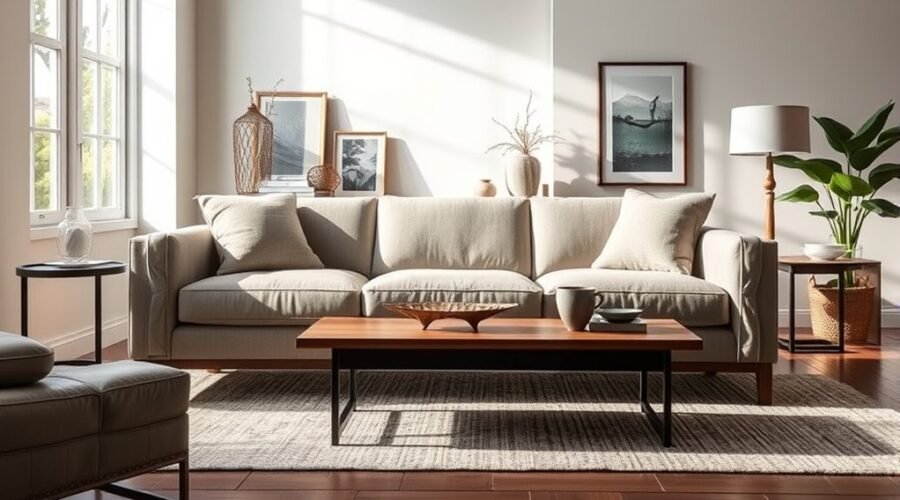
A track arm sofa has straight, squared arms that give the frame a tailored, streamlined look. The shape works especially well in modern, transitional, and mixed-style rooms and can create less visual bulk than heavily rounded arms. Comfort and space efficiency, however, depend on the sofa’s actual measurements, cushions, back, suspension, and arm width—not the arm shape alone.
Quick Answer
A track arm sofa has straight, squared arms and a clean, tailored profile. It can look lighter and less bulky than a rounded-arm sofa, which makes it useful in many small or modern rooms. Before buying, compare the overall size, inside seat width, seat depth, cushions, and delivery dimensions rather than choosing by arm style alone.
Key Takeaways
- A track arm sofa has straight, squared-off arms and a clean, contemporary silhouette.
- Its simple profile can reduce visual bulk, but the actual footprint depends on the sofa’s total width and depth.
- Track arms work with minimalist, contemporary, transitional, and mixed-decor rooms.
- Seat depth, seat height, cushion fill, back design, and suspension usually affect comfort more than arm shape alone.
- Fabric, color, pillows, rugs, and nearby furniture can make the same track-arm design feel formal, casual, warm, or minimal.
What Is a Track Arm Sofa?
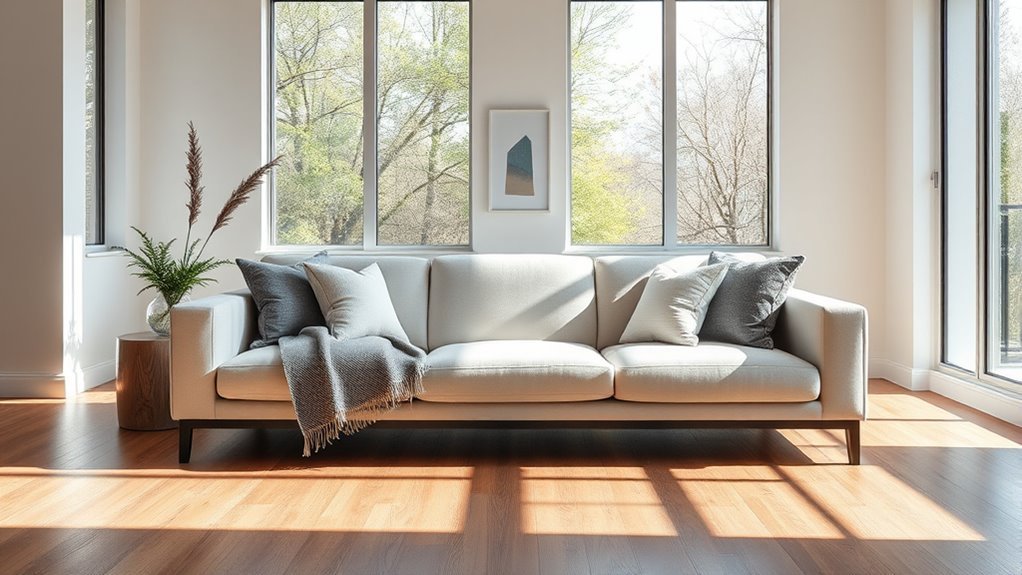
A track arm sofa is defined by its straight, squared-off arms. Instead of curving outward like a traditional rolled arm, a track arm generally follows a simple vertical or nearly vertical line from the seat area to the top of the arm.
That shape creates the clean lines associated with many modern and contemporary sofas. Furniture sellers may also describe similar designs as square-arm sofas, although individual manufacturers can use style names differently.
A track arm can make a sofa look compact because it lacks the pronounced curves of many traditional arm styles. That does not mean every track-arm model is physically small. Some have narrow arms, while others use broad, padded arms that take up considerable width.
Note: “Track arm” describes the arm shape, not one standardized sofa size. Always use the manufacturer’s dimensions for overall width, inside seating width, depth, height, and delivery clearance.
Upholstery options commonly include leather and woven fabrics such as cotton, linen blends, polyester, velvet, and performance textiles. Because the basic arm profile is visually simple, the same shape can work in a polished contemporary room or a softer transitional space.
Why Track Arm Sofas Look So Modern
Track arm sofas often look modern because the straight arms create a clean, streamlined silhouette with few decorative curves. The uninterrupted lines can make the frame appear crisp and architectural rather than ornate.
This simple profile pairs easily with minimalist, contemporary, and mixed-style rooms. It can also work in transitional interiors where cleaner furniture lines are used alongside traditional rugs, wood furniture, lamps, or artwork.
The appeal of a track arm is less about a specific decorating trend and more about its simple geometry: straight lines are easy to combine with many furniture styles.
Throw pillows can soften the squared profile, while a tightly edited pillow arrangement preserves a sharper, more minimal look. Fabric also changes the mood. Smooth leather or a tight weave emphasizes structure, while linen-like textures, boucle-style surfaces, velvet, and other tactile fabrics can make the sofa feel warmer and more relaxed.
How Track Arm Sofas Fit Your Space
Track arms can be useful when you want a sofa to look visually light and orderly. Without a large outward roll or flare, the sides often read as cleaner and less bulky. That can be helpful in apartments, smaller living rooms, and open-plan spaces where sightlines matter.
| Space Need | Potential Track-Arm Advantage |
|---|---|
| Small living room | Straight sides can reduce visual bulk |
| Tight furniture grouping | A narrow-arm model may preserve more usable seat width |
| Open-plan room | A clean back and arm profile can help define a seating zone |
| Mixed decor | Simple geometry blends with many furniture styles |
The important qualifier is actual arm width. A broad track arm can take up as much space as another substantial arm style. Compare the sofa’s total width with its inside seating width if maximizing seating space matters.
Pro Tip: When comparing two sofas of similar overall width, check the inside seating width. The model with narrower arms may provide noticeably more usable seat space even if both are sold as three-seat sofas.
Track Arm Sofa Sizing and Comfort Basics
Comfort is not determined by the track arm alone. Before buying, compare seat depth, seat height, inside seat width, cushion construction, back design, and suspension. These measurements and components have a stronger influence on how upright, relaxed, firm, or lounge-friendly a sofa feels.
Seat Depth and Width
General sofa seat depths commonly fall around 20 to 25 inches, although individual models can be shallower or much deeper. A shallower seat generally favors an upright posture, while a deeper seat gives more room to lounge or tuck up your legs.
Seat height also varies. Many sofas fall roughly in the mid-to-high teens, but the right height depends on your body proportions and how easily you want to sit down and stand up.
Do not confuse seat depth with overall sofa depth. Overall depth includes the back and frame. A sofa can therefore have a comfortable seat while still maintaining a relatively compact footprint—or have a deep frame that projects much farther into the room.
Width deserves the same attention. Compare:
- Overall width: the full outside width from one arm to the other.
- Inside seating width: the usable width between the arms.
- Arm width: the space each arm consumes.
- Cushion configuration: whether the sofa uses one bench cushion or several individual cushions.
Arm Height and Support
Track arms can be low, medium, or high, and there is no single standard height that defines the style. Look at the arm in relation to the seat cushion rather than relying on a universal number.
A lower arm can preserve open sightlines and make the sofa look visually lighter. A higher or more padded arm may be more comfortable if you regularly lean against it, although the shape, firmness, and padding matter as much as height.
If you like resting your head against the side of the sofa, try the position in person when possible. A perfectly vertical, firm track arm may feel very different from a padded rolled arm unless you use a pillow.
Cushions, Back, and Suspension Matter Too
The rest of the sofa construction can have more effect on comfort than its arm style. Seat cushions may contain foam, fiber, feathers, springs, or combinations of these materials. Softer fills often feel plush but may need more reshaping, while firmer foam can provide a more structured seat.
The back design also matters. Loose pillow backs tend to feel softer and more relaxed, while tight or structured backs can produce a more tailored feel. The suspension system beneath the cushions—including springs or webbing—contributes to support and how the seat responds under weight.
For that reason, two track-arm sofas can feel completely different even when their exterior shape looks similar.
How to Measure for a Track Arm Sofa
Measure more than the wall where the sofa will sit. You also need to make sure the piece can travel from the delivery entrance to its final position.
- Measure the available floor area. Check the maximum sofa width and depth that the room can comfortably handle.
- Mark the footprint. Painter’s tape can help you visualize how far the sofa will project into the room and whether it interferes with doors, tables, vents, or walkways.
- Check product dimensions. Record overall width, overall depth, height, and diagonal depth when the manufacturer provides it.
- Measure usable seating. Compare the inside seat width and depth rather than relying only on the advertised number of seats.
- Measure the full delivery path. Check the height and width of doorways, halls, stairways, elevator openings, and tight turns.
- Look for obstacles. Railings, light fixtures, trim, narrow corners, and low ceilings can prevent a large sofa from being maneuvered into place.
Taking these measurements before ordering is especially important with fixed-frame sofas that cannot be disassembled into smaller modules.
Best Track Arm Sofa Fabrics and Colors
Because a track arm sofa has a relatively simple outline, upholstery has a major influence on its personality. Leather can emphasize the structured shape, while woven cotton, linen blends, polyester, velvet, and textured fabrics can make the same form feel softer or more casual.
For a busy family room, look for upholstery specifically designed for frequent use and check the maker’s care instructions. Performance fabrics from established textile manufacturers may be engineered to improve resistance to staining, abrasion, pilling, or everyday messes, but performance characteristics differ by fabric.
Light neutrals can keep the room visually airy. Mid-tone colors tend to hide everyday marks better than very pale upholstery, while dark or saturated colors can turn the sofa into a stronger focal point.
Texture matters as much as color. A nubby or dimensional weave adds depth to the straight silhouette, while smoother upholstery reinforces a sharper, more tailored appearance.
Pros and Cons of Track Arm Sofas
| Advantages | Potential Trade-offs |
|---|---|
| Clean shape works with many modern and transitional rooms | A firm square arm may be less comfortable for resting your head without a pillow |
| Can create less visual bulk than strongly rounded or flared arms | Broad track arms can still consume significant floor and seating width |
| Narrow-arm versions can preserve useful interior seating space | The style alone tells you little about cushion softness or overall comfort |
| Simple lines are easy to style with pillows, rugs, and accent furniture | Very boxy versions may feel too angular in rooms dominated by soft traditional shapes |
Track Arm Sofa vs. Rolled and English Arms
The clearest difference among these sofa styles is the shape of the arm, not a guaranteed difference in comfort or seating capacity.
| Arm Style | Typical Appearance | Space Consideration | Comfort Consideration |
|---|---|---|---|
| Track arm | Straight, squared, tailored | Can look visually compact; actual arm width varies | Firm straight arms may benefit from a pillow when lounging sideways |
| Traditional rolled arm | Rounded and usually more decorative | The outward curve can add visual and physical bulk | A padded curve may feel comfortable for leaning, depending on height and firmness |
| English roll arm | Low, rounded arm with a classic relaxed profile | Proportions vary considerably by model | Low arms can work well for lounging, but seat and back construction remain important |
A track arm reads crisp and tailored. A traditional rolled arm produces a softer outline, while an English roll arm combines a low rounded arm with a classic, relaxed look.
Do not assume that one arm style automatically creates a deeper seat, firmer posture, or greater seating capacity. Compare the actual seat depth, back angle, cushion fill, suspension, and inside seating width of the models you are considering.
How to Style a Track Arm Sofa
Styling a track arm sofa is largely about deciding whether to emphasize or soften its geometry. For a crisp contemporary look, use a restrained palette and a small number of structured throw pillows. To make the sofa feel cozier, introduce pillows and throws in softer textures and varied shapes.
A wood or metal accent table can complement the squared profile without competing with it. In a compact room, placing the sofa against a wall may preserve circulation. In a larger or open-plan room, floating the sofa can help define a seating zone.
A textured rug grounds the arrangement and introduces softness beneath the straight frame. Rounded lamps, circular tables, curved chairs, or organic accessories can provide contrast if the room begins to feel overly angular.
Color can change the effect just as strongly. A pale neutral keeps the sofa understated, a warm earth tone makes it feel relaxed, and a rich saturated shade can turn the simple silhouette into a focal point.
How to Choose the Right Track Arm Sofa
Start with the room rather than the upholstery swatch. Measure the location and delivery route, then compare the sofa’s outside dimensions with its usable interior seat dimensions.
- For upright sitting: favor a seat depth and back design that let your feet rest comfortably on the floor while supporting your back.
- For lounging: consider a deeper seat, softer back cushions, or enough width to curl up comfortably.
- For a small room: compare total depth and arm width rather than assuming every track-arm sofa is compact.
- For heavy everyday use: check frame construction, suspension, cushion specifications, upholstery-care codes, and fabric-performance information.
- For maximum seating: compare inside seating width against overall width.
- For long-term satisfaction: sit on the sofa in person when practical or study the retailer’s complete measurements, cushion specifications, warranty, and return policy before ordering.
Leather and performance upholstery can both suit frequent use, but neither should be selected on a label alone. Check the specific material’s finish, maintenance instructions, cleaning restrictions, and warranty.
How to Care for a Track Arm Sofa
The correct cleaning method depends on the upholstery, not the arm shape. Follow the sofa or fabric manufacturer’s care code and instructions before applying water, detergent, solvents, stain removers, or other cleaning products.
For routine care, remove loose dust and crumbs with an upholstery attachment when the fabric maker permits it. Clean spills promptly according to the approved method, and rotate or reposition removable cushions when the manufacturer recommends doing so to distribute wear.
Performance fabrics can simplify maintenance, but they are not maintenance-free. Different textile technologies have different cleaning procedures, so avoid assuming that a method approved for one performance fabric is safe for another.
Sources
- Crate & Barrel — How to Choose a Sofa: track-arm definition, sofa styles, seat-depth considerations, cushion types, suspension, and routine upholstery guidance.
- Wayfair — Sofa Dimensions: How to Choose the Right Size Sofa for Your Home: general sofa, seat-depth, and seat-height measurement ranges.
- Pottery Barn — How to Measure for Furniture: room footprint, diagonal-depth, doorway, hallway, stairway, and delivery-path measurements.
- Sunbrella — Interiors Performance Fabric Guidance: durability characteristics and resistance to everyday upholstery wear and messes.
- Crypton — Fabric Care and Cleaning Guidance: routine maintenance and fabric-specific cleaning considerations for performance upholstery.
Frequently Asked Questions
What is a track arm on a sofa?
A track arm is a straight, squared-off sofa arm. It creates a clean, box-like outline instead of the rounded profile of a rolled arm. Track arms are common on contemporary and transitional furniture, although the width, height, padding, and exact proportions vary by model.
What type of sofa arm is the most comfortable?
There is no universally most comfortable sofa arm. A soft rolled arm may feel pleasant for leaning or resting your head, while a padded track arm can provide firm side support. Overall comfort depends more on the seat depth, seat height, back shape, cushion fill, suspension, arm padding, and your preferred sitting position.
What are the key differences between track arm and roll arm sofas?
Track arms are straight and squared, producing a crisp, tailored outline. Rolled arms curve outward and create a softer, more traditional profile. Rolled arms can occupy more visual or physical space, but actual dimensions vary. Neither style automatically provides more seating or greater comfort, so compare the specific sofa’s inside width, depth, cushions, and arm measurements.
Are rolled arm couches still in style?
Yes. Rolled-arm and English roll-arm sofas continue to be used in traditional, transitional, and eclectic rooms. Their rounded lines create a softer look than a track arm. Updated upholstery, simplified frames, and contemporary colors can also make a rolled-arm sofa work in a more current interior.
Is a track arm sofa good for a small living room?
It can be. The straight profile often looks less bulky than a heavily rounded or flared arm. For a genuinely space-efficient choice, however, compare the sofa’s overall width and depth, arm width, and inside seating width. A broad track-arm sofa can still be too large for a compact room.
What should you measure before buying a track arm sofa?
Measure the sofa’s planned floor area and compare it with the model’s overall width, depth, and height. Also check its inside seat width, seat depth, and diagonal depth when available. Finally, measure every doorway, hallway, stairway, elevator, and tight turn along the delivery path so the sofa can reach the room.
Conclusion
A track arm sofa is defined by its straight, squared arms and clean profile, making it an adaptable choice for contemporary, transitional, and mixed-style rooms. Its shape can reduce visual bulk, but a track arm does not automatically make a sofa smaller or more comfortable. Measure the room and delivery path, compare usable seat dimensions, and evaluate the cushions, back, suspension, upholstery, and arm width. Choosing from those details will give you a sofa that fits both the space and the way you actually sit.