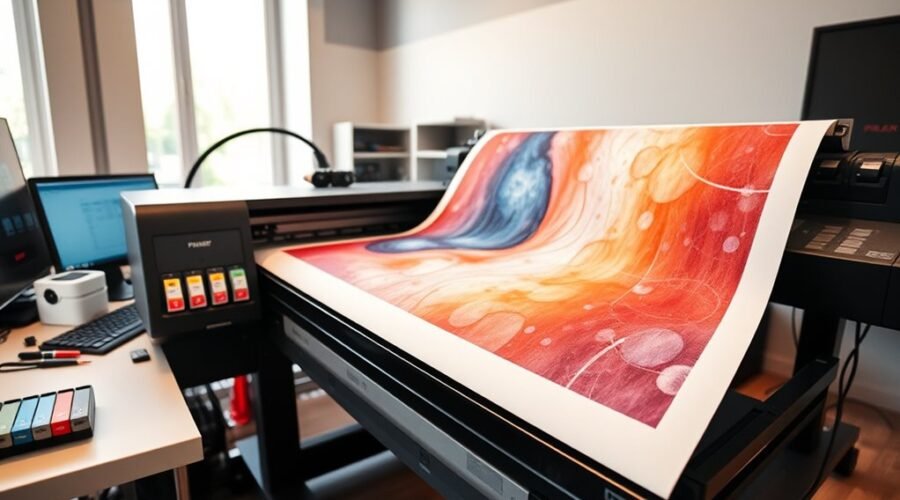
Giclée printing is a high-quality digital inkjet process used for fine-art reproductions and, in some cases, original digital artwork. The best results come from a strong source file, controlled color management, a suitable professional printer, and a tested ink-and-media combination. The word “giclée” alone, however, does not guarantee archival quality or a specific lifespan.
Quick Answer
A giclée print is a digital fine-art print produced with inkjet technology. Professional giclée printing commonly uses pigment inks, fine-art paper or canvas, color-managed files, and careful proofing. Because the term has broad modern usage, verify the exact ink, media, printing process, and permanence information instead of relying on the label alone.
Key Takeaways
- Giclée refers to digital inkjet fine-art printing and may be used for reproductions or artwork created digitally.
- The label itself does not guarantee archival permanence; the exact printer, ink, paper or canvas, coating, and display conditions matter.
- A color-managed workflow using an appropriate ICC profile and a physical proof helps produce more predictable color.
- Around 300 PPI at the final print size is a common high-quality source-file target, but required resolution varies with image detail, print size, and viewing distance.
- For valuable prints, verify the materials, edition information, permanence testing, proofing process, and storage or framing recommendations.
What Are Giclée Prints?
Giclée prints are digital prints produced with an inkjet process and intended for the fine-art market. The Getty Art & Architecture Thesaurus places giclée within digital inkjet printing and notes that printmaker Jack Duganne coined the term in 1991.
The word originally helped distinguish emerging fine-art inkjet output from ordinary commercial inkjet printing. Its usage has broadened considerably since then. A giclée can be a reproduction of a painting, watercolor, photograph, drawing, or mixed-media work, but digital printing can also be the final medium for artwork created digitally.
Note: “Giclée” is best treated as a description of a type of fine-art inkjet print, not as an automatic certificate of permanence. Quality-focused printers often use pigment inks and archival-grade media, but you should verify those details rather than assume them from the name.
Organizations can set more specific quality requirements. For example, the Fine Art Trade Guild Print Standards include requirements for lightfastness, substrate pH, paper weight, approved inks, and tested materials for work represented as meeting its standards.
In practical terms, a well-made giclée normally combines a detailed source file, professional inkjet output, compatible fine-art media, controlled color management, and careful quality checking.
How Giclée Prints Are Made
A giclée workflow usually begins by capturing or preparing a high-quality digital master. A painting may be photographed under controlled lighting or scanned when its size and surface allow it. Digital artwork can start from the original working file instead.
| Stage | Purpose |
|---|---|
| Capture | Create a detailed digital master from the original artwork when reproduction is required. |
| File preparation | Set the crop, final dimensions, effective resolution, tonal range, and embedded color profile. |
| Color management | Use calibrated equipment and the correct printer-and-media ICC profile for predictable conversion. |
| Proof | Check color, contrast, shadow detail, highlights, sharpness, and the paper surface before a full edition is produced. |
| Apply the chosen ink set to compatible fine-art paper or canvas using the appropriate media settings. | |
| Finish and inspect | Allow appropriate drying or curing time, inspect the print, trim if needed, and then sign, number, mount, stretch, or frame it as appropriate. |
Capture and File Preparation
Reproducing an original accurately requires more than taking a quick photograph. Even lighting, controlled reflections, accurate white balance, sufficient camera or scanner resolution, and careful alignment all affect the master file. Textured paintings can be especially difficult because glare and directional light can change the apparent color and surface depth.
The source image should also contain enough pixels for the planned print size. Instead of describing the file as having a fixed “DPI,” calculate its effective pixels per inch at the final output dimensions.
Color Management and Proofing
Professional inkjet printing relies on color management to translate colors between the source file, monitor, printer, ink, and media. Printer manufacturers provide ICC-profile workflows because the same RGB values can produce different results on different papers and printers.
A practical workflow uses a calibrated display, an embedded RGB color profile, the appropriate ICC profile for the printer-and-media combination, and a physical proof before committing to a large or limited edition. The printer should also avoid applying conflicting color corrections in both the editing software and printer driver.
Pro Tip: Before ordering an expensive edition, ask the print studio which RGB profile, effective PPI, file format, and ICC workflow it prefers. Then approve a physical proof on the exact paper or canvas you plan to use.
Printing and Quality Control
During printing, the machine lays down extremely small ink droplets according to its screening and printhead system. Professional models may use several inks beyond basic cyan, magenta, yellow, and black to improve tonal transitions, neutral grays, shadow reproduction, or portions of the color gamut.
Ink-channel count by itself does not prove better quality. The print should be judged as a complete system: source preparation, profile quality, printer condition, ink set, media compatibility, rendering settings, proofing, and final inspection all matter.
Why Artists Use Giclée Prints
Artists use giclée printing because it can reproduce detailed artwork in small or large quantities without requiring a traditional plate, screen, or press setup. It is particularly useful for print-on-demand sales because additional impressions can be produced from a controlled master file as orders arrive.
Archival Quality
Quality-focused giclée printing often combines pigment-based inks with stable fine-art papers or canvas. The Library of Congress preservation guidance notes that pigment-based inkjet systems used with the appropriate matching paper can provide more stable images, particularly when stored under suitable conditions.
However, “pigment” does not translate into one universal lifespan. Permanence ratings are based on a particular printer, ink, paper, test method, and environmental assumption. Changing any part of that system can change the result.
When archival performance matters, check:
- the exact ink set used;
- the manufacturer and product name of the paper or canvas;
- whether the combination has published permanence or lightfastness testing;
- recommended display and storage conditions; and
- the mounting and framing materials that will contact the print.
Edition Income
Giclée printing lets an artist produce additional impressions from a digital master without manufacturing the whole run in advance. That can reduce inventory and upfront production costs compared with processes that require a larger initial run.
An artist can sell an open edition or define a fixed limited edition. For a limited edition, consistency and documentation matter: decide the edition size, maintain the same intended specifications, track the impressions produced, and clearly disclose the edition information to buyers.
Archival materials may support the perceived quality of an edition, but scarcity, an artist’s reputation, provenance, condition, demand, and documentation are separate factors. A limited-edition label by itself does not guarantee future resale value.
Wider Reach
A single original can be offered at several accessible price points through reproductions while the artist retains the original work. Digital production also makes it practical to offer selected dimensions or substrates, provided each version is proofed so changes in size or surface do not undermine the intended appearance.
Collectors may also appreciate documented edition numbers, signatures, certificates of authenticity, and clear material specifications. These details establish what the buyer is receiving even though they do not independently prove archival longevity.
Giclée Printing vs Fine Art Printing
“Giclée” and “fine art print” overlap, but they are not perfect synonyms. Giclée identifies a digital inkjet-printing category. “Fine art print” is broader and its meaning depends on context.
In traditional printmaking, an original fine-art print can be made from a plate, block, stone, screen, or another matrix created as part of the artwork. Lithographs, etchings, woodcuts, and screenprints are examples. In commercial art reproduction, “fine art print” is also commonly used for premium reproductions made by digital or other printing methods.
| Term | Typical Process | Original or Reproduction? | Automatic Archival Guarantee? |
|---|---|---|---|
| Giclée | Digital inkjet printing | Can be either, depending on the artwork | No |
| Traditional original print | Etching, lithography, woodcut, screenprint, and related processes | Created as an original multiple | No; materials and storage still matter |
| Fine-art reproduction | May use inkjet or another reproduction process | Reproduction | No |
For buyers, the process description is more useful than a prestige label. Ask exactly how the image was made, whether it reproduces another artwork, what materials were used, and whether it belongs to an open or limited edition.
What Makes a Giclée Print Archival?
Archival performance is a property of the complete print system and its environment, not simply the word “giclée.” Ink chemistry, paper or canvas, coatings, atmospheric pollutants, humidity, light exposure, framing, and storage can all affect how a print ages.
Archival Inks and Papers
Pigment-based inks are widely used for long-life fine-art inkjet printing because pigment systems can provide strong image permanence when paired with compatible media. The most reliable way to evaluate a system is to look for permanence or lightfastness data covering the exact ink-and-paper combination.
For paper, acid-free and low-lignin or lignin-free materials are widely used for preservation because unstable paper chemistry can contribute to discoloration and embrittlement. The paper should also be appropriate for the printer’s ink system and coating requirements.
Do not assume that cotton content alone proves permanence. Cotton rag can provide an attractive, durable fine-art surface, but a serious archival claim should still be based on the complete specifications of the finished material and printed system.
Acid-Free Longevity Standards
ISO 11108:2025 specifies requirements for archival paper intended for documents and publications requiring high permanence and durability. It replaced the 1996 edition in May 2025.
Note: ISO 11108:2025 applies to archival paper, not to the complete life expectancy of a finished giclée print. A paper can meet a permanence standard while the final printed image still depends on its ink, coating, light exposure, humidity, pollutants, and handling.
The Fine Art Trade Guild uses a different print-quality framework. Its current standard calls for a finished-print lightfastness result of Blue Wool Scale 6 or equivalent, a substrate pH of 7–9, a minimum substrate weight of 250 gsm, approved inks, and tested materials for qualifying work.
Neither type of standard justifies a blanket statement that every giclée will last a century. Ask for testing that relates to the actual product you are buying.
The Best Paper for Giclée Prints
There is no single best giclée paper for every artwork. The right choice depends on texture, color, contrast, subject matter, handling, and display goals.
- Smooth matte fine-art paper: useful for detailed drawings, illustration, typography, and artwork where surface texture should remain subtle.
- Textured cotton rag: adds a tactile surface that can suit watercolor, painting reproductions, and expressive artwork.
- Satin, luster, or baryta-style media: can provide deeper-looking blacks and more surface sheen than matte rag papers, making them popular for photography and high-contrast work.
- Canvas: can visually complement paintings and can be stretched rather than presented like a conventional paper print.
Look beyond marketing terms such as “museum grade.” Check the manufacturer’s material specifications, compatibility with the printer and ink set, surface finish, weight, brightness, and any available permanence testing.
The paper’s base tone also affects the image. A warmer natural-white sheet can make the same file look different from a bright white paper, which is another reason to approve a physical proof rather than judging from a monitor alone.
Why Pigment Inks and Printer Resolution Matter
Ink stability, source-file resolution, printhead technology, screening, and color management all contribute to a strong giclée print. They should not be reduced to one printer-DPI number.
Pigment Ink Longevity
Pigment inks are commonly chosen for professional fine-art output because tested pigment systems can provide excellent image permanence. However, published longevity figures apply to defined combinations and test conditions.
For example, professional printer manufacturers publish permanence information for specific ink-and-media systems rather than claiming that every pigment print has the same life. Light levels, humidity, atmospheric contaminants, glazing, and storage can materially change real-world aging.
A better question than “Does it use pigment ink?” is: “What exact ink and media combination is being used, and is there published permanence testing for it?”
Resolution and Detail
Source-image resolution and printer resolution are different measurements. A digital image should be evaluated in pixels per inch (PPI) at the intended print dimensions. Printer specifications expressed in dots per inch (DPI) describe how the printer places ink dots and cannot be compared directly with source-image PPI.
Adobe’s current print-resolution guidance describes 300 PPI as the standard target for high-quality prints viewed closely, while also noting that lower effective resolution can work for larger output viewed from farther away.
Professional inkjet printers may advertise hardware resolutions such as 2400 × 1200, 2880 × 1440, or 4800 × 2400 DPI depending on the machine. Those figures are printer specifications, not a requirement that the source image contain thousands of pixels per inch.
Pro Tip: Resize the artwork to its intended physical dimensions, then check the resulting effective PPI without unnecessary upscaling. Around 300 PPI is a strong starting point for close-viewed fine-art prints, but follow your print provider’s recommendation for its workflow.
Color Accuracy Matters
A high-resolution file does not guarantee accurate color. The print workflow also needs consistent color interpretation from capture through output.
A professional workflow typically includes:
- a calibrated and profiled monitor;
- a known embedded RGB working profile;
- an ICC profile matched to the specific printer and media;
- soft proofing when appropriate;
- correct media and ink settings;
- one controlled color-management path rather than conflicting adjustments; and
- a physical proof for critical work.
Even a carefully calibrated screen emits light while paper reflects it, so the two will never behave identically. The goal is predictable translation, not a physically identical appearance under every viewing condition.
Common Giclée Print Problems to Avoid
Many disappointing giclée prints come from workflow errors rather than from the basic inkjet process itself.
- Insufficient effective resolution: enlarging a small source file too far can soften fine details or reveal pixelation.
- Confusing PPI with printer DPI: a printer’s advertised DPI cannot add genuine detail that is absent from the source image.
- Uncalibrated color: editing on a poorly adjusted display can produce prints that look unexpectedly dark, warm, cool, or oversaturated.
- Wrong ICC or media profile: profiles are specific to printing conditions and media; using the wrong one can change tone and color.
- Double color management: allowing both the application and printer driver to perform unintended color conversions can create inaccurate output.
- Skipping the proof: a small physical proof can reveal clipping, weak shadows, color shifts, paper-tone effects, and sharpening problems before a costly run.
- Changing materials mid-edition: switching paper, ink systems, printers, or profiles can make later impressions visibly different from earlier ones.
- Assuming “archival” means indestructible: even durable prints can fade or deteriorate under intense light, moisture, heat, pollutants, or poor framing materials.
Open vs Limited Edition Giclée Prints
A giclée can be sold as an open edition or a limited edition. The printing technology does not determine which type it is.
An open edition has no predetermined maximum number of impressions. The artist or publisher can continue producing copies as demand requires.
A limited edition has a stated maximum edition size. Prints are commonly identified with information such as the individual impression number and total edition size. Artists may also sign the print and supply documentation describing the title, dimensions, paper, printing method, and edition.
For a limited edition, the publisher should maintain accurate production records and explain any artist’s proofs, printer’s proofs, size variations, or other edition categories that are part of the release.
A certificate of authenticity can document provenance and specifications, but the certificate alone does not prove lightfastness or permanence. Those claims still depend on the materials and testing.
How to Store Giclée Prints Safely
Storage and display conditions strongly influence how long a print retains its appearance. The Library of Congress guidance for works on paper recommends a cool, relatively dry, clean, stable environment and minimal exposure to light.
For unframed paper prints, use suitable acid-free and lignin-free folders, mats, boxes, or other conservation-quality enclosures. Store them flat when practical and keep food, liquids, adhesives, rubber bands, and other potentially damaging materials away from the surface.
Avoid direct or intense sunlight. UV-filtering glazing can reduce ultraviolet exposure, but it cannot make a print immune to light damage because visible light can also cause deterioration.
Warning: Do not press a valuable paper print directly against its glazing. Use an appropriate window mat or spacer so the printed surface remains separated from the glass or acrylic.
For paper giclées, conservation-minded framing may include stable matboard, an appropriate backing, UV-filtering glazing, and mounting methods that avoid damaging pressure-sensitive tapes or adhesives on the artwork itself.
Canvas giclées are different. A stretched canvas may be displayed without glass or acrylic, depending on its coating, surface sensitivity, value, and conservation needs. Follow the printmaker’s recommendations rather than applying paper-framing rules automatically.
Inspect stored or displayed prints occasionally for discoloration, staining, mold, surface abrasion, warping, edge damage, or changes in image density.
How to Choose a Giclée Printing Service
A good giclée printing service should be able to explain its process in specific terms instead of relying entirely on labels such as “museum quality” or “archival.”
Before committing to a print or edition, ask:
- Which printer and ink set will you use? Look for a professional system suited to fine-art output.
- What is the exact paper or canvas? Ask for the manufacturer and product name so you can review its specifications.
- Is permanence testing available? The best evidence relates to the exact ink-and-media combination.
- What file specifications do you prefer? Confirm dimensions, effective PPI, color profile, bit depth, and accepted file formats.
- Do you use ICC profiles and a color-managed workflow? The studio should be able to explain how it profiles or calibrates its output.
- Can I approve a physical proof? This is especially important before a limited edition or expensive large-format print.
- How do you reproduce original artwork? If the shop handles capture, ask about lighting, scanning or photography, glare control, and color matching.
- How do you keep an edition consistent? Ask what happens if paper, ink, printer hardware, or profiles change later.
- How are files stored? Clarify whether the studio keeps the master, for how long, and who has access to it.
- What finishing and handling options are available? Discuss trimming, deckled edges, signing space, mounting, stretching, protective interleaving, packaging, and framing.
Paper samples are particularly useful because texture, base color, sheen, and apparent black depth are difficult to judge from a website. A test print on the final media is even more valuable.
Frequently Asked Questions
What is the difference between a fine art print and a giclée print?
Giclée specifically refers to digital inkjet printing used in a fine-art context. “Fine art print” is broader. It may describe an original lithograph, etching, woodcut, screenprint, or another printmaking process, and the term is also used commercially for premium reproductions. A giclée can therefore be one type of fine-art print, but not every fine-art print is a giclée.
Do you put glass over a giclée print?
For a giclée on paper, protective glass or acrylic is commonly used, preferably with suitable UV filtering and a mat or spacer that keeps the print from touching the glazing. A stretched canvas giclée is often displayed without glazing. In either case, keep the artwork away from direct or intense sunlight because UV filtering does not stop all light-related deterioration.
Can you explain giclée printing simply?
Giclée is fine-art inkjet printing. An artwork is either created digitally or captured as a high-quality digital file, prepared through a color-managed workflow, and printed onto suitable paper or canvas. Professional printers commonly use pigment inks and carefully profiled media when accurate color and long-term stability are priorities.
Are giclée prints worth buying?
They can be a good way to own a detailed, well-produced version of artwork at a lower price than the original. Judge the print by the artist, image, materials, printing quality, provenance, edition information, and price. Do not assume that the word “giclée” or “limited edition” automatically makes a print archival, rare, or a financial investment.
How long does a giclée print last?
There is no single lifespan for all giclée prints. Permanence depends on the specific ink, paper or canvas, coating, light exposure, humidity, pollution, storage, and framing. Some professionally tested pigment-ink systems receive very long accelerated-aging ratings, but those figures apply only to the tested combination and conditions.
Is every giclée print archival?
No. The modern use of “giclée” does not by itself prove a particular permanence rating. For an archival-quality purchase, verify the ink set, paper or canvas, available permanence testing, production standards, and recommended storage or framing conditions.
Conclusion
Giclée printing can produce exceptionally detailed fine-art prints, but the quality comes from the complete workflow rather than the name alone. A strong digital master, sufficient effective resolution, controlled color management, compatible professional inks and media, careful proofing, and appropriate storage all contribute to the final result.
If you are producing an edition, request a physical proof and document the materials and settings so later impressions remain consistent. If you are buying a giclée, ask what printer, ink, paper or canvas, edition system, and permanence evidence sit behind the label. Those details tell you far more about the print than the word “giclée” by itself.
Sources
- Getty Research Institute — Art & Architecture Thesaurus: Giclée Prints — definition, inkjet classification, broader modern usage, and origin of the term.
- Fine Art Trade Guild — Guild Print Standards — current lightfastness, substrate pH, weight, ink, and material-testing requirements used by the Guild.
- International Organization for Standardization — ISO 11108:2025 — current requirements and scope for archival paper permanence and durability.
- Library of Congress — Paper Preservation FAQ — pigment inkjet stability, matched media, light exposure, glazing, and paper-preservation guidance.
- Library of Congress — Care, Handling, and Storage of Works on Paper — storage environment, protective enclosures, light exposure, and safe handling.
- Adobe — Resolution Specs for Printing Images — current guidance on 300 PPI, print size, and viewing distance.