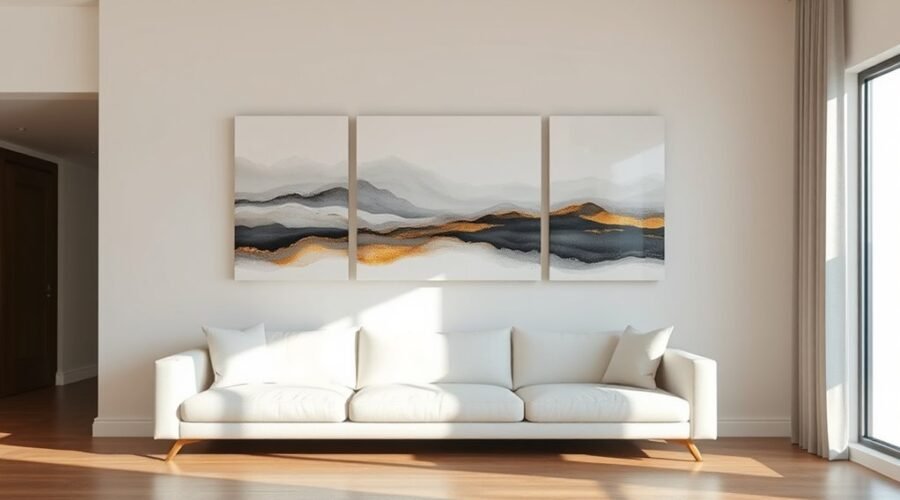
If you have a blank wall that feels unfinished, triptych wall art can give it structure without relying on one oversized piece. A triptych uses three related panels as a single composition. The panels may continue one image across the wall or show separate scenes that share the same colors, subject, or style. The best result comes from treating all three panels as one artwork when you choose the size, spacing, placement, and hanging height.
Quick Answer
Triptych wall art is a three-panel artwork designed to be viewed as one composition. For a balanced display, measure the complete width of all three panels plus the two gaps, keep the gaps equal, center the full grouping over the wall or furniture, and choose mounting hardware rated for each panel’s weight and wall surface.
Key Takeaways
- Triptych wall art uses three panels that work together as one visual composition.
- The design may be one continuous image or three coordinated images with a shared theme.
- Measure the complete installed width, including both gaps, before choosing a size.
- A gap of roughly 2 to 4 inches between panels is a useful starting point, but panel size and the artwork itself should guide the final spacing.
- Center and level the entire three-panel arrangement rather than judging each panel separately.
- Choose hanging hardware according to the weight of each panel and the type of wall.
What Is Triptych Wall Art?
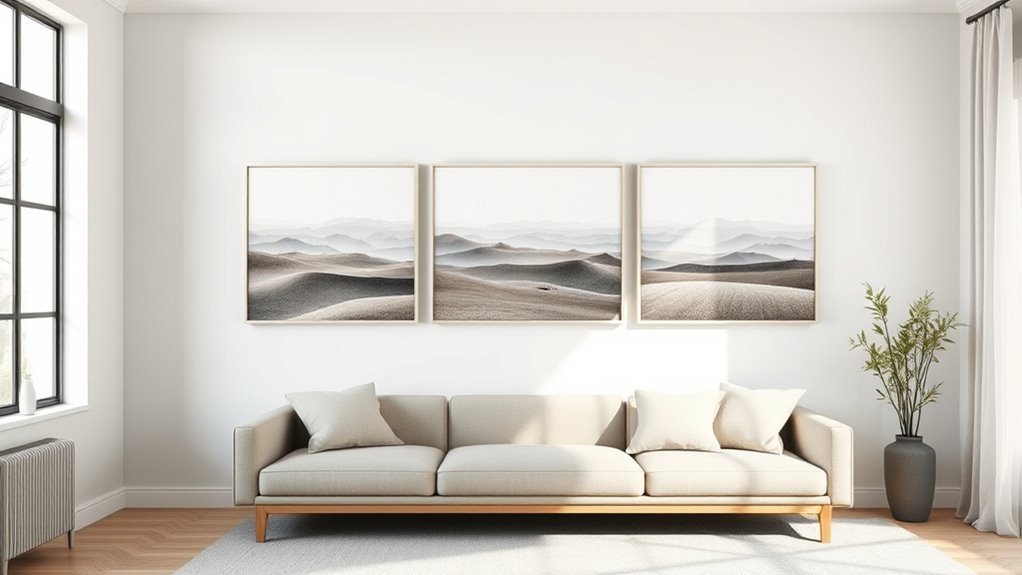
A triptych is an artwork made in three related sections. Traditional triptychs often had a larger central panel with two hinged side panels. The Cambridge Dictionary describes the historic form as three connected paintings, while surviving museum examples show how the panels worked together as one composition.
Many historical triptychs were religious works. For example, The Metropolitan Museum of Art’s Annunciation Triptych, dated to about 1427–32, has a central scene and two wings and was intended for private prayer.
Modern triptych wall art uses the term more broadly. The three panels do not need to be physically hinged. They may display a single photograph divided into three sections, three abstract canvases designed as a set, or three separate prints connected by subject, palette, or style.
Continuous-Image vs. Coordinated Triptychs
A continuous-image triptych divides one picture across all three panels. Landscapes, city skylines, maps, and panoramic photographs often use this format. Smaller, consistent gaps help the eye reconnect the interrupted image.
A coordinated triptych uses three separate images that belong together without forming one continuous picture. Botanical sets, abstract compositions, line drawings, and related photographs are common examples. These designs can usually tolerate slightly more space between the panels.
Why Choose Triptych Wall Art?
Triptych wall art does more than fill an empty wall. Three panels create rhythm across a wider area and can establish a strong focal point without requiring one unusually large frame or canvas. The format also gives you more control over spacing and overall width than a single fixed-size piece.
| Benefit | Effect | Space |
|---|---|---|
| Three panels | Dynamic storytelling | Living areas |
| Cohesive design | Enhanced balance | Offices |
| Flexible layout | Personal expression | Hallways |
The format also works with many decorating styles. Minimalist black-and-white photography can suit a modern room, while landscapes, florals, traditional prints, or textured paintings can work in warmer or more classic interiors.
Unlike three unrelated pictures, a well-designed triptych gives the eye a clear relationship between the panels. Repeated color, shape, subject matter, horizon lines, or visual movement helps the three pieces read as a single display.
How to Pick the Right Triptych Size
To choose the right triptych size, measure the available wall area and the furniture below it before looking at individual panel dimensions. What matters most is the width and height of the complete installed arrangement, not the size of one panel by itself.
Calculate the Full Installed Width
If all three panels have the same width, use this simple formula:
Total triptych width = panel width × 3 + gap × 2. Three panels create two spaces between them.
For example, three 20-inch-wide panels with 3-inch gaps occupy 66 inches of wall space: 20 + 20 + 20 + 3 + 3 = 66 inches.
If the panels have different widths, add all three panel widths and then add the two gaps. For framed artwork, measure the outside edges of the frames rather than the printed image inside them.
Compare the Art With Nearby Furniture
Above a sofa, bed, console, or sideboard, the triptych should look visually connected to the furniture rather than floating independently above it. A useful approach is to tape the planned outer boundaries on the wall and step back before buying or drilling.
There is no universal furniture-to-art percentage that works in every room. A low, wide sofa may support a broad panoramic set, while tall furniture or a narrow wall may call for a smaller or more vertical arrangement. Leave visible wall space around the composition so it does not appear squeezed between corners, windows, shelving, or tall furniture.
How Much Space Should Be Between Triptych Panels?
For many residential installations, about 2 to 4 inches between panels is a practical starting range. Smaller panels or a continuous photograph often look more connected with tighter gaps. Large framed panels or three distinct images may benefit from slightly more breathing room.
The most important rule is consistency: the first gap should match the second gap unless the artwork was deliberately designed otherwise.
Pro Tip: Cut paper or cardboard templates to the size of all three panels and tape them temporarily to the wall. This lets you test the total width, height, and spacing from across the room before making holes.
Which Triptych Styles Fit Your Space
The best triptych style depends on the scale of the room, the colors already present, and the mood you want the wall to create.
In a larger room, a bold triptych can spread visual interest across a wide wall. Panoramic landscapes, oversized abstract designs, architectural photography, and dramatic botanical pieces work especially well where the artwork can be viewed from several feet away.
In a smaller space, use narrower panels, lighter visual detail, or more restrained colors so the set does not dominate everything around it. A triptych does not need to be oversized to work; the relationship between the panels is more important than sheer scale.
Match the Mood, Not Every Color
Your triptych does not need to copy the exact colors of the sofa, rug, or curtains. Instead, look for one or two repeated tones or a similar visual mood. Serene landscapes and soft organic shapes can make a room feel quieter, while high-contrast photography, geometric designs, and energetic abstracts create more visual movement.
Canvas vs. Framed Triptychs
Canvas panels usually have less visual separation because there may be no outer frame surrounding each image. Framed triptychs create stronger boundaries between the three pieces, so frame thickness and frame color become part of the composition.
When comparing sizes online, check whether the listed dimensions refer to each panel or to the complete set. Also confirm whether framing changes the finished dimensions.
Where Triptych Wall Art Works Best
Triptych wall art is especially useful on walls that have enough width for all three panels and their gaps. Living rooms, dining rooms, bedrooms, offices, entryways, and long hallways are common locations.
Triptych wall art makes the biggest impact on large walls, creating a striking focal point in living rooms, dining areas, or entryways.
In open-concept interiors, a three-panel arrangement can visually define a seating or dining zone without adding a physical divider. Above a sofa, headboard, or console, treat the entire set as one artwork and center the overall composition over the furniture.
A horizontal arrangement is the most familiar option for panoramic art, but a vertical triptych can make better use of a narrow wall, stair landing, or tall section of hallway. The artwork itself should determine whether the panels belong side by side, stacked vertically, or arranged with intentionally different heights.
How to Hang Triptych Wall Art
Hanging three panels is easier when you plan the full composition before installing the first hook. You will usually need a tape measure, pencil, level, painter’s tape or paper templates, and hanging hardware appropriate for the wall and panel weight.
- Measure all three panels. Record each panel’s outside width and height.
- Choose the gap. Start around 2 to 4 inches and adjust according to panel size and whether the image continues across the gaps.
- Calculate the complete width. Add the three panel widths and both gaps.
- Mark the center of the arrangement. Center the complete triptych over the wall area or the furniture below it.
- Preview the layout. Use painter’s tape or paper templates and view the arrangement from normal seating and walking positions.
- Install the middle panel first. Level it carefully because it becomes the reference point for the two side panels.
- Measure outward. Mark equal gaps to the left and right and install the remaining panels.
- Check the complete grouping. Step back and confirm that the spacing, tops or centerlines, and overall height look intentional.
How High Should a Triptych Be Hung?
On a mostly empty wall, placing the center of the entire composition roughly around normal standing eye level is a useful starting point. The often-used 57-to-60-inch measurement from the floor can help you begin, but it is not a rule that overrides the room.
When the artwork is above furniture, the relationship with that furniture matters more. Avoid creating such a large vertical gap that the artwork appears disconnected from the sofa, bed, or console below it. Use templates first if you are uncertain.
Warning: Choose mounting hardware that is appropriate for both the wall material and the weight of each panel. If you use adhesive hanging products, follow the manufacturer’s surface preparation, placement, and weight limits. Command’s official guidance specifically advises choosing the product according to what you are hanging, where it will be installed, and how much it weighs.
Common Triptych Wall Art Mistakes
- Measuring only one panel: Always calculate the complete installed width, including both gaps.
- Using uneven gaps: Small differences are easy to notice when three panels are aligned in a row.
- Hanging each panel independently: Plan and center the whole arrangement first.
- Placing the set too high: Artwork can look disconnected from furniture when too much blank wall separates them.
- Ignoring frame dimensions: Frames can add several inches to the total installed width.
- Using the wrong hardware: A hanger that is suitable for a light canvas may not be appropriate for a heavy framed panel.
- Making a continuous image too widely spaced: Excessive gaps can make the three sections harder to read as one picture.
- Buying before measuring: Product photos can make wall art appear much larger than its real dimensions.
Frequently Asked Questions
How Is Triptych Pronounced?
Triptych is pronounced “TRIP-tik”, with the stress on the first syllable. The Cambridge Dictionary gives the pronunciation as /ˈtrɪp.tɪk/ in both UK and US English.
How Do You Hang Triptych Pictures?
Measure all three panels and both gaps first, find the center of the complete arrangement, and preview it with paper or painter’s tape. Hang and level the middle panel first, then measure equal distances outward for the two side panels. Choose hardware rated for the panel weight and wall surface.
How Far Apart Should Triptych Panels Be?
About 2 to 4 inches between panels is a practical starting point for many home installations. Use tighter spacing for small panels or one continuous image and slightly wider spacing for larger framed pieces. Keep both gaps equal unless the artwork was intentionally designed differently.
How Much Does a Triptych Cost?
There is no dependable universal price range. Simple prints and mass-produced canvas sets can cost relatively little, while large framed pieces, premium materials, commissioned work, and original paintings may cost hundreds or thousands of dollars. Compare the material, dimensions, framing, printing method, artist, and whether all three panels are included before judging value.
What Is 3 Piece Wall Art Called?
Three-piece wall art is commonly called a triptych when the three panels are intended to work together as one composition. They may form one continuous picture or use three coordinated images connected by subject, color, or style.
Do All Three Triptych Panels Have to Be the Same Size?
No. Equal-sized panels are common because they are easy to align, but traditional and contemporary triptychs can use a larger center panel with narrower side panels. What matters is that the proportions look intentional and that you calculate the complete width before installation.
Conclusion
Triptych wall art gives you a flexible way to turn a blank wall into a coordinated focal point. The three panels can add width, rhythm, depth, and visual structure without requiring one enormous piece of art. The key is to treat the set as a single composition: measure the complete width, keep the spacing intentional, relate the artwork to nearby furniture, and use mounting hardware suited to each panel. With those details planned first, a triptych can work just as effectively in a compact hallway as it can across a large living-room wall.
Sources
- Cambridge Dictionary — Triptych — definition and pronunciation of the term.
- The Metropolitan Museum of Art — Annunciation Triptych (Merode Altarpiece) — historical example and devotional use of a traditional triptych.
- National Gallery of Art — Scenes from the Passion of Christ Triptych — three-panel construction and historic hinged-panel format.
- Command Brand — Picture Hanging FAQs — manufacturer guidance on selecting mounting products by weight and surface.
- Buildings — Eye-Tracking Study of Living-Room Décor — research on how decorative elements can influence visual attention and perception of an interior.