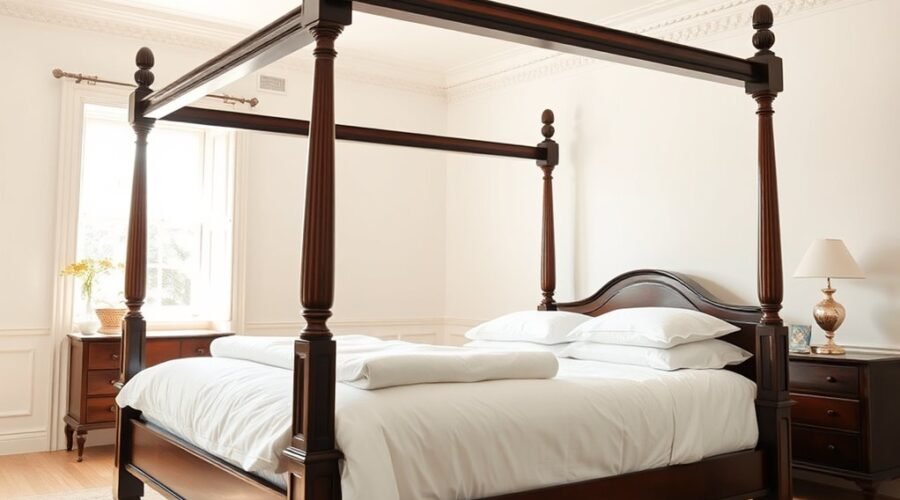
A four-poster bed uses tall vertical posts at the four corners to frame the mattress and create a strong architectural focal point. Traditional versions often support an overhead tester, canopy, or curtain rails, while modern designs may leave the posts open. The right size depends less on one “ideal” room dimension and more on the bed’s actual height, footprint, walking clearance, and your ceiling fixtures.
Quick Answer
A four-poster bed has a tall post at each corner and often includes an overhead frame or tester for curtains. Modern models vary widely in height, so there is no universal 81-inch minimum or required 20-by-20-foot bedroom. Measure the exact frame, ceiling height, fixtures, and walking space before buying.
Key Takeaways
- A four-poster bed is defined mainly by its four tall corner posts; traditional designs often support a tester, canopy, or curtains.
- Post and overall bed height vary by model. Current four-posters can be around 80 inches, 90 inches, or other heights.
- You do not need a 20-by-20-foot room or a 10-foot ceiling as a universal rule; use the manufacturer’s actual dimensions.
- Allow enough circulation to walk and make the bed comfortably, and provide wider clear routes where accessibility is required.
- Before ordering, measure ceiling fixtures, doors, hallways, stairs, mattress support requirements, and the assembled frame.
What Is a Four Poster Bed?
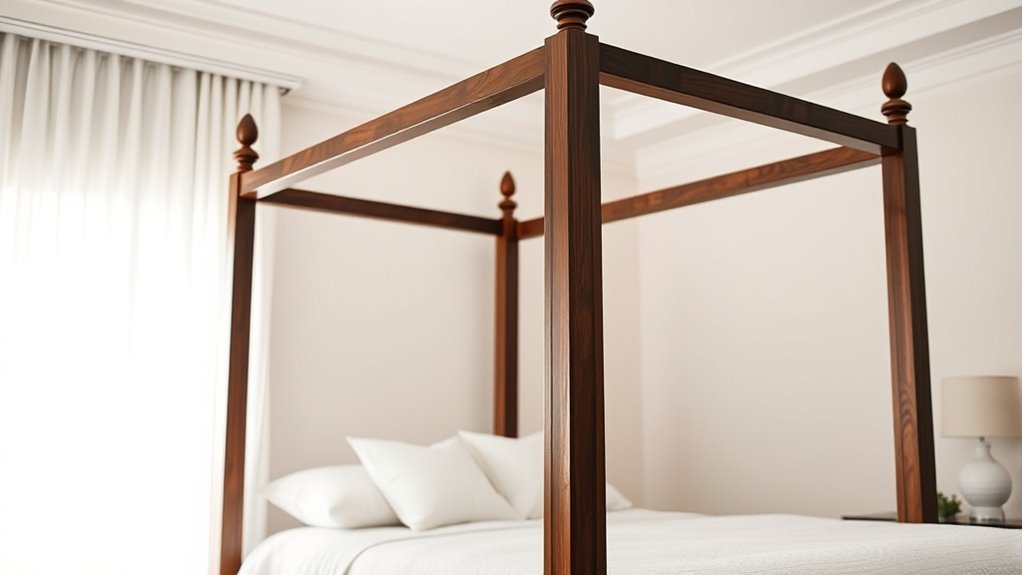
A four-poster bed has four tall vertical posts, one at each corner of the bed. In traditional designs, those posts may support an overhead frame, a fabric canopy, or a tester. Modern furniture makers also use the term for open designs that emphasize the four posts even when no fabric is attached.
The style has a long history. Historic high-post bedsteads often used an overhead framework to support bed curtains, while richly decorated examples became important pieces of furniture in prominent households. The Victoria and Albert Museum’s Great Bed of Ware, made around 1590, is an unusually large four-poster with a decorated tester and elaborate woodwork.
That history explains why four-posters can feel formal or dramatic, but modern versions range from heavy carved wood to slim metal or pencil-post designs. You can leave the frame open for a cleaner look or use compatible curtains if the bed is designed to support them.
Note: “Four-poster” and “canopy bed” are overlapping terms rather than completely separate categories. A bed can have four tall corner posts and also support a canopy.
What Room Size Works Best for a Four Poster Bed?
There is no single minimum room size for a four-poster bed. A 20-by-20-foot bedroom with a 10-foot ceiling would certainly provide generous space, but it is not a requirement. What matters is whether the specific bed fits your floor plan and ceiling while leaving comfortable circulation around it.
Start with the manufacturer’s overall width, depth, and height rather than mattress size alone. A queen mattress may be about the same size from one bed to another, but the posts, headboard, footboard, and side rails can make the assembled frame noticeably larger.
Ideal Room Dimensions
The best room is one that leaves enough usable space around the actual frame. As a practical furniture-planning guide, Room & Board recommends at least 18 inches beside a bed for basic walking, while 24 to 36 inches provides more comfort.
If you have room for about 24 to 30 inches or more on the accessible sides, making the bed and moving around it will usually feel easier. Larger clearances also keep substantial posts from visually pressing against nearby walls, dressers, or nightstands.
A very large bedroom can handle heavier posts, curtains, and ornate carving more easily. In a mid-size or compact bedroom, slimmer posts, lighter finishes, and an open frame reduce visual weight.
Ceiling Height Needs
Ceiling height should be compared with the overall height of the exact bed. There is no universal rule that a four-poster must be 81 inches high or that the room must have a 10-foot ceiling.
Current products illustrate the variation. The Pottery Barn Willow Four Poster Bed is listed at 80 inches high, while the Ethan Allen Andover Poster Bed is listed at 90 inches high.
| Room / ceiling condition | What to check | Best approach |
|---|---|---|
| 10-ft ceiling or higher | Bed height plus fans and fixtures | Can accommodate many tall or visually substantial designs |
| 9-ft ceiling | Exact overall bed height | Works with many modern four-posters |
| 8-ft ceiling | Overhead clearance and fixture locations | Choose a lower model and measure carefully |
| Sloped or irregular ceiling | Lowest ceiling point over the frame | Map the full post footprint before ordering |
| Small room | Floor clearance and visual weight | Favor slender posts and an open, undraped frame |
Warning: Check the full path of ceiling-fan blades, pendant lights, chandeliers, sprinklers, and other overhead fixtures. A bed that technically fits below the ceiling can still interfere with a moving fan or hanging light.
Clearance Around Bed
Leave enough clearance to enter the bed, change sheets, open nearby drawers, and walk through the room without squeezing around the posts. About 24 to 36 inches feels more comfortable where the room allows, although compact bedrooms may use less on a non-traffic side.
Accessibility is a separate consideration. Where an accessible route is required, the 2010 ADA Standards generally specify a 36-inch minimum clear width for walking surfaces, subject to the standard’s detailed exceptions and turning requirements. That should not be confused with an ordinary interior-design recommendation for every private bedroom.
Also check the foot of the bed. A dresser, bench, or open door can reduce the usable walkway even when the sides have plenty of room.
How to Measure Before Buying
Measure the room and the route into it before you order. A tall bed may arrive in sections, but large headboards, rails, or tester components still have to pass through your home.
- Record the room dimensions: Measure wall-to-wall width, depth, and ceiling height.
- Mark the bed footprint: Use the manufacturer’s overall width and depth, not just the mattress dimensions.
- Check the vertical space: Compare overall bed height with the ceiling, fan blades, lights, beams, and sloped areas.
- Plan circulation: Measure the remaining space at the sides and foot of the bed with nightstands and dressers included.
- Measure the delivery route: Check doors, hallways, stairs, elevators, and tight turns.
- Confirm mattress support: Determine whether the frame uses slats, a foundation, a box spring, or another support system.
Pro Tip: Mark the bed’s full outside dimensions on the floor with painter’s tape. Then stand at the doorway and walk around the outline. This shows much more clearly than mattress measurements alone whether the posts and frame will crowd the room.
How Tall Are Four Poster Bed Posts?
There is no single standard height for four-poster bed posts. Modern models differ by manufacturer and style, and historical beds varied even more.
Current four-poster examples range from an 80-inch-high Pottery Barn design to a 90-inch-high Ethan Allen model, so the product specification matters more than a supposed industry-wide minimum.
| Example | Overall height | What it shows |
|---|---|---|
| Pottery Barn Willow Four Poster Bed | 80 in. | Some modern four-posters are below 81 inches |
| Ethan Allen Andover Poster Bed | 90 in. | Taller contemporary designs are also common |
| Historic and custom designs | Varies widely | Measure the actual piece rather than relying on a typical figure |
Post thickness also varies. Slender pencil posts create a lighter silhouette, while carved or turned posts can be much more substantial. There is no dependable universal rule that posts stay under five inches wide.
Four Poster Bed vs. Canopy Bed
Four-poster bed and canopy bed describe closely related features, and the terms often overlap.
A four-poster bed is identified by its four tall corner posts. Traditionally, those posts could support a tester or framework from which curtains hung. A canopy bed is defined more by the overhead canopy or frame, which may carry fabric or remain open.
That means one bed can reasonably be described as both a four-poster and a canopy bed.
| Feature | Four-poster bed | Canopy bed |
|---|---|---|
| Main identifying feature | Four tall corner posts | Overhead canopy or canopy framework |
| Curtains | Traditional versions often support them | Often associated with curtains or drapery |
| Modern appearance | May be open, carved, turned, wood, or metal | May be open or fabric-draped |
| Overlap | A four-poster with an overhead canopy framework can fit both descriptions | |
Historically, canopy curtains had practical value as well as decorative value. The Metropolitan Museum of Art notes that bed draperies helped provide privacy and, particularly in colder parts of Europe, helped keep the sleeping area more comfortable.
How to Choose a Four Poster Bed Style and Wood?
Choose a four-poster bed style by matching the scale of the frame to the architecture and furniture already in your room.
Traditional designs often use turned or carved posts and darker wood finishes. Contemporary versions usually simplify the silhouette with straight posts, lighter finishes, or metal framing. Pencil-post designs are especially useful when you want the height of a four-poster without as much visual weight.
Wood choice changes both appearance and character. Oak can show a strong grain, cherry tends to develop a warm appearance, maple often looks clean and understated, and walnut provides a naturally deeper tone. Construction quality, joinery, finish, and the manufacturer’s weight rating matter more to durability than choosing a species by appearance alone.
Also consider the rest of your bedroom. Substantial posts pair naturally with larger nightstands and visually heavier furniture. Slim posts work well when you want the bed to feel taller without making the room appear packed.
Can You Customize a Four Poster Bed?
Yes. Four-poster beds are available in many combinations of wood species, finishes, headboard treatments, post shapes, and canopy details. Some furniture makers also offer made-to-order finishes or custom dimensions.
However, do not assume that every manufacturer will alter the post height. Custom options vary by brand and collection, so confirm the exact finished dimensions before ordering.
- Choose the post style: Slim, turned, carved, square, or metal posts create very different visual weight.
- Select the finish: Light finishes can soften a tall frame, while dark finishes make the outline more pronounced.
- Decide on an overhead frame: Choose an open four-post design, a full tester, or a canopy frame if the model offers those options.
- Plan curtains carefully: Drapery makes the bed feel more enclosed and requires a frame designed to support it.
- Confirm support requirements: Check whether the bed requires a foundation, box spring, specific mattress height, or compatible adjustable base.
After assembly, make sure the bed sits level and all connections are tightened according to the manufacturer’s instructions. Hardware can loosen over time on some furniture, so periodic inspection is sensible, especially after moving the bed.
Sources
- Victoria and Albert Museum — The Great Bed of Ware — historical four-poster construction, tester terminology, and documented dimensions.
- The Metropolitan Museum of Art — Design for a Canopy Bed — historical use of bed draperies for privacy and warmth.
- Pottery Barn — Willow Four Poster Bed — current 80-inch overall-height example and manufacturer dimensions.
- Ethan Allen — Andover Poster Bed — current 90-inch overall-height example.
- Room & Board — How to Choose a Bed — practical bedroom clearance and measurement guidance.
- U.S. Department of Justice — 2010 ADA Standards for Accessible Design — accessible-route clear-width guidance where applicable.
Frequently Asked Questions
Why Are Four Poster Beds so High off the Ground?
The defining height is mainly in the posts, not necessarily the mattress platform. Historically, tall posts supported a tester and curtains that could add privacy and help reduce drafts. Some historical beds also had high sleeping surfaces because several mattresses were stacked, but a modern four-poster can have a fairly ordinary mattress height.
How Tall Are Four Poster Beds?
There is no single standard height. Current examples include four-posters around 80 inches and 90 inches high, while historical and custom beds may be shorter or much taller. Always check the manufacturer’s overall-height specification and compare it with your ceiling and fixtures.
Does a 4 Poster Bed Make a Room Look Small?
It can if the posts are visually heavy, the ceiling is low, or the frame leaves little open space around it. A slim pencil-post or metal design, lighter bedding, and an undraped overhead frame can make a four-poster feel much lighter in a compact bedroom.
What Is the Top of a 4 Poster Bed Called?
The overhead panel or framework on a traditional four-poster is commonly called a tester. It can support decorative fabric or curtain hardware. In everyday use, people may also refer to the overhead structure more generally as a canopy or canopy frame.
Do You Need a 10-Foot Ceiling for a Four-Poster Bed?
No. Some four-posters fit under an 8- or 9-foot ceiling. What matters is the exact overall bed height and the location of fans, lights, beams, and other overhead objects. A taller ceiling simply gives large posts more visual breathing room.
Is a Four-Poster Bed the Same as a Canopy Bed?
The terms overlap. “Four-poster” emphasizes the four tall corner posts, while “canopy bed” emphasizes the overhead frame or canopy. Many traditional four-poster beds also have a tester or canopy, so the same bed can fit both descriptions.
Conclusion
A four-poster bed adds height, structure, and a strong architectural outline to a bedroom, but it does not require one fixed ceiling height or room size. Measure the specific bed rather than relying on an assumed 81-inch standard, leave practical walking space, check overhead fixtures, and confirm the delivery path and mattress-support requirements. Whether you prefer carved wood, slim pencil posts, or a modern open frame, the best four-poster is the one that fits both your room and the way you use it.