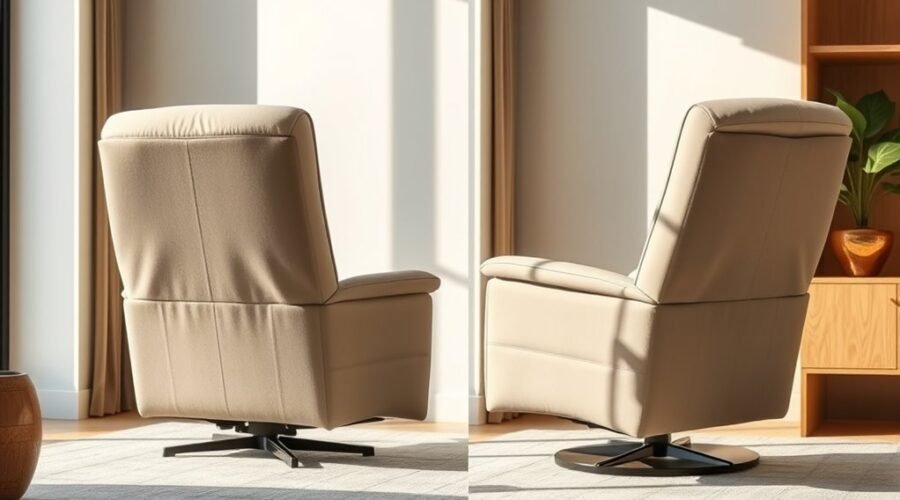
A pushback recliner gives you reclining comfort without a visible side handle, lever, or power button. You sit normally, press your torso against the backrest, and let the chair’s manual mechanism move into its reclining position. The basic idea is simple, but footrests, resistance, recline positions, wall clearance, and closing methods can vary significantly from one model to another.
Quick Answer
A pushback recliner is a manual recliner that opens when you lean your torso against the backrest instead of pulling a lever or pressing a button. Depending on the model, the back may move through fixed positions and a footrest may rise at the same time. Operation, wall clearance, and closing method vary by chair.
Key Takeaways
- A pushback recliner is a type of manual recliner operated mainly by leaning against the backrest.
- Some models raise an integrated footrest as you recline, while other designs work differently or do not include one.
- Reclining resistance and the number of usable positions vary by mechanism.
- Wall and legrest clearance are model-specific, so measure the chair in its fully reclined position instead of assuming it is a wall-hugger.
- If pushing back or rising from a low seat is difficult, a lever, power, or power-lift recliner may be easier to use.
At a Glance
| Time Required | A few seconds to recline or return upright |
| Difficulty | Easy for most users, but resistance varies by chair |
| Tools Needed | None for normal operation |
| Cost | No operating cost for a non-powered pushback mechanism |
What Is a Pushback Recliner?
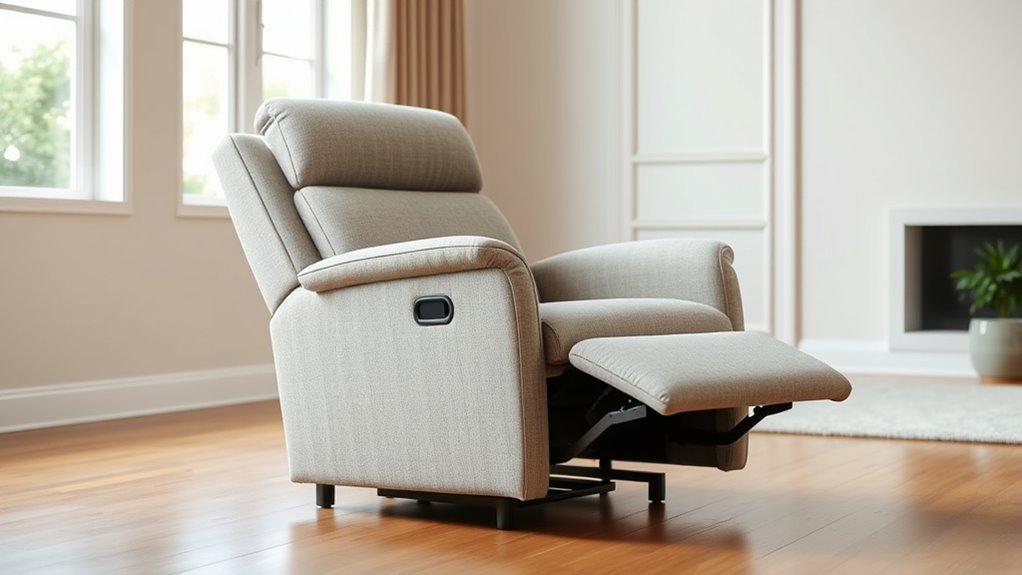
A pushback recliner is a manual reclining chair that changes position when you lean against the backrest. Unlike a lever-operated manual recliner, it normally has no large side handle to start the reclining motion.
That hidden operating method lets many pushback chairs look more like traditional armchairs, wing chairs, or accent chairs. For example, La-Z-Boy’s current high-leg push-back recliners use manually activated mechanisms while retaining a stationary-chair appearance.
Pushback chairs are still manual recliners. The term describes how the user activates the mechanism, not an entirely separate category from manual furniture.
The exact motion varies. Some models recline into two or more defined positions. Some raise an integrated legrest as the back moves. Others use a different leg-support arrangement, so you should not assume every pushback recliner works identically.
Because you must generate enough backward pressure to move the mechanism, a pushback chair may be less convenient for someone who has difficulty pushing with the torso, controlling the return motion, or rising from the seat.
How a Pushback Recliner Works
A pushback recliner uses a mechanical linkage concealed inside or beneath the frame. When you lean against the backrest, the mechanism allows the back to move rearward. On models with an integrated footrest, the same movement may also bring the legrest forward and upward.
The chair does not need electricity unless it includes separate powered features. The user’s body pressure supplies the force needed to start the normal reclining movement.
Pushback Recliner Mechanism
The mechanism usually sits below the seat and inside the chair frame, which is why pushback recliners can avoid the prominent side handles found on many traditional manual recliners.
The backrest, seat linkage, and legrest are connected differently from model to model. Some current push-back recliners use a two-position mechanism, while other chairs may provide a wider movement range.
Do not assume that a stiff chair is defective simply because it needs more pressure than another recliner. Mechanism geometry, spring tension, chair size, and user weight can all affect how easily a manual recliner moves.
Reclining With Body Pressure
To activate a typical pushback mechanism, sit fully in the seat with your back against the backrest and apply smooth, controlled backward pressure. Avoid suddenly throwing your weight backward.
As the back begins to move, keep your body centered in the chair. If the model includes an integrated footrest, it may begin to rise as the back reclines.
Some chairs have adjustable mechanism tension. If yours does, follow its manual exactly. A manufacturer may require both tension adjusters to be changed equally and may warn against fully loosening or fully tightening the mechanism.
Note: Reclining resistance is model-specific. Do not copy tension-adjustment instructions from a different brand or recliner mechanism.
How to Recline a Pushback Chair
For most pushback chairs, reclining takes only a few controlled movements:
- Check the space around the chair. Make sure the back and any legrest can move without hitting a wall, table, rug, pet bed, or other object.
- Sit fully back in the seat. Keep your hips centered and rest your back against the backrest.
- Keep your feet stable. Start with your feet on the floor unless your model’s instructions specify another method.
- Lean back smoothly. Apply steady pressure through your torso rather than jerking or throwing your weight backward.
- Stop at the intended position. If the chair has fixed positions, let the mechanism settle naturally into the appropriate one.
Warning: Keep hands, fingers, children, and pets away from the mechanism and legrest while the chair is moving. Keep tables, rugs, and other objects clear of the legrest. Manufacturer operating instructions also recommend moving into and out of the reclining position slowly and closing the back and legrest before getting out of the chair.
Recline With Body Pressure
The easiest technique is to let your upper body do most of the work. Sit deep enough that your lower back is supported, place your shoulders against the backrest, and gradually press backward.
If the chair is functioning normally, the movement should be controlled rather than abrupt. Do not bounce against the backrest or push violently to overcome resistance.
If you cannot make the chair move with reasonable pressure, first confirm that nothing is blocking the mechanism and that the chair is assembled correctly. Do not force a mechanism that appears jammed, bent, or damaged.
Return To Upright Position
Returning upright is also model-specific, especially when a footrest is involved. In general:
- Shift your upper body forward in a controlled motion.
- Allow the backrest to move toward its upright position.
- If your chair has an integrated footrest, close it using the method specified by the manufacturer. Some designs require controlled downward pressure with the legs or feet.
- Confirm that the back and footrest are fully closed before you stand.
If the footrest will not latch or the chair binds while returning upright, stop forcing it. Check for carpet, fabric, objects, or other interference around the moving parts.
Pro Tip: If your model includes reclining-tension adjusters, read its manual before changing them. Manufacturer instructions may require small, equal adjustments on both sides to preserve stability and smooth operation.
How to Sit in a Pushback Recliner
Approach a pushback recliner as you would a normal armchair, but make sure the chair is fully upright first. Lower yourself into the center of the seat rather than dropping heavily onto the front edge.
Settle your hips toward the back of the cushion and support your back against the backrest. Before reclining, keep your feet flat on the floor and make sure the chair feels stable.
When you lean back, keep the motion smooth and centered. Avoid twisting to one side or using the armrest as a lever to force the mechanism.
When you want to stand, return the recliner fully upright, close the footrest if one is fitted, place both feet securely on the floor, and move forward before rising.
Common Pushback Recliner Mistakes
Most operating problems come from incorrect placement, forcing the mechanism, or assuming every pushback chair behaves the same way.
- Putting the chair too close to a wall. Clearance varies by model, so test the full recline envelope.
- Blocking the footrest. Tables, rugs, baskets, and other furniture can prevent a legrest from extending or closing correctly.
- Ignoring the weight rating. Use the chair only within the manufacturer’s stated occupant limits.
- Assuming every model has the same footrest. Check the product specifications and manual.
- Forcing a stiff or jammed mechanism. Inspect for obstruction or damage instead.
- Standing on an open footrest. A footrest is intended to support the legs while seated, not to act as a step.
- Allowing children or pets near moving parts. Recliner mechanisms contain pinch and entrapment areas.
- Standing before the chair is fully closed. Bring the back upright and close the legrest first.
Pushback Recliner Pros and Cons
A pushback recliner can combine the appearance of an accent chair with a hidden manual reclining mechanism, but that design is not automatically the best choice for every user or room.
Pushback Recliner Benefits
- Clean appearance: There is normally no prominent side lever or wired remote.
- No outlet required: A basic manual pushback chair does not depend on household power.
- Simple operation: Reclining begins by leaning against the backrest.
- Armchair-style designs: High-leg, wingback, traditional, and contemporary versions are available.
- Fewer visible controls: The operating hardware stays largely hidden inside the chair.
These features make pushback chairs appealing in living rooms, bedrooms, offices, libraries, and reading areas where the look of a traditional armchair is important.
Pushback Recliner Drawbacks
- Physical effort is required: You must generate enough backward pressure to activate the mechanism.
- Recline positions may be limited: Some models use only a small number of defined positions.
- Footrest designs vary: Do not assume every chair provides the same leg support.
- Wall clearance varies: A pushback recliner is not automatically a wall-hugger.
- Standing assistance is absent: A standard pushback chair does not lift the user toward a standing position.
Pushback vs. Lever-Operated Manual Recliners
A pushback recliner and a lever-operated recliner are both manual recliners. The main difference is how you start and control the movement.
| Feature | Pushback Recliner | Lever-Operated Manual Recliner |
| Activation | Body pressure against the backrest | Side lever or handle |
| Visible hardware | Usually minimal | Usually visible on one side |
| User effort | Requires backward body pressure | Requires operating the lever plus normal body movement |
| Appearance | Often resembles an accent chair | Often has a more recognizable recliner design |
| Wall clearance | Model-specific | Model-specific |
If you prefer a chair without obvious controls, pushback operation may appeal to you. If you want a clearly defined control point rather than using torso pressure, a lever-operated model may feel easier to manage.
Where Pushback Recliners Work Best
Pushback recliners work particularly well where you want reclining function without the visual bulk of an obvious handle or control panel. A high-leg model can fit naturally in a living room, bedroom, office, reading area, or other space where a conventional accent chair would look appropriate.
They can also work in multi-purpose rooms because a basic manual model needs no electrical outlet.
However, do not choose one for a tight room solely because it is described as a pushback chair. Pushback operation and wall-hugger operation are different design characteristics. Always check the chair’s upright depth, fully reclined depth, rear clearance requirement, and front legrest clearance.
A pushback recliner may look compact when upright, but the fully reclined footprint—not the chair category—determines whether it fits your room.
What to Check Before Buying One
Before buying a pushback recliner, test both body fit and room fit. A chair can have a smooth mechanism and still be uncomfortable if its seat dimensions do not suit you.
Check the Seat and Back Fit
- Seat height: Your feet should reach the floor comfortably when the chair is upright.
- Seat depth: You should be able to sit against the backrest without the front edge pressing hard behind your knees.
- Seat width: Allow enough room to sit comfortably without being squeezed by the arms.
- Back height: Check whether your shoulders, neck, and head receive the support you expect.
- Leg support: If the chair has a footrest, make sure its length suits you when fully extended.
Measure the Fully Reclined Space
Do not measure only the chair’s upright footprint. Recline the chair fully and determine how far the back moves toward the wall and how far the legrest moves into the room.
La-Z-Boy’s operating instructions, for example, tell users to provide a clear operating path for the chair, back, and legrest and to prevent rugs or furniture from interfering with the legrest. Your own chair may specify a different clearance, so follow its manual.
Check the Mechanism and Weight Rating
Recline and return upright several times before buying in person. The movement should feel controlled, and you should be able to close the chair without struggling.
Also check the manufacturer’s occupant weight rating. Weight limits are specific to the frame and mechanism and should not be guessed from the chair’s size or appearance.
Think About Mobility Before Choosing Pushback
If you have difficulty pushing backward, controlling a manual recliner, or standing from a seated position, compare other mechanisms rather than assuming a pushback design will be easier.
A power lift recliner is specifically designed to provide powered assistance when moving between seated and standing positions. That makes the mechanism type—not the user’s age—the important factor to consider.
Troubleshooting a Pushback Recliner
If a pushback recliner becomes difficult to operate, start with simple external checks before attempting any repair.
| Problem | What to Check |
| Chair is hard to recline | Check for obstructions, verify the chair is on a stable surface, and see whether your model has manufacturer-approved tension adjustment. |
| Footrest will not close | Look for carpet, fabric, objects, or other interference around the mechanism. Do not force it closed. |
| Chair feels loose or wobbly | Stop using it until legs, back attachment points, and visible fasteners can be checked according to the assembly instructions. |
| Movement suddenly binds or makes a new noise | Inspect for a foreign object or obvious damage. If the cause is not clear, contact the manufacturer or a furniture-repair professional. |
Do not place your hands inside a moving mechanism to diagnose a problem while someone is sitting in or operating the chair.
How to Care for a Pushback Recliner
A few regular care habits can help the upholstery and mechanism remain in good condition.
Vacuum fabric upholstery gently to remove dust, crumbs, and pet hair. For deeper cleaning, read the chair’s upholstery label or manufacturer’s cleaning code first. Different fabrics can require different cleaners and methods.
Do not assume every fabric or leather surface should be wiped with the same damp cloth or cleaner. La-Z-Boy’s upholstery care guidance, for example, states that deeper cleaning depends on the specific cover’s cleaning code.
If you own a leather recliner, use a leather cleaner or conditioner only when the upholstery manufacturer’s instructions permit it. Products suitable for one leather finish can be inappropriate for another.
Periodically inspect the visible mechanism area for loose objects, fabric caught in moving parts, or obvious damage. Keep the space beneath and around the legrest clear.
Do not spray lubricant onto the mechanism simply because the chair feels stiff. Lubrication requirements differ, and excess lubricant can damage surrounding materials or attract dirt. Follow the chair’s manual or manufacturer service instructions.
Avoid prolonged exposure to conditions the upholstery manufacturer warns against, such as excessive heat, moisture, or strong direct sunlight.
Sources
- La-Z-Boy — Eldorado High Leg Reclining Chair — push-back operation, recline positions, dimensions, and integrated leg support.
- La-Z-Boy — Recliner Operating Instructions — moving-part safety, recliner placement, legrest clearance, and tension-adjustment precautions.
- La-Z-Boy — Charlotte High Leg Reclining Chair — push-back design, dimensions, and upholstery-care guidance.
- Golden Technologies — Lift Chair FAQs — purpose and operation of power lift recliners for users who need assistance standing.
- Pride Mobility — Essential LC-250 — example of powered movement through reclined, seated, and standing positions.
Frequently Asked Questions
How Does a Pushback Recliner Work?
A pushback recliner uses a manual mechanism that responds when you press your torso against the backrest. The back moves into a reclining position and, on models with an integrated legrest, the footrest may rise at the same time. The number of positions, resistance, and exact motion depend on the chair.
What Is the Best Recliner for an Older Person?
Age alone does not determine the best recliner. Check seat height, depth, support, ease of operation, stability, and how easily the user can sit down and stand up. Someone who has difficulty rising from a chair may find a power lift recliner more practical than a body-pressure pushback model because a lift chair can provide powered stand assistance.
How Do I Get My Recliner to Recline?
If it is a pushback recliner, sit fully in the chair and apply smooth backward pressure to the backrest. If it does not move normally, check for objects blocking the chair or legrest and review the manufacturer’s instructions. Do not force a mechanism that is jammed, damaged, or unusually resistant.
What Is the Best Push-Back Recliner?
The best pushback recliner is one that fits both your body and your room. Compare seat height, depth and width, back support, footrest length, recline resistance, weight capacity, fully reclined dimensions, upholstery, frame quality, warranty, and how easily you can return the chair upright.
How Much Wall Clearance Does a Pushback Recliner Need?
There is no single clearance that applies to every pushback recliner. Measure the chair in its fully reclined position and follow the manufacturer’s stated wall clearance. Also leave enough space in front for the footrest to extend without contacting tables, rugs, or other furniture.
Do All Pushback Recliners Have a Footrest?
No. Many pushback recliners include an integrated legrest, but the term “pushback” describes how the reclining mechanism is activated rather than guaranteeing a particular footrest design. Check the specifications for the individual chair before buying.
Conclusion
A pushback recliner is a manual recliner designed to move when you lean against the backrest rather than operate a side lever or power control. Its clean appearance can make it a good fit for rooms where you want an armchair-style look with reclining function.
The important part is to judge the individual chair rather than the category alone. Check how much pressure it requires, whether it includes the leg support you want, how much room it needs when fully reclined, whether the seat fits your body, and whether you can return upright comfortably. With the right fit and safe operating space, a pushback recliner can provide simple, dependable everyday seating.