
People searching for a carnivore diet for acne are usually tired of products that did not work and hope food is the missing piece. Some online accounts describe clearer skin after switching to meat, while others describe breakouts getting worse. This article looks at what research actually shows and where standard acne care still matters most.
Quick Answer
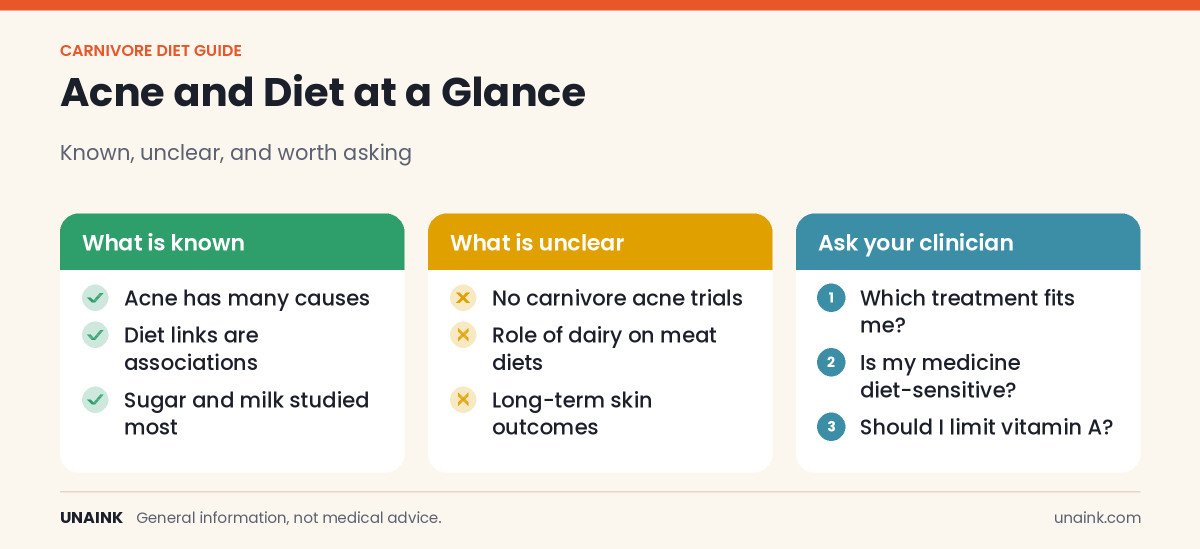
A carnivore diet for acne has not been tested in clinical trials, so there is no evidence that it clears skin. Research on other eating patterns points to sugary foods and possibly milk as acne links, which may explain some success stories, but those are associations and not proof. Persistent or scarring acne is best managed with a dermatologist.
Key Takeaways
- Acne starts in the hair follicle and is shaped by oil, hormones, bacteria, and genetics.
- Diet research links sugary foods and milk to acne, but only as associations.
- No trials test a meat-only diet for acne, and personal reports go both ways.
- Liver and vitamin A matter if you take isotretinoin or are pregnant.
- Proven acne treatments still do most of the work for moderate or scarring acne.
What Actually Drives Acne
Acne develops when hair follicles clog with oil and dead skin cells. Bacteria on the skin, inflammation, hormones that boost oil production, and family history all play a part. That is why acne shows up in teens, and also in many adults, especially around hormonal changes (Harvard Health overview).
With so many moving parts, a single food is unlikely to be the whole story, which is worth remembering before cutting out whole food groups.
What Research Says About Diet and Acne
Harvard Health describes a large survey of about 24,000 adults in JAMA Dermatology. People with current acne were more likely to report heavy milk intake, sugary foods and drinks, and high-fat, high-sugar eating patterns. The same article stresses that this shows association, not cause, and that recall bias could skew the answers (Harvard Health on diet and adult acne).
One proposed explanation is that sugary foods raise insulin, which may nudge hormones that affect oil glands. The article notes there is still no consensus that changing diet is an effective acne treatment.
Carnivore Diet for Acne: What People Report
Online stories of clearer skin on meat-only eating are common, and so are stories of new breakouts. Neither type of story is controlled. The largest survey of carnivore eaters included 2,029 adults and relied on self-reported answers (2021 survey), and a 2026 review of nine human studies called the evidence very limited (Nutrients review). Neither looked at acne specifically.
Which Carnivore Foods Raise Acne Questions
| Food | What the research hints | Caution |
|---|---|---|
| Milk and whey protein | Linked to acne in several surveys | Many carnivore plans include dairy, but not all do |
| Cheese, cream, butter | Less studied and unclear | Response likely differs by person |
| Fatty red meat | High-fat eating pattern linked to acne in one survey | Association only, not shown to cause acne |
| Sugar and refined carbs | Sugary foods were linked to acne in the same survey | Cutting them may explain some improvements |
| Liver | Very rich in vitamin A | Check with a prescriber if you take isotretinoin |
Why Skin Might Improve or Worsen
If skin clears on a carnivore diet for acne, the likely reasons are indirect:
- Far less sugar and ultra-processed food.
- Dropping dairy or another personal trigger.
- Better sleep, less stress, or a tidier skin routine at the same time.
- Normal ups and downs in acne, which often fluctuates on its own.
Breakouts can also worsen, particularly on plans heavy in milk, cream, or whey. Some people call early breakouts a detox, but no research supports that idea.
Risks and Who Should Be Careful
A carnivore diet is not recommended for teenagers, who are still growing and have high nutrient needs, and it lacks safety evidence in pregnancy and breastfeeding. Anyone with a history of disordered eating should avoid restrictive diets without clinical support.
If you take prescription acne medicine such as isotretinoin or spironolactone, tell your prescriber about any major diet change. Do not stop or adjust treatment because of a diet, and ask before eating large amounts of liver, since it is a concentrated source of vitamin A.
Proven Acne Care That Still Matters
- Wash gently once or twice a day and avoid picking or scrubbing.
- Try over-the-counter benzoyl peroxide, salicylic acid, or adapalene consistently for several weeks.
- See a dermatologist for deep, painful, or scarring acne, or if nothing helps.
- Ask about prescription options such as topical retinoids, antibiotics, hormonal therapy, or isotretinoin.
Carnivore Diet for Acne: The Short Version
A carnivore diet for acne is unproven, and the best evidence on food and acne points to sugar and milk rather than to meat itself. If you are curious about a carnivore diet for acne, treat it as an experiment to discuss with a clinician and not a replacement for proven care.
Frequently Asked Questions
Can a carnivore diet clear acne?
No study shows that it does. Some people report clearer skin, probably because they cut sugar, processed food, or a personal trigger, but others report more breakouts.
Does dairy cause acne?
Surveys and some reviews link milk to acne, but they show association rather than proof. Responses differ from person to person, and a clinician can help you test it fairly.
Is the purge on carnivore real?
There is no evidence that skin purges toxins. A breakout after a diet change may be coincidence, stress, or a reaction to something like heavy dairy. Persistent flares deserve a dermatologist visit.
Is eating liver safe if I take isotretinoin?
Liver is very high in vitamin A, so ask your prescriber before eating it regularly while on isotretinoin. Pregnancy adds further reasons for caution.
Should teens try a carnivore diet for acne?
No. Teenagers need a wide range of nutrients for growth, and acne has effective, well-studied treatments. A pediatrician or dermatologist can guide next steps.
Conclusion
Acne is shaped by hormones, oil, bacteria, and genes, and food is one possible influence among many. A meat-only diet is untested for skin and carries real nutritional trade-offs. A balanced approach is to track your skin, trim obvious triggers such as heavy sugar, and keep proven treatment in place with a dermatologist.
Medical note
This article is for general education and is not medical advice. Talk with a doctor or registered dietitian before making major diet changes, especially if you have a health condition, take medication, or are pregnant or breastfeeding.
Keep Reading
- Carnivore Diet Rash: Skin changes some people report after switching.
- Carnivore Diet and Eczema: Another skin condition people link to food.
- Carnivore Diet and Menstrual Cycle: Hormones, cycles, and diet changes.
- Beef Liver Benefits: Nutrients in liver, and why amounts matter.
Sources
- Does diet really matter when it comes to adult acne? (Harvard Health): Survey findings and limits on milk, sugar, and fat.
- Acne: What you need to know (Harvard Health): Overview of causes and treatment.
- Nutrients scoping review of carnivore diets (PMC): Evidence on carnivore diets is very limited.
- Self-reported survey of 2,029 carnivore adults (PMC): Self-reported outcomes, not a trial.