A missed period is one of the more worrying surprises people report after changing how they eat, and the carnivore diet and menstrual cycle is a topic with very little direct research. No controlled study has followed menstrual cycles in people who eat only animal foods. What we do know is that periods respond to energy intake, body weight, stress, hormones, and pregnancy, and an all-meat plan can change several of those at once.
Quick Answer
A period can be late or stop while someone eats carnivore, but the diet itself has not been shown to be the cause. The most common reason for a missed period is pregnancy, so take a test first. After that, the usual suspects are eating too little, losing weight quickly, heavy training, high stress, and thyroid or hormone conditions. If you have missed three periods in a row, see a clinician.
Key Takeaways
- No study has tracked menstrual cycles in people eating only animal foods, so a direct link to the diet is unproven.
- Pregnancy is the most common reason for a missed period, so a test comes before any diet theory.
- Eating too little, fast weight loss, hard training, and stress can pause ovulation, and an all-meat plan can make under-eating easy.
- Thyroid problems, PCOS, and pituitary conditions can also stop periods and need blood tests, not guesses.
- See a clinician after three missed periods in a row, or sooner with pain, heavy bleeding, headaches, or milky nipple discharge.
Why a missed period needs a clinician first
Doctors define absent periods, called amenorrhea, as missing three or more cycles in a row, or never starting at all. Mayo Clinic lists pregnancy as the most common cause in someone who has had periods before, which is why a home pregnancy test comes before any diet theory. Stress, low body weight, intense exercise, polycystic ovary syndrome (PCOS), and thyroid problems follow on the list.
Eating steak and eggs does not change that order of events. One late cycle after a big life or diet change is common, but repeated misses deserve a proper workup rather than waiting it out.
What the research says about the carnivore diet and menstrual cycle
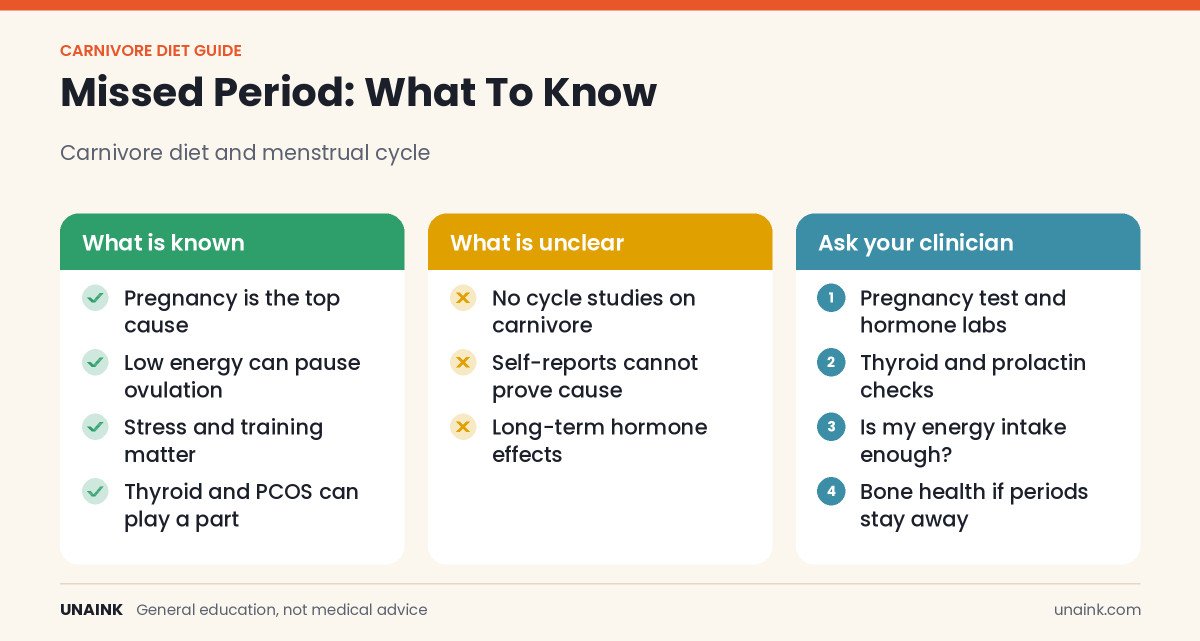
The honest answer is that nobody knows yet. A 2026 scoping review gathered just nine human studies on carnivore-style eating and called the evidence very limited (Nutrients review). The largest data set, a self-reported survey of 2,029 adults, relied on online answers and was not built to follow menstrual cycles (2021 survey).
That means any claim that carnivore fixes cycles, or ruins them, is a guess. A better approach is to look at the known causes of missed periods and ask whether an all-meat plan could push on any of them.
How eating too little can switch off ovulation
The hypothalamus, a control center in the brain, helps run the monthly hormone cycle. When the body senses low energy availability, meaning too few calories for daily life plus exercise, it can turn that signal down and periods may stop. Reviews of functional hypothalamic amenorrhea describe this pattern (dietary and lifestyle review).
Why might carnivore matter? Meat, fat, and eggs are filling, and some people find their appetite shrinks. Add fast weight loss or hard training and it is possible to land in a deficit without meaning to. This is a plausible route, not a proven one. Our guide to how many calories on carnivore diet can help you check your intake.
- Rapid weight loss over a few months
- Low body fat to begin with
- Long fasts layered on top of the diet (carnivore diet and intermittent fasting)
- Daily hard training with little recovery
- Poor sleep and high life stress
Other causes that can look like a diet problem
| Possible cause | Common clues | Who sorts it out |
|---|---|---|
| Pregnancy | Positive home test, nausea, breast tenderness | Home test, then a prenatal clinician |
| PCOS | Long gaps between cycles, acne, extra hair growth (see carnivore diet for pcos) | Clinician with blood tests and sometimes an ultrasound |
| Thyroid problems | Tiredness, temperature changes, weight and hair changes (see carnivore diet and thyroid health) | Blood test ordered by a clinician |
| Pituitary or prolactin issues | Headaches, vision changes, milky nipple discharge | Clinician, with hormone tests and possibly imaging |
| Perimenopause | Age in the 40s, hot flashes, cycles that drift | Clinician |
What people report, and why it is not proof
Online, some women say periods got lighter, shorter, or stopped after starting carnivore. Others with irregular cycles say theirs became more regular. These are self-reports, and they cannot separate the diet from weight loss, stress, or a change in training that happened at the same time.
One caution: a diet with strict rules can sit alongside disordered eating. If food rules cause anxiety, guilt, or fear of eating more, talk with a clinician or an eating disorder professional. Missed periods plus food fear is a combination to take seriously.
Red flags that need prompt care
- Three or more missed periods in a row, or no first period by age 15 (Mayo Clinic guidance)
- A positive pregnancy test: contact a prenatal clinician, and note that carnivore has no safety evidence in pregnancy (carnivore diet while pregnant)
- Severe pelvic pain, fainting, or bleeding that soaks a pad or tampon every hour for several hours
- Milky nipple discharge, ongoing headaches, or vision changes
- Stress fractures, extreme tiredness, or a racing or very slow heartbeat
- Any bleeding after menopause
Long stretches without periods can mean low estrogen, which may affect bone health over time. That is one more reason not to wait.
Practical steps while you sort it out
- Take a pregnancy test if there is any chance you are pregnant.
- Write down the date of your last period, recent weight changes, training load, and stress.
- Estimate how much you actually eat on a typical day. If it is low, do not push lower.
- Book a visit and ask about a pregnancy test, thyroid and prolactin checks, and other hormone labs.
- Bring a food log and any supplements to the appointment.
- Avoid using supplements or herbs to force a period without medical advice.
If you are breastfeeding, periods may be absent for natural reasons, and the diet carries its own question marks (see carnivore diet while breastfeeding). For a broader look at the diet and female health, read carnivore diet for women.
Carnivore Diet and Menstrual Cycle: The Short Version
The carnivore diet and menstrual cycle relationship has not been studied directly, so a missed period is a symptom to investigate rather than a side effect to wait out. Whatever you eat, questions about the carnivore diet and menstrual cycle start with a pregnancy test and, if periods stay away, a conversation with a clinician.
Frequently Asked Questions
Can the carnivore diet cause missed periods?
It is possible through indirect routes such as eating too little or losing weight fast, but no study has shown that carnivore itself stops periods. Pregnancy, thyroid disease, and PCOS need to be ruled out first.
How late is too late for a period?
If there is any chance of pregnancy, test as soon as you are late. Mayo Clinic describes amenorrhea as three or more missed periods in a row, which is the point to see a clinician at the latest.
Will eating more bring my period back?
When low energy is the cause, restoring enough food and a healthy weight is the main approach described in reviews. Whether it works for you depends on the true cause, so get it checked.
Is a lighter period on carnivore normal?
Cycle changes during big diet shifts are common, and lighter periods can reflect weight loss or stress. Very light, very heavy, or absent periods that persist are worth discussing with a clinician.
Should I quit carnivore if my period stops?
That is a decision to make with your clinician after the cause is known. At minimum, make sure you are eating enough food and getting medical tests, whatever eating pattern you follow.
Conclusion
A missed period deserves attention, not guesswork. Rule out pregnancy, look honestly at calories, weight change, training, and stress, and let a clinician check hormones and thyroid. The diet may or may not play a role, and right now the research cannot say. The link between the carnivore diet and menstrual cycle changes is still poorly studied, so a missed period should always be checked by a clinician.
Medical note
This article is for general education and is not medical advice. Talk with a doctor or registered dietitian before making major diet changes, especially if you have a health condition, take medication, or are pregnant or breastfeeding.
Keep Reading
- Carnivore Diet for Women: What women should weigh before going all-animal
- Carnivore Diet for PCOS: What is known and unknown about PCOS and diet
- Carnivore Diet and Thyroid Health: Why thyroid checks matter on a low-carb plan
- How Many Calories on Carnivore Diet: Check whether you are eating enough
Sources
- Mayo Clinic: Amenorrhea: definition, causes, and when to see a doctor
- Dietary and Lifestyle Management of Functional Hypothalamic Amenorrhea: review of low energy availability and cycle loss
- Carnivore diet scoping review (Nutrients, 2026): very limited human evidence
- Self-reported carnivore diet survey: 2,029 adults, self-reported data