The 30 day carnivore challenge is a one-month trial where you eat only animal foods, usually to see how your body and appetite respond. It is popular because it has a clear start and finish, and a month is long enough to get past the first rough week. It is also a short experiment, and what a single month shows about long-term health is limited.
Quick Answer
The challenge usually means eating meat, fish, eggs, animal fats, salt, and water for 30 days, with no plants, grains, or sugar. Many people report early water weight loss and changes in appetite, but evidence is mostly self-reported. Talk to a clinician before starting, especially if you take medication or have a health condition.
Key Takeaways
- Rules vary, so write yours down before day one.
- Week one is often the hardest, with fatigue and headaches reported by some people.
- Early scale drops are partly water, so do not read them as pure fat loss.
- LDL cholesterol rose in several studies, so baseline and follow-up labs are worth discussing.
- Plan how you will exit the month before you begin.
What the Rules Usually Look Like
There is no official rulebook, but most versions follow a strict pattern:
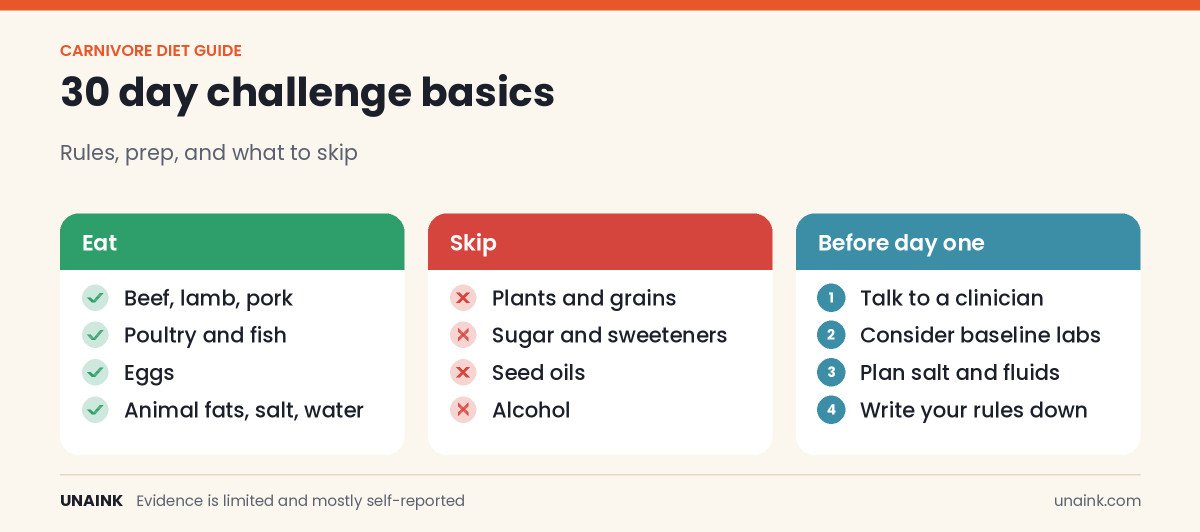
- Eat beef, lamb, pork, poultry, fish, seafood, and eggs.
- Cook with animal fats such as tallow, lard, or butter if you tolerate dairy.
- Drink water, and use salt to taste.
- Skip plants, grains, sugar, sweeteners, seed oils, and alcohol.
- Eat when hungry and stop when full.
If you have not started yet, what is the carnivore diet and the carnivore diet food list cover the basics.
Before Day One: Set Up the 30 Day Carnivore Challenge
Preparation makes the month easier and safer. Book a visit to discuss the plan, and ask whether baseline bloodwork (lipids, kidney function, blood sugar) makes sense. Decide how you will handle salt, fluids, and social events, and stock the kitchen with a week of simple meals; carnivore diet meal prep can help.
A Week-by-Week Look at 30 Days
These patterns come from self-reports and online communities, not controlled trials, so your experience may differ.
| Week | What some people report | Practical move |
|---|---|---|
| 1 | Cravings, fatigue, headaches, digestive changes, sometimes called carnivore flu | Salt, fluids, enough fat and food |
| 2 | Energy dips or steadier hunger | Eat to appetite; do not under-eat |
| 3 | Quieter appetite, slower scale changes | Watch for dizziness, cramps, palpitations |
| 4 | Routine feels familiar | Decide your next step and recheck labs |
For rough patches, see carnivore flu symptoms and carnivore diet leg cramps.
What Results Can You Expect?
The best-known human data is a self-reported survey of 2,029 adults who followed the diet for months, not a controlled trial. A 2026 scoping review of nine studies called the evidence very limited and found LDL rose in several of them.
Low-carb eating often causes quick early weight loss that is partly water, as a StatPearls overview of low-carb diets notes. Measure more than the scale: waist, energy, sleep, digestion, and labs.
Risks and Who Should Skip It
Cleveland Clinic and Harvard Health both point to higher saturated fat, very low fiber, and possible kidney and gout concerns. The 30 day carnivore challenge is not suitable, or lacks safety evidence, for:
- Pregnant or breastfeeding people, children, and teens.
- People with kidney disease, gout, or a history of eating disorders.
- People using insulin, sulfonylureas, SGLT2 inhibitors, blood pressure drugs, diuretics, or GLP-1 medicines without clinician input.
- Anyone with high LDL or heart disease risk, without a plan to monitor it.
Never change a medicine on your own. Your prescriber should guide any adjustments.
What Happens on Day 31?
Decide ahead of time. Some people extend the diet, some reintroduce foods one at a time, and some return to a mixed diet. For the last option, how to transition off carnivore diet explains how to avoid digestive upset and rebound weight gain, and carnivore diet maintenance covers staying the course.
The 30 Day Carnivore Challenge: The Short Version
The 30 day carnivore challenge is a short, strict experiment with limited research behind it, so set rules, track results, and involve a clinician. Treat the 30 day carnivore challenge as a test of how you feel, not a guaranteed fix.
Frequently Asked Questions
Can I have dairy during the 30 day carnivore challenge?
Rules differ. Strict versions allow only meat, eggs, water, and salt, while relaxed versions allow butter or hard cheese. Pick your rules before you begin.
How much weight will I lose in 30 days?
It varies widely and no reliable average exists for this diet. Early loss often includes water. CDC describes 1 to 2 pounds a week as a steady pace for most people.
Do I need supplements?
The 2026 scoping review noted possible shortfalls in vitamin C, calcium, magnesium, and others, so ask a clinician or dietitian what makes sense for you.
Is the carnivore flu real?
Many people report fatigue, headaches, and digestive changes in the first week or two. It is not a formal medical diagnosis, and symptoms that are severe deserve medical attention.
Should I get blood tests?
It is reasonable to ask. LDL cholesterol rose in several studies, so baseline and follow-up labs can show how your body responds.
Conclusion
Thirty days is a manageable window to see how you feel, but it will not settle the long-term questions. Go in with clear rules, medical input, and an exit plan, and judge the month by more than the scale.
Medical note
This article is for general education and is not medical advice. Talk with a doctor or registered dietitian before making major diet changes, especially if you have a health condition, take medication, or are pregnant or breastfeeding.
Keep Reading
- How to Start the Carnivore Diet: Step-by-step first week guide.
- Carnivore Flu Symptoms: What week one can feel like.
- How to Transition Off Carnivore Diet: Plan the day after the challenge.
- Carnivore Diet Maintenance: Staying consistent after your goal.
Sources
- Nutrients scoping review of the carnivore diet (2026): Nine studies, very limited evidence.
- Self-reported survey of 2,029 adults on a carnivore diet: Largest human dataset, self-reported.
- Cleveland Clinic: The Carnivore Diet: Risks and dietitian perspective.
- Harvard Health: What Is the Carnivore Diet?: Physician overview of risks.
- StatPearls: Low-Carbohydrate Diet: Definitions and early water loss.