The carnivore diet for lipedema is a growing topic in online groups, mostly because many women with this painful fat disorder find that ordinary dieting barely changes the affected areas. Lipedema is a chronic medical condition, not a willpower problem, and it needs a proper diagnosis. This guide looks at what is known about eating only animal foods, what small studies of low-carb diets suggest, and where the real gaps are.
Quick Answer
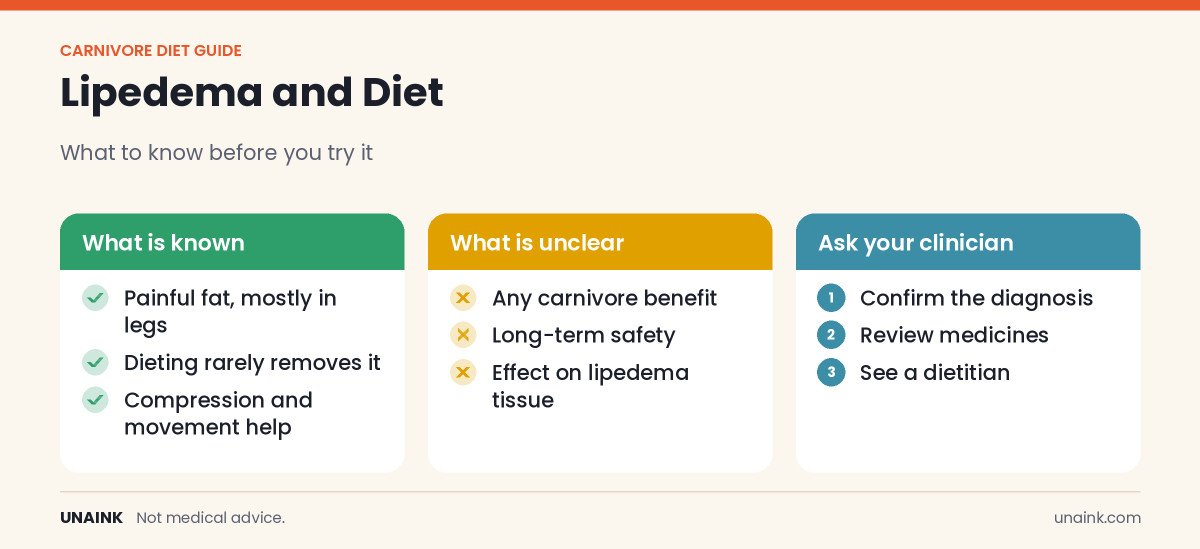
Possibly for some symptoms, but there is no proof. No study has tested a carnivore diet in lipedema. A few small studies of ketogenic or low-carb diets report weight loss and less pain in some women, but they are short, small, and mostly uncontrolled. Lipedema fat often responds poorly to dieting, so compression, movement, and specialist care remain the foundation.
Key Takeaways
- Lipedema is a long-term condition of painful, symmetrical fat in the legs and sometimes the arms, and it is not caused by eating too much.
- No trial has studied a carnivore diet in lipedema, so any benefit is unproven.
- Small low-carb and ketogenic studies show weight and pain changes in some women, but they cannot show that the diet treats lipedema itself.
- Fat in the affected areas often stays put even when overall weight drops.
- Talk to a clinician who knows lipedema before changing your diet, especially if you take medicine.
What Lipedema Is and What It Is Not
According to the Cleveland Clinic, lipedema is a long-term condition that causes abnormal fat buildup, usually on both sides of the lower body, most often the buttocks, thighs, and calves. It happens almost only in women, often runs in families, and tends to start or worsen around puberty, pregnancy, or menopause.
The fat can be tender, bruise easily, and feel heavy. Lipedema is not the same as obesity, although the two can overlap, and it is not the same as lymphedema, which involves fluid from a blocked lymphatic system. Because it is often misdiagnosed, getting a clear diagnosis comes first.
What Research Says About Low-Carb Diets and Lipedema
The best available data come from ketogenic and low-carbohydrate diets, not carnivore. A systematic review and meta-analysis pooled the small number of studies on ketogenic diets in lipedema. Reviewers in this area generally describe the evidence as limited, because trials are few, short, and often lack a control group.
Reported changes include lower body weight, less pain, and better quality of life in some participants. What is not clear is whether the diet changes the lipedema tissue itself or simply lowers overall body fat and inflammation. A recent review of lipedema biology and treatment also notes that the cause is still not fully understood.
Why People Try the Carnivore Diet for Lipedema
Women in lipedema communities often describe less swelling, less pain, and easier weight loss after cutting sugar, grains, and processed food. A strict meat-based plan is an extreme version of that idea. These reports are anecdotal, and they cannot separate the effect of carnivore from the effect of simply eating less ultra-processed food or losing weight overall.
- Reduced sugar and refined carbs may lower swelling for some people.
- Higher protein can make meals more filling.
- Food tracking is simple, with few decisions to make.
- Some people feel motivated by early water-weight loss, which is not fat loss.
Risks and Downsides to Consider
The 2026 scoping review of the carnivore diet found only nine human studies and called the evidence very limited, with long-term use not recommended. For lipedema specifically, there are extra concerns.
- Nutrient gaps: no fiber, vitamin C from plants, or varied micronutrients unless planned carefully.
- Rapid weight changes and strict rules can trigger or worsen disordered eating.
- Very low carb intake can bring headaches, fatigue, and dizziness at first. See carnivore diet side effects.
- Chasing fat loss in the affected areas can lead to frustration when those areas do not shrink.
- Meat-only plans may be costly and hard to keep up for years.
Who Should Not Try This Alone
Anyone who is pregnant, breastfeeding, under 18, or has a history of an eating disorder should not start this diet without medical guidance. People with kidney disease, diabetes, high blood pressure, or heart disease also need supervision. If you take insulin, sulfonylureas, SGLT2 inhibitors, diuretics, or blood pressure drugs, these may need adjusting as your intake changes. Never change medicine on your own. See who should not do the carnivore diet.
Standard Care With Better Support
| Approach | What it may do | Notes |
|---|---|---|
| Compression garments | Eases heaviness and swelling | Often a first step |
| Complex decongestive therapy | Gentle massage plus wrapping | Done by trained therapists |
| Low-impact exercise | Improves mobility and swelling | Swimming, walking, cycling |
| Anti-inflammatory style diet | May slow progression if started early | Per Cleveland Clinic |
| Liposuction by a specialist | Can reduce pain and bulk | Surgical decision with a surgeon |
Cleveland Clinic notes that diet and exercise may help symptoms, but dieting usually does not remove lipedema fat the way it removes ordinary fat.
Questions to Ask Your Clinician
- Do my symptoms match lipedema, lymphedema, or both?
- Which treatment should I start first?
- Would a dietitian-guided, lower-carb or anti-inflammatory plan fit my health history?
- Which labs should we track if I change how I eat?
- How will my medicine be adjusted if my weight or blood sugar changes?
Carnivore Diet for Lipedema: The Short Version
The carnivore diet for lipedema has no direct research behind it, only stories and small studies of related low-carb diets. If you try any diet change, treat it as a side project to compression, movement, and specialist care, and check in with a clinician first, since the carnivore diet for lipedema may not suit every body.
Frequently Asked Questions
Does the carnivore diet cure lipedema?
No. Lipedema has no cure, and no diet has been shown to reverse it. Treatments aim to ease symptoms.
Can a low-carb diet reduce lipedema pain?
Some small studies report less pain with ketogenic diets, but they are few and short, so the benefit is uncertain.
Why does lipedema fat not shrink with dieting?
The fat appears to behave differently from ordinary fat, and weight loss often happens elsewhere on the body first.
Is carnivore safe if I have lipedema and obesity?
Safety over the long term is not established. A clinician should review your heart, kidney, and medicine needs first.
What should I do before changing my diet?
Get a diagnosis, review your medicines, and ask about a dietitian who understands lipedema.
Conclusion
Lipedema deserves real medical attention, and a meat-only diet is not a proven part of that care. Some women feel better on low-carb eating, but the research is small and cannot prove cause and effect. Build your plan around diagnosis, compression, movement, and a clinician you trust, and treat diet changes as one carefully monitored experiment.
Medical note
This article is for general education and is not medical advice. Talk with a doctor or registered dietitian before making major diet changes, especially if you have a health condition, take medication, or are pregnant or breastfeeding.
Keep Reading
- Carnivore Diet and Inflammation: What the research says about inflammation markers.
- Who Should Not Do the Carnivore Diet: Groups that need extra caution.
- Carnivore Diet for Women: Hormones, cycles, and nutrient needs.
- Weight Loss on the Carnivore Diet in a Month: What early changes really mean.
Sources
- Cleveland Clinic: Lipedema: Overview of symptoms, causes, and treatment.
- Efficacy of Ketogenic Diets for Lipedema: Systematic Review and Meta-Analysis: Pooled data on ketogenic diets in lipedema.
- Lipedema: Pathophysiology and Treatment Strategies: Review of causes and treatment options.
- Scoping Review of the Carnivore Diet (Nutrients, 2026): Nine human studies, very limited evidence.