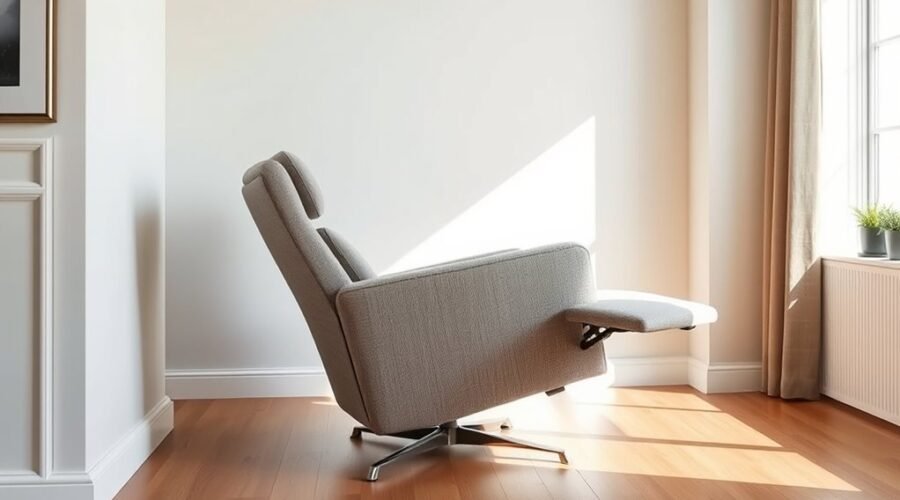
If you’re working with a small room, a wall hugger recliner can make furniture placement easier because its reclining motion is designed to reduce the space needed behind the chair. The key is not to rely on one universal clearance number. Check the exact wall-clearance and fully extended dimensions for the model you want, then measure its complete moving footprint before you buy.
Quick Answer
A wall hugger recliner is designed to sit close to a wall because the seat moves forward as the back reclines. Many current models specify roughly 4 to 7 inches of rear clearance, but the exact number varies. Always check the model’s wall-clearance and fully extended or open-depth measurements before buying.
Key Takeaways
- A wall hugger recliner saves rear space by moving the seat forward as the back reclines instead of requiring a large backward swing.
- Current wall-hugger examples from major manufacturers use about 4 to 7 inches of rear clearance, but the exact requirement is model-specific.
- Do not assume 12 to 18 inches of front space is enough. Compare the chair’s upright depth with its fully extended or open depth.
- Measure width, upright depth, fully reclined depth, wall clearance, nearby walkways, doorway access, and the legrest path before buying.
- For power models, plan for the outlet and cord and follow the manufacturer’s safety and placement instructions.
What Is a Wall Hugger Recliner?
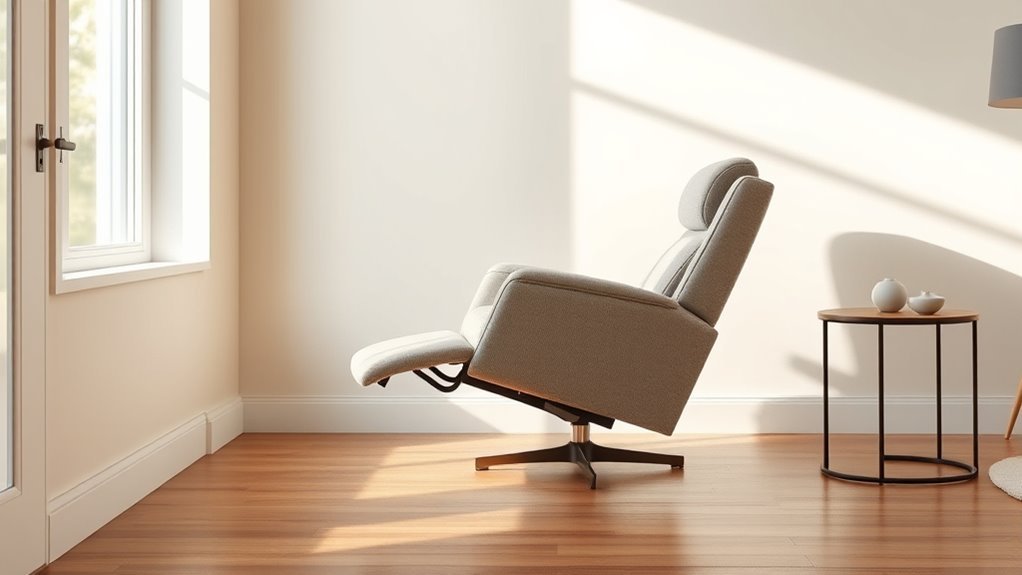
A wall hugger recliner, also called a wall-saver or space-saving recliner by some manufacturers, is a reclining chair designed to work with much less rear clearance than many conventional recliners.
Instead of depending mainly on the backrest swinging far backward, the mechanism moves the seat forward as you recline. That forward travel lets the chair stay relatively close to the wall while still providing a comfortable reclining position.
That makes wall hugger recliners useful in a compact living room, apartment, bedroom, home theater, or other multi-use space where furniture cannot sit far from the wall. However, “wall hugger” does not mean that every model uses exactly the same mechanism or requires the same amount of clearance.
Current products illustrate the variation. Some wall-hugger recliners specify about 4 inches of wall clearance, while others specify 5, 6, or 7 inches. The safest rule is simple: use the published measurement for the exact chair you are considering.
Note: A wall hugger and a “zero-wall” or “zero-clearance” recliner are not automatically the same thing. Some manufacturers use zero-wall terminology for mechanisms designed to need virtually no rear travel. Always rely on the specification sheet rather than the marketing label alone.
How Does a Wall Hugger Recliner Work?
When you recline a wall hugger chair, the seat moves forward while the backrest tilts. This changes the chair’s movement path so less of the motion occurs behind the chair.
The exact hardware varies by manufacturer. A recliner may use linked pivots, tracks, sliding components, or other motion hardware to coordinate the seat, back, and legrest. What matters to the buyer is the result: the occupant moves forward into the room as the chair reclines, reducing the rear clearance required.
- The backrest reclines while the seat travels forward.
- The legrest extends into the room, so front clearance still matters.
- Manual models may use a side handle, pull release, or other manual control depending on the design.
- Power models use one or more electric actuators and may offer independently adjustable back, legrest, headrest, or lumbar support.
- Rocking, swivel, gliding, lift, and reclining functions are separate features and can change the chair’s required movement area.
This compact reclining motion can improve furniture placement in a narrow room, but it does not eliminate the chair’s overall footprint. The fully extended legrest and forward seat travel still occupy floor space in front of the chair.
How Much Room Do Wall Hugger Recliners Need?
The amount of room a wall hugger recliner needs depends on the exact model. Current wall-hugger examples commonly publish rear-clearance figures in the neighborhood of 4 to 7 inches, but that should be treated as a reference range rather than a buying rule.
The more important measurement is the chair’s complete active footprint. You need enough space behind the chair for its specified wall clearance and enough total room in front for the chair to reach its fully extended position without hitting a table, wall, rug edge, or walkway obstruction.
Clearance Behind the Wall
Rear clearance varies even within the same product category. For example, current manufacturer specifications include wall-hugger models with approximately 4-inch, 5-inch, 6-inch, and 7-inch wall-clearance requirements.
That variation is why a statement such as “every wall hugger needs only 4 inches” can lead to a poor fit. Baseboards, trim, electrical plugs, uneven walls, and upholstery movement may also affect practical placement.
- Check the exact “wall clearance” or equivalent specification.
- Measure from the wall or the most projecting trim to the chair’s placement point.
- Allow for plugs, cords, baseboards, radiators, or other fixed obstacles.
- Do not force the chair closer to the wall than the manufacturer recommends.
- Recheck the gap with the chair fully reclined before finalizing placement.
The La-Z-Boy Belmont Wall Recliner is one current example that specifies approximately 4 inches from the wall, but that figure belongs to that model and should not be assumed for every wall hugger.
Front Space to Recline
A wall hugger recliner may save space behind the chair, but the seat and legrest move forward into the room. That makes the chair’s open depth or fully extended length more useful than a generic front-clearance estimate.
Current wall-hugger specifications show why. The examples below have roughly 25 to 30 inches more overall depth when open than when upright:
| Example model | Upright depth | Open / fully extended depth | Published wall clearance |
| La-Z-Boy Belmont Wall Recliner | 36 in. | 66 in. | Approx. 4 in. |
| Flexsteel Rio | 41 in. | 68 in. | 4 in. |
| Flexsteel Davis | 40 in. | 67 in. | 5 in. |
| Flexsteel Chip | 35 in. | 63 in. | 6 in. |
| Flexsteel Belle | 38 in. | 63 in. | 7 in. |
These examples show why a fixed “12 to 18 inches in front” rule is unreliable. Instead, mark the chair’s published fully extended or open depth on the floor and confirm that its legrest and seat can travel through the entire range without hitting anything.
Pro Tip: Use painter’s tape to mark both the upright footprint and the fully reclined footprint. You will immediately see whether a coffee table, ottoman, doorway, or main walking route falls inside the chair’s movement zone.
Measuring Your Room Fit
To determine whether a wall hugger fits your room, measure the full motion of the chair rather than only the gap behind it.
- Width: Check the chair’s overall width and any space needed beside the arms.
- Upright depth: Measure how far the closed chair extends into the room.
- Fully extended or open depth: This shows the chair’s maximum overall front-to-back size while reclined.
- Wall clearance: Use the manufacturer’s exact minimum for that model.
- Legrest path: Keep tables, rugs, toys, baskets, and other furniture outside the movement area.
- Walkways: Check whether people can still move through the room when the chair is reclined.
- Delivery route: Measure the narrowest doorway, hall, turn, stair, or elevator the chair must pass through.
If the recliner has a removable back, delivery may be easier, but confirm the manufacturer’s assembly instructions instead of assuming the back can be removed.
How Is a Wall Hugger Recliner Different From a Standard Recliner?
The main difference is the direction of the reclining motion. A wall hugger recliner shifts the occupant forward as the back reclines, reducing the rear travel needed near the wall.
A conventional recliner may require more space behind the back because more of its reclining arc moves rearward. There is no single wall-clearance figure that applies to every standard recliner, so compare the published dimensions of the specific models you are considering.
The wall-hugger advantage is therefore not that the chair becomes physically small. Its advantage is that more of the reclining footprint is moved toward the front of the chair instead of behind it.
Recline Mechanism Differences
A wall hugger recliner uses motion hardware that coordinates forward seat travel with the reclining back and extending legrest. A more conventional reclining mechanism may allow greater backward travel.
- Wall-hugger designs prioritize reduced rear clearance.
- Standard reclining designs may require more rear room, depending on the mechanism.
- Both still need enough total floor area for the open chair.
- Power and manual operation do not by themselves determine whether a chair is a wall hugger.
- Swivel, rocking, gliding, lift, headrest, and lumbar features should be checked separately.
Because the designs vary, avoid estimating that a wall hugger will always “save two feet.” Compare the actual wall-clearance and fully extended dimensions of two specific chairs instead.
Space Clearance Requirements
Space clearance is where a wall hugger recliner can provide its biggest practical advantage. Current wall-hugger products can sit only several inches from a wall, which can let you move the chair farther back and preserve more usable space in the center of a small room.
However, rear clearance is only one part of the layout. A compact rear gap does not help if the extended footrest hits a coffee table or completely blocks the room’s only walking route.
The most useful number is not simply “inches from the wall.” It is the chair’s complete footprint when fully reclined.
How Do You Measure Your Room for One?
Before you buy a wall hugger recliner, start with the manufacturer’s dimension sheet. Write down the overall width, upright depth, fully extended or open depth, and required wall clearance.
Then use painter’s tape to mark the chair’s position on the floor. First mark its upright footprint. Next extend the tape to the published fully reclined dimension so you can see exactly how far the chair will project into the room.
- Confirm the specified clearance between the chair and wall.
- Mark the full front edge of the extended legrest.
- Check the recliner against coffee tables, end tables, rugs, doors, and cabinets.
- Make sure the reclined chair does not block a required exit or major traffic path.
- Check baseboards, wall trim, floor registers, outlets, and cords.
- Measure the delivery path before ordering.
- If possible, operate a floor model through its entire range before buying.
Warning: Keep hands, children, pets, furniture, and loose objects away from the moving mechanism and legrest path. For a power recliner, route the cord where it cannot be pinched or become a trip hazard, and follow the electrical and placement instructions in that model’s manual.
How Do You Choose the Right Wall Hugger Recliner?
To choose the right wall hugger recliner, begin with fit. A chair with impressive features is not a good choice if its open footprint blocks your walkway or its back cannot maintain the required wall clearance.
Compare these specifications before you focus on color or upholstery:
- Wall clearance: The manufacturer’s required rear gap.
- Overall width: Especially important between end tables, cabinets, or other seats.
- Upright depth: How far the chair projects when closed.
- Open depth or fully extended length: The maximum footprint while reclining.
- Seat width and depth: These affect how well the chair fits the user, not just the room.
- Seat height: Important for comfortable entry and exit.
- Weight capacity: Use the rating published for the exact model.
- Manual or power controls: Power offers push-button adjustment but requires electrical planning.
- Headrest and lumbar adjustment: Useful if several people use the same chair or you watch TV while reclined.
- Rocking, swivel, gliding, or lift functions: These may change the movement envelope and placement options.
- USB ports and charging: Convenient on some power models, but they should be secondary to fit and support.
- Delivery dimensions: Make sure the chair can reach the room through doors, halls, stairs, or elevators.
For small spaces, current models such as the La-Z-Boy Belmont, Flexsteel Rio, and wall-hugging Valencia Oslo or Tuscany configurations show how manufacturers approach reduced rear clearance. None is automatically the best choice for every room. Compare the exact configuration’s measurements with your taped floor plan.
Finally, sit in the chair when possible. A compact recliner can still be uncomfortable if the seat is too deep, too shallow, too high, or too narrow for the primary user.
Frequently Asked Questions
How Much Room Does a Wall Hugger Recliner Need?
There is no single room-size requirement. Current wall-hugger examples commonly specify about 4 to 7 inches behind the chair, but you must also account for the chair’s fully extended or open depth. Check the exact model specifications and mark the full reclined footprint before buying.
How Close Can a Wall Hugger Recliner Be to the Wall?
Place it only as close as the manufacturer allows. Some current wall-hugger models specify about 4 inches, while others require 5, 6, or 7 inches. Baseboards, plugs, trim, and upholstery movement can also affect the practical gap.
What Is the Best Wall Hugger Recliner for Small Spaces?
The best fit is the model whose published wall clearance, width, upright depth, and fully extended depth match your actual room while still fitting the person who will use it. Compact examples exist from La-Z-Boy, Flexsteel, Valencia, and other manufacturers, but compare the exact configuration rather than choosing by brand name alone.
What Are the Benefits of a Wall Hugger Recliner?
The main benefit is reduced rear clearance, which can make furniture placement easier in apartments, bedrooms, home theaters, and narrow living rooms. You can also choose among manual and power controls, different upholstery materials, adjustable headrests, lumbar support, charging ports, and other comfort features.
Is a Wall Hugger the Same as a Zero-Wall Recliner?
Not necessarily. Both terms describe space-saving reclining designs, but manufacturers may use them differently. A product marketed as zero-wall may be designed for even less rear movement than a conventional wall hugger. Check the stated wall-clearance requirement instead of relying on the label.
Do Power Wall Hugger Recliners Need an Outlet?
Most power recliners require an electrical power source, although some models may offer battery options. Check the manual for the exact chair and plan the cord route before placement so the cord is not stretched, pinched, hidden where it can wear, or placed where someone can trip over it.
Conclusion
A wall hugger recliner can provide full reclining comfort while using much less space behind the chair than many conventional designs. The important point is that “wall hugger” does not guarantee one fixed clearance measurement. Current models vary, and their extended footprints can be much larger than their upright dimensions.
Measure the wall gap, width, upright depth, fully extended depth, walking space, delivery route, and power access before buying. When those numbers fit your room and the seat fits the person using it, a wall hugger can preserve open floor space without sacrificing the comfort of a reclining chair.
Sources
- La-Z-Boy Belmont Wall Recliner product specifications — wall clearance, upright dimensions, and fully extended dimensions.
- La-Z-Boy Power Recliner operating instructions — moving-part, cord, legrest-clearance, and furniture-placement safety guidance.
- Flexsteel Rio, Davis, Chip, and Belle recliner specifications — current wall-clearance and open-depth examples.
- Valencia Theater Seating Oslo and Tuscany specifications — current wall-hugging theater-seat clearance and full-recline measurements.