
To restuff throw pillows and bring back their shape, first check whether the pillow has a removable insert, a zippered liner, or a permanently sewn shell. Remove worn or clumped filling, repair weak seams, then add the replacement stuffing a little at a time. Fill the corners first, test the firmness as you work, and close the pillow without forcing the zipper or seam.
Quick Answer
To restuff a throw pillow, open its zipper or carefully undo part of a seam, remove worn filling, and add fresh fiberfill or another compatible insert material. Push stuffing into all four corners first, build the center gradually, then close the opening and massage the pillow until the fill is smooth and evenly distributed.
Key Takeaways
- Check the pillow construction and care label before opening, washing, or replacing the fill.
- Polyester fiberfill is easy to add in small amounts, while feather/down and foam usually work best when their original insert construction is preserved.
- Fill the corners first, then add stuffing gradually so the pillow becomes full without stressing the zipper or seams.
- After closing the pillow, shake, massage, and reshape it to remove lumps and restore an even outline.
At a Glance
| Time Required | About 20–45 minutes per pillow, depending on whether it has a zipper or sewn opening |
| Difficulty | Easy |
| Tools Needed | Seam ripper or small scissors, replacement fill, stuffing tool or blunt wooden spoon, matching thread, and a hand-sewing needle if the pillow is sewn shut |
| Cost | Varies by pillow size and filling; polyester fiberfill is generally one of the simpler lower-cost options |
Before You Restuff a Throw Pillow
Start by identifying what is actually inside the pillow. Some decorative covers hold a separate pillow insert, while others contain loose stuffing directly inside the outer shell. If there is a removable insert, replacing or refilling that insert is usually better than cutting into the decorative cover.
Press the pillow in several places. Filling that stays badly compressed, feels hard and lumpy, or no longer springs back is a good candidate for replacement. If the existing fill is still clean and resilient, you may be able to loosen it and combine it with a smaller amount of fresh stuffing.
Inspect the zipper, seams, piping, and fabric before adding more material. Repair small tears first so the pressure of fresh fill does not make them larger.
Warning: Use a seam ripper or scissors slowly and point the cutting edge away from your hands and the pillow fabric. Before washing or tumble drying any pillow insert, read its sewn-in care label. Some foam materials should not be submerged or machine washed.
Remove the Old Pillow Fill
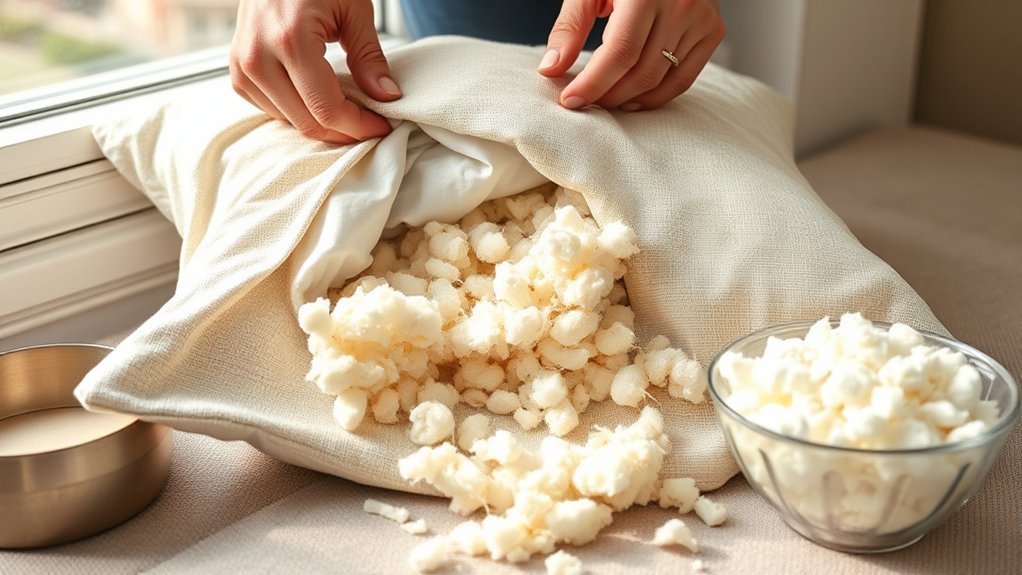
If the pillow has a zipper, unzip it fully before pulling on the insert or stuffing. Opening the zipper all the way reduces stress on the slider and gives you more room to work.
If the pillow is sewn shut, find a straight section of seam away from a corner. Use a seam ripper to open only as much of the seam as you need. A small opening may be enough for loose fiberfill, while a complete pillow form may require a wider opening.
Remove the old pillow fill in steady handfuls. Loosen material trapped in the corners instead of pulling hard on the shell. Separate compressed clumps so you can judge whether any of the existing material is still usable.
Once the interior is clear, check for frayed seams, thinning fabric, loose piping, or small tears. Make repairs before adding new stuffing.
Reuse old filling only when it is clean, dry, odor-free, and still resilient. Otherwise, bag it and follow local disposal or textile-recycling rules rather than assuming loose pillow fill belongs in curbside recycling.
Choose the Right Stuffing for Throw Pillows
The best stuffing for throw pillows depends on the pillow’s original construction and the feel you want. Matching the new material to the old construction usually produces a more predictable result than mixing very different types of fill.
Polyester fiberfill is one of the easiest materials for loose restuffing because it can be added in small amounts and shaped by hand. Fairfield lists 100% polyester fiberfill for pillows and other home-decor projects. The company also lists rayon-from-bamboo and PLA corn-sugar fiberfill among its specialty filling materials. Fairfield’s fiberfill guide explains the differences among these products.
Down or feather fill creates a soft, moldable feel, but loose feathers are best kept inside a liner or insert designed to contain them. If your decorative cover originally used a finished feather/down insert, replacing that insert is usually cleaner than pouring loose feathers directly into the cover.
Foam needs more care because foam pillows are not all built the same way. Some use a solid shaped core, while others use loose pieces or adjustable fill. If the original pillow contains foam, keep the same basic construction rather than automatically replacing it with ordinary fiberfill.
Do not assume that words such as “natural,” “bamboo,” “plant-based,” or “hypoallergenic” guarantee a particular environmental or allergy benefit. Check the actual fiber content, certifications, and manufacturer instructions for the material you are considering.
Choose the fill for the way the pillow should feel and behave—not simply by which material sounds the most luxurious.
How Much Stuffing Should You Add?
There is no universal stuffing weight that works for every throw pillow because cover size, fabric stretch, fill density, and desired firmness all change the amount required.
Start with less than you think you need. Add small handfuls, distribute them fully, and test the pillow after every few additions. Stop when the corners look filled, the faces look smooth, and the zipper or closing seam can meet without being forced.
An overfilled pillow often feels unusually hard, develops a rounded or distorted shape, and puts unnecessary tension on the zipper and stitching. An underfilled pillow develops empty corners, wrinkles, and a hollow center.
Pack the Fill Into the Corners
With the replacement stuffing ready, begin at the corners instead of filling the middle first. Established pillowmaking guidance recommends pushing stuffing firmly into the corners before finishing the rest of the pillow. Sewing & Craft Alliance pillowmaking guidance also notes that extra polyester fiberfill can be used around a pillow form when the corners need additional fullness.
- Pull off small, loose tufts rather than forcing one large compressed clump into the pillow.
- Push material into one corner at a time with your fingers or a blunt stuffing tool.
- Rotate the pillow frequently so you can compare all four corners.
- Add fill to soft or wrinkled areas instead of automatically adding more to the center.
- Massage the outer surface as you work to break up lumps before they become packed in place.
Pro Tip: Fill each corner before building the center. Small tufts are easier to control than large handfuls and are less likely to create hard lumps.
Once the corners hold their shape, add material across the center in thin layers. Periodically hold the pillow upright, pat its sides, and look at it from the front. This makes uneven areas easier to spot.
Close the Seam Securely
If the pillow has a zipper, smooth the fill away from the zipper track before closing it. Support the pillow with one hand so the zipper is not carrying the full pressure of the stuffing. If it takes excessive force to close, remove a little fill rather than pulling harder.
For a sewn opening, fold the raw edges back to their original seam line and align them carefully. A slip stitch, also called an invisible or ladder-style closing stitch in many sewing guides, can keep the opening neat. Sewing & Craft Alliance specifically recommends slip stitch for closing seams on stuffed pillows. Its hand-stitch guide also identifies backstitch as useful where extra strength is needed.
Use a sharp needle that suits the fabric and matching thread. Keep the stitches small and evenly spaced, but do not pull so tightly that the fabric puckers. For a pillow that receives frequent handling, reinforce the beginning and end of the repaired seam securely.
Fluff and Shape the Pillow
After the pillow is closed, distribute the filling one last time. Grasp opposite sides and give the pillow several firm shakes. Then massage the front and back with both hands to move filling from overstuffed areas into softer areas.
- For polyester fiberfill, squeeze and release the pillow from several directions to break apart small clumps.
- For down or feather inserts, shake and gently redistribute the filling toward the corners.
- For foam or latex constructions, use gentle hand shaping instead of aggressive punching or folding unless the manufacturer says otherwise.
- For a decorative “karate chop” look, make a shallow indentation at the top only after the pillow is evenly filled.
Do not automatically put a flattened pillow in the washer or dryer. Care instructions vary by construction. Tempur-Pedic, for example, states that its TEMPUR material should not be washed or submerged. Tempur-Pedic’s pillow care guidance directs owners to the care tag for the exact product.
Down and feather products may have different instructions. Pacific Coast’s current pillow-care guidance recommends checking the sewn-in label first and, for compatible products, following the specified gentle wash and low, air-fluff, or no-heat drying instructions. The center must be completely dry before the pillow is used or stored. Pacific Coast’s laundry-care guide provides the product-specific precautions.
Note: Dryer balls can help separate and redistribute fill in some washable pillows, but only use a dryer when the pillow’s own care label permits tumble drying.
Troubleshooting a Restuffed Throw Pillow
Why Does the Pillow Look Lumpy?
Large compressed handfuls of fiberfill commonly create lumps. Reopen the pillow, pull the dense areas apart, and replace them with smaller, loosened tufts. Massage each layer before adding more.
Why Are the Corners Still Flat?
Add small pinches of fiberfill directly into each weak corner with your fingers or a blunt stuffing tool. Avoid adding a large amount to the center because that can make the middle hard while the corners remain empty.
Why Is the Zipper Hard to Close?
The pillow may be overfilled or the stuffing may be sitting directly behind the zipper. Push the fill away from the zipper track first. If the cover still has to be stretched forcefully, remove a small amount of filling.
Why Does the Pillow Still Look Flat?
If fresh fill does not restore the shape, the insert shell may be oversized, stretched, or worn. A removable pillow cover may look better with a fuller replacement insert rather than additional loose stuffing.
Frequently Asked Questions
How do you make throw pillows look fuller?
Redistribute the existing filling into the corners first, then add fresh stuffing to low areas. If the cover uses a removable insert and still looks loose, replacing it with a slightly fuller insert may produce a cleaner result than packing more material into a worn insert.
What is the 2-2-1 throw pillow rule?
The 2-2-1 rule is a decorating formula that uses five pillows: two larger pillows as the base, two slightly smaller coordinating pillows layered with them, and one accent or lumbar pillow centered in front. It is a styling guideline rather than a requirement, so adjust the arrangement for the width and depth of your sofa or bed.
How do you revive flattened pillows?
Start by shaking and massaging the pillow to redistribute the filling. Break apart compressed polyester clumps by hand and move fill back into the corners. If the material no longer rebounds, add fresh fill or replace the insert. Wash or tumble dry a pillow only when its care label specifically allows it.
How do you make throw pillows look fluffy?
Use enough filling to support the corners without making the cover rigid. Shake the pillow from several directions, massage lumps apart, and pat the front and back into an even shape. Soft fiberfill and feather/down inserts can usually be shaped more dramatically than solid foam inserts.
Can you restuff a throw pillow without sewing?
Yes, if the pillow cover or inner liner has a working zipper. Open it fully, adjust or replace the filling, then close the zipper after moving loose material away from the teeth. A permanently sewn pillow usually needs a small seam opened and stitched closed again.
How much stuffing should you put in a throw pillow?
There is no single correct weight. Add small amounts until the corners stay full, the faces look smooth, and the cover closes without excessive tension. If the pillow feels hard or the zipper is difficult to close, remove some fill.
Conclusion
Restuffing throw pillows is a simple way to restore cushions that have become flat, lumpy, or uneven. Identify the original construction first, remove worn fill carefully, choose a compatible replacement, and build the shape from the corners toward the center. Finish with a secure closure and thorough hand-fluffing. Most importantly, follow the pillow’s care label before washing, drying, or treating the insert.
Sources
- Sewing & Craft Alliance — Pillowmaking 101 — supports corner filling, pillow forms, stuffing, and hand-closing guidance.
- Sewing & Craft Alliance — Hand Stitches — supports slip stitch and backstitch recommendations.
- Fairfield World — Fiberfill FAQ — documents polyester, rayon-from-bamboo, and PLA corn-sugar fiberfill options.
- Tempur-Pedic — Can I Wash My Pillow? — supports the caution against washing certain foam materials.
- Pacific Coast — Laundry Care — supports care-label-first washing, drying, and fluffing guidance for compatible pillows.