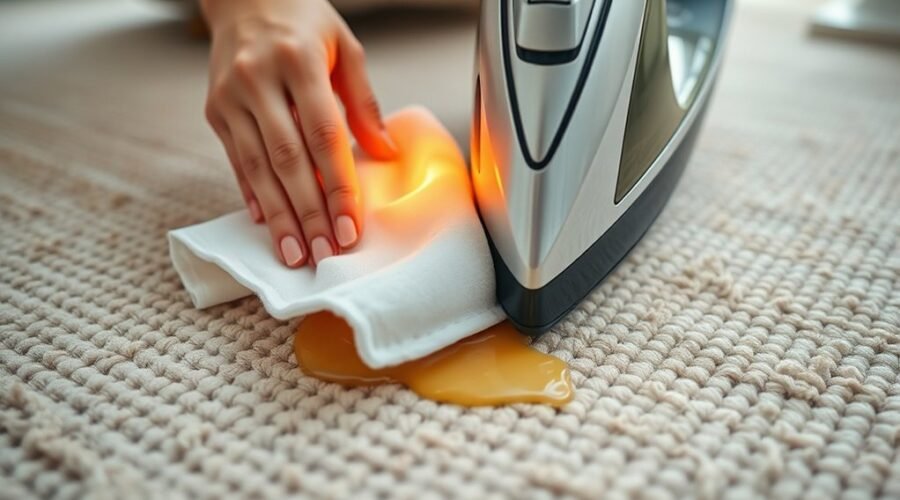
To remove candle wax from a rug, let the wax harden, lift off as much solid wax as possible, and then use controlled low heat only if the rug’s care instructions allow it. Work slowly, avoid rubbing, and treat any leftover dye or oily residue separately so you do not spread the stain or damage the fibers.
Quick Answer
Harden candle wax with a sealed bag of ice for about 10 to 15 minutes, gently lift the brittle wax with a dull scraper, and vacuum the flakes. If the rug can tolerate heat, cover the remaining wax with plain absorbent paper and apply brief, low, dry heat until the wax transfers into the paper.
Key Takeaways
- Harden and remove as much wax as possible before introducing heat.
- Check the rug label or manufacturer’s care instructions before using an iron, hairdryer, alcohol, or stain remover.
- Use only low, dry heat through plain white absorbent material or an unprinted brown paper bag; never put an iron directly on the rug.
- Blot rather than rub, because scrubbing can spread residue and damage the pile.
- For wool, silk, viscose, antique, hand-knotted, or unknown-fiber rugs, use extra caution and consider professional cleaning.
At a Glance
| Time Required | About 20–30 minutes of active work, plus drying time if a cleaner is used |
| Difficulty | Easy to moderate; delicate rugs require more caution |
| Tools Needed | Sealed ice pack, dull scraper, vacuum, white absorbent paper or cloth, low-heat iron or hairdryer if permitted, and a rug-safe cleaner if needed |
| Cost | Usually no extra cost if you already have the supplies; otherwise the main expense is a fiber-compatible spot cleaner |
What You’ll Need to Remove Candle Wax
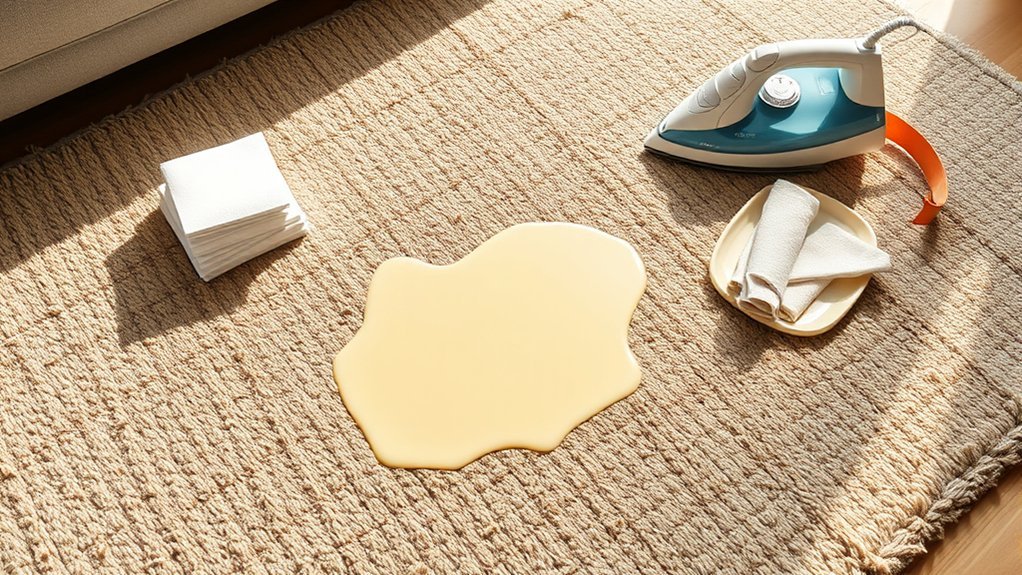
Gather the supplies before you begin so you do not have to leave softened wax unattended. Useful items include a sealed ice pack or bag of ice, a dull butter knife or plastic scraper, a vacuum cleaner, plain white paper towels or a clean white cotton cloth, and an unprinted brown paper bag.
If the rug’s care instructions permit heat, you can also use an iron on its lowest effective dry setting. A hairdryer on low heat can be used as a gentler alternative on some rugs. Keep any heat source moving and never apply an iron directly to the fibers.
For residue left after the wax itself is gone, choose a spot cleaner that is approved for the rug’s fiber. For wool rugs, look for a WoolSafe-approved carpet-care product rather than assuming that any general carpet cleaner is suitable.
Warning: Check the rug label or manufacturer’s care instructions before applying heat, alcohol, solvents, peroxide-based cleaners, or other stain removers. Silk, viscose, antique, hand-knotted, loop-pile, and unknown-fiber rugs are easier to damage and may be better handled by a professional rug cleaner.
A white cotton cloth is preferable to a colored towel because it lets you see whether wax or dye is transferring and avoids introducing fabric dye. Avoid newspaper, printed paper bags, and colored paper under heat.
Keep clean paper towels or cloths nearby for blotting and for rinsing away any cleaning-product residue at the end.
How to Harden Candle Wax
The safest first step is to make the candle wax fully solid. The University of Georgia Cooperative Extension recommends placing ice in a plastic bag over carpet wax to harden it before gently scraping the surface.
Place a sealed ice pack or bag of ice over the spill for about 10 to 15 minutes, or until the wax feels firm and brittle. Keep melting ice and condensation off the rug by sealing the ice in plastic and, if necessary, wrapping the bag in a thin towel.
Freeze Wax Quickly
If the wax is still soft, do not rub, wipe, or press it deeper into the pile. Set the sealed ice pack directly over the affected area and leave it in place until the wax has hardened throughout.
Once the surface is brittle, lift away any large pieces that release easily. The goal is to remove as much wax as possible while it is solid so less needs to be melted later.
Pro Tip: If the spill is thick, chill and remove the upper layer first, then repeat the cold treatment on wax that remains deeper in the pile instead of trying to pry everything out at once.
Prepare For Scraping
Before scraping, check the rug construction. Loop-pile, shag, hand-knotted, and delicate natural-fiber rugs can snag or fuzz if a tool is pulled aggressively across the surface.
Choose a dull butter knife, spoon edge, plastic scraper, or old plastic card. Hold the tool nearly flat and work with light pressure. Avoid razor blades or sharp knives.
Keep a vacuum nearby so loose fragments can be removed immediately instead of being pressed back into the pile.
How to Scrape Hardened Wax
Once the wax is fully hard, gently lift it from the edges toward the center of the spill. Do not saw at the fibers or dig the scraper into the rug backing. If the wax starts to soften, stop and chill it again.
| Tool | Action | Result |
|---|---|---|
| Ice pack | Chill wax | Makes wax brittle |
| Dull knife | Lift raised edges | Removes larger pieces |
| Plastic scraper | Break up brittle wax | Reduces fiber damage risk |
| Light pressure | Work from edge inward | Helps contain the spill |
| Vacuum | Collect loose flakes | Prepares the pile for the next step |
After scraping, vacuum the area thoroughly. Removing the loose fragments first reduces the amount of wax that must be softened with heat.
Aggressive scraping should be avoided, especially on loop-pile and wool rugs, because rough mechanical action can fray, fuzz, or pull fibers.
How to Remove Candle Wax With Heat
After the loose wax has been removed, controlled heat can transfer remaining wax from the rug into absorbent material. Both the University of Georgia Cooperative Extension and the Carpet and Rug Institute describe using absorbent paper and warm or low iron heat for candle wax on carpet.
Warning: Heat can permanently distort some synthetic or delicate rug fibers. Test an inconspicuous area first, use the lowest effective setting, switch steam off, never let the iron touch the rug directly, and stop immediately if the pile changes texture, sheen, shape, or color.
Low-Heat Iron Method
Place several layers of plain white paper towel, a clean white cotton cloth, or an unprinted brown paper bag over the remaining wax. The material needs to absorb the wax as it melts.
- Set the iron to its lowest effective dry setting and turn steam off.
- Place the absorbent material completely between the iron and the rug.
- Press the iron briefly against the paper or cloth for only a few seconds.
- Lift the iron and check whether wax has transferred.
- Move to a clean section of paper or replace the cloth as it becomes loaded with wax.
- Repeat brief applications until little or no additional wax transfers.
Do not slide the iron back and forth as though you are ironing clothing. Short press-and-check cycles give you more control over the amount of heat reaching the rug.
If no wax transfers at the lowest setting, increase heat only if the rug manufacturer permits it. Never compensate by holding a hot iron in one place for a long period.
Hairdryer And Blotting
If you do not want to use an iron and the rug’s care instructions permit gentle heat, a hairdryer on its low setting can soften small amounts of remaining wax.
Hold the dryer several inches above the area and keep it moving. As the wax begins to soften, press a fresh white paper towel or clean white cloth against the area to absorb it. Lift rather than scrub, replace the absorbent material frequently, and stop if the rug feels excessively hot.
A hairdryer is not a reason to skip the cold-removal step. Harden, scrape, and vacuum away the bulk of the wax first.
Note: Do not substitute a heat gun. A heat gun can produce much more concentrated heat than is necessary for wax removal and increases the chance of permanently damaging rug fibers.
How to Blot Up Melted Wax
As the wax softens, let the paper or white cloth absorb it. The goal is controlled transfer, not rubbing. Press, lift, inspect, and move to a clean section of the absorbent material.
- Lay fresh absorbent paper or cloth flat over the wax.
- Apply brief, controlled heat if the rug permits it.
- Lift the paper and look for translucent or waxy transfer marks.
- Move to a clean section or use a fresh sheet.
- Repeat until the paper stops picking up meaningful amounts of wax.
The safest sequence is cold first, heat second: remove as much hardened wax as possible before warming the small amount left in the fibers.
Let the area cool and inspect it from several angles. A remaining mark may be candle dye or fragrance oil rather than solid wax, so it needs a different treatment.
How to Remove Leftover Stains
Once the wax itself is gone, look for an oily patch or color left by fragrance oils and candle dye. Do not keep reheating the area if no wax is transferring into the paper.
| Residue | Action | Important Precaution |
|---|---|---|
| Light oily residue | Blot with a fiber-safe carpet cleaner or a small amount of mild dishwashing solution | Do not saturate the backing |
| Colored dye residue | Use only a treatment compatible with the rug fiber | Pretest first |
| Wool rug | Use a WoolSafe-approved spot treatment | Follow the product instructions exactly |
For a light oily residue on a compatible rug, dampen a clean white cloth with a small amount of mild cleaning solution and blot from the outer edge toward the center. Avoid pouring cleaner directly onto the rug.
After detergent treatment, dampen another clean white cloth with plain water and blot lightly to remove cleaner residue. Then press with a dry towel and allow the rug to air-dry completely.
For residual candle dye, University of Georgia guidance describes using a mixture of 1 part rubbing alcohol to 2 parts water in small amounts, followed by thorough blotting. However, the same guidance warns against that method on acrylic or modacrylic carpet. Always pretest and follow the rug manufacturer’s instructions before using alcohol.
Baking soda is sometimes used to absorb a light surface odor or oily trace, but it is not a substitute for removing the hardened wax. If you use it on a rug whose care instructions allow it, apply only a light amount to a fully dry surface and vacuum it out thoroughly rather than rubbing it into the pile.
Pro Tip: Stop adding cleaning products once the stain is improving. Repeatedly layering detergent, alcohol, oxidizers, solvents, and home remedies can create a harder problem than the original wax spill.
When to Call a Professional Rug Cleaner
DIY treatment is not always the best option. Contact a qualified rug cleaner if the rug is valuable, antique, silk, viscose, hand-knotted, heavily dyed, or made from an unknown fiber. Professional help is also appropriate when the spill is large, wax has soaked through to the backing, or previous cleaning attempts have changed the texture or color.
For wool carpets and rugs, the WoolSafe Organisation maintains information about approved products and trained service providers.
If the rug label prohibits heat or solvent treatment, do not override those instructions simply because a general carpet-cleaning method recommends them.
How to Prevent Candle Wax Spills
Preventing the next spill is easier than removing another one. Place candles in sturdy holders on stable, heat-resistant surfaces rather than directly over rugs, upholstery, or other materials that can burn.
The National Fire Protection Association advises using sturdy candle holders, keeping lit candles away from materials that can burn, supervising burning candles, and keeping them out of the reach of children and pets.
- Use a sturdy candle holder with a stable base.
- Keep burning candles away from rugs, curtains, paper, and other combustible materials.
- Do not leave a burning candle unattended.
- Keep candles away from children and pets.
- Let wax cool before moving a candle or holder.
- Clean accumulated wax from holders according to the holder manufacturer’s instructions.
- Consider flameless battery-operated candles where an open flame is unnecessary.
A candle warmer can provide fragrance without a burning wick, but it still heats wax. Place it on a stable surface and follow the appliance manufacturer’s operating instructions.
Frequently Asked Questions
What Is the Easiest Way to Remove Candle Wax From Carpet?
The simplest reliable process is to harden the wax with sealed ice, gently scrape and vacuum away the brittle pieces, then transfer remaining wax into plain absorbent paper with brief low heat if the carpet allows it. Treat any leftover dye or oil only after the wax itself has been removed.
Will Dawn Dish Soap Get Wax Out of Carpet?
Not by itself. Dish soap does not replace the harden-scrape-and-transfer process used to remove solid candle wax. A small amount of mild dishwashing solution may help with an oily residue after the wax is gone, provided the rug manufacturer allows it. Blot rather than scrub, rinse lightly with a damp cloth, and avoid soaking the backing.
How Can I Remove Candle Wax From My Carpet Without Using an Iron?
Start with sealed ice, a dull scraper, and a vacuum. If a little wax remains and the rug can safely tolerate gentle heat, use a hairdryer on low while pressing the softened wax into clean white paper towels. Keep the dryer moving and several inches from the surface. Do not use a heat gun. For heat-sensitive or valuable rugs, have a professional remove the remaining residue.
What Removes Dried Candle Wax?
Dried candle wax is usually easiest to remove while it is cold and brittle. Chill it further if necessary, lift off the solid pieces, vacuum the fragments, and then use controlled low heat through absorbent paper only if the rug’s care instructions permit it. Treat any remaining dye or oily mark separately.
Can I Remove Candle Wax From a Wool Rug?
Yes, but use more caution with chemistry and mechanical action. Harden and gently lift the wax first. Check the care label before applying heat, pretest any treatment, and use a WoolSafe-approved product if a spot cleaner is needed. Valuable, hand-knotted, antique, or heavily dyed wool rugs are good candidates for professional treatment.
What Should I Do if Colored Candle Wax Leaves a Stain?
First make sure the solid wax has been removed. Then treat the remaining color according to the rug fiber. A fiber-safe spot cleaner is the safest general choice. University of Georgia guidance also describes diluted rubbing alcohol for some residual dye stains, but alcohol is not suitable for every fiber, so pretest it and follow the rug manufacturer’s instructions.
Sources
- University of Georgia Cooperative Extension — Candle Wax/Paraffin Stain Removal — backs the ice-hardening, gentle scraping, warm-iron transfer, pretesting, diluted-alcohol, and solvent-safety guidance.
- Carpet and Rug Institute — Easy Carpet Cleaning Tips — supports blotting instead of scrubbing and low-heat wax transfer using brown paper.
- The WoolSafe Organisation — Approved Consumer Carpet-Care Products — supports using products specifically tested for wool carpets and rugs.
- The WoolSafe Organisation — Cleaning and Maintenance of Fine Fibres — supports treating blended rugs according to the most sensitive fiber and using extra care with delicate constructions.
- National Fire Protection Association — Candle Safety — supports sturdy candle holders, supervision, and keeping candles away from children, pets, and combustible materials.
Conclusion
Removing candle wax from a rug is easiest when you work in the right order: harden the wax, gently lift the solid pieces, vacuum the flakes, and then use controlled low heat only if the rug can safely tolerate it. Treat leftover dye or oily residue separately rather than continuing to heat the area.
The most important precautions are to avoid rubbing, high heat, excessive moisture, and untested cleaning chemicals. Check the rug’s care instructions first, especially with wool, silk, viscose, antique, hand-knotted, or unknown-fiber rugs. When the rug is valuable or the stain does not respond safely to these steps, professional cleaning is the better next step.