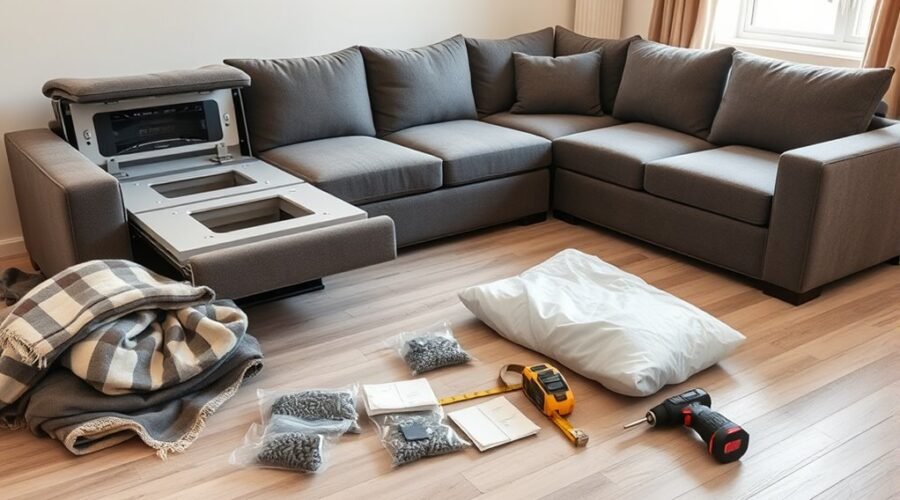
Most sectional sofas can be made much easier to move once you identify how their modules are connected. Before lifting anything, confirm that your sectional is designed to separate, photograph its original layout, measure the moving route, and inspect every joint. Work one connection at a time, use a helper for heavy pieces, and treat powered sections as electrical furniture that requires extra care.
Quick Answer
To disassemble a sectional sofa, remove loose cushions, identify the connectors between modules, unplug any powered seats, and release one connection at a time using the method specified by the manufacturer. Label every section and bag its hardware. Never pry or force a joint that does not release with controlled movement.
Key Takeaways
- Confirm that the sectional is designed to separate and check the manufacturer’s assembly instructions when available.
- Photograph the original layout, label the modules, and identify every hook, clamp, bracket, pin, bolt, or electrical connection before lifting.
- Measure doorways, halls, stairs, ceilings, and tight turns before deciding which legs, backs, or other removable parts actually need to come off.
- Use at least two people for heavy or awkward modules and carry from strong frame areas rather than reclining parts, controls, or loose upholstery.
- Unplug powered seats before disassembly, protect wiring from pulling or pinching, and follow the exact manufacturer’s procedure for battery-equipped furniture.
- Bag and label all loose hardware so each piece can be reassembled without guesswork.
At a Glance
| Time Required | About 30–60 minutes for a straightforward modular sectional; powered or heavily bolted models may take longer. |
| Difficulty | Easy to moderate, depending on connector type, module weight, and powered features. |
| Tools Needed | Flashlight, measuring tape, masking or painter’s tape, zip bags, moving blankets, plus the screwdriver, hex key, socket, or wrench required by your specific hardware. |
| Cost | Usually little or no added cost if you already have basic hand tools and moving blankets; otherwise supplies vary by what you need. |
Can Your Sectional Sofa Come Apart?
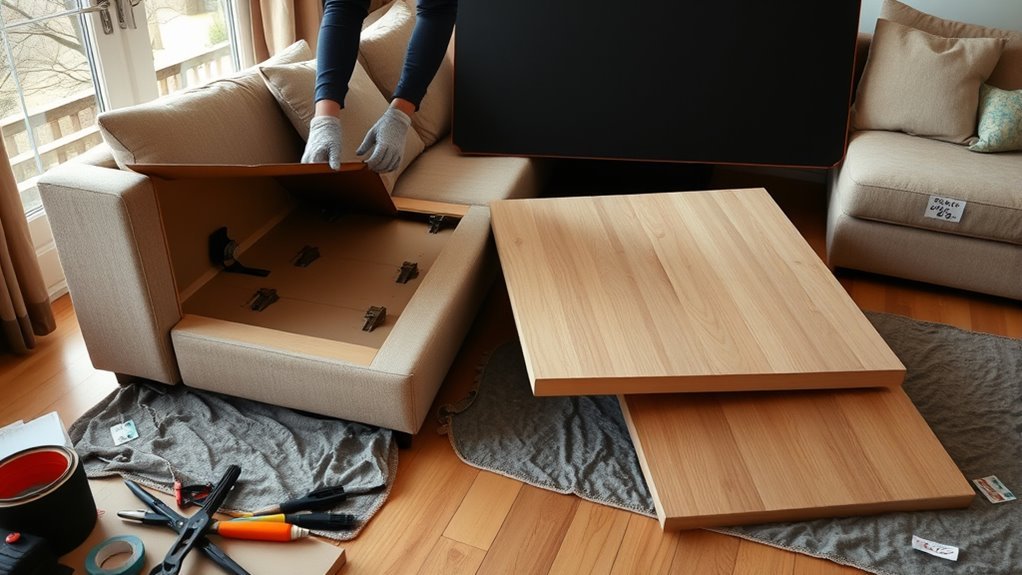
Before taking anything apart, confirm whether your sectional was built as separate modules. Many sectionals are modular, but the connection system varies by brand and model. For example, IKEA’s KIVIK sectional documentation shows a sectional made from multiple frame components, while other modular furniture uses clamps, shoes, hooks, pins, or bolted brackets.
Inspect the seams where two seating units meet, then check the rear and underside of the frame with a flashlight. Look for hooks, slots, metal plates, clamps, pins, bolts, latches, or other hardware joining one module to the next.
If you cannot identify the connection, find the sofa’s model label and look for the manufacturer’s assembly or setup guide. Assembly instructions are especially useful because disassembly usually follows the same connection points in reverse, although some locking mechanisms require a specific release action.
Note: A visible seam does not prove that a joint should be pulled apart. Some sectionals have fixed or partially fixed assemblies. If the manufacturer does not identify a joint as removable, do not pry it apart.
Powered reclining sectionals need an additional inspection because wiring may pass between modules. Identify the power supply, electrical plugs, controls, and any battery system before separating the mechanical connectors.
Measure the Route and Gather Tools
Before disassembly, measure the full route from the sofa to the moving vehicle or destination. Check the height and width of doorways, hallways, stairwells, elevators, low ceilings, and tight corners. Compare those spaces with the dimensions of the individual sectional modules rather than only the dimensions of the complete sofa.
A quick floor-plan sketch can help you spot difficult turns before you are carrying a heavy section. Remember that a module may need room to rotate or tilt, so a doorway that appears wide enough on paper can still be difficult when there is a wall or stair landing immediately behind it.
Gather a flashlight, measuring tape, masking or painter’s tape, labeled zip bags, moving blankets, and any hand tools required by the sofa’s fasteners. Common possibilities include Phillips or flat-head screwdrivers, hex keys, sockets, or an adjustable wrench, but do not loosen hardware simply because you can see it. Remove only hardware that the manufacturer’s instructions or the construction clearly identifies as joining removable pieces.
Remove loose seat cushions, back cushions, throw pillows, blankets, cup-holder inserts, and similar accessories first. This reduces clutter and gives you a clearer view of the frame.
Pro Tip: Before touching any connector, take one wide photo of the complete sectional and close-up photos of every joint. Label the modules A, B, C, and so on, and put the same labels on your photos or hardware bags. Reassembly becomes much easier.
Find the Connectors Before You Start
Pull the sectional far enough from the wall to inspect the seams, rear edges, and underside safely. Clear lamps, tables, rugs, and other obstacles from the working area so both people have room to move.
Connector designs vary, which is why identifying the hardware must come before choosing a release method. Modular systems such as Lovesac’s Sactionals, for example, use an interlocking system with components such as steel clamps and shoes. Other sectionals may use hooks, pins, slots, latches, or bolted plates.
| Connector | What to Look For | Safe Approach |
| Hook-and-slot bracket | One metal part hooks into a receiving slot or plate. | Many release by lifting the correct module before moving it away, but confirm the direction from the manual or visible hardware first. |
| Clamp or locking connector | A clamp, latch, or locking piece bridges two modules. | Release or remove the locking part exactly as designed before moving the modules. |
| Pin-and-fork or interlocking bracket | A pin, post, or projecting bracket sits inside a mating bracket. | Support both frames and disengage the pieces in the direction indicated by the hardware; do not twist the joint sideways. |
| Bolted plate | Bolts, washers, or joining plates visibly fasten two separate frames. | Support the modules, remove the joining fasteners with the correct tool, and bag the hardware immediately. |
Inspect the entire joint before lifting. Some connections may be near the front and rear of the same seam. As you identify each one, mark the connection with tape and note which module appears to move during release.
Warning: Do not pry two modules apart with a screwdriver, crowbar, or other lever. If controlled movement does not release the joint, stop. A hidden connector, bolt, wire, or model-specific locking mechanism may still be engaged.
Take the Sectional Apart Safely
Once you have identified the connections, separate the sectional one joint at a time. Move each freed module out of the immediate work area before starting on the next one so exposed hardware cannot scratch the next piece or catch clothing.
- Remove loose items. Take off cushions, pillows, removable trays, and other accessories.
- Photograph and label the layout. Mark every module and connection before anything changes position.
- Disconnect power where applicable. Powered sections should be electrically safe before their mechanical connections are released.
- Support both modules. Have one person stabilize the stationary piece while the other performs the documented lift, slide, unlatch, or unbolt action.
- Release the connector. Use controlled movement rather than twisting, jerking, or forcing the frame.
- Move the free module away. Set it on a moving blanket or furniture sliders and protect exposed brackets.
- Bag hardware immediately. Label bolts, washers, removable feet, clamps, and other loose hardware with the module they belong to.
For heavy pieces, use two people or appropriate moving equipment. OSHA’s heavy-lifting guidance notes that injury risk increases with heavier manual loads and recommends two or more people for loads over about 50 pounds. Some reclining mechanisms are considerably heavier than an ordinary seat frame; Lovesac, for example, specifies two people for its 80-pound reclining-seat mechanism.
Lift from a strong lower frame area where your specific design allows it. Do not use a moving footrest, electrical control, loose cushion, trim piece, or unsupported reclining mechanism as a carrying handle.
Should You Remove the Legs or Backrests?
Remove legs, feet, or detachable backrests only when the sofa’s construction allows it and doing so gives you useful clearance or reduces weight. Many legs are removable, but the attachment style varies. Backrests on reclining furniture can also use specialized locking brackets, so follow the manufacturer’s instructions rather than assuming they simply pull upward.
If a module already fits safely through the route, unnecessary disassembly creates extra hardware to lose and extra opportunities for damage.
How to Protect the Sections for Moving
Cover upholstery, corners, wood trim, and exposed hardware with moving blankets or other suitable furniture padding. Stretch wrap can help hold protective material in place when appropriate, but avoid relying on tight plastic directly against delicate finishes for extended storage.
Secure loose cords against the frame without sharply bending them. Protect projecting brackets so they cannot tear upholstery, scrape flooring, or injure someone carrying the module.
What If a Section Will Not Come Apart?
If a module refuses to separate, stop applying force and work through these checks:
- Inspect the full seam again for a second connector or hidden bolt.
- Look underneath and behind the joint with a flashlight.
- Check for an electrical cable still joining powered modules.
- Confirm which side of an interlocking bracket is supposed to lift or slide.
- Make sure the connector is not under sideways tension from an uneven floor or twisted frame.
- Search the model number for the manufacturer’s assembly instructions.
- If the connection remains unclear or damaged, stop and use a furniture technician or professional mover rather than forcing it.
Disconnect Power Recliners Safely
Unplug a powered reclining sectional from the wall before beginning disassembly. Manufacturer instructions can be very specific: Lovesac’s reclining-seat setup guide, for example, explicitly instructs owners to unplug the seat from its power source for safe disassembly.
If your sectional has a battery pack or backup power system, follow the manufacturer’s instructions for isolating that power source too. Unplugging the wall transformer may not describe the complete procedure for every design.
Before separating an electrical plug, photograph it and label both sides with matching tape. Grip the connector housing rather than pulling on the wires. Do not cut factory wiring or dismantle a motor, control box, or reclining mechanism unless the product’s service instructions specifically call for it.
Coil loose cables gently and secure them to the frame so they cannot snag while the section is carried. Avoid sharp bends, crushing, or placing the weight of a sofa module on a plug.
Cable routing matters during reassembly as well. Lovesac’s current instructions warn that cables must be positioned so they are not pinched by the furniture’s connecting components.
Warning: Do not reconnect power until all modules are mechanically secure, cables are clear of brackets and moving mechanisms, and no insulation, plug, or wire appears damaged. If wiring is cut, crushed, overheated, or otherwise damaged, leave the furniture unplugged and have it inspected.
Reassemble the Sectional Without Guesswork
At the destination, use your photos and labels to restore the original layout. Follow the manufacturer’s assembly order whenever it is available rather than assuming every sectional should begin with the corner or heaviest piece.
- Place the first layout-defining module in its approximate final position.
- Bring the matching labeled module beside it without trapping cords underneath.
- Align the connector halves before applying downward or sideways force.
- Reinstall bolts, clamps, pins, feet, or other hardware in their original locations.
- Make sure each connection is fully seated and the frames sit level.
- Route electrical cables away from brackets, feet, reclining linkages, and other pinch points.
- Reconnect electrical plugs only after the mechanical assembly is complete.
- Reconnect wall power and test each powered function with the area around the footrest clear.
- Sit gently on each section and check for unwanted movement before normal use.
If a joint does not align naturally, do not pull the frames together with a bolt or clamp. Recheck orientation, labels, connector position, and floor level first.
The safest sectional disassembly is not the one that uses the most tools; it is the one where you identify the exact connector before applying force.
Frequently Asked Questions
Can Sectional Sofas Be Disassembled?
Many sectional sofas can be separated into modules, especially designs built from individual seat, corner, or chaise sections. The exact connection varies by model, so inspect the underside and seams for brackets, clamps, pins, hooks, or bolts and check the manufacturer’s assembly instructions before forcing anything. Remove loose cushions and removable legs only as needed, label every module, and unplug powered sections before separating them.
How Do I Disassemble My Couch for Moving?
Start by removing cushions and photographing the furniture. Measure the moving route, identify removable pieces and connectors, gather the correct tools, and label each section. Release only hardware that joins parts designed to separate. Bag the hardware immediately, protect each module with moving blankets, and use a helper for heavy or awkward sections. A standard one-piece sofa may have far fewer removable parts than a modular sectional.
What Is the 2-2-1 Rule for Sofas?
In sofa styling, the 2-2-1 rule commonly refers to arranging five decorative cushions: two larger foundation pillows, two smaller or contrasting pillows layered inside them, and one accent or lumbar pillow in the center. It is a decorating guideline, not a rule for seating capacity or sectional disassembly, so it does not change how you should take a couch apart for moving.
How Do I Take Apart My Sectional Couch?
Check the seams, back, and underside for the hardware joining each module. Clear the area, remove loose cushions, photograph the layout, and label the sections. Identify the connector before choosing whether to lift, slide, unlatch, or unbolt the joint. Disconnect powered wiring first, keep hardware in labeled bags, protect each freed module, and measure the exit route before carrying it away.
Why Won’t My Sectional Come Apart?
A connector may still be engaged, another fastener may be hidden along the same seam, an electrical cable may still join two powered sections, or you may be lifting the wrong side of an interlocking bracket. Stop pulling, inspect the complete joint again, and check the manufacturer’s instructions. Never assume extra force is the solution.
Do I Need to Remove the Legs Before Moving a Sectional?
Not always. Remove the legs only if they are designed to come off and doing so gives you useful doorway clearance, protects them from damage, or makes the module easier to handle. If a section already fits through the route safely, leaving unnecessary parts assembled can simplify the move.
Conclusion
Disassembling a sectional safely comes down to preparation rather than force. Confirm how your sofa is built, measure the moving route, photograph and label every module, identify each connector, and use enough help for heavy sections. If the sectional has powered recliners, unplug it and protect every cable before separating the frames. Keep the hardware organized, pad the individual modules, and use your labels and manufacturer instructions to put everything back together without guesswork.
Sources
- Lovesac Reclining Seat Setup & Configuration — manufacturer guidance for unplugging before disassembly, two-person handling, cable routing, and powered reclining-seat setup.
- Lovesac Reclining Sactionals — manufacturer information on modular connections, clamps, shoes, and reclining-seat construction.
- IKEA KIVIK Sectional Documentation — manufacturer example of a sectional composed of multiple frame components with model-specific assembly documents.
- OSHA Heavy Lifting Guidance — official guidance on manual handling, heavier loads, and use of two or more people or mechanical assistance.