The ground beef only diet takes the carnivore idea to its simplest extreme: one food, eaten for every meal. Social media has made it look easy and surprisingly effective, but a diet built on a single food raises obvious questions about nutrients, safety and sustainability. This guide explains what the ground beef only diet is, what ground beef does and does not supply, which fat ratio makes sense, how to handle it safely, and who should avoid the plan.
Quick Answer
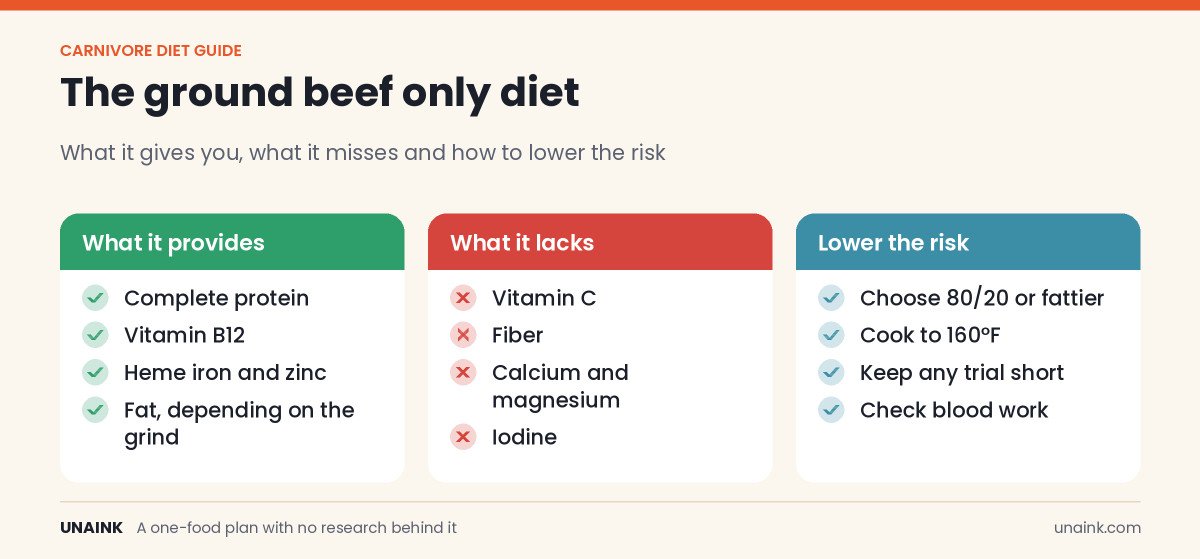
The ground beef only diet means eating ground beef, with salt and water, as your sole food. Ground beef supplies protein, vitamin B12, iron and zinc, but almost no vitamin C, fiber, calcium or magnesium, and no trial has tested the plan. If you try it, choose a fattier grind such as 80/20, cook it to 160°F, keep it short, and have blood work checked. Most professionals would not recommend it long term.
Key Takeaways
- A ground beef only diet is a one-food version of the carnivore diet, usually with salt and water.
- Ground beef is rich in protein, B12, iron and zinc but lacks vitamin C, fiber, calcium and magnesium.
- Very lean grinds can leave you low on fat, so most followers choose 80/20 or fattier.
- Ground beef must be cooked to 160°F to be safe.
- There are no studies of the diet, so keep any trial short and supervised.
What Is the Ground Beef Only Diet?
It is a mono diet: one food, usually ground beef, with salt, water and sometimes coffee. Followers cook patties, crumbles and meatballs and eat until full. The appeal is obvious. Shopping and cooking take minutes, the food is cheap compared with steak, and it is filling. It sits next to other very narrow plans such as the BBBE diet and the lion diet.
What Ground Beef Provides
Beef is a dense source of complete protein, vitamin B12, heme iron, zinc, selenium and niacin, and the fat in the grind adds calories and flavor. That is a strong base for a meat-heavy diet, and it explains why many people feel satisfied.
What Ground Beef Does Not Provide
The problem is what a single food cannot supply. Ground beef has virtually no vitamin C or fiber, and it is low in calcium, magnesium and iodine. The 2026 scoping review of the carnivore diet flagged possible shortfalls in vitamins C and D, calcium, magnesium, iodine and fiber even on plans with more variety than this one.
People sometimes point to Vilhjalmur Stefansson, who lived for a year on an all-meat diet under medical observation and stayed healthy. As Hektoen International describes, though, he ate meat, fish, poultry, fat and organ meats such as brain and liver, which is far broader than ground beef alone.
Which Fat Ratio Should You Choose?
Fat matters. A very lean grind such as 93/7 gives you a lot of protein and little fat, which can leave you hungry, tired or unwell. This is the pattern explained in our guide to rabbit starvation. Most followers choose 80/20 or fattier, and some add tallow. The right level depends on your appetite and goals, so there is no single ratio.
| Grind | What to expect |
|---|---|
| 93/7 (lean) | High protein, low fat. Often unsatisfying on a one-food plan. |
| 85/15 | A middle option that cooks well in patties. |
| 80/20 | The most common choice, with enough fat to feel full. |
| 73/27 or fattier | Very rich. Useful for people who need more fat. |
Food Safety With Ground Beef
- Cook ground beef to 160°F, as the USDA safe temperature chart advises, and check with a thermometer. Color is not reliable.
- Do not eat it raw. Grinding spreads surface bacteria through the whole batch.
- Refrigerate cooked ground beef within two hours and use it within three to four days, or freeze it.
- Use separate boards and wash hands after touching raw meat.
Risks and Who Should Avoid It
- Possible deficiencies in vitamin C, calcium, magnesium and fiber if the plan is long.
- High saturated fat, which can raise LDL cholesterol, as Harvard Health notes for carnivore-style diets.
- Possible kidney stone and gout risk with very high red meat intake.
- Boredom, which can drive overeating or an unhealthy relationship with food.
Avoid it, or speak to a clinician first, if you are pregnant or breastfeeding, have kidney disease, heart disease, high LDL cholesterol or a history of disordered eating.
Easy Ways to Add Variety
- Rotate patties, crumbles, meatballs and meat loaf bound with eggs if you eat them.
- Add fish, eggs and organ meats, which turns it into a standard carnivore plan.
- See our carnivore recipes with ground beef for 20 ideas.
Frequently Asked Questions
Can you live on ground beef only?
Short term, many people do without obvious problems, but there is no research on the diet and ground beef lacks vitamin C, fiber, calcium and magnesium. Long-term use is not recommended.
What fat ratio is best for a ground beef only diet?
Most followers choose 80/20 or fattier because very lean beef can feel unsatisfying and leave you low on fat.
Is it safe to eat ground beef every day?
If cooked to 160°F and stored properly it is safe from a food-safety view. Daily intake of red meat is linked in large studies to higher disease risk, so talk with a clinician.
Do you need supplements on a ground beef only diet?
Possibly. A dietitian can check for gaps in vitamin C, magnesium and calcium and advise on testing.
How long can you do the ground beef only diet?
No safe duration is established. If you try it, keep it short, with a doctor involved.
Conclusion
The ground beef only diet is simple and cheap, but it is a one-food plan without research behind it. If you try it, pick a fattier grind, cook it to 160°F, keep the trial short and add other animal foods as soon as you can.
Medical note
This article is for general education and is not medical advice. Talk with a doctor or registered dietitian before making major diet changes, especially if you have a health condition, take medication, or are pregnant or breastfeeding.
Keep Reading
- 20 Carnivore Diet Recipes With Ground Beef: that never bore
- What Is Rabbit Starvation?: and can it happen on carnivore
- The BBBE Diet: beef, butter, bacon and eggs
- What Is the Carnivore Diet?: the complete overview
Sources
- Lietz, Dapprich and Fischer. Carnivore Diet: A Scoping Review. Nutrients, 2026: nutrient gaps on plant-free diets
- Hektoen International. Rabbit starvation (protein poisoning): Stefansson and the importance of fat
- USDA FSIS. Safe Minimum Internal Temperature Chart: 160°F for ground meat
- Harvard Health Publishing. What is the carnivore diet?: saturated fat and LDL concerns