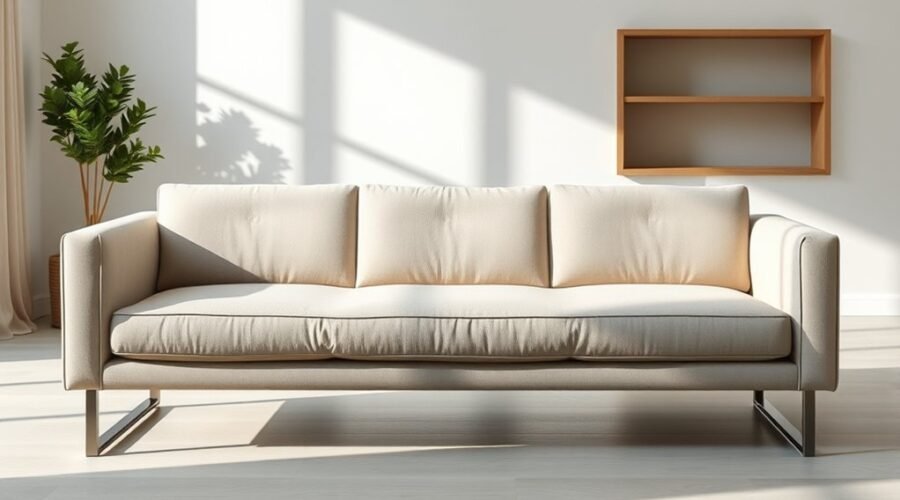
A bench cushion sofa uses one continuous seat cushion—or one continuous upholstered seat—instead of two or three separate seat cushions. That gives the sofa a clean line with no cracks between seating positions. It can also be excellent for stretching out, but comfort depends on much more than the number of cushions. Fill, firmness, suspension, seat depth, seat height, back support, and upholstery all affect how the sofa actually feels.
Quick Answer
A bench cushion sofa can be very comfortable, especially if you like lounging on a smooth seat without gaps between cushions. The bench design itself does not guarantee better support, though. Comfort depends on the cushion fill, firmness, suspension, seat dimensions, back design, and how well those features fit your body and sitting style.
Key Takeaways
- A bench cushion sofa has one continuous seating surface instead of separate seat cushions.
- The uninterrupted seat works especially well for lounging because there is no cushion gap under your hips, back, or legs.
- Bench seating is not automatically softer or more supportive; foam, fill, suspension, seat depth, and back design matter more.
- Foam density and firmness are different properties, so a higher-density cushion is not necessarily a firmer cushion.
- Before buying, check whether the bench cushion is removable, reversible, washable, and available as a replacement part.
What Is a Bench Cushion Sofa?
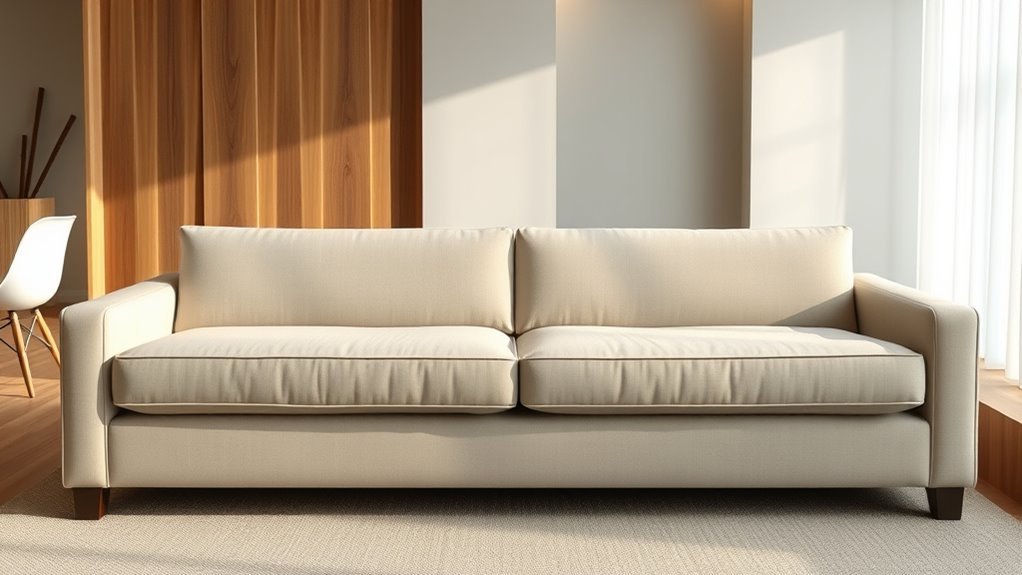
A bench cushion sofa, also called a bench-seat or single-cushion sofa, replaces the usual two or three separate seat cushions with one continuous seating surface. Furniture manufacturers use the same terminology; for example, Hooker Furnishings describes its Gianna model as having a “one cushion bench seat.”
The long horizontal line gives the sofa a streamlined appearance. It also removes the cracks between separate cushions, so phones, remotes, toys, and crumbs have fewer places to disappear.
A continuous cushion does not necessarily mean the sofa is larger or can safely hold more people. Actual seating capacity depends on the usable seat width and the manufacturer’s specifications. What the bench design does change is how the seating surface is divided: there are no cushion boundaries telling each person exactly where to sit.
Loose vs. Tight Bench Seats
Not every bench-seat sofa is built the same way. A loose bench cushion can usually be lifted away from the frame. Depending on its construction, it may also be reversible or removable from its cover. A tight bench seat is upholstered directly onto the sofa and does not come off for flipping or cleaning.
This distinction matters for long-term ownership. A removable cushion can be easier to vacuum underneath and may be easier to rotate, while a tight seat usually stays visually neater but offers fewer maintenance options. Always check the manufacturer’s care instructions before assuming a cushion can be flipped or a cover can be machine-washed.
How a Bench Cushion Sofa Feels
The most noticeable difference is the uninterrupted seating surface. When you sit, stretch out, or lie across the sofa, there is no center seam or gap between individual seat cushions.
That can make lounging feel smoother, but it does not tell you whether the sofa will be soft, firm, springy, deep, or upright. Those qualities come from the cushion materials and the rest of the seating system.
Seat Feel And Support
A bench cushion can range from structured and tailored to soft and sink-in. Flexible polyurethane foam, fiber wraps, feather or down blends, springs, and other materials may be combined to create different results.
The Polyurethane Foam Association explains that flexible polyurethane foam can be engineered for different levels of surface softness and deeper support. It may also be combined with fiber to change the cushion’s surface feel.
For that reason, do not judge a sofa only by whether it has a bench cushion. Two bench-seat sofas can feel completely different if one uses a firm foam core and the other uses a softer wrapped construction.
Comfort Across The Cushion
The bench format mainly changes surface continuity. It can be particularly pleasant when you like to lie across the sofa because there is no cushion split underneath you.
| Feature | What It Changes |
|---|---|
| Continuous bench surface | Removes gaps between individual seat cushions |
| Foam firmness | Strongly affects how soft or firm the seat initially feels |
| Foam density and construction | Influence durability and how well cushioning retains its properties |
| Suspension and decking | Help determine deeper support and how far the seat yields under weight |
| Seat depth, height, and back design | Affect posture and whether the sofa fits your body and preferred sitting position |
In other words, a seamless bench can remove an annoying cushion crack, but comfort still comes from the complete sofa construction.
How Bench Cushions Affect Comfort
A bench cushion changes comfort most clearly when you move around on the sofa. You can slide sideways, curl up, or stretch across the seat without encountering a gap between cushions.
That can be useful for naps and casual lounging. It can also make the sofa feel less divided when two or more people share it.
However, a continuous cushion does not automatically distribute pressure better or provide stronger postural support. A poorly chosen bench cushion can still feel too hard, too soft, too deep, or too low.
Seat dimensions deserve particular attention. A published study on seat depth found meaningful differences in comfort across different depths for the population tested, illustrating why seat depth should be matched to the user rather than treated as a universal number. Sofa designs are more varied than the experimental seating in that research, so the best approach is still to test your normal sitting position whenever possible.
Bench Cushions vs. Multiple Cushions
Bench cushions and multiple cushions solve different problems. A bench seat prioritizes one visually continuous surface. Separate cushions divide the sofa into individual seating zones and usually give you more pieces that can be moved or serviced independently.
Seamless Look
A bench cushion creates a long, uninterrupted horizontal line. That often suits contemporary, transitional, and minimalist interiors, but the design is not limited to modern rooms.
- There are fewer visual breaks across the seat.
- There are no deep cracks between separate seat cushions.
- Throw pillows and blankets can be arranged without working around individual seating sections.
Separate cushions create more visible divisions, which may suit a traditional sofa or anyone who prefers clearly defined seats.
Comfort And Support
Neither configuration is automatically more supportive. The main comfort advantage of a bench cushion is the absence of gaps, while the main practical advantage of multiple cushions is that the pieces can often be rotated, swapped, or serviced individually.
| Feature | Bench Cushion | Multiple Cushions |
|---|---|---|
| Seat surface | Continuous, with no cushion cracks | Divided into individual seating areas |
| Lounging | Convenient for lying across the sofa | Gaps may be noticeable when lying down |
| Rotation | Possible only if the large cushion is removable and designed to rotate or flip | Individual cushions are often easier to rotate or swap |
| Stains or damage | One damaged area affects the single large cushion or cover | A problem may be limited to one cushion |
| Support | Depends on fill, suspension, dimensions, and construction | Also depends on fill, suspension, dimensions, and construction |
Maintenance And Wear
A bench cushion has fewer cracks to vacuum, but the cushion itself can be large and cumbersome. Depending on the fill and upholstery, body impressions, wrinkles, or fabric stretching may be easier to notice because the seat is one broad surface.
Separate cushions can often be rotated or exchanged from one position to another, which may help distribute use. If one cover becomes damaged, replacing or repairing that individual section can also be easier than dealing with one full-width bench cover.
- Check whether the bench cushion is removable before you buy.
- Ask whether it is reversible or only designed to face one way.
- Confirm whether the cover can be removed and how it must be cleaned.
- Ask whether replacement cushion inserts or covers can be ordered later.
- Follow the upholstery manufacturer’s cleaning instructions rather than assuming a removable cover is machine-washable.
Pro Tip: Before buying a bench-seat sofa, lift the cushion if possible. A removable, reversible cushion gives you more maintenance options than a fixed or one-sided seat, especially in a busy household.
Where Bench Cushion Sofas Work Best
Bench cushion sofas work especially well when you value an uninterrupted seat more than individually defined seating positions.
- Lounging rooms: The lack of cushion cracks makes it convenient to stretch out for reading, television, or naps.
- Clean-lined interiors: One horizontal cushion creates a simple, tailored appearance.
- Shared seating: People are not visually assigned to individual cushion sections, although actual seating capacity still depends on seat width.
- Homes bothered by lost objects: Fewer cushion gaps mean fewer places for remotes, coins, crumbs, and small toys to fall.
- Rooms that need visual simplicity: The continuous line can make the seating area look less segmented.
A bench seat may be less convenient if you strongly prefer individual cushions that can be swapped, rotated frequently, or replaced one at a time.
Bench Cushion Sofa Pros and Cons
The best choice depends on how you use your sofa. A bench cushion has real advantages, but the same continuous construction that creates its clean appearance can make certain repairs and maintenance jobs less convenient.
| Pros | Cons |
|---|---|
| No gaps between individual seat cushions | One stain or damaged area affects the larger cushion |
| Comfortable surface for stretching out | Large loose cushions can be awkward to turn or remove |
| Clean, continuous visual line | Wrinkles or body impressions may be noticeable across the broad surface |
| Fewer crevices for crumbs and small objects | You cannot usually replace just one seating section |
| Flexible shared seating without cushion boundaries | Rotation options depend heavily on whether the cushion is removable and reversible |
What Makes a Bench Cushion Sofa Comfortable
The bench format is only one part of sofa comfort. The Polyurethane Foam Association describes upholstered-furniture comfort as the result of multiple materials, construction choices, and design factors. These are the details worth examining before you buy.
Cushion Fill and Firmness
Foam may feel firm or soft depending on its formulation. A foam core can also be wrapped with fiber, feathers, down, or other materials to create a softer surface while retaining a supportive center.
Soft wrapped cushions usually create a more relaxed look and may need more reshaping. Firmer foam-forward cushions generally keep a tailored profile more easily, although the exact result depends on the construction.
Foam Density Is Not the Same as Firmness
This distinction is important when comparing specifications. According to the Polyurethane Foam Association’s foam-performance guidance, density is the mass of foam per unit volume and is an important indicator of durability and support retention. Firmness is measured separately and describes how much force is required to compress the foam.
That means a higher-density foam can still be relatively soft, and a lower-density foam can be made firm. If a salesperson gives you a density number, do not assume that number tells you exactly how hard the seat will feel.
Suspension and Seat Foundation
The material underneath the cushion matters, too. Springs, webbing, decking, and other support systems affect how far the seat yields and whether you feel adequately supported before reaching the harder structure below.
This is another reason a cushion-thickness number by itself is not enough to judge comfort.
Seat Depth, Height, and Back Support
Seat depth changes your posture. A deep sofa may be excellent for curling up but uncomfortable for an upright sitter whose feet no longer rest naturally on the floor. A shallower seat can make upright sitting and standing easier but may feel restrictive to someone who likes to lounge.
Seat height, back angle, back-cushion thickness, and arm position also affect the experience. When possible, sit on a sofa in the same way you use one at home rather than testing it for only a few seconds in a formal upright posture.
The absence of cushion gaps can improve lounging comfort, but the best sofa is the one whose complete seating system fits your body and the way you actually sit.
How to Choose the Right Bench Cushion Sofa
Start with fit rather than appearance alone. A sofa can look perfectly proportioned in the room and still feel wrong if the seat is too deep, too low, too soft, or too upright for you.
- Check the overall dimensions. Measure the wall, room, doorways, stairs, elevators, and delivery path before ordering.
- Check usable seat dimensions. Compare the seat height, depth, and width with sofas that you already find comfortable.
- Ask about the cushion construction. Find out whether it uses foam, wrapped foam, feather/down blends, springs, or another system.
- Separate density from firmness. If foam specifications are available, remember that density is not a firmness rating.
- Check whether the bench cushion is loose or fixed. A loose cushion may offer more cleaning and rotation options.
- Ask whether it is reversible. Some cushions have upholstery or construction that allows only one side to face upward.
- Read the fabric-care instructions. Choose upholstery that fits your household rather than relying only on color and texture.
- Ask about replacement parts. Find out whether a new cover or complete cushion can be ordered if the original is damaged years later.
- Test your normal posture. Sit upright, lean back, cross your legs, and stretch out if those are things you regularly do at home.
Note: For U.S. buyers, indoor upholstered furniture within the federal standard’s scope is subject to 16 C.F.R. Part 1640. The U.S. Consumer Product Safety Commission says applicable furniture manufactured, imported, or reupholstered from June 25, 2021 must meet the specified smolder-resistance requirements, and the permanent certification-label requirement applies to products manufactured, imported, or reupholstered from June 25, 2022.
You can review the current requirements in the U.S. Consumer Product Safety Commission’s upholstered-furniture guidance.
How to Care for a Bench Cushion Sofa
Routine care helps a large bench surface stay neat and reduces the chance that the same area takes all the wear.
- Vacuum the upholstery and the area around or beneath a removable cushion regularly using an attachment appropriate for the fabric.
- If the manufacturer says the cushion can be rotated, change its orientation periodically rather than always sitting in the same spot.
- If the cushion is reversible, flip it according to the manufacturer’s instructions.
- Reshape soft fiber-, feather-, or down-wrapped cushions when they begin to look compressed.
- Blot spills promptly using the cleaning method specified for the upholstery. Avoid scrubbing unless the manufacturer specifically recommends it.
- Do not machine-wash a removable cover merely because it has a zipper. Some removable upholstery covers still require professional or solvent-based cleaning.
- Keep the sofa away from unusual heat, moisture, and other conditions prohibited by the manufacturer’s care instructions.
If one area begins to feel noticeably softer or lower than the rest, inspect the cushion and underlying support rather than assuming the fabric alone is causing the change.
Frequently Asked Questions
Are bench sofas comfortable?
Yes. A well-designed bench sofa can be very comfortable, particularly for lounging because there is no gap between separate seat cushions. Comfort still depends on the cushion fill, firmness, suspension, seat dimensions, back design, and how well the sofa fits your body.
What type of sofa is the most comfortable?
There is no single most comfortable sofa for everyone. Deep, soft sofas often suit relaxed lounging, while shallower and more structured seats can be easier for upright sitting. Compare seat depth, seat height, back support, cushion firmness, and suspension rather than choosing by cushion style alone.
What is a bench cushion on a sofa?
A bench cushion is one continuous seat cushion spanning most or all of the usable seating width instead of separate cushions for each seating position. Some bench cushions are loose and removable, while other sofas use a fixed or tight bench seat.
What do you call a bench couch?
Common names include bench-seat sofa, bench cushion sofa, single-cushion sofa, and one-cushion sofa. The terms generally describe the continuous seat rather than a particular frame style.
Do bench cushion sofas sag more?
They can develop visible body impressions or uneven wear, but sagging is not determined by the bench format alone. Foam quality, fill, suspension, construction, usage, and whether the cushion can be rotated all affect how the seat ages.
Is a bench cushion sofa good for homes with children or pets?
It can be. Fewer gaps make crumbs and small objects easier to spot, but a spill, scratch, or stain affects the same large cushion. For a busy household, pay particular attention to upholstery-care requirements, removable covers, stain resistance, and whether replacement covers or cushions are available.
Can you flip or rotate a bench sofa cushion?
Only if the sofa is designed for it. Some loose bench cushions are reversible or can be rotated end to end, while fixed cushions and one-sided constructions cannot. Check the manufacturer’s instructions before flipping or rotating the seat.
Conclusion
A bench cushion sofa can be an excellent choice when you want a clean-looking seat with no gaps and plenty of uninterrupted space for lounging. Its comfort, however, comes from more than the single-cushion layout. Cushion fill, foam properties, suspension, seat depth, seat height, back design, and upholstery all matter.
Before buying, sit on the sofa the way you actually relax at home and check whether the cushion is removable, reversible, and replaceable. If those details suit your lifestyle, a bench seat can combine a streamlined appearance with practical everyday comfort.
Sources
- Polyurethane Foam Association — Furniture Case Study — foam construction, support, comfort, durability, and residential furniture applications.
- Polyurethane Foam Association — Foam Performance — density, firmness, support factor, resilience, and fatigue properties.
- PubMed — Determining Optimum Seat Depth Using Comfort and Discomfort Assessments — evidence that seat depth and user fit affect perceived comfort.
- U.S. Consumer Product Safety Commission — Upholstered Furniture — current U.S. flammability requirements and certification-label guidance.
- Hooker Furnishings — Gianna Bench Sofa — manufacturer example identifying a one-cushion bench-seat construction.