People who search for carnivore diet benefits usually want a straight answer: does eating only animal foods actually do anything good, and what does the science say? The honest summary is that a few benefits are plausible, some are backed by general nutrition research, and many rest on personal stories. This guide walks through nine commonly claimed benefits and rates how strong the evidence is for each, so you can separate real signal from social media noise.
Quick Answer
The most credible carnivore diet benefits are short-term weight loss, better appetite control, a simple food plan, and a steady supply of protein, vitamin B12, iron and zinc. Claims about blood sugar, inflammation, energy and mood mostly come from self-reported surveys and small studies. A 2026 review found only nine human studies and could not recommend the diet for the long term.
Key Takeaways
- The best-supported benefits are tied to protein, satiety and a short list of whole foods, not to anything unique about going plant-free.
- Reports of better blood sugar, mood and symptom relief come mainly from self-reported surveys with no control group.
- Most benefits show up in the short term, and long-term data is missing.
- Many benefits can be reached with less restrictive plans, such as a high-protein, low-processed diet that includes plants.
- Every benefit comes with trade-offs such as nutrient gaps and higher LDL cholesterol.
How Strong Is the Evidence for Carnivore Diet Benefits?
Before the details, here is an overview of the carnivore diet benefits. The ratings below are a plain-language summary of the carnivore diet benefits, not a formal grade.
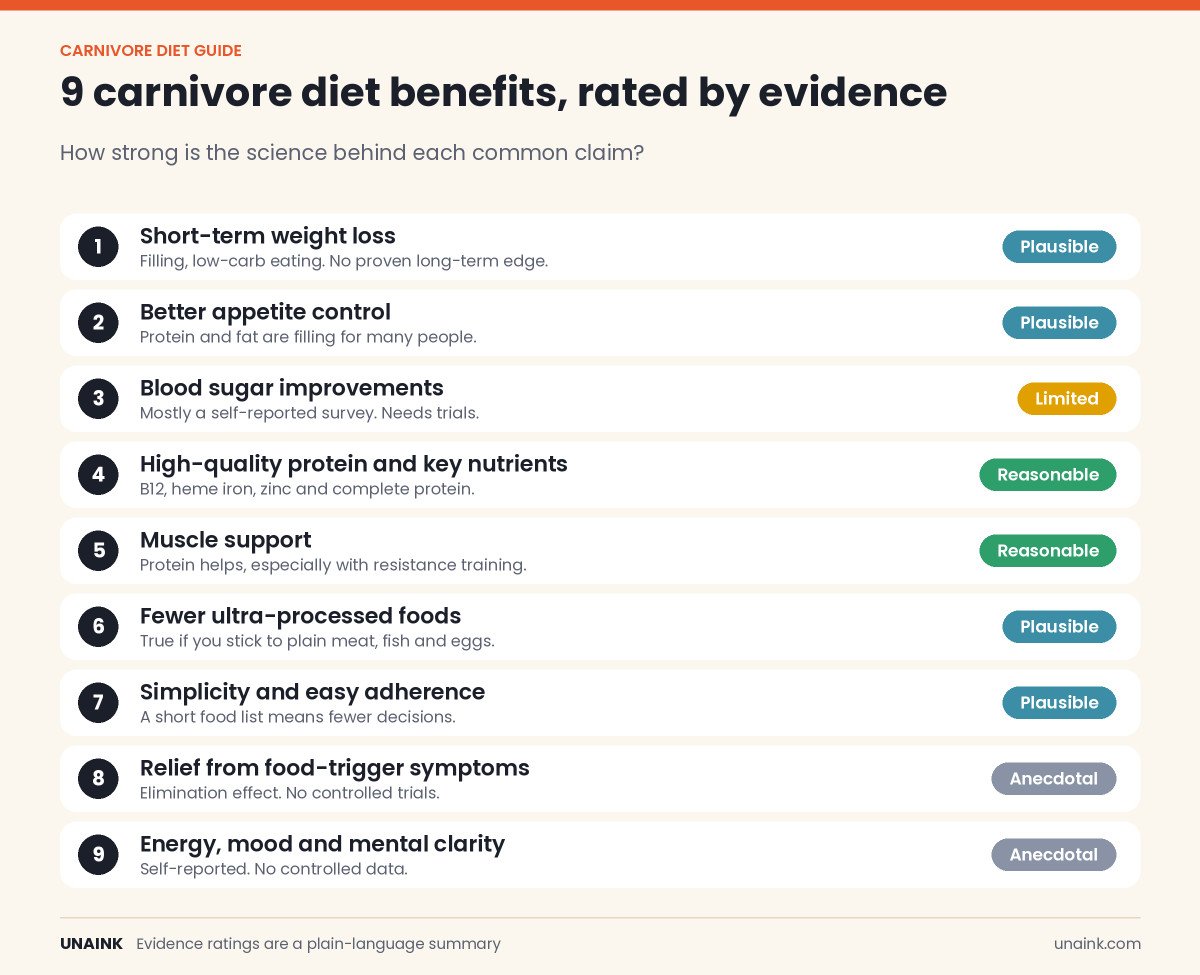
- Reasonable: supported by broader nutrition science, even if not proven for carnivore eating specifically.
- Plausible: makes biological sense, with little diet-specific data.
- Limited: early or self-reported findings that need confirmation.
- Anecdotal: personal reports only.
The main studies behind these ratings are a 2021 survey of 2,029 adults and a 2026 scoping review that found just nine human studies. Both are described in our overview of what the carnivore diet is.
1. Short-Term Weight Loss
Weight loss is the benefit people mention most. Cutting carbohydrates and eating filling protein and fat often reduces total calories without conscious counting, and the diet removes most snack foods and desserts. The 2026 scoping review noted possible short-term improvements in weight in the small studies it examined.
The catch is durability. Harvard Health notes that very low carb plans can jump-start weight loss, but its editor says he would never recommend a carnivore diet for that purpose. No strong trial shows that carnivore eating beats other diets for keeping weight off.
2. Better Appetite Control
Protein is generally considered the most filling nutrient, and fat slows digestion, so meals built around steak, eggs and fish can keep hunger quiet for hours. Many followers say cravings fade within a few weeks. That experience is common, but it has not been tested head to head against other plans in well-designed trials.
3. Possible Blood Sugar Improvements
With almost no carbohydrate, blood sugar spikes after meals are small. In the 2021 survey, respondents with diabetes reported lower BMI, a modest median drop in HbA1c (a marker of long-term blood sugar) and less use of diabetes medication. That sounds promising, but the authors themselves warned about bias, and the data were self-reported.
Important
If you take insulin or other glucose-lowering medicine, never change your diet drastically on your own. Doses often need adjusting, and going very low carb without guidance can cause dangerous lows.
4. High-Quality Protein and Key Nutrients
This is one of the more solid points. Meat, fish and eggs supply complete protein plus vitamin B12, readily absorbed heme iron, zinc and choline. Organ meats go further, with liver in particular supplying vitamin A and iron. Anyone who struggles to get enough of these nutrients may genuinely benefit from eating more animal foods.
The same research also warns about what the diet leaves out. The scoping review flagged possible low intake of vitamins C and D, calcium, magnesium, iodine and fiber, so the nutrient story cuts both ways.
5. Muscle Support
Adequate protein helps maintain and build muscle, especially when you do resistance training. A carnivore plate makes high protein intake easy. You do not need to give up plants to get the benefit. Some clinicians also caution that endurance athletes may struggle with energy on a plan with so few carbohydrates.
6. Fewer Ultra-Processed Foods
Plain meat, fish and eggs are minimally processed, so a clean carnivore plan removes most ultra-processed products from your diet. That alone may explain some improvements people report. The benefit disappears if the plan leans on bacon, sausage and deli meats. The WHO classifies processed meat as carcinogenic to humans, which is why we separate strict and relaxed versions in our dirty carnivore diet guide.
7. Simplicity and Easy Adherence
A food list of a dozen items takes the guesswork out of eating. There is little to track, few recipes to plan and clear rules about what is in or out. This simplicity can help people stick with the diet in the short term. The same restriction makes it hard to maintain over years.
If you want to see exactly what the plan includes, read the full carnivore diet food list.
8. Relief From Food-Trigger Symptoms
Some people with bloating, skin problems or joint pain report feeling better after cutting out plants. Removing everything at once is a blunt elimination diet, and relief could come from dropping one specific trigger or from cutting processed foods. Without controlled trials, nobody can say whether carnivore eating helps conditions such as autoimmune disease. Claims of cures go well beyond the evidence.
If you suspect a food trigger, a structured elimination plan with a dietitian is safer, because it includes a plan to reintroduce foods and find out what actually bothers you.
9. Energy, Mood and Mental Clarity
Better energy, steadier mood and clearer thinking are among the most common testimonials. They may reflect more stable blood sugar, better sleep after quitting late-night snacking, or simply the motivation that comes with starting a new regimen. There is no controlled evidence that carnivore eating improves mental health. Some people also report fatigue, headaches and poor sleep in the first weeks.
Benefits vs Trade-Offs
| Claimed benefit | Trade-off to weigh |
|---|---|
| Weight loss | May not last, and the diet can be hard to sustain. |
| Appetite control | Can lead to very lean eating or restricted variety. |
| Blood sugar | Medication changes may be needed, so supervision matters. |
| Nutrients from animal foods | Possible gaps in vitamin C, calcium, magnesium and fiber. |
| Simplicity | Social eating and travel get harder. |
| Fewer processed foods | Only true if you avoid cured and processed meats. |
How to Get Similar Benefits Without Going Fully Carnivore
Most carnivore diet benefits come from protein, fewer processed foods and fewer refined carbohydrates, none of which require removing plants. A high-protein, mostly whole-food diet that still includes vegetables and some fruit gives you many of the same results with fewer risks. If you like the meat-forward style, the ketovore diet and the animal based diet keep a few plant foods while staying heavy on animal protein.
Frequently Asked Questions
What are the benefits of the carnivore diet?
The most plausible benefits are short-term weight loss, better appetite control, a simple eating plan and a good supply of protein, B12, iron and zinc. Other claims, such as improved mood or symptom relief, rely mostly on self-reported accounts.
Are carnivore diet benefits proven?
Not to a high standard. A 2026 scoping review found only nine human studies, mostly small and short, and concluded that long-term adherence cannot be recommended.
Does the carnivore diet reduce inflammation?
Some people report less joint pain or swelling, and small studies hint at short-term changes in certain markers. There is no strong evidence that the diet treats inflammatory or autoimmune diseases.
Does the carnivore diet help with diabetes?
A survey found that people with diabetes reported better blood sugar and less medication use, but it was self-reported and unverified. Anyone on diabetes medicine needs medical supervision before changing their diet.
Can you get these carnivore diet benefits from a less strict diet?
Often yes. A high-protein, low-processed diet that includes vegetables and some fruit can deliver much of the same appetite and weight benefit with fewer nutrient risks.
Conclusion
The best-supported carnivore diet benefits are short-term weight loss, fullness and simplicity, along with plenty of high-quality protein. Beyond that, the science thins out quickly. Treat bold promises about blood sugar, mood and disease with caution, and remember that the same research also lists real risks. If the benefits appeal to you, talk with a clinician, get baseline blood tests and decide in advance how you will judge the results.
Medical note
This article is for general education and is not medical advice. Talk with a doctor or registered dietitian before making major diet changes, especially if you have a health condition, take medication, or are pregnant or breastfeeding.
Keep Reading
- What Is the Carnivore Diet?: how it works and who it suits
- Carnivore Diet Food List: what to eat and what to skip
- Does the Carnivore Diet Put You in Ketosis?: what the ketone data shows
- Ketovore Diet Explained: a middle path between keto and carnivore
Sources
- Lietz, Dapprich and Fischer. Carnivore Diet: A Scoping Review of the Current Evidence, Potential Benefits and Risks. Nutrients, 2026: nine human studies, benefits and risks
- Lennerz et al. Behavioral Characteristics and Self-Reported Health Status among 2029 Adults Consuming a Carnivore Diet. Current Developments in Nutrition, 2021: self-reported benefits and limits
- Science Feedback. Claim review of carnivore diet survey results: biases in the self-reported survey
- Harvard Health Publishing. What is the carnivore diet?: weight loss comments and risks
- Cleveland Clinic. Carnivore Diet: What Is It and Is It Healthy?: commonly cited benefits versus the research
- ZOE. Does the carnivore diet really work? A look at the evidence: survey selection bias and cholesterol findings