
Rotating a mattress can help spread normal wear more evenly, but there is no single schedule that fits every mattress. The safest approach is to check the care label or manufacturer instructions first, then rotate only if the design allows it. For most rotatable mattresses, the move is simple: clear the area, remove the bedding, and turn the mattress 180 degrees from head to foot.
Quick Answer
To rotate a mattress, remove the bedding, clear nearby furniture, and turn the mattress 180 degrees so the head end becomes the foot end. Get help with a heavy or awkward mattress. Repeat only as often as the manufacturer recommends; depending on the design, that may range from every few months to no rotation at all.
Key Takeaways
Key Takeaways
- Check the mattress maker’s care instructions before rotating or flipping; schedules vary by model.
- When rotation is allowed, turn the mattress 180 degrees from head to foot rather than 90 degrees.
- Most one-sided foam, hybrid, and pillow-top mattresses should not be flipped unless the manufacturer specifically says they are reversible.
- Ask for help with a heavy, bulky mattress and keep the path clear to reduce lifting and trip hazards.
- Rotation may even out wear, but it cannot repair structural sagging, damaged foam, broken coils, or an inadequate foundation.
At a Glance
| Time Required | About 5–10 minutes |
| Difficulty | Easy, but bulky mattresses may require two people |
| Tools Needed | None; a second person may be helpful |
| Cost | $0 |
How Do You Rotate a Mattress?
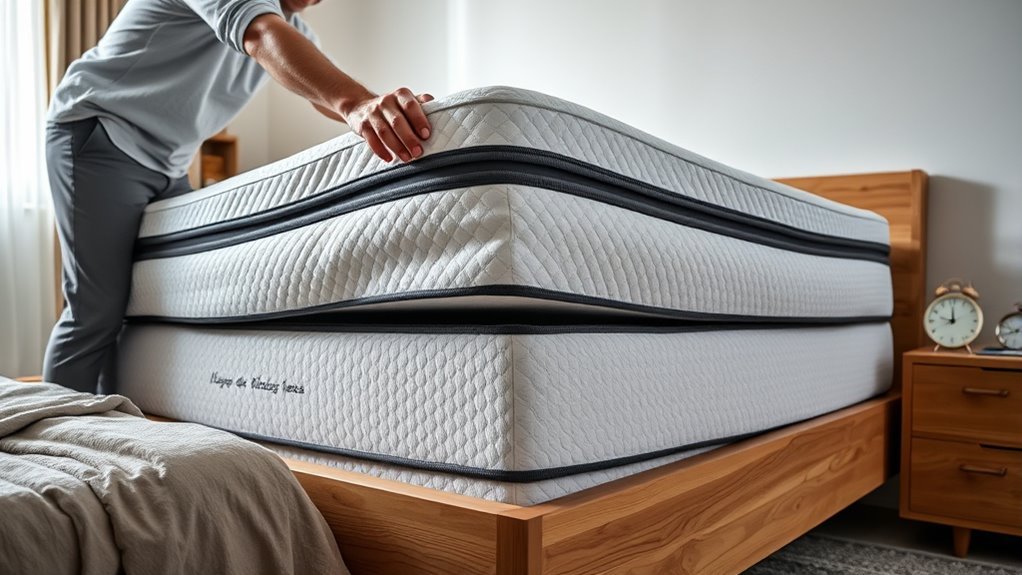
Before moving the mattress, check its care label or the manufacturer’s website. Some mattresses are designed to be rotated regularly, while some zoned or model-specific designs do not require rotation. For example, Tempur-Pedic says rotation is optional for its mattresses, while other brands use their own schedules.
- Strip the bed. Remove sheets, blankets, pillows, and the mattress protector so nothing catches or slips while you move the mattress.
- Clear the area. Move lamps, nightstands, cords, and other obstacles away from the bed.
- Plan the lift. If the mattress is heavy, floppy, or awkward, ask another person to help. Avoid twisting your torso while lifting or turning.
- Turn the mattress 180 degrees. Move the end that was at the headboard to the foot of the bed. Keep the sleeping surface facing up unless the mattress is specifically designed to be flipped.
- Realign the mattress. Center it on the foundation or frame and check that the base is flat, sturdy, and compatible with the mattress.
- Replace the protector and bedding. Smooth the protector before remaking the bed.
Warning: Mattresses can be large and difficult to grip even when they are not extremely heavy. Clear the path first and get help with a bulky load. OSHA notes that lifting risk rises with weight, awkward posture, reaching, and twisting; team lifting is appropriate for heavy loads. See OSHA’s lifting guidance.
Pro Tip: Take a quick photo of the mattress label and save the rotation date in your phone. That gives you the exact model information and an easy reminder without guessing at a generic schedule.
Do not routinely rotate a rectangular king or queen mattress 90 degrees. Standard rotation is 180 degrees from head to foot; a 90-degree turn can leave the mattress misaligned with the frame. If a manufacturer gives different instructions for a particular model, follow those instructions instead.
How Often Should You Rotate Your Mattress?
There is no universal rotation interval. The correct schedule depends on the mattress model and construction, so the manufacturer’s instructions should come first.
As examples, Casper recommends rotating its mattresses every 3 to 6 months. Saatva says many of its mattresses should be rotated after six months and then yearly, while some zoned Saatva models do not need head-to-foot rotation. Tempur-Pedic says rotation is optional for its current mattresses.
A simple routine is:
- Find the exact model name on the law tag or purchase record.
- Check the manufacturer’s current care instructions or warranty.
- Set a reminder based on that model’s schedule.
- Inspect the sleep surface and foundation when you rotate.
Rotation can help distribute normal wear and body impressions more evenly when the mattress is designed for it. It should not be used as a substitute for a supportive foundation, proper cleaning, or replacement when the mattress has lost support.
The best rotation schedule is the one specified for your exact mattress—not a one-size-fits-all calendar rule.
Which Mattresses Should You Rotate, Not Flip?
Many modern mattresses are one-sided. Their comfort and support layers are arranged to work with one sleeping surface facing up, so flipping them can change the feel and may conflict with the manufacturer’s care instructions.
One-Sided Mattress Types
Many memory-foam, hybrid, pillow-top, and latex mattresses are one-sided, but material alone does not determine the care routine. Some models should be rotated; others use zoned construction or other features that make rotation optional or unnecessary.
For a one-sided mattress:
- Keep the designated sleeping surface facing up.
- Rotate head to foot only if the manufacturer allows or recommends it.
- Do not assume a 3- to 6-month schedule applies to every model.
Note: Zoned mattresses are an important exception. Saatva, for example, says several of its zoned models do not need head-to-foot rotation. That is why the model-specific care guide matters more than the mattress material alone.
Why Rotation Beats Flipping
For a one-sided mattress, rotating is usually more appropriate than flipping because it changes where your body loads the surface without putting the support side on top. This can help distribute wear while preserving the intended layer order.
Do not flip a one-sided mattress unless its manufacturer specifically says it is reversible. Casper, for example, instructs owners to rotate its mattresses rather than flip them. If you have a true double-sided mattress, follow its separate flipping and rotation schedule.
Should You Flip a Mattress?
Flip a mattress only when the manufacturer says the model is double-sided or reversible. Most current one-sided foam, hybrid, and pillow-top mattresses have a designated sleep surface and should stay in that orientation.
- Check the label and care guide. Look for terms such as “one-sided,” “no flip,” “reversible,” or “double-sided.”
- Keep one-sided mattresses upright. Rotate them only if the manufacturer recommends it.
- Flip only reversible models. Follow the maker’s schedule because some double-sided mattresses also need head-to-foot rotation.
If you are unsure, do not flip the mattress until you verify the model instructions. Tempur-Pedic, for example, warns that flipping its mattresses can affect comfort, damage the mattress, and affect warranty coverage.
How Can You Rotate a Mattress Evenly?
Start with the mattress centered on the frame and turn it a full 180 degrees. Use the corners or sides to guide it gradually rather than dragging one edge across a sharp bed-frame part.
If the mattress has handles, check the manufacturer’s instructions before using them to lift or carry the full mattress; on some models, handles are intended mainly for positioning. With a large mattress, two people can control the movement more evenly and reduce awkward lifting.
After the turn, center the mattress again and make sure it is fully supported. A weak or incompatible foundation can contribute to uneven wear, so rotating a mattress will not solve a support problem underneath it.
When Is Rotation Not Enough?
Rotation is preventive care, not a repair. If the mattress has persistent sagging, deep body impressions, broken or noisy support components, torn materials, or a loss of comfort that does not improve after rotation, inspect the mattress and foundation more closely.
Visible Sagging Signs
Check the mattress with the bedding removed. Warning signs include:
- deep or permanent depressions in your usual sleep areas
- uneven support that remains after rotation
- edges or the center sinking more than they used to
- coils, foam, or other internal components that feel damaged
Rotation may move your body away from a worn area, but it cannot rebuild damaged foam, restore a failed spring system, or correct an inadequate bed base.
Time To Replace
Mattresses do not have a single expiration date. Age can be a useful reminder to inspect the bed, but condition, construction, use, and support matter more than a fixed number.
The Better Sleep Council recommends evaluating a mattress once it is about seven years old and also watching for sagging, visible damage, stiffness or aches on waking, and better sleep on other beds.
If comfort and support have clearly declined and the foundation is not the cause, replacement may make more sense than continuing to rotate the mattress.
When Should You Replace Your Mattress?
Consider replacement when one or more of these problems persist:
- Sagging or body impressions leave you unevenly supported.
- Lumps, damaged edges, torn materials, or broken support components affect comfort.
- You regularly wake uncomfortable and the problem appears tied to the mattress rather than another cause.
- The mattress no longer feels supportive even after you check the foundation and follow the maker’s care guidance.
A mattress that is seven years old is not automatically worn out, and a newer mattress can fail earlier. Use age as a checkpoint, not a deadline.
Your sleep surface should still provide the comfort and support it was designed to provide. When it no longer does, rotation is unlikely to solve the underlying wear.
Frequently Asked Questions
What happens if I don’t rotate my mattress?
If your manufacturer recommends rotation and you never do it, wear and body impressions may develop less evenly. However, not every mattress requires rotation. Check the care instructions for your exact model before assuming that skipping rotation is harmful or affects warranty coverage.
What happens if I sleep on a new mattress before 24 hours?
It depends on the mattress. There is no universal rule that sleeping on a boxed mattress before 24 hours damages it or reduces expansion. For example, Tuft & Needle says its mattress can be slept on right away even though full expansion can take 48 to 72 hours. Follow the setup instructions for your specific mattress.
What mattresses do not need to be rotated?
Some mattresses with zoned construction or model-specific designs do not require rotation. Tempur-Pedic says rotation is optional for its current mattresses, and Saatva says several zoned models do not need head-to-foot rotation. Do not decide based only on whether the mattress is foam, latex, hybrid, or innerspring; use the manufacturer’s instructions.
What is the golden rule for flipping a mattress?
Flip only a mattress that the manufacturer identifies as double-sided or reversible. Keep a one-sided mattress with its intended sleeping surface facing up. When in doubt, verify the model before flipping because turning a one-sided mattress over can change its comfort and support and may conflict with warranty instructions.
Can you rotate a king-size mattress 90 degrees?
Normally, no. A standard rectangular mattress is rotated 180 degrees from head to foot. A 90-degree turn changes which dimension runs along the bed frame and can leave the mattress unsupported or overhanging. Use a different rotation only if the manufacturer specifically instructs you to do so.
Conclusion
To rotate a mattress safely, remove the bedding, clear the area, get help if the mattress is heavy or awkward, and turn it 180 degrees from head to foot. The key correction is timing: do not rely on a universal 3- to 6-month rule. Check the exact model’s care instructions because rotation schedules vary and some mattresses do not need rotation at all. Never flip a one-sided mattress unless the manufacturer says it is reversible, and remember that rotation cannot repair structural sagging or lost support.
Sources
- Casper — How Often Should You Flip or Rotate Your Mattress? — rotation method, model-specific schedule, and one-sided vs. two-sided guidance.
- Saatva — Do I Need to Flip or Rotate My Mattress Regularly? — rotation intervals and zoned-model exceptions.
- Tempur-Pedic — Do I Need to Rotate or Flip My Mattress? — optional rotation and no-flip guidance.
- Tuft & Needle — How Long Do I Need to Wait Before Sleeping on My New Mattress? — boxed-mattress expansion and first-night use.
- Better Sleep Council — Replacing a Mattress — age, condition, comfort, and replacement signs.
- OSHA — Heavy Lifting — lifting-risk factors and team-lifting guidance for heavy or awkward loads.