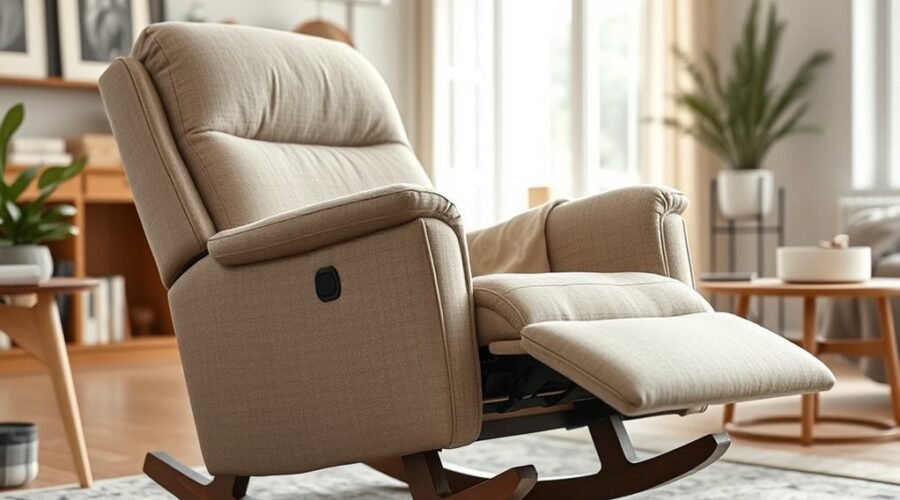
A rocker recliner combines the relaxing back-and-forth motion of a rocker with the adjustable backrest and leg support of a recliner. That makes it useful for reading, watching TV, feeding a baby while awake, or simply relaxing. The important detail is that rocking and reclining do not work the same way on every model, so fit, clearance, mechanism, and safety all matter before you buy.
Quick Answer
A rocker recliner is a reclining chair that also rocks when upright or in certain non-reclined positions. The rocking and reclining systems are usually separate, and exact operation depends on the model. Many designs stop rocking once the legrest is raised, so check the manufacturer’s specifications instead of assuming both motions work at the same time.
Key Takeaways
- A rocker recliner combines a rocking mechanism with a reclining backrest and legrest.
- Do not assume the chair will rock with the legrest raised; operation varies by model.
- Manual models are simple and do not need an outlet, while power models can offer finer adjustment and optional features.
- The best fit depends on seat dimensions, body size, weight capacity, room clearance, stability, and upholstery care requirements.
- For nursery use, the chair is for an awake caregiver; an adult rocker recliner is not a safe infant sleep surface.
What Is a Rocker Recliner?
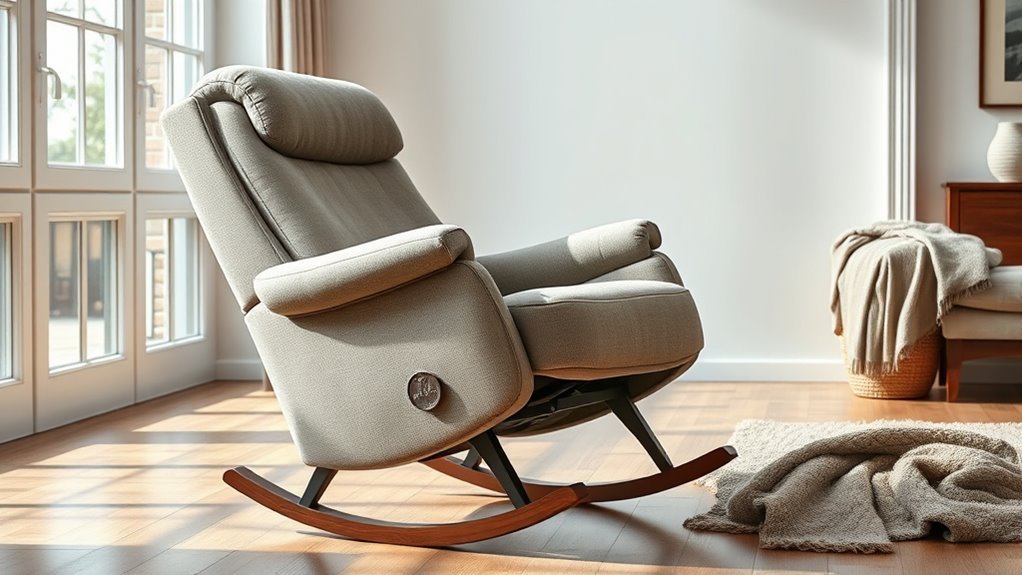
A rocker recliner blends two familiar seating functions: the forward-and-back motion of a rocker and the adjustable position of a recliner. In its normal seated position, the chair can move through a gentle rocking arc. Its reclining mechanism lets you lean the back and, on most models, raise a padded legrest.
That does not necessarily mean both functions operate at the same time. On some current designs, including several La-Z-Boy rocking recliners, the chair rocks when the legrest is down and becomes a reclining chair after the legrest is engaged. The manufacturer’s operating instructions should always take priority because mechanisms differ by brand and model.
Rocker recliners are available in manual and power versions. Some power models add features such as adjustable head support, adjustable lumbar support, independent back and legrest controls, USB charging, or memory settings. These are optional features rather than requirements for a chair to qualify as a rocker recliner.
Because the chair provides motion as well as reclining positions, it can work in living rooms, bedrooms, reading areas, and nurseries when there is enough surrounding clearance.
How a Rocker Recliner Works
A rocker recliner normally uses two related but distinct systems. A rocking mechanism in or beneath the base allows the seat to move back and forth, while separate reclining hardware controls the backrest and legrest.
A rocker recliner offers two functions in one chair, but those functions may operate separately rather than simultaneously.
Rocking Base Mechanism
Unlike a traditional wooden rocking chair with exposed curved runners, an upholstered rocker recliner may use concealed springs, rails, pivots, or other manufacturer-specific hardware to create its rocking motion. The exact construction varies, so it is more accurate to think of it as a rocking mechanism rather than assuming every chair has the same curved base.
The chair should move smoothly on a level, stable floor without contacting a wall, side table, lamp, or other furniture. Cushioning, seat geometry, and back support influence how the chair feels, but comfort is personal and should be tested whenever possible.
Some models provide several backrest or legrest positions. For example, current La-Z-Boy rocking recliner specifications state that the chair can be gently rocked while its legrest is not engaged and list a model-specific wall-clearance requirement.
Reclining Motion Explained
When you activate the reclining mechanism, the backrest moves rearward and the legrest can rise to support your lower legs. Depending on the mechanism, the back and legrest may move together or independently.
On many rocker recliners, raising the legrest changes or stops the rocking action. This improves stability in the reclined position and prevents the chair from behaving like an unrestricted rocking chair while fully extended.
Manual models typically use a side handle, lever, or pull tab. Power models use an electric motor controlled by buttons, a control panel, or a remote. Some power designs let you adjust the back, legrest, headrest, and lumbar area separately.
Note: “Rocks and reclines” does not automatically mean “rocks while fully reclined.” Check the operating instructions for the exact chair you are considering.
Key Rocker Recliner Comfort Features
Rocker recliners are defined by motion and reclining capability, but their comfort features vary widely. Instead of shopping by a long feature list, focus on the options that affect how the chair fits your body and daily routine.
- Lumbar support: Some models use fixed padding, while others provide power-adjustable lumbar support.
- Head and neck support: A tall padded back or adjustable headrest can help you maintain a comfortable viewing angle.
- Cushion construction: Foam density, fiber fill, springs, and seat construction affect firmness and long-term feel. No cushion should be assumed to be sag-proof.
- Legrest length: Your heels and lower legs should feel supported without an uncomfortable pressure point.
- Independent adjustment: Selected power models let you move the backrest and legrest separately.
- USB charging and memory controls: These are convenient extras available on some power chairs.
The right combination depends on how long you sit, whether you read or watch TV in the chair, and whether you prefer a soft sink-in feel or firmer support.
Manual vs. Power Rocker Recliners
A manual rocker recliner relies on a handle, lever, pull tab, or body pressure to change position. A power rocker recliner uses one or more electric motors. Neither type is automatically better; they suit different priorities.
| Feature | Manual Rocker Recliner | Power Rocker Recliner |
|---|---|---|
| Adjustment | Lever, handle, pull tab, or body pressure | Button, control panel, or remote |
| Electrical outlet | Not normally required | Usually required |
| Position control | Usually simpler | Often allows finer adjustment |
| Optional extras | Usually fewer electronic features | May include headrest, lumbar, USB, memory, heat, or massage |
| Maintenance | Fewer electrical components | Includes motors, controls, wiring, and power supply |
Manual Control Basics
Manual rocker recliners keep operation straightforward. Depending on the chair, you may pull a lever or handle, activate a pull tab, or lean back to change the backrest position.
- Start from a stable seated position.
- Use the handle, lever, or manufacturer-specified control.
- Raise the legrest and adjust your back position as the design allows.
- Return the chair fully to its upright position before standing if the manufacturer instructs you to do so.
A manual recliner can be attractive if you do not want to depend on an electrical outlet or electronic controls. Test the operating force before buying because the amount of effort required varies.
Power Reclining Benefits
A power rocker recliner lets you adjust the chair with electric controls instead of a manual lever. Some designs allow independent movement of the back and legrest, while upgraded models may include power headrests, lumbar adjustment, USB charging, or saved positions.
Current La-Z-Boy power rocker models, for example, offer combinations of adjustable headrest, lumbar support, independent back and legrest movement, memory settings, and USB charging. Those features are specific to selected products rather than universal standards.
Before buying a power model, check where the nearest outlet is located and make sure the cord can be routed without crossing a walkway or passing beneath moving parts. If operation during a power outage matters to you, ask whether the specific model offers an approved battery-backup option.
Choosing Your Mechanism
- Preferred effort: Decide whether you are comfortable operating a manual mechanism.
- Adjustment control: Choose power if fine positioning is important to you.
- Room setup: Consider outlet location and cord routing for power chairs.
- Repair complexity: Power chairs add electrical components that may require service.
- Budget: Compare the complete delivered price, not just the base chair price.
- Features: Pay for headrest, lumbar, USB, heat, massage, or memory functions only if you will use them.
Rocker Recliner vs. Glider vs. Wall Recliner
These chairs can look similar, but their motion and space requirements differ.
| Type | Motion | Best Fit |
|---|---|---|
| Rocker recliner | Arcing back-and-forth motion plus reclining | People who want traditional rocking motion and have adequate clearance |
| Glider recliner | Smoother front-to-back gliding motion plus reclining | People who prefer a more linear motion |
| Wall recliner | Reclines without rocking and is designed to work closer to a wall | Small rooms or users who prefer a stationary chair when sitting or standing |
La-Z-Boy’s current wall-recliner guidance distinguishes the arcing movement of a rocker from the smoother track movement of a glider and the stationary, space-saving behavior of a wall recliner.
Best Rocker Recliner Types for Each Room
Choosing a rocker recliner by room is less about style labels and more about clearance, stability, upholstery, and how the chair will actually be used.
In a nursery, a rocker or glider can give an awake caregiver comfortable movement during feeding and soothing routines. Choose easy-care upholstery, keep cords out of reach, and make sure the chair has space to move without striking a crib, table, or wall.
Warning: A rocker recliner, sofa, or soft armchair is not a safe sleep surface for an infant. The American Academy of Pediatrics recommends placing babies on their backs on a firm, flat, separate sleep surface such as an appropriate crib or bassinet. If you become sleepy while holding a baby, move the baby to a safe sleep space rather than sleeping together in the chair.
In a living room, a manual rocker keeps the setup simple, while a power rocker can add adjustable head, back, leg, or lumbar positioning. Retailer-specific names such as Liam, Ava, or similar collections can change, so compare the current specifications rather than relying on an old model recommendation.
For a home theater, a rocker recliner can work when there is enough room between rows and surrounding furniture. If floor space is tight, a wall recliner may be a better alternative because it is specifically designed to recline closer to the wall.
In a reading nook, an oversized rocker can provide more room, but only if the wider seat and larger rocking arc fit the space. Bigger is not automatically more comfortable; proper seat depth and back support matter more than overall bulk.
How to Choose the Right Rocker Recliner Size
Start with two separate measurements: the available room space and your body fit. A chair can fit the floor plan but still feel uncomfortable if the seat is too deep, too high, too narrow, or poorly matched to your legs and back.
- Measure overall width and depth. Confirm the chair will fit through doors, hallways, stairs, and the final room.
- Check wall clearance. Use the manufacturer’s required clearance rather than a generic number.
- Allow room for the rocking arc. Make sure the chair cannot strike a wall, table, lamp, or another seat as it moves.
- Check fully reclined length. Include the extended legrest when planning walking space.
- Compare seat height. Your feet should be able to reach the floor comfortably in the upright position.
- Compare seat depth. An excessively deep seat can make it difficult for shorter users to sit with back support and feet down.
- Compare seat width. Allow enough room to sit comfortably without feeling squeezed or unsupported.
- Check the legrest. Make sure it supports your legs in a comfortable position rather than ending at an awkward pressure point.
- Check the weight capacity. Follow the manufacturer’s published limit for the exact model.
Pro Tip: If possible, sit in the exact chair for several minutes. Rock it, recline it, return it upright, and stand up again. A specification sheet cannot fully reveal whether the seat depth, arm height, head position, or operating force fits you.
If you prefer a chair that stays firmly planted when you sit down or stand up, compare a wall recliner or another stationary recliner with the rocker. A lift recliner may also be worth discussing with a qualified retailer or healthcare professional when assistance with standing is a specific need.
Rocker Recliner Clearance and Placement
A rocker recliner requires more planning than a stationary chair because you must account for both its rocking motion and its reclined footprint.
- Follow the manufacturer’s stated wall-clearance requirement.
- Rock the chair through its normal range and confirm it cannot hit nearby furniture.
- Leave a usable walking path when the legrest is fully extended.
- Place the chair on a stable, level surface.
- Keep power cords away from the chair’s moving base and away from walkways.
- Do not place loose objects where they can slide beneath the mechanism.
Manufacturer specifications can vary significantly. One model may need roughly a foot of clearance for full recline, while a wall recliner can be designed for much less. Always use the dimensions for your exact chair.
Rocker Recliner Safety for Children, Pets, and Everyday Use
Recliners contain moving joints, gaps, footrests, and mechanisms. Before opening or closing the legrest, make sure children, pets, blankets, toys, and other objects are clear of the moving parts.
The U.S. Consumer Product Safety Commission has documented child entrapment incidents involving recliner chairs and has warned parents against allowing young children to play on them. See the CPSC recliner-chair safety guidance.
- Do not let children climb or play on an extended legrest.
- Look beneath and around the chair before closing the legrest.
- Keep fingers away from exposed hinges, gaps, and moving hardware.
- For a power recliner, route electrical cords where children and pets cannot pull or chew them.
- Stop using a chair that feels unstable, has damaged wiring, makes unusual mechanical noises, or has loose or broken hardware until it is inspected.
Best Easy-Care Materials for Rocker Recliners
The easiest upholstery to maintain depends on the exact fabric, finish, cleaning code, household, and type of spill. Material names alone do not guarantee stain resistance.
Polyester upholstery is common and can be durable, but stain performance varies by weave and treatment. Microfiber can be practical in busy rooms, yet it still needs to be cleaned according to its care instructions rather than with whichever household cleaner is nearby.
Leather can be durable and easy to wipe in some situations, but different leather finishes require different cleaners and conditioners. Faux leather can offer a wipeable surface, but long-term cracking, peeling, and heat sensitivity vary by material quality and care.
Performance fabrics can simplify everyday maintenance. La-Z-Boy’s iClean cleaning guidance, for example, provides stain-specific instructions for its iClean fabric rather than recommending one universal cleaning method.
Before buying, check:
- the manufacturer’s upholstery cleaning code;
- whether the fabric has a specific stain-resistant treatment;
- what cleaners are prohibited;
- whether fabric treatment affects warranty coverage;
- how pet hair, claws, food spills, or frequent use may affect your household.
Rocker Recliner Prices and Financing
Rocker recliner pricing varies too much by brand, retailer, upholstery, size, power mechanism, optional features, delivery location, and promotion to rely on one evergreen price range. Manual fabric models generally cost less than comparable power, leather, oversized, or feature-heavy versions, but current listings should be checked before making a budget.
Retailer-specific promotional prices and models such as Morrison, Kodie, or “Blockbuster” offers can change. A price or monthly payment quoted during one promotion may not apply later.
When comparing prices, look beyond the sticker:
- Base chair price: Confirm the exact upholstery and mechanism included.
- Power upgrades: Headrest, lumbar, heat, massage, USB, and memory controls may increase the price.
- Delivery: Ask whether shipping, room placement, assembly, or removal of packaging costs extra.
- Protection plans: Separate optional protection plans from the manufacturer’s standard warranty.
- Financing: Compare APR, term length, minimum purchase, deferred-interest conditions, and total amount paid rather than focusing only on the monthly payment.
A lower monthly payment does not necessarily mean a lower total cost, especially when the repayment period is longer.
Delivery, Pickup, and Warranty Options
Delivery and pickup services differ by retailer. Some sellers provide room-of-choice delivery or assembly, while others offer basic doorstep delivery or store pickup. Confirm exactly what is included before ordering, especially for a heavy power recliner.
| Option | What to Verify | Why It Matters |
|---|---|---|
| Delivery | Doorstep vs. room placement, assembly, packaging removal, fees | Large recliners can be difficult to move through a home |
| Pickup | Package dimensions, vehicle space, lifting requirements | The chair or carton may be larger and heavier than expected |
| Warranty | Frame, mechanism, motor, electrical parts, upholstery, and labor periods | “Lifetime” coverage may apply only to selected parts |
| Returns / exchanges | Time limit, custom-order exclusions, condition requirements, pickup and restocking fees | Furniture policies can be much stricter than ordinary retail returns |
Warranty coverage should be read component by component. La-Z-Boy’s current residential upholstered furniture warranty, for example, lists different coverage periods for reclining mechanisms, bases, labor, and other components.
Do not assume you have a 30-day furniture return period. La-Z-Boy’s current online return policy states different rules for residential upholstered furniture and other product categories, and local retailer policies may also differ. Read the applicable policy before placing the order.
Rocker Recliner Buying Checklist
Before paying for a rocker recliner, run through this practical checklist:
- Does the chair fit through your home’s doors and hallways?
- Is there enough room for both the rocking arc and full recline?
- Do your feet reach the floor comfortably when upright?
- Does the seat depth support your back without pressing awkwardly behind your knees?
- Does the legrest support your legs comfortably?
- Can you operate the manual control easily, or would power control suit you better?
- If it is powered, is an outlet available without creating a trip hazard?
- Does the chair still rock after the legrest is raised, and do you actually want it to?
- What is the published weight capacity?
- What cleaning code applies to the exact upholstery?
- What parts and labor are covered by the warranty?
- What are the return, exchange, delivery, and restocking rules?
- Can children and pets be kept safely away from the moving mechanism?
Frequently Asked Questions
What Is the Difference Between a Rocker and a Recliner?
A rocker is designed primarily to move back and forth, while a recliner changes the angle of the backrest and usually raises a legrest. A rocker recliner combines both functions. Because the rocker mechanism moves while upright, it generally needs more surrounding clearance than a stationary recliner.
What Is the Best Brand of Rocker Recliners?
There is no single best brand for every buyer. Brands such as La-Z-Boy, Ashley Furniture, Flexsteel, and Southern Motion may offer different sizes, mechanisms, fabrics, power features, warranties, and service networks. Compare the exact chair’s dimensions, mechanism, upholstery, warranty, return policy, and comfort instead of choosing by brand name alone.
What Are the Benefits of a Rocker Recliner?
A rocker recliner gives you two seating options in one chair: rocking motion while seated and adjustable reclining positions for reading, watching TV, or relaxing. Depending on the model, you may also get adjustable head or lumbar support, power controls, USB charging, or memory settings.
What Are the Disadvantages of a Rocking Chair?
Rocking chairs need space to move and may feel less stable than stationary chairs when someone is sitting down or standing up. Some people also dislike continuous motion. With a rocker recliner, you must additionally account for the extended legrest, moving mechanism, child and pet safety, and full reclining clearance.
Does a Rocker Recliner Rock While Fully Reclined?
Not necessarily. On many models, rocking is available only while the legrest is down. When the legrest is raised, the chair functions as a recliner and the rocking action stops or becomes restricted. Always check the manufacturer’s description and operating instructions for the exact model.
How Much Clearance Does a Rocker Recliner Need?
Clearance varies by model. You need enough room behind and around the chair for its rocking arc, plus enough space in front for the fully extended legrest. Use the manufacturer’s wall-clearance and fully reclined dimensions rather than relying on one generic measurement.
Is a Rocker Recliner Safe to Use in a Nursery?
It can be useful for an awake caregiver during feeding or soothing, provided the chair is stable and the moving mechanism and cords are kept clear of children. It is not a safe infant sleep surface. The American Academy of Pediatrics recommends that babies sleep on their backs on a separate, firm, flat sleep surface designed for infant sleep.
Conclusion
A rocker recliner can be a practical choice when you want both gentle seated motion and the ability to recline, but the best chair is the one that fits your body, room, and routine. Check how the rocking and reclining functions interact, measure the full movement area, test the seat if possible, and compare manual versus power controls based on features you will actually use.
Before buying, also verify upholstery care, electrical needs, weight capacity, warranty details, delivery charges, and the seller’s return or exchange policy. If children or pets share the room, keep them clear of moving mechanisms, and if the chair is used in a nursery, follow current infant safe-sleep guidance.
Sources
- La-Z-Boy — Cade Rocking Recliner — current rocking/reclining operation, dimensions, clearance, and feature information.
- La-Z-Boy — iClean Recommended Cleaning Methods — upholstery and stain-care guidance.
- La-Z-Boy — Parts & Warranty Information — component-specific parts and labor warranty coverage.
- La-Z-Boy — Online Return Policy — current upholstered-furniture exchange and return conditions.
- American Academy of Pediatrics — Safe Sleep Guidance — infant sleep-surface and armchair safety guidance.
- U.S. Consumer Product Safety Commission — Recliner Chair Safety Alert — child entrapment hazards around recliner mechanisms.