You’ve just carried a compressed queen mattress into a narrow bedroom and need it ready as soon as possible. The safest approach is to prepare the room first, move the sealed mattress close to its final position, cut only the packaging, and give the mattress enough room to expand. The exact wait before sleeping depends on the mattress brand and model, so keep the manufacturer’s setup instructions nearby.
Quick Answer
To unbox a mattress in a box, prepare the bed frame first, move the sealed package into the bedroom, position the rolled mattress on the frame, and carefully cut the plastic without touching the mattress fabric. Let it expand flat, ventilate the room, and follow the manufacturer’s instructions for when it is ready to sleep on.
Key Takeaways
- Clear the room, measure the space, and assemble the bed frame or foundation before opening the mattress package.
- Move the boxed or rolled mattress carefully through doorways and use a helper or dolly when the package is difficult to control.
- Position the sealed mattress near its final location before cutting the plastic so you do not have to move it after expansion.
- Keep blades shallow and pointed away from the mattress, your hands, and other people.
- Expansion time varies by brand and model; follow the manufacturer’s instructions instead of relying on a universal 4-, 24-, or 48-hour rule.
At a Glance
| Time Required | About 10–20 minutes of active setup, plus the mattress manufacturer’s expansion time |
| Difficulty | Easy to moderate; large or heavy packages are easier with two people |
| Tools Needed | Scissors or a packaging-safe cutter, tape measure, and optionally a dolly or helper |
| Cost | Usually $0 if you already have basic cutting and measuring tools |
Prep the Room Before Unboxing
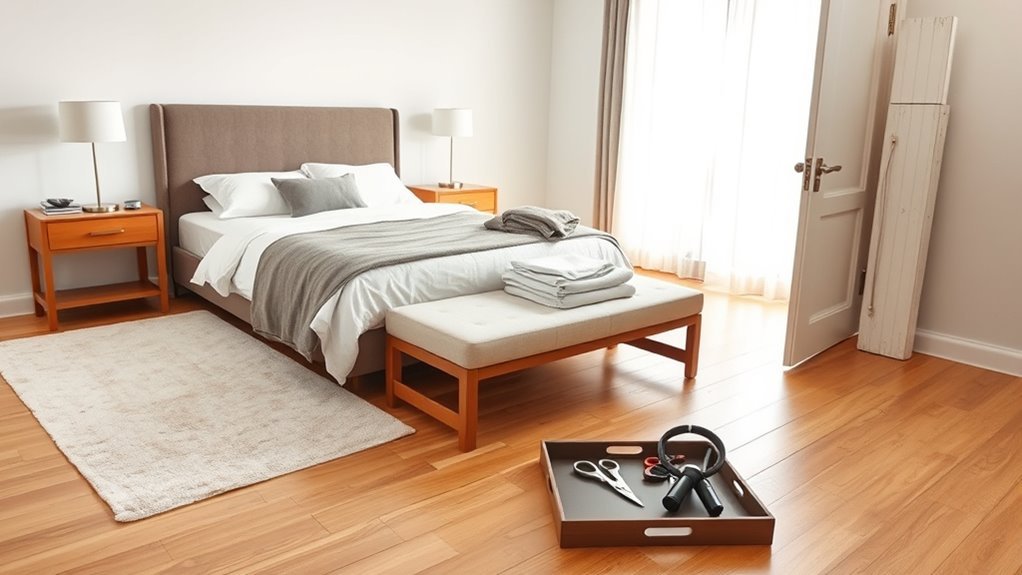
Before you unbox the mattress, make sure the room is ready for it. Start by measuring the frame and available floor space against the mattress dimensions. Common U.S. nominal dimensions include Twin at about 38″ x 75″, Queen at 60″ x 80″, and King at 76″ x 80″, although individual models can vary slightly. Saatva, for example, publishes those common measurements for its standard U.S. sizes.
Next, shift furniture away from the landing area and open a direct path from the doorway to the bed. Clear obstacles, including cords, lamps, rugs, decor, and sharp objects, so you do not trip, scrape the walls, or puncture the package.
Do the heavy moving while the mattress is still compressed. Once it expands, it becomes much larger and usually harder to position.
If you are using a bed frame, platform, or compatible foundation, assemble it before opening the mattress. Place it where the mattress will stay, check that it is level, and make sure you have enough clearance to walk around at least the accessible sides.
A prepared room gives you more control, protects the mattress and surrounding furniture, and keeps the setup process clean and efficient.
Pro Tip: Read the package label or setup guide before cutting anything. Some compressed mattresses should be opened soon after delivery; for example, Tempur-Pedic states that its compressed products should be opened within 30 days of receipt, while other brands may specify a different window.
Move the Box to the Right Bedroom
Once the room is ready, move the boxed mattress to the correct bedroom before opening it. Check that the package can pass through doorways, hallways, stairwells, and tight corners, especially if you ordered a Queen or King.
Mattress package weight varies widely by model and size, so check the shipping label instead of assuming every Queen weighs about 100 pounds. If the box is awkward or too heavy to control safely, use a dolly or a second person.
Clear furniture, rugs, shoes, toys, and other obstacles from the path to the designated room. Keep the mattress compressed during transport because the smaller package is normally easier to maneuver than the expanded bed.
If you use a helper, agree on turns, stair steps, and narrow passages before lifting. Keep fingers away from door frames and corners, lift with control, and avoid suddenly twisting while carrying a heavy package.
Once you reach the room, place the package horizontally on a flat surface or directly beside the prepared frame. Follow any orientation arrows or handling instructions printed on the packaging.
Open a Mattress in a Box Safely
Before opening the mattress, give yourself enough clear space for the roll to unfold without hitting furniture, walls, lamps, or another person.
Set the package on a clean, flat surface. Whenever practical, position the sealed roll on the bed frame or foundation before opening the final compression layer. Purple and other mattress manufacturers recommend positioning the compressed mattress near its final location before it expands.
- Open the outer carton, shipping bag, or tape carefully without pushing the blade deep into the package.
- Remove the compressed mattress from the outer packaging while keeping the inner protective plastic intact.
- Place the sealed roll in the correct orientation on the bed frame or other manufacturer-approved surface.
- Use scissors or a packaging-safe cutter to open the plastic along an exposed edge, keeping the tool away from the mattress cover.
- Stand clear as the mattress begins to unroll and expand, then remove the remaining plastic.
- Keep the mattress flat and unobstructed while it regains its shape.
Warning: Never cut toward your body or push a blade into the compressed mattress. Keep the large plastic bag and film away from children and pets and dispose of them promptly. The U.S. Consumer Product Safety Commission warns that thin plastic packaging can create a suffocation hazard for children.
Do not assume that every mattress needs the same wait before use. The safest rule is to follow the setup instructions for your exact mattress model.
Unroll and Cut the Inner Seal
Gently unroll the mattress on the bed frame or another approved flat surface so you can reach the final sealed layer without bending or twisting the mattress unnecessarily.
Locate the ends or seam of the plastic wrap and peel away any loose outer film. Keep your movements controlled so you do not snag the fabric or puncture the compressed mattress underneath.
Once the outer wrap is removed, identify the inner seal. Use scissors or a guarded package cutter along the sealed edge instead of stabbing through the plastic. A shallow, deliberate cut gives you better control.
As the seal opens, the mattress will begin to expand. Some models rise gradually while others respond quickly, so keep your hands, tools, bedding, and nearby objects clear.
Remove the remaining film and let the mattress rest flat. Check that no plastic is trapped underneath it and that the corners have room to expand.
This sequence releases the mattress from compression while reducing the chance of damaging the cover or foam.
How Long Does a Mattress in a Box Take to Expand?
There is no single expansion time for every mattress in a box. Some beds become usable within minutes or a few hours, while others can take 24, 48, or even 72 hours to reach their intended dimensions and feel.
For example, Purple’s setup guidance says to allow about 4–6 hours for its mattress to bloom and notes that full blooming may take up to 24 hours. In contrast, Casper says many of its foam and hybrid mattresses can be slept on almost right away but may need up to 48 hours to expand fully; some Snow models can need up to 72 hours.
The important distinction is that initial expansion, being usable, and reaching full expansion are not always the same point in time.
Note: Treat the mattress manufacturer’s instructions as the controlling guidance. If your manual says the mattress can be used immediately, you do not need to impose an arbitrary 24-hour wait. If it gives a specific blooming period, follow that instead.
Initial Expansion Time
Many mattresses start rising as soon as the vacuum seal is broken. A mattress may look close to its normal shape within 30 minutes, but appearance alone does not prove that the internal materials have completely recovered.
- Check that the mattress is lying flat and is not trapped against a wall or headboard.
- Inspect the corners and edges for reasonably even expansion.
- Measure the length, width, and height only after giving the mattress the time specified by its manufacturer.
- Keep heavy objects off the surface while the mattress is still noticeably recovering.
Instead of assuming that every model reaches full shape in 3 to 5 hours, use the time range provided with your mattress. Temperature, mattress construction, compression duration, and model design can affect how quickly it reaches its intended shape.
Minor wrinkles in the cover or slightly slow corners can improve as the mattress continues to settle.
Full Settle Period
Some mattresses need a longer settle period even after they look usable. Depending on the model, full recovery can range from a few hours to several days.
You may be able to sleep on the mattress before it reaches its final dimensions if the manufacturer specifically permits it. Do not apply a blanket 24-hour restriction to every compressed mattress.
During the settle period, keep the room ventilated. New foam, fabric, adhesives, and packaging can produce noticeable odors. The U.S. Environmental Protection Agency explains that volatile organic compounds can be released from many indoor products and recommends ventilation as one way to reduce indoor exposure.
Do not describe every odor as automatically harmless. If the smell is unusually strong, causes irritation, or does not improve as expected, increase ventilation, leave the room if necessary, and contact the mattress manufacturer for product-specific advice.
Cover wrinkles often smooth as the mattress relaxes. Small dimensional differences may also improve during the manufacturer’s stated recovery window.
If the mattress is still significantly undersized, misshapen, or uneven after the maximum expansion period in its instructions, photograph the issue, compare its measurements with the product specifications, and contact the seller or manufacturer rather than trying to stretch or aggressively manipulate the foam.
Check the Frame, Odor, and Fit
Before regular use, confirm that your frame or foundation is sturdy, fully assembled, and compatible with the mattress.
Check for new-material or packaging odors during unboxing and keep fresh air moving through the room if needed.
Inspect the mattress for fit, even expansion, tears, stains, broken seams, or other visible defects. Keep photos of any delivery damage or persistent expansion problem in case you need warranty support.
Frame Support Check
The bed frame or foundation must be strong enough for the mattress and sleepers, but there is no universal slat-spacing number that applies to every brand.
For example, Purple’s warranty requirements specify slats no more than 3.5 inches apart for relevant slatted setups, while Tempur-Pedic specifies slats at least 3 inches wide and no more than 4 inches apart for certain slatted frames. Other manufacturers use different limits.
- Confirm that the frame is sturdy and level.
- Check the mattress warranty or setup guide for its exact foundation and slat-spacing requirements.
- For larger beds, verify that any required center beam, center leg, or additional support is installed.
- Place the mattress flat without folding or twisting it unless the manufacturer specifically says the model can be handled that way.
Proper support can reduce premature sagging and may be required to keep the mattress warranty valid.
Odor And Fit
Once the frame is confirmed, verify the fit. Common U.S. nominal sizes include Twin at about 38″ x 75″, Queen at 60″ x 80″, and King at 76″ x 80″. Saatva publishes these dimensions for its standard-size mattresses, but individual products from other manufacturers can differ slightly.
If the mattress does not fit the frame, check both the mattress model specifications and the inside dimensions of the frame before assuming either product is defective.
Let the mattress air out in a ventilated room if you notice a new-product smell. Open windows when practical or use a fan to improve air movement.
The EPA’s indoor-air guidance notes that VOCs are emitted by many household products and recommends increasing ventilation around products that emit them.
Check the corners and edges during the manufacturer’s stated expansion period. If one area remains compressed, first make sure the mattress is lying flat and unobstructed. Avoid pulling, stretching, or applying concentrated heat unless the manufacturer specifically recommends doing so.
A sturdy foundation and correct fit help the mattress expand and perform as intended.
Care for Your Mattress After Expansion
To keep your mattress performing well, follow the care instructions for the exact model rather than assuming every mattress should be cleaned, flipped, or rotated the same way.
- Rotate the mattress only on the schedule recommended by its manufacturer. Casper, for example, recommends rotating many of its mattresses every 3–6 months, while Tempur-Pedic says rotation is optional and not required.
- Do not flip a one-sided mattress unless the manufacturer explicitly says it is designed to be flipped.
- Use a compatible mattress protector to help prevent spills and stains from reaching the cover.
- Vacuum or spot clean only as allowed by the care label; do not soak foam or use harsh chemicals unless the manufacturer permits them.
- Let any cleaned area dry completely before replacing bedding.
Regular care can help keep the sleep surface clean and reduce avoidable wear, but the warranty and care guide for your mattress should always take priority over generic maintenance advice.
Small, consistent habits—proper support, spill protection, careful cleaning, and manufacturer-approved rotation when applicable—are more useful than a one-size-fits-all maintenance schedule.
Frequently Asked Questions
How to Get a Mattress in a Box to Expand Faster?
Remove all required packaging, place the mattress flat on a manufacturer-approved base, give it open space on every side, and keep the room at a normal comfortable indoor temperature. Avoid hair dryers, space heaters, heated blankets, jumping, or aggressive manipulation unless the mattress manufacturer specifically recommends them. The safest way to speed recovery is simply to follow the model’s setup instructions.
Can You Sleep on a Mattress in a Box Before It Fully Expands?
Sometimes. It depends on the mattress. Some manufacturers allow sleeping on a compressed mattress almost immediately, while others recommend several hours of blooming before use. Check the setup guide for your exact model. A mattress can be safe to sleep on before it has reached every final dimension, but only when the manufacturer says that early use is acceptable.
How to Open a Mattress That Comes in a Box?
Move the sealed mattress into the bedroom, prepare the frame, open the outer box or shipping bag, place the compressed roll near its final position, and carefully cut the protective plastic along an exposed seam. Keep the blade away from the mattress cover and your body. Remove the plastic as the mattress expands, then let the bed rest flat according to the manufacturer’s instructions.
How Long Does It Take for a Mattress to Expand After Unboxing?
Expansion time varies by brand and construction. Some mattresses look close to full size within minutes or hours. Purple recommends about 4–6 hours of blooming for its mattress and says full bloom may take up to 24 hours. Casper says many foam and hybrid models may take up to 48 hours to expand fully, while some Snow mattresses can take up to 72 hours. Always use the instructions for your exact model.
What Should I Do if the Mattress Has Not Fully Expanded?
First, confirm that all compression plastic has been removed and that the mattress is lying flat with nothing blocking the corners or edges. Give it the full recovery time listed by the manufacturer. If it remains significantly undersized, uneven, or misshapen after that period, take measurements and photos and contact the seller or manufacturer instead of pulling, stretching, or heating the mattress.
Why Does a New Mattress Smell After Unboxing?
New mattresses and their packaging can have noticeable material or packaging odors after opening. Ventilate the room by opening windows when practical or using a fan. Do not assume every odor is harmless; if the smell causes eye, nose, throat, breathing, or other irritation, move away from the room and contact the manufacturer for product-specific advice.
Conclusion
Now that you know how to unbox a mattress in a box, you can complete the setup without rushing the steps that matter. Prepare the frame first, move the compressed mattress into position, open the packaging carefully, dispose of the plastic safely, and let it expand according to the manufacturer’s instructions. Check the fit, foundation, odor, and final shape before treating the mattress as fully settled. Following the product-specific guidance helps protect the mattress, avoid accidental damage, and give it the support it was designed to use.
Sources
- Purple — Mattress Setup Instructions — supports safe positioning, unboxing, and Purple-specific 4–6-hour blooming guidance.
- Casper — Frequently Asked Questions — supports manufacturer-specific sleep-readiness and full-expansion timelines.
- Tempur-Pedic — Mattress and Foundation Warranty — supports foundation and slat-spacing requirements.
- Saatva — Standard Mattress Dimensions — supports common U.S. Twin, Queen, King, and other mattress dimensions.
- U.S. Environmental Protection Agency — VOCs and Indoor Air Quality — supports ventilation guidance and cautious treatment of VOC-related claims.
- U.S. Consumer Product Safety Commission — Packaging Safety Guidance — supports prompt disposal of thin plastic packaging because of suffocation risk.